

In 2026, channel compliance is no longer a legal checkbox but a data-driven security discipline that protects brand equity and financial margins. Failing to prioritize channel program compliance and security is a direct invitation for financial leakage and regulatory scrutiny. You likely understand the frustration of managing fragmented partner data across disparate spreadsheets while facing increasingly strict global data privacy laws. It’s difficult to maintain operational integrity when you lack real-time visibility into partner activities or when incentive and rebate fraud goes undetected.
This guide will help you master these complexities to eliminate fraud and ensure a secure, audit-ready ecosystem. You’ll learn how to transition from manual, error-prone workflows to modernized systems that automate reporting for regulatory bodies. We will examine the critical roles of centralized POS Data Management and secure Rebates & Incentives tracking in building a resilient infrastructure. By the end of this article, you’ll have a pragmatic roadmap to secure your partner data and optimize your Co-op/MDF Management without creating friction for your distributors.
Key Takeaways
- Understand why manual tracking is now a critical security risk rather than just an operational bottleneck.
- Strengthen your channel program compliance and security by implementing essential architecture layers like SSO and multi-factor authentication to protect sensitive ecosystem data.
- Learn to identify common fraud patterns in MDF and co-op spend while implementing automated claim validation to replace manual auditing.
- Follow a logical 5-step framework to centralize partner data and digitize your compliance policies.
- Explore how leveraging PartnerPortal™ provides a single source of truth to future-proof your ecosystem against evolving regulatory demands.
Defining Channel Program Compliance and Security in 2026
Channel compliance is the baseline for ecosystem health. It encompasses the adherence to contractual obligations, global regulatory mandates, and internal operational standards. In 2026, the shift is clear: manual tracking is no longer just inefficient; it’s an existential security risk. Legacy systems can’t keep pace with the velocity of modern data exchanges. Effective channel program compliance and security requires a holistic approach that integrates Third-Party Risk Management into every partner touchpoint.
To better understand the practical challenges of modern software security and regulatory adherence, watch this helpful video:
The core pillars of channel program compliance and security include data privacy, financial integrity, and brand protection. Data privacy ensures that partner information remains shielded from unauthorized access. Financial integrity focuses on preventing the misuse of Co-op/MDF Management funds. Brand protection guards against unauthorized resellers or counterfeit activities. We must distinguish between passive compliance, which relies on reactive reporting, and active compliance. Active compliance utilizes automated enforcement to block non-compliant actions in real-time. This proactive stance is the only way to maintain a secure perimeter in 2026.
The Regulatory Landscape: From GDPR to CMMC
Global partner networks now face a complex web of data residency laws. GDPR was the starting point, but newer standards like the Cybersecurity Maturity Model Certification (CMMC) are now mandatory for many tech manufacturers. These regulations require a compliance-by-design philosophy. This means your PartnerPortal™ must be built with these restrictions as a foundation, not as an afterthought. Failing to account for local data sovereignty can result in massive fines and the immediate suspension of regional operations.
The Cost of Non-Compliance and Security Breaches
Financial leakage is a silent margin killer. Unverified Rebates & Incentives claims and duplicate MDF requests drain resources that should drive growth. Without robust POS Data Management, verifying the legitimacy of these claims becomes a manual nightmare. Beyond the balance sheet, partner-led data breaches can cause irreversible reputational damage. A single compromised partner account can lead to a massive leak of proprietary intellectual property. The compliance gap is the space between an organization’s written policy and its actual automated enforcement capabilities.
The Security Architecture of Modern Partner Portals
A secure portal acts as the digital gatekeeper for your entire ecosystem. Establishing robust channel program compliance and security begins at the access layer, where identity management becomes the first line of defense. Single Sign-On (SSO) and Multi-Factor Authentication (MFA) are no longer optional features; they’re essential requirements for maintaining an audit-ready environment. These protocols ensure that only verified individuals gain entry, effectively mitigating the risk of credential theft and unauthorized data exfiltration.
Data protection extends deep into the platform architecture through advanced encryption standards. Sensitive information, such as POS Data Management reports and inventory levels, must be encrypted both at rest and in transit. This prevents intercepted data from being readable by malicious actors. To further minimize exposure, Role-Based Access Control (RBAC) allows administrators to define granular permissions. By limiting data access based on partner tiers or specific job functions, you ensure that users only see the information necessary for their specific roles, reducing the potential impact of a compromised account.
Securing the Partner Onboarding Journey
The onboarding phase is the most critical time to vet potential risks. Automated vetting processes can now flag high-risk entities before they ever gain access to your internal resources. Integrating “Know Your Partner” (KYP) protocols and background checks ensures that every participant meets your corporate and legal standards. This is particularly vital when navigating the complexities of Federal Sales Partner Compliance, where the stakes of an unvetted partnership can include severe legal penalties. Secure document exchange during the contract phase further protects intellectual property and sensitive agreement terms.
Continuous Monitoring and Threat Detection
Security doesn’t end once a partner is onboarded. Modern systems use AI to monitor for anomalous login patterns or unusual data export activity in real-time. If a partner suddenly attempts to download an entire database of Deal Registration records from an unrecognized IP address, the system can automatically trigger a lock or alert. Detailed audit logs track every modification within the portal, providing a clear trail for future audits. A centralized partner relationship management platform serves as the hub for these security efforts, providing the visibility needed to manage a global network with confidence. If you’re struggling with fragmented data, consolidating your operations into a secure environment is the most logical step toward operational stability.
Financial Compliance: Mitigating Fraud in MDF and Rebate Programs
Financial integrity serves as the foundation of a resilient partner ecosystem. Without rigorous oversight, incentive programs often become primary sources of margin erosion. Common fraud patterns in Market Development Funds (MDF) and co-op spend include duplicate claim submissions, unauthorized marketing activities, and inflated performance metrics. Integrating channel program compliance and security directly into these financial workflows is the only way to stop systemic leakage. Automated claim validation has replaced error-prone manual auditing, allowing organizations to verify thousands of transactions with a level of precision that human reviewers simply cannot match.
Decision-Grade data is the essential requirement for effective financial reconciliation. This level of data accuracy ensures that every dollar allocated to the channel is accounted for and tied to a verified business outcome. A critical component of this security architecture is the Ship & Debit process. By cross-referencing distributor claims against real-time sales data and inventory levels, manufacturers can prevent over-claiming. This technical control ensures that credits are only issued for legitimate price protections or special bid scenarios, effectively closing a common loophole used for financial exploitation.
Automating the MDF Approval Workflow
Modernizing your approach to market development funds requires moving beyond spreadsheets. You must establish predefined compliance rules within your system to determine eligibility automatically. This ensures that funds are only accessible for approved marketing tactics that align with brand standards. Requiring mandatory Proof of Performance (PoP) uploads, such as digital tear sheets or lead reports, before any funds are released creates a transparent audit trail. This systematic approach eliminates the “spend it or lose it” mentality that often leads to low-quality or fraudulent marketing claims.
Elimating Rebate Overpayments with Data Normalization
Rebate fraud often thrives in the shadows of fragmented information. When POS data is inconsistent or uncleansed, it’s easy for partners to submit duplicate claims across different regions or business units. Implementing robust channel data management allows you to normalize incoming data streams, identifying and flagging identical transactions before payment occurs. Real-time inventory visibility further strengthens this defense by ensuring that rebate requests don’t exceed the actual volume of products moved through the channel. This level of scrutiny protects your capital while ensuring that high-performing partners are rewarded fairly and accurately.
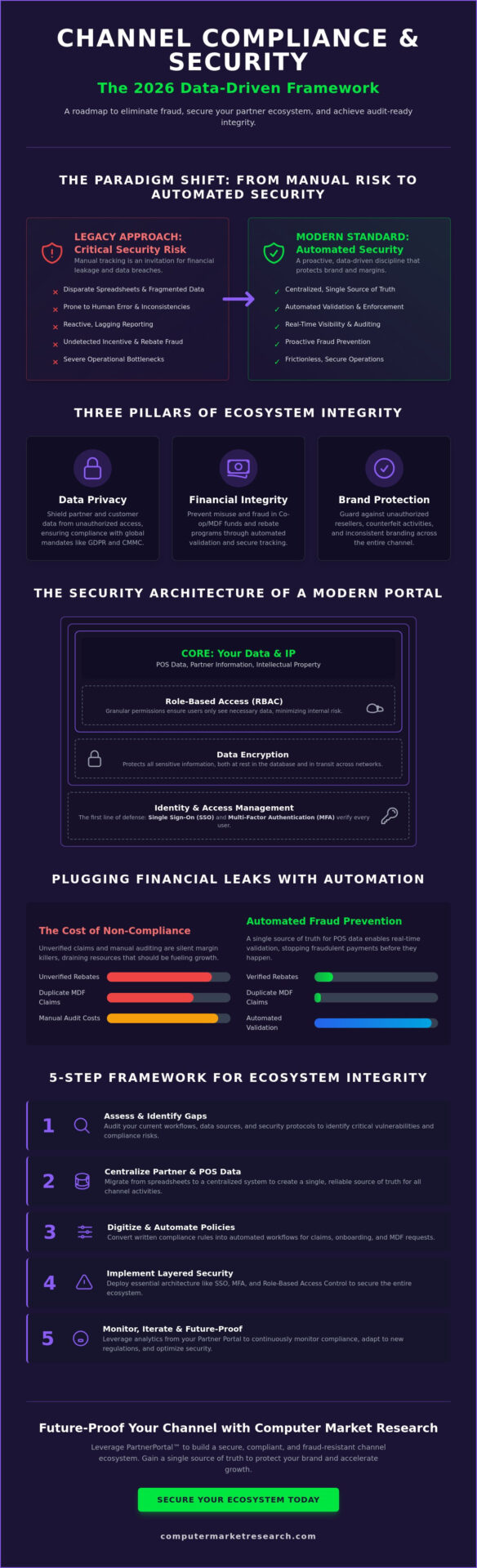
A 5-Step Framework for Establishing Channel Ecosystem Integrity
Building a resilient ecosystem requires a structured, logical approach that moves beyond reactive fixes. A well-defined framework ensures that channel program compliance and security are baked into the daily operations of your partner network. This systematic progression transforms compliance from a manual burden into an automated competitive advantage. By following these five steps, organizations can eliminate the vulnerabilities that lead to financial leakage and data exposure.
- Step 1: Centralize partner data. Establishing a single source of truth is the only way to eliminate the risks associated with fragmented spreadsheets.
- Step 2: Digitize compliance policies. Move your program rules from static PDF documents into active, system-enforced logic within your portal.
- Step 3: Implement automated validation. Ensure that every activity, from Deal Registration to Lead Management, is verified against your criteria before any action is taken.
- Step 4: Conduct continuous auditing. Shift from annual reviews to real-time, data-driven monitoring to catch anomalies as they occur.
- Step 5: Establish off-boarding protocols. Define clear steps for removing non-compliant partners to protect your proprietary information and brand equity.
Centralization: The Foundation of Control
Silos are the primary enemy of channel security. When information is trapped in separate departments, fraud thrives in the gaps. Integrating your existing CRM and ERP systems with a centralized channel management platform eliminates these blind spots. This integration allows for the seamless flow of POS Data Management and Inventory Management records, ensuring that every transaction is visible and verifiable. Radical visibility is the first step toward total compliance.
Closing the Loop: From Audit to Enforcement
Real-time dashboards allow operations teams to flag compliance red zones before they escalate into significant financial losses. If a partner falls out of compliance, the system should trigger automated notifications and temporary access restrictions. This leads to the strategic importance of a formal partner closeout process. Properly off-boarding non-compliant partners ensures that your proprietary intellectual property and lead data remain secure. For organizations ready to modernize their infrastructure, implementing a systematic data administration strategy is the most effective way to ensure long-term integrity and ecosystem stability.
Future-Proofing Compliance with Computer Market Research
Transitioning from legacy manual processes to a modernized infrastructure is the only logical step for enterprises aiming to secure their indirect sales channels. Computer Market Research (CMR) provides the technical depth required to manage these complex B2B relationships with precision. With a 40-year legacy in the industry, CMR has built its reputation on transforming spreadsheet chaos into structured, high-quality information. Their flagship solution, PartnerPortal™, serves as the definitive platform for channel program compliance and security, offering the stability and accuracy needed to protect financial margins and brand equity.
The strength of CMR’s approach lies in its modular design, which allows organizations to address specific operational bottlenecks systematically. Whether your primary challenge is unverified Co-op/MDF Management spend, duplicate Rebates & Incentives claims, or fragmented POS Data Management, the platform provides a unified environment for enforcement. By digitizing compliance logic directly into the workflow, companies can move away from reactive auditing and toward a model of automated integrity. This transition ensures that every transaction is validated against real-world data before any funds are disbursed or leads are assigned.
Why Fortune 500 Companies Trust CMR
Stability and accuracy are the hallmarks of CMR’s cloud-based SaaS solutions. Large enterprises require a partner who understands the nuances of global data residency and complex financial tracking. CMR doesn’t just provide software; they offer managed data services that offload the heavy administrative burden from internal teams. This expert-led partnership allows business leaders to focus on strategic growth rather than manual data entry. The quiet confidence that comes from working with a seasoned consultant ensures that your ecosystem remains audit-ready and resilient against evolving threats.
Getting Started with a Compliance Audit
Evaluating your current channel program for security vulnerabilities is the first step toward long-term stability. You should identify where manual hand-offs occur and where data silos might be obscuring fraudulent activity. CMR’s implementation and integration services are designed to bridge these gaps, connecting your existing CRM and ERP systems into a single source of truth. This systematic integration provides the real-time visibility necessary for maintaining channel program compliance and security in a high-stakes environment. To see how these tools can modernize your operations, request a demo of the CMR PartnerPortal™ today.
Securing Your Ecosystem for Sustainable Growth
Computer Market Research brings over 40 years of channel management expertise to your organization. Trusted by Fortune 500 and Global 2000 companies, our modular SaaS architecture is designed to handle the most complex B2B data relationships with precision and reliability. You don’t have to settle for the frustration of fragmented spreadsheets and manual errors. It’s time to build a more resilient, audit-ready future for your partner network.
Secure Your Channel Ecosystem with PartnerPortal™
Frequently Asked Questions
What is the difference between channel compliance and channel security?
Channel compliance focuses on the adherence to contractual, operational, and legal obligations within your ecosystem. It ensures partners follow specific rules regarding branding, pricing, and reporting. Channel security involves the technical protection of the data and infrastructure that supports these relationships. While compliance defines the rules, security provides the defensive perimeter to prevent data breaches and unauthorized access.
How does automated PRM software prevent incentive fraud?
Automated software prevents fraud by enforcing predefined validation rules before any funds are disbursed. Systems like PartnerPortal™ require mandatory Proof of Performance (PoP) uploads and cross-reference claims against verified POS Data Management records. This eliminates the possibility of duplicate submissions or unauthorized marketing spend. It ensures that financial rewards are only issued for legitimate, documented partner activities.
Is manual spreadsheet tracking compliant with 2026 data regulations?
Manual spreadsheet tracking is generally not compliant with 2026 data regulations because it lacks robust audit trails and secure version control. Modern privacy laws require strict visibility into who accessed data and where it is stored. Spreadsheets are prone to manual errors and lack the encryption necessary to protect sensitive information, making them a primary obstacle to achieving channel program compliance and security.
What are the most common compliance risks in a partner ecosystem?
The most common risks include incentive and rebate fraud, unauthorized reselling, and the exposure of proprietary intellectual property. Fragmented partner data often hides these vulnerabilities from operations teams. Without real-time visibility, organizations often suffer from financial leakage through unverified MDF claims. They may also face legal penalties for failing to track partner activities according to global data residency requirements.
Can a partner portal help with GDPR and CCPA adherence?
A partner portal assists with GDPR and CCPA adherence by centralizing data and providing granular access controls. These platforms allow for automated consent management and ensure that partner information is handled according to regional laws. By moving data out of disparate silos and into a secure, encrypted environment, organizations can provide the transparency and reporting required by regulatory bodies.
What is ‘Ship & Debit’ compliance and why is it critical?
Ship & Debit compliance involves verifying that distributor claims for price protection match actual sales and inventory levels. It’s critical because it prevents over-claiming and ensures that manufacturers don’t lose margin on illegitimate requests. By automating this validation process, companies can reconcile claims with high-quality POS data. This closes a common loophole used for financial exploitation within the channel.
How often should a company conduct a channel compliance audit?
While formal reviews should occur at least semi-annually, modern enterprises are moving toward continuous, data-driven monitoring. Real-time dashboards allow operations teams to flag anomalies as they happen rather than waiting for a yearly report. This proactive approach to channel program compliance and security ensures that non-compliant activities are addressed immediately. This reduces the window of risk for the organization.
What features should I look for in a secure channel management system?
Look for features such as Single Sign-On (SSO), Multi-Factor Authentication (MFA), and Role-Based Access Control (RBAC). A secure system must also offer advanced encryption for sensitive POS and inventory reports. Automated validation for Co-op/MDF Management and Rebates & Incentives is equally vital for maintaining financial integrity. These technical controls create a defensive perimeter that protects your ecosystem’s data and capital.

Article by
Del Heles
Del Heles is the founder and CEO of Computer Market Research (CMR), a channel management software company he launched in 1984. With more than 40 years of experience, he’s known for helping manufacturers and distributors simplify complex partner programs through practical, customer-focused technology solutions.