

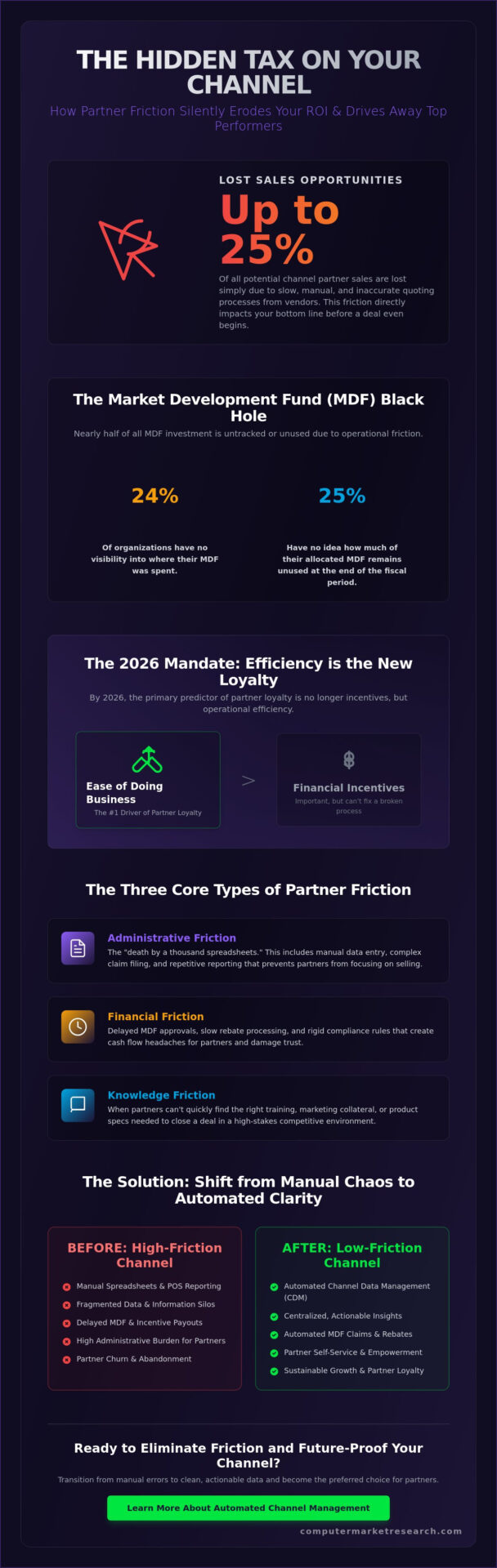
Did you know that channel partners lose up to 25% of sales opportunities simply because of slow and inaccurate quoting processes from their vendors? If you’re managing a complex channel, you’ve likely felt the strain of manual spreadsheets and the “black hole” of untracked Market Development Funds. Research shows that 24% of organizations don’t know where their MDF was spent, while another 25% have no idea how much remains unused. Prioritizing reducing friction in partner programs is the only way to break this cycle of frustration that eventually drives your best partners toward the competition.
Partner friction is primarily a data integrity problem, not a relationship problem. When you eliminate the administrative overhead and technical silos that slow down your distributors, you’re building a foundation for sustainable growth. In this guide, you’ll learn how to identify, quantify, and remove the operational bottlenecks that stifle loyalty and erode your channel ROI. We’ll examine the shift toward automated systems that replace manual errors with clean, actionable data, ensuring your program remains the preferred choice for partners in 2026.
Key Takeaways
- Understand why “Ease of Doing Business” (EoDB) has surpassed financial incentives as the primary predictor of partner loyalty in the 2026 landscape.
- Learn how to transition from manual spreadsheets to automated Channel Data Management to secure decision-grade insights and eliminate data silos.
- Discover a systematic approach to reducing friction in partner programs by automating complex MDF claims and incentive payouts to boost fund utilization.
- Explore how centralizing operations within a PRM system empowers partners through self-service tools and real-time visibility into sales and inventory.
- Identify the technical requirements for a cloud-ready infrastructure that scales with enterprise complexity without increasing your administrative burden.
The Economic Impact of Friction in Modern Partner Programs
Partner friction represents any structural or operational obstacle that hinders a partner’s ability to onboard, execute a sale, or receive compensation. In the current B2B environment, these bottlenecks act as a “friction tax” that quietly erodes profitability. Industry analysis suggests that manual processes and fragmented data systems drain between 20% and 30% of channel management budgets. This isn’t just a loss of capital; it’s a loss of momentum. Focusing on reducing friction in partner programs is no longer just a tactical preference; it’s a financial necessity for manufacturers who want to protect their margins.
When internal operational friction exists, it creates a ripple effect that results in external market delays. If your internal team takes three days to validate a lead or a week to approve a quote, your partner is left standing in front of a customer with no answers. These delays allow more agile competitors to capture the lead before you’ve even processed the paperwork. Legacy systems that rely on manual data entry are the primary drivers of this waste, creating a disconnect between the brand and the distributor.
By 2026, the “Ease of Doing Business” (EoDB) metric has emerged as the primary predictor of partner loyalty. While financial incentives still matter, they can’t compensate for a program that’s difficult to navigate. If a partner finds your portal unintuitive or your claim process exhausting, they’ll simply pivot to a vendor that respects their time. Efficiency is the new currency of the channel, and clean data is the only way to mint it.
To better understand the financial implications of streamlined operations, watch this helpful video:
Identifying the Invisible Friction Points
Friction is often invisible until it impacts the bottom line. Administrative friction consumes hours of partner time on repetitive data entry and complex claim filing. It’s the “death by a thousand spreadsheets” that prevents sales reps from actually selling. Financial friction occurs when rigid compliance rules or manual reviews cause delays in MDF approvals and rebate processing. This creates a cash-flow headache for partners who are floating the costs of your marketing campaigns. Finally, knowledge friction leaves partners stranded when they can’t quickly access training or the specific marketing collateral needed to close a deal in a high-stakes environment.
The Partner Abandonment Rate
In a competitive landscape, “likable” brands are losing to “efficient” brands. A partner might enjoy your corporate culture, but they’ll abandon your program if the operational burden is too high. The cost of replacing a top-tier partner is significantly higher than the investment required to optimize an existing one. High churn rates are often a symptom of systemic friction rather than product quality. The process of reducing friction in partner programs requires a shift from manual oversight to automated clarity. Ultimately, we must view partner friction as the primary barrier to achieving a high-performing channel sales strategy.
Eliminating Data Friction: From POS Silos to Actionable Insights
The reliance on manual spreadsheets is the silent killer of channel growth. When manufacturers ask partners to manually compile monthly Point of Sale (POS) reports, they’re introducing a significant barrier to productivity. This manual data collection process is the antithesis of reducing friction in partner programs. It forces partners to step away from selling to perform administrative tasks, which often results in “dirty” data that is difficult to normalize. Without a centralized system, you’re left with silos of information that provide no real-time value.
Implementing a robust channel data management strategy transforms these disparate data formats into decision-grade intelligence. Instead of struggling with incompatible file types and inconsistent naming conventions, automation allows you to ingest, cleanse, and validate data instantly. This transition from manual entry to automated visibility ensures that both you and your partners are working from a single version of the truth. When data flows seamlessly, the relationship shifts from administrative policing to strategic collaboration.
The Nightmare of Manual Data Normalization
Manual data cleansing is inherently flawed. Industry professionals report that manual processes lead to a 10-15% error rate in channel reporting. These inaccuracies trickle down into every facet of the business, from miscalculated incentive payouts to incorrect inventory forecasts. For the partner, the burden of creating these reports creates immediate friction. It makes your brand difficult to work with and increases the likelihood of reporting delays. CMR’s approach focuses on offloading this administrative weight from both the manufacturer and the partner. By automating the data ingestion process, we remove the “ask” from the partner, allowing them to focus on revenue-generating activities while you receive clean, actionable data.
Streamlining Inventory and Sales Visibility
Automated POS data collection does more than just save time; it provides the real-time visibility necessary to prevent costly stockouts or the accumulation of overstock. When you have a clear view of partner inventory levels, you can engage in proactive demand planning rather than reactive fire-fighting. This level of transparency builds deep trust in the manufacturer-distributor relationship. Partners feel supported when you can anticipate their needs based on actual sales velocity. Ensuring data accuracy is the first step toward a more predictable and profitable channel. To see how this level of accuracy can transform your operations, consider exploring our POS Data Management solutions.
Solving Financial Friction in MDF and Incentive Management
Financial friction is often where the relationship between a manufacturer and a distributor is most tested. While marketing and sales teams focus on growth, the back-office reality of complex claim processes remains the top complaint in partner surveys. If a partner has to wait months for a rebate or navigate a labyrinth of paperwork to access market development funds, they’ll prioritize other vendors who pay faster. Reducing friction in partner programs requires a fundamental shift in how financial incentives are managed. Automation replaces the friction of manual review with the speed of data-driven validation.
“Audit Anxiety” is a real phenomenon that stifles program participation. Manufacturers often implement rigid compliance rules to prevent fraud, but these same rules create a barrier that discourages partners from utilizing available funds. Research from 2026 shows that 25% of organizations are unaware of how much unused MDF they have. When the risk of a claim being denied outweighs the benefit of the marketing activity, the funds sit idle. This underutilization is a missed opportunity for market expansion. By simplifying the compliance framework and providing real-time visibility into fund availability, you can encourage more strategic use of MDF without sacrificing financial oversight.
Automating the rebate lifecycle is essential for maintaining momentum. From the moment a deal is registered to the final payout, the process should be seamless. Manual tracking of milestones often leads to missed payments and frustrated partners. An automated system ensures that every rebate is calculated accurately based on pre-defined criteria, reducing the need for manual intervention and eliminating the “black hole” of untracked incentives. When payouts are predictable, partner loyalty increases because they can rely on that revenue to reinvest in their own growth.
Reducing the MDF Approval Bottleneck
Email-based approvals are slow and prone to error. Moving to automated workflows allows for faster turnaround and better tracking of fund expiration dates. Partners need to know exactly how much they have left and when it expires. Automation provides this clarity, turning a confusing process into a transparent one. By setting clear parameters for approval, you can reduce the back-and-forth communication that often delays campaign execution. This ensures that marketing activities happen when they are most relevant, rather than weeks later when the opportunity has passed.
Automating Ship & Debit to Eliminate Disputes
The high cost of inaccurate ship & debit claims can quickly erode your margins. Disputes often arise because the manufacturer’s records don’t match the partner’s claim. You can eliminate these disputes by validating claims against real-time POS data automatically. This ensures that every credit issued is accurate and verified. Reducing the administrative friction in this process saves time for your sales ops team and prevents the financial tension that ruins partner relationships. When you remove the friction from the financial lifecycle, incentives stop being a “headache” and start being a competitive advantage.
This need for accurate financial record-keeping to prevent disputes is a universal theme; for example, co-parents often use parentpayr.com to track child support and shared expenses with the same level of verifiable transparency required in complex business partnerships.
A Strategic Framework for Reducing Operational Touchpoints
Efficiency in a channel ecosystem isn’t achieved by a single software purchase; it’s the result of a deliberate architecture that prioritizes the partner’s time. Centralizing the partner experience within a robust partner relationship management (PRM) system creates a “single source of truth” for every interaction. When a partner can access training, register a deal, and track their rebates in one location, you’ve removed the cognitive load of navigating multiple disparate systems. This structural alignment is the most effective way of reducing friction in partner programs while ensuring data integrity remains high.
Self-service functionality acts as a significant friction-reducer by empowering partners to find answers independently. If a distributor has to open a support ticket to check inventory levels or verify a claim status, the process has already failed. True optimization requires integrating the partner portal with your existing CRM and ERP systems. This seamless data flow ensures that information updated in your back-office is immediately visible to the partner. Additionally, implementing automated deal registration eliminates the friction of channel conflict. By providing instant feedback on lead ownership, you protect the partner’s investment and foster a culture of trust.
The 5-Step Friction Reduction Roadmap
Building a frictionless channel requires a methodical approach. Follow this roadmap to streamline your operations:
- Step 1: Audit existing touchpoints to identify where partners “drop off” or experience delays.
- Step 2: Consolidate fragmented tools into a unified PartnerPortal™ to simplify the user journey.
- Step 3: Automate high-volume, low-value tasks, such as lead distribution and basic profile updates.
- Step 4: Provide real-time dashboards that show partner performance and incentive status without manual requests.
- Step 5: Continuously refine the experience based on partner feedback and behavioral data.
Leveraging Through-Channel Marketing Automation
Marketing is often a major source of friction for partners who lack dedicated creative teams. You can reduce this burden by providing “ready-to-use” campaigns that are easily co-branded. Utilizing through channel marketing automation (TCMA) scales partner efforts without increasing their administrative workload. By centralizing asset management, you eliminate the “content hunt” that often prevents partners from launching timely promotions. This approach ensures your brand message remains consistent while making it effortless for partners to generate demand. To start optimizing your channel infrastructure, explore how our PartnerPortal™ can centralize your operations today.
Future-Proofing Your Channel with CMR PartnerPortal™
Moving from reactive channel management to a proactive stance is the only way to maintain a competitive edge. When you’re constantly fighting fires related to incorrect rebate payouts or missing inventory data, you can’t focus on strategic growth. Reducing friction directly correlates to increased Channel ROI because it allows your team to focus on high-value activities rather than administrative policing. It’s about creating a path where data flows seamlessly from the point of sale to your final decision-making reports.
The End of the Spreadsheet Era
Manual data entry is a liability, not just an inconvenience. In a high-stakes B2B environment, a single transposition error in a spreadsheet can lead to thousands of dollars in overpaid incentives or missed sales opportunities. Achieving “clean data” isn’t a luxury; it’s a requirement for survival. Automated collection and normalization ensure that the information you receive is accurate, timely, and ready for analysis. CMR’s PartnerPortal™ centralizes operations to eliminate operational headaches, replacing manual guesswork with the “decision-grade” insights that modern sales operations professionals demand.
Scalable Automation for Global Enterprises
Global enterprises face unique challenges that include multi-currency transactions, multi-language support, and diverse regional regulations. Your infrastructure must handle these nuances without creating additional friction for your international partners. A system that doesn’t grow with your partner ecosystem will eventually become the very bottleneck it was meant to solve. By implementing scalable automation, you ensure that reducing friction in partner programs remains a consistent priority regardless of your organization’s size or geographic reach. This systematic approach transforms your channel from a source of frustration into a streamlined engine for revenue. Schedule a demo of PartnerPortal™ to see friction reduction in action.
Building a Frictionless Channel Future
The journey to a high-performing channel ecosystem begins with a fundamental shift in how you manage distributor relationships. By prioritizing reducing friction in partner programs, you’re not just making life easier for your distributors; you’re securing the data integrity required for scalable growth. We’ve explored how moving away from manual spreadsheets to automated POS collection and MDF workflows eliminates the operational “headaches” that stall revenue. In 2026, the brands that win aren’t necessarily the ones with the highest incentives; they’re the ones that are the easiest to work with.
Since 1984, Computer Market Research has specialized in helping manufacturers navigate these technical complexities. Trusted by Fortune 500 and Global 2000 companies, our cloud-based, modular PartnerPortal™ platform provides the stable infrastructure needed to turn fragmented data into decision-grade intelligence. It’s time to stop fighting manual errors and start scaling your channel with quiet confidence.
Automate your channel and eliminate partner friction with CMR today. Your partners will appreciate the clarity, and your bottom line will reflect the newfound efficiency.
Frequently Asked Questions
What is the most common source of friction in partner programs?
Administrative burden from manual data entry is the primary source of friction. When partners must manually compile POS reports or navigate complex claim forms, it consumes time they should spend selling. This operational drag creates a barrier to entry that often leads to underutilized funds and missed market opportunities. Automating these touchpoints is the first step toward a more efficient channel.
How does reducing friction impact partner loyalty?
Reducing friction in partner programs is the most effective way to increase loyalty because it improves the “Ease of Doing Business” (EoDB) metric. Partners prioritize vendors that respect their time and provide fast, accurate payouts. If your program is easier to navigate than a competitor’s, you’ll naturally become their preferred brand, leading to higher retention and more consistent revenue.
Can software really eliminate the need for spreadsheets in channel management?
Yes, specialized channel management software effectively eliminates the “spreadsheet trap” by automating data collection and normalization. Instead of manually reconciling disparate files, the system ingests data directly from partners and validates it against your business rules. This creates a single source of truth without the 10-15% error rate common in manual processes, allowing your team to focus on strategy.
How long does it take to see ROI from reducing partner friction?
Most organizations see measurable ROI within three to six months of implementing automation. The immediate reduction in administrative labor costs and the elimination of overpaid rebates provide quick financial wins. Long-term gains come from increased partner engagement and more accurate inventory planning, which prevents costly stockouts and ensures your products are always available to the end-user.
Does reducing friction require a total overhaul of our existing CRM?
No, you don’t need to replace your current CRM or ERP systems to optimize your channel. Modern platforms like PartnerPortal™ are modular and designed to integrate seamlessly with your existing infrastructure. This allows you to add specific capabilities, such as Ship & Debit or MDF management, without the disruption of a total system overhaul. It’s about enhancing your current stack, not replacing it.
What role does data accuracy play in partner program friction?
Data accuracy is the foundation of a frictionless relationship. Inaccurate POS or inventory data leads to payment disputes and “audit anxiety,” which causes partners to hesitate before participating in new programs. Clean, validated data ensures that incentives are calculated correctly the first time. This builds the trust necessary for a long-term partnership and eliminates the back-and-forth communication that slows down operations.
How do we identify friction points if our partners aren’t complaining?
Silence doesn’t always mean satisfaction; it often indicates disengagement. You can identify friction points by analyzing participation metrics, such as how long it takes for a partner to move from onboarding to their first sale. If MDF utilization is low or deal registrations are declining, these are clear signs that your processes are too cumbersome for your partners to navigate effectively.
Is automated MDF management more secure than manual processing?
Automated MDF management is significantly more secure because it replaces subjective manual reviews with objective validation rules. Every claim is checked against real-time data and pre-defined criteria, creating a transparent audit trail that is easy to review. This reduces the risk of fraud and ensures that marketing funds are spent according to your strategic guidelines, protecting your overall channel investment.

Article by
Del Heles
Del Heles is the founder and CEO of Computer Market Research (CMR), a channel management software company he launched in 1984. With more than 40 years of experience, he’s known for helping manufacturers and distributors simplify complex partner programs through practical, customer-focused technology solutions.