

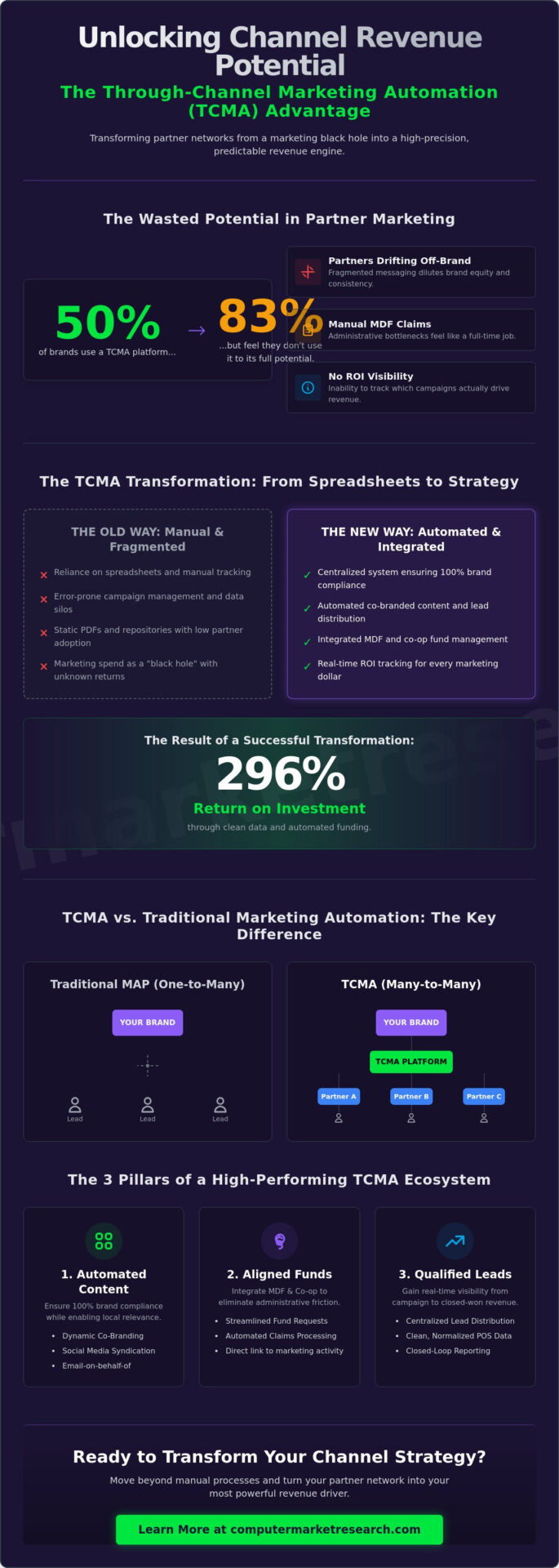
While 50% of brands have invested in a through-channel marketing automation tcma platform, a staggering 83% of those organizations feel they aren’t using the technology to its full potential. You likely recognize the friction: local partners drifting off-brand, manual MDF claims that feel like a full-time job, and a persistent lack of visibility into which campaigns actually drive revenue. It’s a common operational headache that turns your channel into a black hole for marketing spend rather than a predictable revenue driver.
You can transform that network into a high-precision engine that automates co-branded content and streamlines lead distribution while maintaining total brand control. This guide reveals how to move beyond manual processes to achieve a 296% return on investment through clean data and automated funding. We’ll explore the shift toward partner demand automation and how real-time ROI tracking finally signals the death of the spreadsheet for channel managers, ensuring every dollar of spend is accounted for and optimized.
Key Takeaways
- Transition from manual, error-prone campaign management to a centralized system that ensures 100% brand compliance across your entire partner network.
- Learn how through-channel marketing automation tcma bridges the gap between marketing to partners and marketing through them to drive measurable demand.
- Integrate MDF and co-op fund management directly into your marketing workflows to eliminate administrative bottlenecks and manual claim processing.
- Follow a structured 5-step framework to audit existing data silos and replace fragmented spreadsheets with a automated co-branded content engine.
- Leverage clean, normalized POS data to gain real-time visibility into which partner campaigns are actually generating revenue and high-quality leads.
Defining Through-Channel Marketing Automation (TCMA) in 2026
Through-channel marketing automation tcma serves as the strategic bridge between a manufacturer’s brand vision and the local execution of its partner network. In 2026, this technology has matured beyond simple asset management. It now functions as a data-driven ecosystem where brand control and local relevance coexist. By leveraging these platforms, organizations empower their distributors and resellers to launch co-branded, compliant campaigns with minimal technical friction. This setup effectively signals the death of the spreadsheet, replacing manual tracking with a centralized source of truth.
This evolution is critical for any business managing complex Marketing Channels where fragmented messaging often dilutes brand equity. Instead of pushing static content to partners and hoping they use it, manufacturers now orchestrate demand through partners using automated workflows. This shift ensures that every local touchpoint remains professional and aligned with corporate standards. It moves the focus from simple enablement to active, high-precision execution.
To better understand how this technology transforms partner engagement, watch this helpful video:
The Evolution of Distributed Marketing
TCMA has transitioned from static PDF repositories into dynamic, AI-driven hubs. Early iterations required partners to manually download, edit, and upload assets; a process that led to a significant drop in participation. Today, SaaS-based platforms allow for centralized global control while providing the last-mile flexibility local markets demand. For instance, niche professionals can discover REI Reply to see how AI-powered contact centers and marketing automation are applied in specific sectors like real estate. Manual processes are the primary obstacle to partner adoption. When execution is automated, participation rates often climb because the operational burden is removed from the partner’s plate. This creates a “set it and forget it” environment that local teams actually want to use.
TCMA vs. Traditional Marketing Automation
A common mistake is assuming a standard Marketing Automation Platform (MAP) like HubSpot or Marketo can handle channel needs. These tools are built for a one-to-many relationship: one brand talking to many leads. In contrast, through-channel marketing automation tcma manages a many-to-many dynamic. It must support thousands of distinct partners, each with their own local branding, while maintaining a single source of truth for the manufacturer. This requires a multi-tenant architecture designed for partner portal environments. This structure allows for personalized experiences without compromising data security or brand integrity, ensuring that localized campaigns drive real revenue rather than just creating more administrative work.
The 3 Pillars of a High-Performing TCMA Ecosystem
A scalable marketing engine requires more than just a repository of logos and brochures. To achieve measurable growth, you must move beyond viewing tools as isolated features and instead treat them as an integrated lifecycle. According to Gartner’s definition of Channel Marketing, the focus is on the programs and processes that enable partners to move products to the end user. In a modern environment, through-channel marketing automation tcma provides the structural integrity for these processes by relying on three core pillars: content, funds, and leads. Without clean, normalized data as the fuel, these pillars often crumble under the weight of manual administration.
Automated Content & Asset Syndication
Consistency is the primary victim of manual partner marketing. Dynamic co-branding solves this by automatically injecting partner-specific details, such as logos and contact information, into enterprise-grade campaigns. This ensures that every asset remains compliant while feeling local. Social media syndication further extends this reach by pushing pre-approved posts directly to partner feeds, eliminating the need for partners to log in and post manually. For high-volume outreach, email-on-behalf-of technology allows manufacturers to execute sophisticated nurture sequences that appear to come directly from the local partner’s inbox, maintaining the personal relationship while ensuring professional execution; teams often test these automated workflows using temp-mail.org to verify the final recipient experience.
MDF and Co-op Fund Alignment
Most organizations fail here because they treat funding and execution as separate silos. High-performing ecosystems bridge this gap by linking your through-channel marketing automation tcma directly to market development funds. When a partner launches a campaign within the platform, the system should automatically trigger the fund request and track the spend. This reduces friction in the “claim-to-credit” lifecycle and provides real-time visibility into fund utilization versus actual performance. You can even use channel incentive programs to reward partners who consistently use these automation tools, turning your marketing spend into a driver for platform adoption.
Lead Management and Deal Registration
The final pillar is about closing the loop. It’s not enough to generate leads; you must ensure they are followed up on and tracked through the sales cycle. By integrating lead distribution with deal registration, manufacturers can see exactly which co-branded campaigns resulted in closed revenue. This level of transparency eliminates the guesswork from channel spend. If you’re struggling with visibility, it’s likely time to streamline your channel data management to ensure every campaign is backed by actionable insights rather than hopeful estimates.
TCMA vs. Partner Marketing Automation: Bridging the Gap
Understanding the distinction between marketing to partners and marketing through them is the foundation of a modern channel strategy. Partner Marketing Automation (PMA) typically focuses on enablement, which involves providing the training and resources your partners need to be successful. In contrast, through-channel marketing automation tcma is built specifically for demand generation. It enables partners to execute co-branded campaigns that reach the end user directly. This solves the classic brand consistency nightmare by providing a balance of control and flexibility that manual processes simply can’t match.
In 2026, enterprise leaders don’t choose between these two; they implement a hybrid approach within a centralized partner portal. This unified environment uses AI to personalize the partner experience at scale, suggesting specific campaigns based on a partner’s past performance and local market data. By integrating these functions into your broader partner relationship management strategy, you provide a seamless path from training to execution, ensuring your network is always ready to sell.
When to Prioritize TCMA Over PMAP
Your choice depends on the composition of your network. If your channel consists of “transactional” partners—those who sell high volumes but lack internal marketing teams—prioritizing through-channel marketing automation tcma is essential. These “Long Tail” partners often account for a significant portion of revenue but rarely have the resources to build their own campaigns. While 50% of brands currently utilize a TCMA platform, only 17% believe they use it to its full potential. Prioritizing automation for these resource-strapped partners ensures your brand remains visible in local markets where it might otherwise be ignored.
The ROI of Brand Consistency
The cost of “rogue” partner marketing is more than just a visual annoyance; it’s a drain on ROI. When partners use non-compliant assets or fragmented messaging, lead conversion rates drop because the customer experience is broken. A unified TCMA platform protects your brand equity by ensuring every local touchpoint is professional and enterprise-grade. A Forrester study on TCMA platforms found that composite organizations achieved a 296% return on investment over three years, largely by streamlining these execution points. By eliminating non-compliant execution, organizations have seen up to a 50% increase in partner-sourced deals, proving that brand control is a direct driver of revenue growth.
A 5-Step Strategic Framework for TCMA Implementation
Transitioning from manual execution to a structured system requires more than just new software; it requires a shift in operational philosophy. The first step involves a comprehensive audit of your current “spreadsheet-based” marketing silos. These manual tracking methods often hide inefficiencies and data gaps that prevent scaling. Once identified, you must define your channel data management standards for campaign tracking. Clean data ensures that when you implement through-channel marketing automation tcma, every interaction is captured accurately and every lead is accounted for.
Selecting a modular platform is the third step. It must integrate with your existing CRM and PRM to avoid creating another data silo. Once the infrastructure is ready, pilot the system with a “Champion Partner” group. These are your most engaged partners who can help refine co-branding workflows before a full-scale rollout. Finally, scale the program through automated incentives and mandatory deal registration. This creates a clear “if-then” progression where partners are rewarded for their participation and performance, leading to the 50% increase in partner-sourced deals seen by high-performing organizations.
Overcoming the Partner Adoption Barrier
Partner adoption is the most significant hurdle in any automation project. To overcome this, follow the “Ease of Use” rule: the platform interface must be simpler to navigate than an Excel sheet. You can prove the tangible value of these tools by using ship & debit data to show exactly how specific marketing efforts correlate with increased product movement. Providing concierge-level support during the initial rollout phase ensures that partners feel supported rather than overwhelmed by new technology. When partners see that the system saves them time while increasing their sales, adoption becomes a logical business decision rather than a corporate mandate.
Measuring What Matters: TCMA Metrics
Real success in 2026 is measured by the journey from syndication to closed-won revenue, not just vanity metrics like email open rates. You should calculate your “Automation Dividend” by tracking the total hours saved by both your corporate team and your partner marketing teams. Using POS data to validate the ROI of specific MDF-funded campaigns provides the quiet confidence needed to justify further channel investment. This data-driven approach allows you to identify which partners are truly driving growth and which campaigns require optimization. If you’re ready to eliminate the administrative headaches of manual tracking, request a consultation to automate your channel data today.
Beyond Execution: How CMR Integrates TCMA with Decision-Grade Insights
Most TCMA tools focus on the “what”—the emails, social posts, and brochures sent to customers. They often ignore the “why” and the “result.” Without a direct link to actual sales data, marketing spend remains a “black hole” where ROI is impossible to calculate. Computer Market Research changes this by anchoring through-channel marketing automation tcma in a foundation of clean, normalized POS data. This integration ensures that every automated campaign is backed by real-world inventory visibility and purchase history, allowing you to see exactly which partner activities correlate with actual product movement.
The primary differentiator is our focus on eliminating the administrative burden that kills channel growth. Our managed data services handle the heavy lifting of data collection, validation, and cleansing. This allows your team to focus on high-level strategy rather than fixing broken rows in a CSV file or chasing partners for missing reports. By positioning the PartnerPortal™ as your single source of truth, you create a closed-loop system where marketing execution and sales reporting live in the same ecosystem. This visibility transforms your channel from a collection of silos into a high-precision marketing engine.
The Death of the Spreadsheet in Channel Marketing
CMR automates the collection of partner performance data from thousands of disparate sources across your global network. We don’t just aggregate data; we normalize it to ensure every SKU and transaction is identified correctly. This process ensures your through-channel marketing automation tcma strategy is fueled by “Decision-Grade” insights rather than optimistic guesswork. Effective POS data management is the only way to validate which co-branded campaigns are actually moving products off the shelves in specific regions. When your data is clean, your marketing becomes precise and your budget is spent on what actually works.
Future-Proofing Your Channel with CMR
Growth shouldn’t require a linear increase in administrative headcount. Our cloud-based infrastructure allows you to scale from 100 to 10,000 partners while maintaining the same lean sales operations team. This web-based approach supports global enterprises in real-time, providing the stability and accuracy required for complex manufacturer-distributor relationships. It’s time to stop fighting with fragmented data silos and start driving demand with quiet confidence. Centralize your channel operations with CMR’s PartnerPortal™ to secure your path to scalable growth and eliminate the manual errors of the past.
Transforming Channel Complexity into Scalable Demand
The journey from fragmented spreadsheets to a high-precision marketing engine is an operational necessity for growth-oriented manufacturers. By implementing through-channel marketing automation tcma, you replace persistent administrative headaches with a structured ecosystem where brand control and partner flexibility coexist. This shift ensures your marketing spend is no longer a black hole. Instead, it becomes a measurable driver of closed-won revenue backed by real-time ROI tracking and automated fund integration.
Since 1984, Computer Market Research has provided the technical competence required to help Fortune 500 and Global 2000 companies navigate these complexities. We specialize in transforming dirty, fragmented POS data into the Decision-Grade insights needed to scale a global network with quiet confidence. It’s time to eliminate the manual errors that stall your progress and embrace a system built on decades of specialized channel expertise. Automate your partner marketing with CMR’s PartnerPortal™ and build a more predictable, data-driven future for your brand. Your partners are ready to execute; you simply need to provide the engine.
Frequently Asked Questions
What is the difference between TCMA and a standard Marketing Automation Platform?
Standard platforms are designed for direct one-to-many communication between a single brand and its leads. In contrast, a TCMA platform manages the complex many-to-many dynamics of a channel ecosystem. It allows a manufacturer to push campaigns through thousands of distinct partners, each with their own local identity. This multi-tenant architecture ensures that while you control the brand, partners maintain local relevance without needing internal marketing teams.
How does TCMA help with brand compliance across a partner network?
TCMA enforces compliance by providing a centralized library of pre-approved, dynamic assets that partners cannot alter. Instead of partners creating their own non-compliant materials, the system automatically injects their specific logos and contact details into enterprise-grade templates. This “locked-down” approach ensures that every local touchpoint reflects your corporate standards. It eliminates the risk of rogue marketing that often dilutes brand equity in fragmented partner networks.
Can TCMA platforms integrate with our existing enterprise CRM or Microsoft Dynamics?
Modern through-channel marketing automation tcma solutions are built with open APIs designed for seamless integration with major enterprise CRM platforms and Microsoft Dynamics. These connections ensure that lead data flows directly from partner-executed campaigns into your central database. This visibility allows you to track the entire sales lifecycle from the initial marketing touchpoint to final deal registration without manual data entry or error-prone spreadsheet updates.
What is the typical ROI of implementing a through-channel marketing automation system?
Organizations typically see a 296% return on investment over a three-year period according to studies conducted by Forrester. This return is driven by a 50% increase in partner-sourced deals and a significant reduction in administrative overhead. By automating the execution of co-branded content and the processing of MDF claims, companies often achieve a payback period of less than six months. This efficiency turns your channel into a predictable revenue driver.
How do we encourage partners to actually use the TCMA tools we provide?
High adoption rates are achieved by following the “Ease of Use” rule and tying platform participation to financial incentives. When the interface is simpler than a spreadsheet, partners are more likely to engage. You should also link your MDF and co-op fund eligibility to the use of these automation tools. This creates a clear value proposition where partners receive both marketing support and financial rewards for using the system; for instance, providing instant digital rewards through Techhauz.com can significantly boost engagement among partner sales teams.
What role does AI play in through-channel marketing automation in 2026?
In 2026, AI drives hyper-personalization by suggesting specific campaigns to partners based on their historical performance and local market data. Predictive analytics help manufacturers forecast partner performance and anticipate market trends before they happen. These AI-driven insights allow you to automate complex decisions, such as lead distribution and content optimization, ensuring that every partner receives the assets most likely to convert in their specific territory.
How does TCMA simplify the management of Market Development Funds (MDF)?
TCMA simplifies fund management by automating the entire “claim-to-credit” lifecycle within a single platform. Instead of manual email chains and paper receipts, partners submit claims directly through the system as they execute campaigns. This integration provides real-time visibility into fund utilization versus actual campaign performance. It eliminates the administrative headaches of manual processing and ensures that your MDF budget is spent on activities that drive measurable results.
Is TCMA suitable for small partner programs, or only for large enterprises?
Small and mid-sized programs benefit from TCMA because it provides the structure needed to scale without adding significant headcount. While large enterprises use it to manage thousands of partners, smaller programs use automation to punch above their weight class with limited resources. Starting with an automated foundation prevents the creation of data silos that often stall growth. It ensures your channel is built for stability and accuracy from the very first partner.

Article by
Del Heles
Del Heles is the founder and CEO of Computer Market Research (CMR), a channel management software company he launched in 1984. With more than 40 years of experience, he’s known for helping manufacturers and distributors simplify complex partner programs through practical, customer-focused technology solutions.