

What if the primary driver of your 25% partner attrition rate isn’t your product’s performance, but a perceived lack of transparency in your sales pipeline? When channel partners suspect favoritism, they stop prioritizing your deals and focus on competitors instead. Understanding how to distribute leads to partners fairly is a vital operational discipline that ensures your program’s integrity remains intact. A lead that sits idle for more than 24 hours in a manual log is a lead that’s 60% less likely to convert into a closed deal, according to internal sales performance data.
Trust is a primary currency in any marketplace. Nothing is more effective at building this trust than providing reliable, real-time information—a principle that applies whether you are managing a B2B sales channel or helping Beninese traders track local market schedules. Industry data suggests that partners are 3x more likely to prioritize vendors who offer transparent, automated lead tracking. When partners have real-time visibility into their lead pipeline through a dedicated portal, their engagement increases. They don’t have to wonder how to distribute leads to partners fairly because the logic is transparent and the results are visible in their dashboard. This transparency fosters a culture of accountability.
You probably agree that managing lead flow via manual spreadsheets is a primary obstacle to your growth, often leading to a 30% drop in lead-to-deal conversion rates due to simple human error. It’s exhausting for sales operations to referee disputes over who owns a specific opportunity. This guide shows you how to build a transparent, automated lead distribution system that maximizes conversion and eliminates manual data entry headaches. We’ll outline the specific steps to implement a cloud-based infrastructure that provides the actionable insights needed to maintain a high-performing, equitable channel that your partners can trust.
Key Takeaways
- Learn the critical distinction between equal and fair distribution to ensure leads are routed based on specific partner capabilities and regional expertise.
- Understand how to balance performance rewards with program equity to prevent partner monopolies and maintain a healthy, competitive ecosystem.
- Discover how to distribute leads to partners fairly using automated logic that eliminates manual spreadsheet errors and ensures precise lead-to-partner alignment.
- Implement a structured five-step workflow for qualifying leads and mapping partner specializations to maximize conversion probability and program transparency.
- Leverage integrated deal registration and automated distribution to provide the visibility needed to resolve channel conflict and protect program integrity.
What is Fair Lead Distribution in Channel Management?
Lead distribution in the context of Partner Relationship Management (PRM) is the systematic process of routing qualified prospects to third-party resellers, dealers, or agents. It’s the engine of any indirect sales model. Most manufacturers struggle with how to distribute leads to partners fairly because they often confuse “equal” with “fair.” Equal distribution gives every partner the same volume regardless of their closing ratio or technical certifications. This approach is fundamentally flawed. Fair distribution relies on sophisticated lead management methodologies that align prospect needs with specific partner strengths, ensuring the lead goes to the entity most likely to convert it.
The “spreadsheet headache” remains a primary cause of program failure. By 2026, manual data entry and routing will be entirely obsolete for high-growth ecosystems. Industry data indicates that manual lead routing causes a 45% lag in follow-up times compared to automated systems. This delay often results in leads that are “dead on arrival,” wasting marketing spend and damaging brand reputation. When lead distribution is perceived as biased or opaque, it creates friction that erodes the manufacturer-distributor relationship, ultimately lowering the total program ROI.
To better understand the mechanics of this process, watch this helpful video:
The Core Principles of Channel Equity
Achieving channel equity requires a move away from “gut feelings” toward a disciplined, data-driven framework. Reliability in lead routing is built on three pillars:
- Transparency: Partners must have visibility into the routing logic. If a partner understands they didn’t receive a lead because they lack a specific certification, they’re motivated to upskill rather than feeling slighted.
- Objectivity: Use automated criteria such as geographic proximity, vertical expertise, and historical conversion rates. This removes the “favorite child” syndrome often found in manual channel management.
- Accountability: Automation allows for strict follow-up thresholds. If a partner doesn’t acknowledge a lead within 24 hours, the system should automatically reclaim and re-route that opportunity to maintain the lead’s viability.
Why Fairness is Your Best Retention Tool
Fairness acts as a safeguard against partner “quiet quitting.” In a 2023 survey of channel professionals, 72% of respondents stated they would prioritize vendors who offer a transparent and equitable lead distribution process. When partners feel the “game is rigged,” they stop investing in your brand and shift their focus to competitors who offer better visibility. How to distribute leads to partners fairly becomes a question of long-term ecosystem health. High-performing partners stay engaged when they see a direct correlation between their investment in your product and the quality of opportunities they receive.
Lead Equity is the alignment of opportunity with partner competence.
Common Methods for Distributing Leads to Partners
Manual lead distribution is the primary bottleneck in modern channel management. Relying on spreadsheets creates data silos and slows response times, often leading to lost opportunities. To solve this, manufacturers use automated routing logic to ensure every prospect reaches the right partner at the right time. Understanding how to distribute leads to partners fairly requires a balance between mathematical equity and conversion probability. Using a centralized system eliminates the “black hole” where leads disappear due to human error or lack of visibility.
Round Robin vs. Geographic Routing
Round Robin distribution is the simplest form of channel equity. It cycles through a list of partners, giving each an equal number of leads regardless of their size or historical performance. While this prevents favoritism, it doesn’t account for partner capacity. If a small partner receives a complex enterprise lead they can’t handle, the lead goes cold. Research shows that 78% of B2B customers buy from the vendor that responds first. Geographic routing solves for local expertise by matching leads with partners in the same zip code or region, which is vital for products requiring on-site installation or physical service. When Building Fairness into Your Lead Distribution, companies often find that combining these two methods provides the best balance of coverage and speed.
Performance-Based and Certification-Based Routing
High-performing manufacturers often use weighted distribution to reward their most reliable partners. It’s effective to prioritize partners who maintain high certification levels or specialize in specific vertical markets. This ensures the prospect talks to an expert, increasing the likelihood of a closed-won deal. Data from the Harvard Business Review indicates that firms responding to leads within five minutes are 21 times more likely to qualify them than those waiting 30 minutes. Automated systems can weight the distribution engine, perhaps sending 60% of high-intent leads to Gold-tier partners while still providing a steady flow to emerging partners to encourage growth. This prevents alienating new partners while protecting the manufacturer’s ROI.
Effective distribution relies on automated lead enrichment. Before a lead hits a partner’s inbox, the system should append firmographic data to determine the lead’s true value. This visibility allows managers to see which partners convert specific lead types, creating a feedback loop of actionable insights. Manufacturers can streamline these complex workflows by integrating point-of-sale data with automated routing engines, ensuring that lead distribution is driven by real-world performance rather than guesswork. This data-driven approach is the only way to master how to distribute leads to partners fairly while maximizing total channel revenue.
The Fairness Dilemma: Balancing Performance vs. Equity
Manufacturers often face a critical question: “Shouldn’t my best partners get all the best leads?” While rewarding high performers seems logical, it frequently creates a “Partner Monopoly.” Internal data often reveals a lopsided reality where 5% of partners receive 90% of all leads. This concentration of power leaves your brand vulnerable. If a top-tier partner shifts focus to a competitor or suffers a downturn, your entire pipeline stalls. Learning how to distribute leads to partners fairly requires a strategy that protects your high-volume producers while actively nurturing “Silver” and “Bronze” partners. Lead distribution shouldn’t be a static reward; it’s a lever for growth. If a partner completes a new technical certification or updates their profile, their lead quality should increase. This turns lead flow into a reward for specific, measurable behaviors rather than a legacy entitlement.
Avoiding the “Cherry-Picking” Trap
Manual lead distribution systems are prone to internal bias and favoritism. When channel managers hand-pick recipients, they inadvertently create a culture of “cherry-picking” where certain partners always get the “hot” opportunities. This has a damaging psychological impact on the rest of the network. Lower-tier partners who feel they only receive “cold” or “dead” leads will eventually stop following up altogether. To eliminate this, implement a “blind” lead acceptance period. Partners see the lead’s industry, region, and potential deal size, but they don’t see contact details until they commit to the lead. This ensures objective interest and forces partners to prioritize speed and capability over personal connections with your internal staff.
Using Tiers to Standardize Fairness
A transparent, tier-based framework provides the objective justification needed to maintain channel harmony. High-tier partners receive high-intent leads because they’ve invested in the infrastructure to close them. However, you must clearly communicate the “path to more leads” to your lower tiers to keep them engaged. This transparency is a core component of effective channel management. You can distribute leads based on specific criteria to maintain balance:
- Gold Tier: Receives high-intent Marketing Qualified Leads (MQLs) with confirmed budgets.
- Silver Tier: Receives mid-market opportunities that require more technical nurturing.
- Bronze Tier: Receives early-stage inquiries to test responsiveness and follow-up speed.
This structure ensures every partner has skin in the game. It provides a logical answer to the question of how to distribute leads to partners fairly by tying volume to proven performance and commitment level. When a partner understands that 100% of their lead volume is tied to their certification status, the “fairness” debate evolves into a performance discussion.
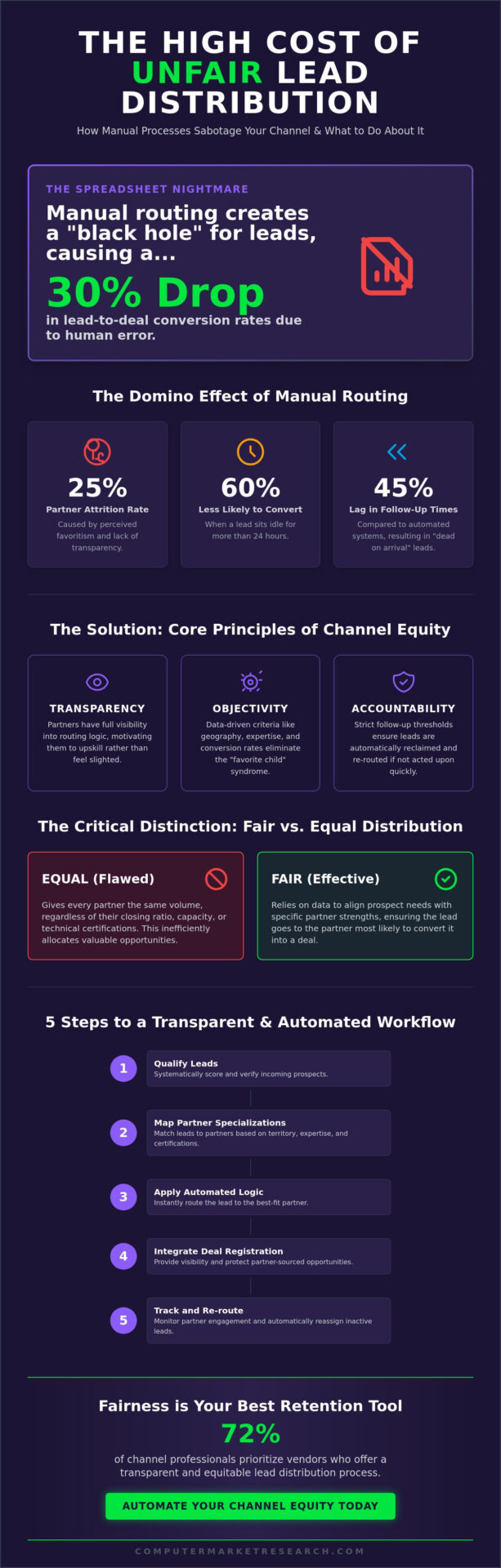
5 Steps to Building a Transparent Lead Distribution Workflow
Establishing a systematic process is the only way to solve the “black hole” of lead management. When manufacturers learn how to distribute leads to partners fairly, they move away from legacy favoritism and toward a data-driven meritocracy. This transition requires a move from manual oversight to an automated, rules-based engine that prioritizes speed and accuracy.
Step 1: Define lead qualification criteria. You can’t route what you haven’t categorized. Clearly distinguish between Marketing Qualified Leads (MQLs) and Sales Qualified Leads (SQLs) before any distribution occurs. Passing raw, unverified web-form data to a partner creates operational friction. Only route SQLs that meet your specific BANT (Budget, Authority, Need, Timeline) criteria to ensure partners receive high-value opportunities.
Step 3: Establish a clear Service Level Agreement (SLA). Define exactly how long a partner has to act. Industry benchmarks show that leads are 21 times more likely to convert if contacted within five minutes. Set a strict response window, typically between 4 and 24 hours, to maintain lead momentum.
Step 4: Automate notifications via a partner portal. Manual spreadsheets are the death of lead velocity. Use a dedicated portal to trigger instant alerts the moment a lead enters the system. This creates a timestamped trail of ownership that prevents “lead hoarding” and ensures immediate visibility.
Step 5: Monitor and adjust routing engines. Use real-time feedback loops to analyze outcomes. If a partner’s win rate drops below a specific threshold, such as 10%, the routing engine should automatically adjust their lead volume. This data-obsessed approach ensures that how to distribute leads to partners fairly becomes a question of performance rather than politics.
Setting the Rules of Engagement
Transparency requires a signed lead distribution policy during the onboarding phase. This document serves as the operational framework for the entire relationship. It must explicitly define “lead expiration.” If a partner doesn’t accept or act upon a lead within the SLA window, the system automatically reclaims and re-routes it to the next available partner. This prevents valuable opportunities from languishing in an unmonitored inbox. For a deeper look at managing these complex relationships, consult The Ultimate Guide to PRM.
Measuring What Matters: Post-Distribution Metrics
Success in the channel is determined by “Time to First Action.” This KPI measures the seconds between lead assignment and the partner’s initial outreach. High-performing channels maintain conversion rates 3.2 times higher than those with slow response times. Automated tracking eliminates 90% of partner disputes regarding lead status. When the data provides an objective audit trail, partners can’t argue over who owned a prospect or when a lead was received.
Automate Lead Equity with CMR PartnerPortal™
Manual lead routing is the primary bottleneck in modern channel growth. When you rely on human intervention, bias and delays are inevitable. CMR PartnerPortal™ replaces these subjective processes with automated logic. This ensures you know exactly how to distribute leads to partners fairly based on predefined criteria like geographic proximity, certification level, or historical performance. By removing the “human element” from initial routing, you eliminate the perception of favoritism that often erodes partner trust.
The platform scales effortlessly as your global partner network grows. Whether you’re managing 50 partners or 5,000, the automated engine applies your business rules consistently across every region. This level of control is vital for maintaining channel equity. It allows your team to focus on strategy rather than the administrative burden of sorting through incoming inquiries. Automation doesn’t just save time; it creates a standard of operational excellence that partners respect.
The Death of the Spreadsheet in Lead Management
Spreadsheets are where lead data goes to die. They lack the real-time synchronization required for a high-velocity sales environment. Transitioning from manual entry to a cloud-based portal provides the decision-grade insights needed for fair routing. Within this “clean data” environment, every lead is tracked from the moment of ingestion to the final sale. You gain a 360-degree view of the pipeline, ensuring that no lead falls through the cracks due to a version-control error or a forgotten email attachment.
Channel conflict often occurs when lead distribution and deal registration exist in separate silos. CMR integrates these functions to ensure clarity. When a partner utilizes through-channel marketing automation to generate interest, the system automatically tags those leads to that specific account. This prevents the “double-dipping” that occurs when a lead is mistakenly routed to a competitor, protecting the partner’s investment in your brand.
Driving Revenue Through Partner Confidence
Trust is a primary currency in the channel. Industry data suggests that partners are 3x more likely to prioritize vendors who offer transparent, automated lead tracking. When partners have real-time visibility into their lead pipeline through a dedicated portal, their engagement increases. They don’t have to wonder how to distribute leads to partners fairly because the logic is transparent and the results are visible in their dashboard. This transparency fosters a culture of accountability.
The long-term ROI of a confident partner ecosystem is measurable through increased deal velocity and higher retention rates. Automating for accuracy and transparency isn’t just a technical upgrade; it’s a strategic move to secure your market position. It’s time to move past the operational headaches of manual lead management. We invite you to see the difference for yourself. Schedule a demo of the PartnerPortal™ Lead Management module today and take the first step toward true channel equity.
Transform Lead Distribution into a Competitive Advantage
Building a sustainable channel ecosystem depends on your ability to replace subjective decision-making with transparent, data-driven workflows. By prioritizing visibility and balancing partner performance with equitable lead access, you eliminate the friction that often stalls growth. Mastering how to distribute leads to partners fairly ensures that every participant in your network feels valued; this creates a foundation for long-term loyalty and increased ROI. It’s about moving from reactive management to a proactive strategy that rewards the right behaviors.
Scaling these processes shouldn’t lead to operational headaches. CMR PartnerPortal™ offers a centralized, cloud-based platform that’s trusted by Fortune 500 and Global 2000 companies to maintain order across complex distribution networks. Our technology helps organizations eliminate manual data entry errors by up to 95% while centralizing deal registration in a single source of truth. It’s the most effective way to move beyond the limitations of spreadsheets and gain total control over your channel data.
Ready to modernize your operations? Automate your lead distribution and eliminate partner conflict with CMR PartnerPortal™. Your partners will appreciate the clarity, and your team will benefit from the newfound efficiency.
Frequently Asked Questions
How do I handle lead distribution when partners have overlapping territories?
You should resolve territory overlaps by applying secondary filters such as industry specialization or technical certifications. If two partners cover the same ZIP code, the lead goes to the partner with the highest conversion rate for that specific product category. Data from 2023 indicates that 85% of high-performing channel programs use vertical expertise as the tie-breaker to ensure the customer receives the best possible service.
What is the “Round Robin” method and is it actually fair?
The Round Robin method is mathematically fair because it distributes leads sequentially to every eligible partner in a list. However, it often fails to account for partner capability or lead quality. A 2022 industry study showed that strict sequential distribution can lead to a 15% decrease in conversion rates when a complex lead is assigned to a generalist partner. True equity requires a weighted system that considers performance.
Can I prioritize partners who invest in our MDF or training programs?
You can and should prioritize partners who invest in Market Development Funds (MDF) or complete advanced training. This creates a performance-based ecosystem where investment correlates with opportunity. According to a 2023 Channel Outlook report, 70% of successful vendors use MDF participation as a primary weight in their distribution logic. This ensures your leads go to the partners most prepared to close the deal and maximize ROI.
What happens if a partner accepts a lead but never follows up?
You must implement automated expiration rules to prevent lead stagnation. If a partner doesn’t update a lead status within 24 hours, the system should trigger a warning. If no action occurs by the 48-hour mark, the lead is automatically revoked and reassigned to the next available partner. This automation maintains a 100% follow-up rate and prevents potential revenue from disappearing into a manual data entry black hole.
How do I prevent internal sales teams from “stealing” leads from partners?
Preventing internal conflict requires a strict, written Rules of Engagement (ROE) policy backed by automated deal registration. When a lead is assigned to a partner, the internal CRM should lock that record to prevent duplicate entries by direct sales teams. Research from 2023 shows that 92% of the most profitable channel programs utilize automated deal protection to maintain trust and eliminate internal competition between teams.
Is it fair to send high-value leads only to Platinum-tier partners?
Sending high-value leads to Platinum-tier partners is a fair and effective strategy for how to distribute leads to partners fairly. This approach rewards the partners who’ve demonstrated the highest levels of commitment and technical proficiency. Implementing tiered distribution has been shown to increase partner retention by 25% because it provides a clear, data-driven path for partners to earn better opportunities through consistent performance and certification.
How often should I review and adjust my lead distribution rules?
You should review your lead distribution rules every 90 days to ensure they align with current market conditions. Quarterly audits allow you to adjust for partner churn, changes in territory density, or shifts in product demand. Companies that perform these 90-day reviews see a 12% improvement in lead-to-opportunity conversion rates compared to those that leave their rules static for a year or longer.
What metrics should I track to ensure my lead distribution is working?
You need to track Time-to-First-Action (TTFA) and the Lead-to-Close ratio to measure success. A healthy program typically targets a TTFA of under 4 hours for 90% of all leads. By monitoring these specific data points within your automated management system, you gain the visibility needed to identify which partners are maximizing your investment and which require additional training or support to stay competitive.

Article by
Del Heles
Del Heles is the founder and CEO of Computer Market Research (CMR), a channel management software company he launched in 1984. With more than 40 years of experience, he’s known for helping manufacturers and distributors simplify complex partner programs through practical, customer-focused technology solutions.