

A 2024 survey of channel operations professionals found that 63% of manufacturers still rely on manual data entry for performance tracking, a practice that leads to a 12% discrepancy in annual incentive payouts. If you’re managing your network through fragmented spreadsheets, you’re dealing with a visibility gap that prevents true strategic growth. Building a channel partner scorecard shouldn’t be an administrative burden that relies on stale information. It’s time to transition to a system where performance is orchestrated through clean, automated data feeds.
You’ve likely felt the frustration of missing Point of Sale data or the inability to justify MDF spend against actual results. This guide will show you how to design automated, data-driven scorecards that move partners from passive resellers to high-growth strategic allies. We will outline a repeatable framework for evaluation and demonstrate how to integrate automated data for a scoring system that drives consistent revenue growth.
Key Takeaways
- Transition from static legacy reporting to real-time performance orchestration that establishes a shared source of truth between manufacturers and distributors.
- Master a weighted metric system across financial, operational, marketing, and competency levers to align partner behavior with your specific business objectives.
- Understand why the “death of the spreadsheet” is critical when building a channel partner scorecard to ensure data integrity and eliminate manual operational headaches.
- Apply a structured 5-step framework to define what “good” looks like and establish realistic benchmarks based on historical performance data.
- Discover how centralizing visibility through automated dashboards connects scorecard data to MDF and rebates for total channel control and increased ROI.
Why Traditional Partner Scoring Fails in the Modern Channel
Building a channel partner scorecard isn’t just about tracking sales. It’s about establishing a strategic shared source of truth between manufacturers and distributors. Historically, companies relied on static quarterly business reviews that looked backward at what had already occurred. By 2026, this model has shifted toward real-time performance orchestration. This approach uses Partner Relationship Management (PRM) frameworks to align goals and visibility across the entire ecosystem. It transforms the scorecard from a judgmental report card into a collaborative roadmap for mutual success.
Revenue-only scoring is a lagging indicator. It records history but fails to predict future growth. If you only look at sales volume, you miss the 35% of emerging partners who are currently investing in the technical skills needed for next year’s market shifts. Effective orchestration requires “Decision-Grade Insights.” This means data that’s clean, automated, and stripped of the manual errors that plague traditional reporting. Without these insights, your scorecard is just a collection of numbers without context, making it impossible to identify where to allocate resources for the highest return.
To better understand how data drives these modern evaluations, watch this detailed webinar on partner scorecards:
The transition to performance orchestration in 2026 demands a move away from the “death of the spreadsheet.” Manual processes can’t keep up with the speed of modern commerce. When manufacturers use automated systems to gather Point of Sale (POS) data, they gain a level of visibility that was impossible a decade ago. This transparency is the cornerstone of building a channel partner scorecard that actually drives behavior rather than just documenting it. It allows both parties to see exactly where they stand at any given moment.
The Shift from Lagging to Leading Indicators
Tracking sales volume alone ignores a partner’s true potential. In a modern channel, leading indicators provide the necessary roadmap for growth. These metrics include certification completion rates, deal registration frequency, and marketing engagement levels. When you monitor these activities, you can provide proactive coaching. Instead of reacting to a missed quota at the end of the quarter, managers can address a lack of pipeline activity in real-time. This shift allows for a supportive relationship where the manufacturer helps the distributor succeed before the deadline passes.
The High Cost of Static Scorecards
Fragmented data silos are a primary operational headache for channel leaders. When information is trapped in disconnected spreadsheets, partners often ignore scorecards because the data is already outdated. This lack of visibility directly impacts channel management efficiency. Manual data entry errors lead to constant disputes over incentives and MDF allocations. Real-time updates aren’t a luxury; they’re the only way to maintain partner trust. Moving away from static reports ensures that every stakeholder is working from the same set of accurate, cloud-based figures.
Selecting the Right Metrics: Performance vs. Potential
Building a channel partner scorecard requires a shift from simple revenue tracking to a multi-dimensional analysis of partner health. If you only measure gross sales, you’re looking at a lagging indicator that ignores future growth capability. Effective orchestration relies on four distinct levers: Financial, Operational, Marketing, and Competency. To maintain clarity and prevent operational “headaches,” it’s best to limit your scorecard to 5-7 high-impact KPIs. Overloading the dashboard with 15 or 20 metrics leads to analysis paralysis and obscures the actual path to ROI.
Weighting these metrics isn’t a one-size-fits-all process. A manufacturer entering a new vertical might weight competency and training at 40%, while a brand focused on renewal stability might place 50% of the weight on operational consistency. This data feeds into a Potential vs. Performance matrix. This 2×2 grid helps segment your ecosystem. High-potential but low-performance partners need enablement, while low-potential and low-performance partners may require offboarding to save resources and improve overall channel health.
Financial & Sales Metrics
Raw revenue numbers often hide the true cost of a partnership. You must track deal registration conversion rates to understand if a partner is actually closing the leads they claim. A 15% increase in conversion usually indicates better sales alignment than a 5% increase in total volume. It’s also vital to measure the impact of channel incentive programs within the scorecard. If a partner consumes 30% of your incentive budget but only contributes 10% of new logo growth, your ROI is misaligned. Tracking partner-specific ROI allows you to justify high-touch support for your most efficient earners.
Engagement & Competency Metrics
A partner’s technical proficiency is a lead predictor of customer retention. Certification levels are critical; data from 2025 shows that partners with advanced certifications see 22% higher renewal rates than non-certified peers. You should also monitor “Through-Channel” activity, specifically how often they utilize market development funds to drive demand. Low MDF utilization often signals a lack of marketing maturity or an overly complex claims process. Automating these data points removes the friction of manual entry and provides the visibility needed for real-time adjustments. To see how automated data management can refine your strategy, consider how streamlining your channel data provides a clear path out of spreadsheet-based chaos.
The Data Integrity Gap: Why Spreadsheets Kill Scorecard Accuracy
Manual data entry is the primary obstacle to scaling a successful partner program. If you’re building a channel partner scorecard, the integrity of your Point of Sale (POS) data determines whether your insights are actionable or merely anecdotal. Relying on manual collection methods often leads to what we call “The Death of the Spreadsheet.” In high-growth environments, static files can’t keep pace with the volume of transactions, leading to visibility gaps that frustrate both manufacturers and distributors.
Inaccurate data doesn’t just ruin a report; it carries heavy financial consequences. Faulty scorecard data often results in disputed Ship & Debit claims. When your records don’t match the partner’s reporting, the reconciliation process can stall for weeks. Research indicates that poor data quality leads to a 10% to 15% leakage in incentive spend, essentially wasting a significant portion of your channel budget on preventable administrative errors.
The Problem with Manual Data Normalization
Sales operations teams frequently spend 15 to 20 hours per week simply cleaning and formatting partner reports. Every distributor has a unique reporting format, creating a normalization crisis that manual entry can’t solve. A single bad entry, such as a misspelled product code or an incorrect date format, can ruin an entire quarterly review. Implementing automated channel data management (CDM) removes this burden. It ensures that every piece of incoming data is scrubbed, validated, and mapped to your internal systems automatically, providing a clean foundation for performance tracking.
Moving to Automated Data Feeds
The transition to automated data feeds is the only logical step for programs aiming for 2026 performance standards. It simplifies the process of building a channel partner scorecard by removing the friction of manual uploads. By integrating your scorecard with ERP and CRM systems, you gain real-time updates that reflect the actual state of the channel. Cloud-based infrastructure provides global visibility, allowing managers to see performance trends as they happen rather than 30 days after the quarter ends.
This automation eliminates common partner disputes over missing sales credit. When the data is clean and synchronized, the scorecard becomes a single source of truth that builds trust. Partners are more likely to engage with a program when they know their rewards are calculated accurately and transparently.
- Eliminate manual errors: Automated validation catches duplicates and formatting issues instantly.
- Reduce administrative overhead: Reclaim hours of sales ops time for strategic analysis instead of data cleaning.
- Improve financial accuracy: Ensure every Ship & Debit claim is backed by verified POS data to protect your margins.
- Enhance partner trust: Provide reliable, real-time feedback that validates partner efforts without constant disputes.
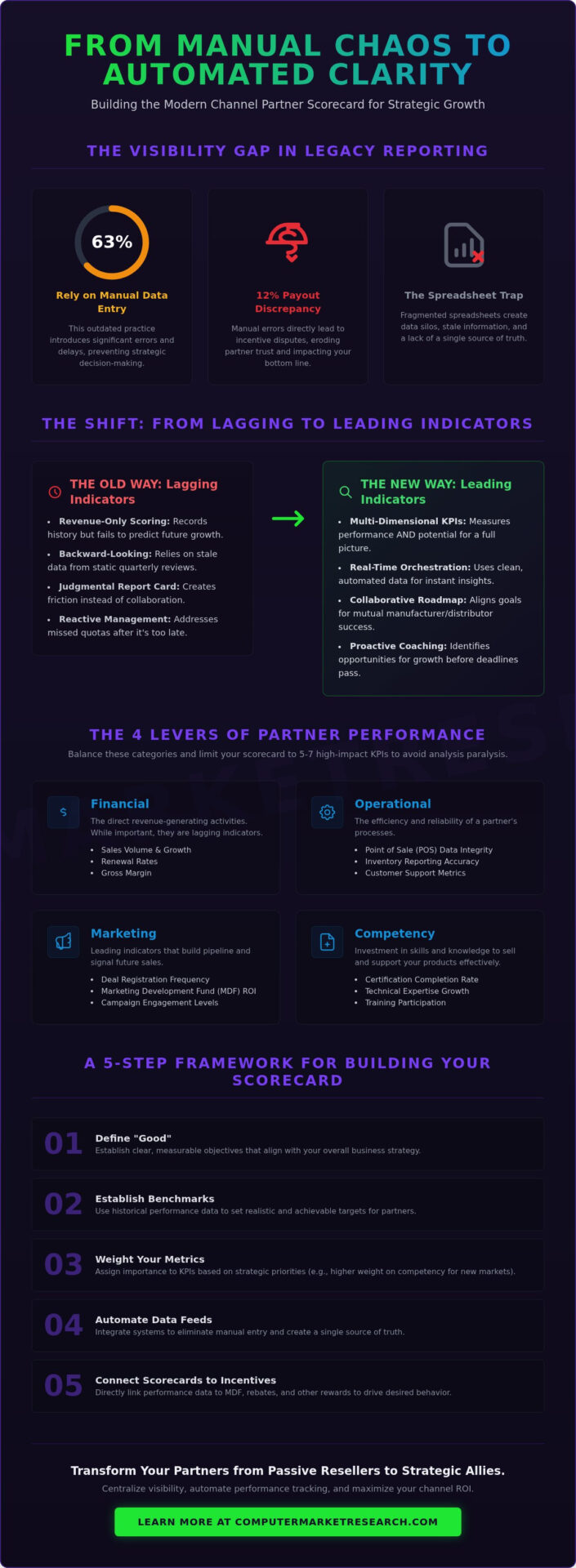
A 5-Step Framework for Building Your Partner Scorecard
Building a channel partner scorecard requires moving beyond static spreadsheets toward a dynamic, data-driven architecture. This transition eliminates the manual errors that frequently plague channel operations. A structured framework ensures your performance metrics align with actual business outcomes rather than vanity metrics.
- Phase 1: Alignment. You must define what “good” looks like for your specific channel model. High-volume distributors require different KPIs than specialized systems integrators; alignment ensures you aren’t measuring a boutique partner against commodity standards.
- Phase 2: Benchmark Setting. Establish realistic standards by analyzing at least 24 months of historical data. This prevents setting arbitrary goals that demotivate the network.
- Phase 3: Technology Integration. Connect your scorecard directly to your partner relationship management system. Automated data ingestion is the only way to maintain a single version of truth.
- Phase 4: Partner Involvement. Secure buy-in by presenting the scorecard as a mutual growth tool. When partners understand how the data benefits their own bottom line, participation rates typically climb.
- Phase 5: Iteration. Review and adjust metric weights every six months. Market conditions change rapidly, and a scorecard that was effective in 2024 might be obsolete by 2026.
Establishing Benchmark Standards
Effective building a channel partner scorecard strategies rely on tiered motivation. Categorizing partners into Gold, Silver, and Bronze tiers creates a clear roadmap for upward movement. Use historical POS data to identify the 20th and 80th percentiles of performance; these become your floor and ceiling. A dynamic benchmark is a performance standard that automatically recalibrates based on real-time regional market growth and localized economic shifts. This ensures targets remain fair even when a specific territory faces unexpected volatility.
Creating a Feedback Loop
Data is useless if it stays trapped in a database. You need automated alerts that trigger the moment a partner’s score drops below a 70% threshold. This allows channel managers to intervene before a minor slump becomes a total churn event. Integrating these scores into Quarterly Business Reviews (QBRs) transforms the meeting from a subjective “vibe check” into a technical audit of performance. Providing a self-service view via a partner portal gives your network 24/7 visibility into their standing. It’s about replacing “where do we stand?” with “how do we improve?”
If you’re tired of managing partner performance through disconnected spreadsheets, it’s time to automate your channel data management for better accuracy and scale.
Automating Performance Visibility with PartnerPortal™
The final stage of building a channel partner scorecard involves moving from theoretical frameworks to operational reality. For many manufacturers, the process of gathering data remains a manual burden that relies on fragmented spreadsheets and delayed emails. Computer Market Research’s PartnerPortal™ eliminates these bottlenecks by centralizing all performance metrics into a single, automated dashboard. This transition provides the “clean data” foundation necessary for performance orchestration, ensuring that every stakeholder operates from a single version of the truth.
When you’re building a channel partner scorecard, the goal is to drive behavior, not just record history. PartnerPortal™ achieves this through modular tools that link performance directly to execution. By connecting scorecard results to Market Development Funds (MDF), Lead Management, and Rebate modules, the platform ensures that incentives are mathematically aligned with partner contributions. This integration transforms the scorecard from a static report into a dynamic engine for channel growth.
Centralizing Your Tech Stack
Fragmented systems are the primary cause of data silos. PartnerPortal™ integrates with your existing CRM and financial systems to provide a holistic view of the channel. This connectivity offers real-time visibility for both the manufacturer and the partner, removing the friction of end-of-month reporting cycles. You can customize these scorecard views based on partner roles. A Distributor might focus on inventory turns and POS accuracy, while a Value-Added Reseller (VAR) prioritizes certification levels and lead conversion rates.
Driving ROI with Automated Insights
Manual data management is an expensive drain on sales operations. Transitioning to an automated scoring system can reduce the time spent on administrative tasks by up to 50 percent. This efficiency gain allows channel managers to spend less time auditing rows of data and more time coaching partners for better results. Our Managed Data Services further alleviate operational headaches by handling the heavy lifting of Point of Sale (POS) and inventory report reconciliation. This ensures that your scorecard is always fueled by accurate, verified information.
If your current process relies on manual entry and guesswork, it’s time to upgrade to a system built for scale. Stop letting operational friction stall your channel strategy. Ready to kill the spreadsheet? Request a demo of CMR’s PartnerPortal™ today.
Future-Proofing Your Channel Strategy Through Performance Orchestration
The transition toward 2026 demands a shift from reactive monitoring to proactive orchestration. Building a channel partner scorecard requires more than just tracking historical sales; it necessitates a robust framework that evaluates both immediate performance and long-term potential. By moving away from the manual spreadsheet processes that lead to significant data integrity gaps, manufacturers can finally achieve a single source of truth. Precision in data management isn’t just an operational goal; it’s the foundation of competitive advantage in a complex global market.
This level of precision and strategic foresight is what separates market leaders from the rest. For entrepreneurs and investors seeking to sharpen their competitive edge through peer-to-peer learning and mentorship, The Boardroom Mastermind offers an elite platform for high-level business development.
Computer Market Research provides the technical competence needed to eliminate these operational headaches. With 40+ years of specialized channel data management expertise, we’ve built a reputation for stability and accuracy. Our cloud-based solutions are currently trusted by Fortune 500 and Global 2000 companies to provide real-time visibility across diverse enterprise landscapes. You don’t have to settle for fragmented insights or manual errors that stall your ROI. High-performance channel management is within reach when you leverage automated, clean data.
Automate your partner performance tracking with CMR’s PartnerPortal™
Take the next step toward a streamlined, high-growth future for your distribution network today.
Frequently Asked Questions
What is a channel partner scorecard?
A channel partner scorecard is a strategic performance management tool that quantifies partner contributions across sales, marketing, and operational metrics. It moves beyond simple revenue tracking to provide a 360 degree view of the relationship. By centralizing disparate data points, it eliminates the guesswork in channel management and provides a clear framework for performance orchestration.
How many metrics should be included in a partner scorecard?
A high-performing scorecard typically tracks between 5 and 8 key performance indicators (KPIs) to maintain focus and clarity. Research from the 2024 Channel State of the Industry report suggests that exceeding 10 metrics leads to analysis paralysis for 62% of channel managers. You should focus on a balanced mix of volume, velocity, and value metrics to ensure data remains actionable.
What is the difference between leading and lagging indicators in partner scoring?
Lagging indicators measure past performance, such as quarterly revenue or deal closures, while leading indicators predict future success through activities like training certifications or deal registrations. For instance, a partner with 15 new certifications this month is statistically 30% more likely to hit revenue targets in the following quarter. Balancing both ensures you aren’t just looking in the rearview mirror.
How often should a partner scorecard be updated?
Automated scorecards should update in real-time, though formal reviews typically occur on a monthly or quarterly basis. If you’re building a channel partner scorecard for a high-velocity market, waiting 90 days to review data means you’re acting on obsolete information. Real-time visibility allows for mid-quarter course corrections that can save up to 15% of underperforming partnerships.
Can I build a partner scorecard in Excel?
While you can build a basic template in Excel, manual spreadsheets are the primary cause of data silos and version control errors. A 2023 study found that 88% of spreadsheets contain significant errors, which leads to incorrect incentive payouts and partner friction. Transitioning to a cloud-based, automated system ensures your data remains clean and eliminates the operational headache of manual entry.
How do I get partners to care about their scorecard performance?
Connect scorecard performance directly to tangible benefits like higher MDF tiers, lead distribution priority, or increased rebate percentages. When partners see that a 10 point increase in their score unlocks a 5% higher incentive bracket, their engagement levels rise. Transparency is vital; providing them with a self-service portal to view their own metrics builds trust and accountability without constant manual intervention.
How do scorecards impact MDF and incentive payouts?
Scorecards serve as the objective source of truth for performance-based incentive structures. By automating the link between scorecard data and your MDF management system, you ensure that 100% of payouts are backed by verified performance data. This removes the administrative burden of manual verification and prevents the misallocation of marketing funds to unproductive partners who don’t meet specific performance thresholds.
What are the most common mistakes when building a partner scorecard?
The most frequent error when building a channel partner scorecard is over-weighting lagging revenue data while ignoring operational health. Many manufacturers also fail to integrate their CRM and POS data, resulting in a fragmented view of partner activity. Without clean, automated data feeds, your scorecard becomes a static document rather than a dynamic tool for performance orchestration and growth.

Article by
Del Heles
Del Heles is the founder and CEO of Computer Market Research (CMR), a channel management software company he launched in 1984. With more than 40 years of experience, he’s known for helping manufacturers and distributors simplify complex partner programs through practical, customer-focused technology solutions.