

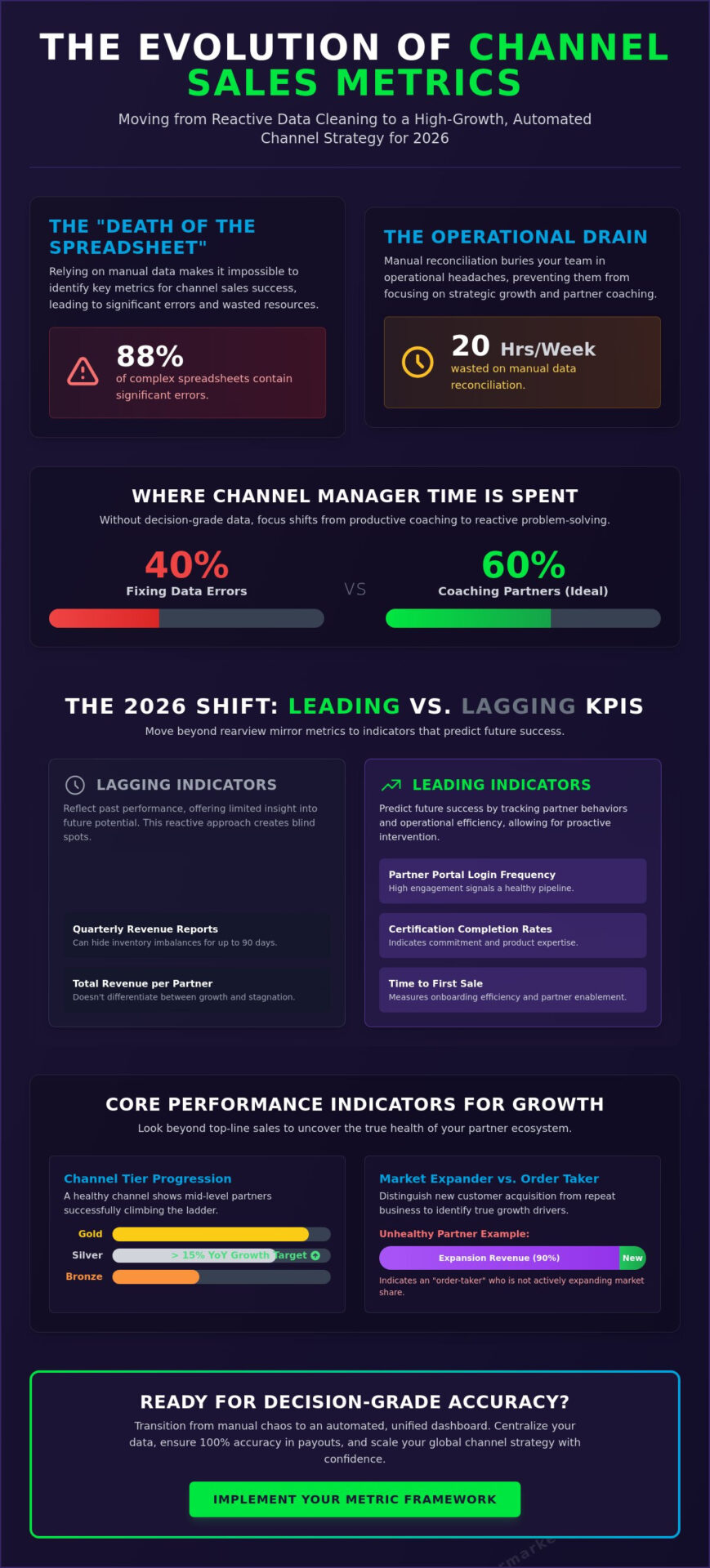
Research indicates that 88% of complex spreadsheets contain significant errors, yet many manufacturers still rely on them to manage millions in partner revenue. Relying on manual data makes it nearly impossible to identify the key metrics for channel sales success without wasting 20 hours a week on reconciliation. You know that real-time visibility into partner inventory and point-of-sale data is the only way to scale, but manual entry keeps your team buried in operational headaches. It’s time to move past the era of guesswork and inaccurate Ship and Debit claims.
This 2026 guide provides the technical framework to move from reactive data cleaning to a high-growth, automated channel strategy. You’ll learn how to master critical KPIs and ensure 100% accuracy in your rebate and MDF payouts. We’ll break down the essential operational metrics and cloud-based workflows needed to transform your partner performance and reclaim your sales operations’ time.
Key Takeaways
- Move beyond trailing revenue figures to master the leading behavioral and operational indicators that predict future channel growth.
- Identify your highest-potential “star” performers by implementing key metrics for channel sales success that measure total versus average revenue per partner.
- Reduce operational friction by tracking critical enablement markers like “Time to First Sale” to ensure a faster, more profitable partner onboarding experience.
- Transition from manual spreadsheet chaos to automated data cleansing to ensure your incentive ROI and performance reports are built on decision-grade accuracy.
- Learn how centralizing disparate data sources into a unified dashboard provides the visibility needed to scale a global channel strategy with confidence.
The Evolution of Channel Sales Metrics: Why Revenue is No Longer Enough
In the high-velocity global market of 2026, defining key metrics for channel sales success requires more than a cursory glance at the bottom line. Traditional financial KPIs only tell half the story. To gain a competitive edge, manufacturers must treat metrics as a multidimensional blend of partner behaviors, operational efficiency, and financial outcomes. Relying on fragmented data sources often leads to a 15% to 20% margin of error in forecasting. This reality has accelerated the “Death of the Spreadsheet,” as manual tracking cannot keep pace with real-time demand. Centralizing these complex data streams within a channel management system is the only way to maintain a single version of the truth across a diverse partner network.
To better understand how data-driven numbers influence your growth strategy, watch this helpful video:
The Problem with Lagging Indicators
Relying on quarterly revenue reports is like driving a vehicle while only looking at the rearview mirror. These lagging indicators reflect past performance rather than future potential. Without real-time Point of Sale (POS) data, manufacturers face blind spots that can hide inventory imbalances for up to 90 days. Modern sales management principles suggest that staying reactive is a recipe for lost market share. Decision-Grade Insights are defined as data that is normalized, cleansed, and ready for immediate executive action. Without this level of precision, channel managers spend 40% of their time fixing data errors instead of coaching partners.
The 2026 Shift: Leading vs. Lagging KPIs
The focus has shifted toward leading indicators that predict success. While “Revenue per Partner” remains a standard lagging metric, savvy channel managers now prioritize “Partner Portal Login Frequency” and “Certification Completion Rates” as leading signals. If a partner hasn’t engaged with training materials in 30 days, their sales trajectory will likely dip in the coming quarter. Predictive analytics now dictate how manufacturers distribute MDF and Co-op funds. Instead of blindly rewarding past wins, funds are allocated to partners showing high top-of-funnel activity. Visibility into the middle of the funnel ensures that key metrics for channel sales success are proactive, allowing for intervention before a slump occurs.
Core Performance Indicators: Measuring Growth and Partner Profitability
Successful channel management requires moving beyond top-line sales figures to uncover the underlying health of the ecosystem. Relying on manual spreadsheets often masks the true key metrics for channel sales success, leading to missed opportunities and inefficient resource allocation. To gain a competitive edge in 2026, manufacturers must transition to automated systems that provide real-time visibility into partner performance. This data-driven approach is the foundation of a modern partner relationship management strategy, ensuring that every incentive and marketing dollar produces a measurable return.
Revenue Metrics and Growth Rates
Measuring Year-over-Year (YoY) growth across Gold, Silver, and Bronze segments reveals whether your program is scaling or stagnating. A healthy channel typically sees at least 15% growth in the Silver tier, signaling that mid-level partners are successfully climbing the ladder. It’s vital to distinguish between new customer acquisition and expansion revenue. If 90% of a partner’s revenue comes from existing accounts, they may be acting as order-takers rather than market-expanders. Tracking market share capture within specific territories allows managers to see if a partner is actually displacing competitors or simply riding a wave of general market demand.
Identifying “Star” performers requires looking at the delta between Total and Average Revenue Per Partner. A high total revenue figure can be misleading if it’s concentrated in a single mega-partner. By analyzing actionable channel sales insights, organizations can track Partner Tier Migration. When 10% of your Bronze partners move to Silver within a 12-month period, it validates your enablement and training initiatives. If migration is zero, your program requirements might be too restrictive or your support too thin.
Profitability and Cost of Sale
Revenue alone doesn’t guarantee a sustainable channel. Managers must calculate the Cost of Partner Acquisition (CoPA) against the Lifetime Value (LTV) of the accounts they bring in. High-touch partners who demand constant support and heavy discounting can erode net margins by as much as 25%. Automated Point of Sale (POS) data tracking identifies Low-Engagement, High-Cost partners who consume resources without delivering growth. When rebates and MDF funds aren’t tied to performance, they become “dead money.” Streamlining these processes through automated data management allows you to identify which partners to invest in and which to offboard to protect your bottom line.
Beyond the Sale: Operational Efficiency and Enablement Metrics
Revenue is a lagging indicator that tells you what happened in the past. To predict future performance, manufacturers must focus on the partner journey and the operational friction that either accelerates or stalls growth. Measuring the efficiency of your ecosystem requires a shift toward enablement data. “Time to Onboard” and “Time to First Sale” are the primary indicators of program health. If a partner takes six months to reach proficiency, the opportunity cost is immense. These are the key metrics for channel sales success that define whether a program is built for scale or destined for stagnation.
Operational efficiency is often compromised by manual data silos. When partners struggle to access co-op funds or register deals, their loyalty wavers. By tracking how quickly a partner moves from contract signature to their first transaction, you identify where the enablement process is failing. This data allows for a surgical approach to partner management, replacing guesswork with technical precision.
Onboarding and Enablement Velocity
Proficiency should be measured within a strict 90-day window. Analysis of channel data shows a direct correlation between training module completion and immediate pipeline generation. Partners who engage with co-branded marketing within the first 30 days are 3x more likely to close a deal in Q1. This makes early engagement a critical predictor of long-term ROI.
The integration of through channel marketing automation is a significant factor in accelerating these timelines. Automation removes the burden of manual asset creation, allowing partners to deploy ready-made campaigns with minimal effort. Programs utilizing these automated tools typically see a 40 percent reduction in the time to first sale compared to those relying on manual distribution methods. Training effectiveness is also measured by the quality of the leads generated post-certification, not just the number of badges issued.
Engagement and Portal Utilization
Effective channel management requires distinguishing between active and passive partners. High login counts don’t always equate to productivity. You must track specific activities, such as deal registration frequency and the adoption rate of inventory management modules. If a partner stops using the portal after their initial training, it’s a clear signal that the interface is too complex or the tools lack practical utility.
- Active vs. Passive Tracking: Measure the ratio of partners who regularly update deal statuses versus those who only log in once per quarter.
- Tool Adoption: Monitor which specific sales tools provide the most value by tracking click-through rates on pricing calculators or technical spec sheets.
- Support Request Correlation: A high volume of support tickets per partner often indicates a gap in training or an overly complex product line.
By monitoring these key metrics for channel sales success, organizations can move away from reactive troubleshooting. Instead, they can proactively refine their enablement strategies to ensure every partner has a clear, automated path to profitability.
Data Integrity and Incentive ROI: The New Standard for Success
High-performing channel programs treat data integrity as a foundational pillar rather than a background task. If your data is fragmented or delayed, your dashboard is merely a collection of educated guesses. Achieving channel data management excellence means moving past the era of manual spreadsheet reconciliation. Clean data is a metric because it dictates the reliability of every other KPI in your stack. When data is automated and verified, it transforms from a liability into a strategic asset.
POS and Inventory Data Accuracy
Raw Point of Sale (POS) files are often riddled with inconsistent SKUs and formatting errors. You should track “Data Normalization Time” as a core operational metric. By 2026 standards, leading manufacturers aim to convert raw partner files into decision-grade reports within 24 to 48 hours. Delays exceeding 72 hours result in stale insights that hinder agile decision-making. It’s also vital to monitor reporting gaps. If only 60% of your channel partners provide consistent POS data, your visibility into the market is dangerously incomplete. Tracking the “Inventory Turnover Ratio” at the distributor level helps you identify where capital is tied up in slow-moving stock, preventing costly stockouts in high-demand regions.
Incentive Program Integrity
Financial leakages often hide within poorly managed incentive programs. The “Claim Accuracy Rate” for Ship & Debit claims is a vital metric; manual processes frequently suffer from a 12% to 15% error rate in overpayments. Measuring the “MDF Utilization Rate” reveals if partners are actually deploying market development funds to drive demand. If your utilization rate sits below 75%, your program likely lacks the simplicity or alignment needed to motivate partners.
You should also evaluate the “Rebate-to-Revenue Ratio” to ensure incentives drive incremental sales. This metric clarifies whether your spend is fueling growth or simply subsidizing transactions that would’ve occurred anyway. These are the key metrics for channel sales success that protect your bottom line from operational “headaches” and margin erosion. By auditing these figures, you move from passive spending to active investment.
Implementing a Decision-Grade Metric Framework with CMR
Global 2000 companies often lose 10% of their potential channel revenue because of fragmented reporting and data silos. Relying on manual spreadsheet updates is no longer a viable strategy for scaling in 2026. These manual processes are not just slow; they’re prone to errors that compromise the integrity of your strategic planning. CMR’s PartnerPortal™ eliminates the “headache-inducing” labor of chasing down partner reports by centralizing every data point into one unified dashboard. Automated cleansing ensures that the data is normalized, removing duplicates and correcting formatting errors that plague manual systems. This transition provides the “Decision-Grade Insights” necessary to pivot strategies mid-quarter rather than reacting to outdated reports.
Centralizing Your Channel Data
Modular SaaS solutions provide the flexibility to track key metrics for channel sales success across diverse partner ecosystems. By integrating POS data, MDF requests, and Lead Management into a single digital flow, manufacturers gain a 360-degree view of the channel. Automation reduces the administrative burden on channel managers by approximately 45 hours per month per region. It’s about moving from data collection to data analysis. Real-time visibility ensures that if a partner’s performance dips below a specific threshold, you can intervene before it impacts the bottom line. This level of transparency builds a stronger manufacturer-distributor relationship through shared, validated facts.
Building Your 2026 Channel Dashboard
A high-performance dashboard focuses on the numbers that drive growth. Every channel executive needs a home screen that highlights specific performance indicators to stay ahead of market shifts. We recommend these five essential widgets for your 2026 setup:
- Real-time POS Revenue: Track sales as they happen across different geographic territories.
- MDF ROI Tracking: Measure the direct impact of marketing spend on lead generation.
- Partner Compliance Status: Monitor which partners are meeting their contractual obligations.
- Inventory Velocity: Identify slow-moving stock before it becomes a liability.
- Lead-to-Deal Conversion: See exactly how fast partners are moving prospects through the funnel.
CMR’s managed data services ensure 100% accuracy by combining sophisticated algorithms with expert human oversight. You won’t have to guess if your numbers are correct or if a partner has misreported their figures. It’s time to retire the spreadsheet and embrace a system built for the complexity of modern trade. To begin your transition to automated visibility, schedule a demo of PartnerPortal™ to see your metrics in action.
Future-Proofing Your Channel Performance
Success in 2026 demands a shift from reactive reporting to proactive data management. Relying on revenue alone ignores the underlying health of your distribution network. To truly master the key metrics for channel sales success, you’ve got to prioritize partner profitability and operational efficiency. If you continue to rely on manual data entry, then you risk the 1% to 3% error rates common in fragmented spreadsheets. These inaccuracies directly undermine your incentive ROI and cloud your visibility into actual market demand.
Computer Market Research provides the technical framework trusted by Fortune 500 and Global 2000 companies to maintain data integrity. Our platform eliminates manual errors and delivers real-time visibility into POS and inventory data. This level of precision ensures that your MDF and co-op funds drive measurable growth rather than administrative waste. It’s time to trade operational headaches for actionable insights that protect your bottom line.
Automate your channel metrics with CMR’s PartnerPortal™ to secure a competitive advantage. You’ll gain the clarity needed to lead your channel with total confidence.
Frequently Asked Questions
What is the most important metric for channel sales success?
Partner Profitability is the most vital metric because it dictates long-term engagement and loyalty. Monitoring this alongside key metrics for channel sales success ensures your program remains competitive in a crowded market. If a partner’s gross margin on your products falls below 15 percent, they’ll likely prioritize your competitors. By focusing on this data, you secure mindshare and drive sustainable revenue growth through a stable distribution network.
How do I measure the ROI of my Market Development Funds (MDF)?
You calculate MDF ROI by dividing the incremental revenue generated from a specific campaign by the total funds allocated to that activity. For instance, if a $5,000 webinar produces $50,000 in new pipeline, your 10:1 ratio indicates high efficiency. Tracking this accurately requires bridging the gap between fund disbursements and Point of Sale data to ensure every dollar spent correlates directly with a closed deal.
What is the difference between leading and lagging channel indicators?
Leading indicators are predictive activities like training completion rates or deal registrations that signal future performance. Lagging indicators are historical results such as quarterly revenue or total units sold. A healthy channel program maintains a balance where leading metrics forecast growth. If 80 percent of your partners complete technical certification, you can expect a rise in sales volume within the following six months.
How often should I audit my partner’s POS and inventory data?
You should conduct automated data audits weekly to prevent the accumulation of reporting errors that lead to overpayments. Manual quarterly audits often result in a 10 percent discrepancy rate due to stale information. By implementing a cloud-based system that refreshes daily, you gain real-time visibility into stock levels. This prevents stockouts and ensures incentive payouts remain accurate based on verified sales rather than estimates.
Why is “Time to First Sale” a critical metric for new partners?
Time to First Sale measures the duration between partner onboarding and their initial transaction, serving as a litmus test for your enablement process. Partners who close their first deal within 90 days are 3 times more likely to remain active over a two-year period. Shortening this window through automated training and lead distribution reduces the risk of partner disengagement and accelerates your return on recruitment costs.
How can automation improve the accuracy of my channel sales metrics?
Automation eliminates the “death of the spreadsheet” by replacing manual data entry with direct API integrations and standardized reporting. This shift reduces human error by up to 95 percent, providing a single source of truth for your key metrics for channel sales success. When your system automatically cleans and validates incoming POS data, you stop wasting hours on reconciliation and start making decisions based on reliable facts.
What is a good MDF utilization rate for a healthy channel program?
A healthy MDF utilization rate typically falls between 70 percent and 85 percent of the total allocated budget. If utilization drops below 50 percent, it suggests your partners find the claim process too complex or the marketing assets ineffective. Conversely, a 100 percent utilization rate might indicate that your funds are being distributed too broadly without enough focus on high-performing strategic partners who drive the most value.
How do I identify “at-risk” partners before they churn?
You identify at-risk partners by monitoring a decline in engagement signals, such as a 30 percent drop in portal logins or a six-month gap in deal registrations. When a partner stops utilizing their co-op funds or ignores certification updates, it’s a clear indicator of waning interest. Tracking these behavioral shifts in a centralized dashboard allows you to intervene with targeted support before the partner moves to a competitor.

Article by
Del Heles
Del Heles is the founder and CEO of Computer Market Research (CMR), a channel management software company he launched in 1984. With more than 40 years of experience, he’s known for helping manufacturers and distributors simplify complex partner programs through practical, customer-focused technology solutions.