

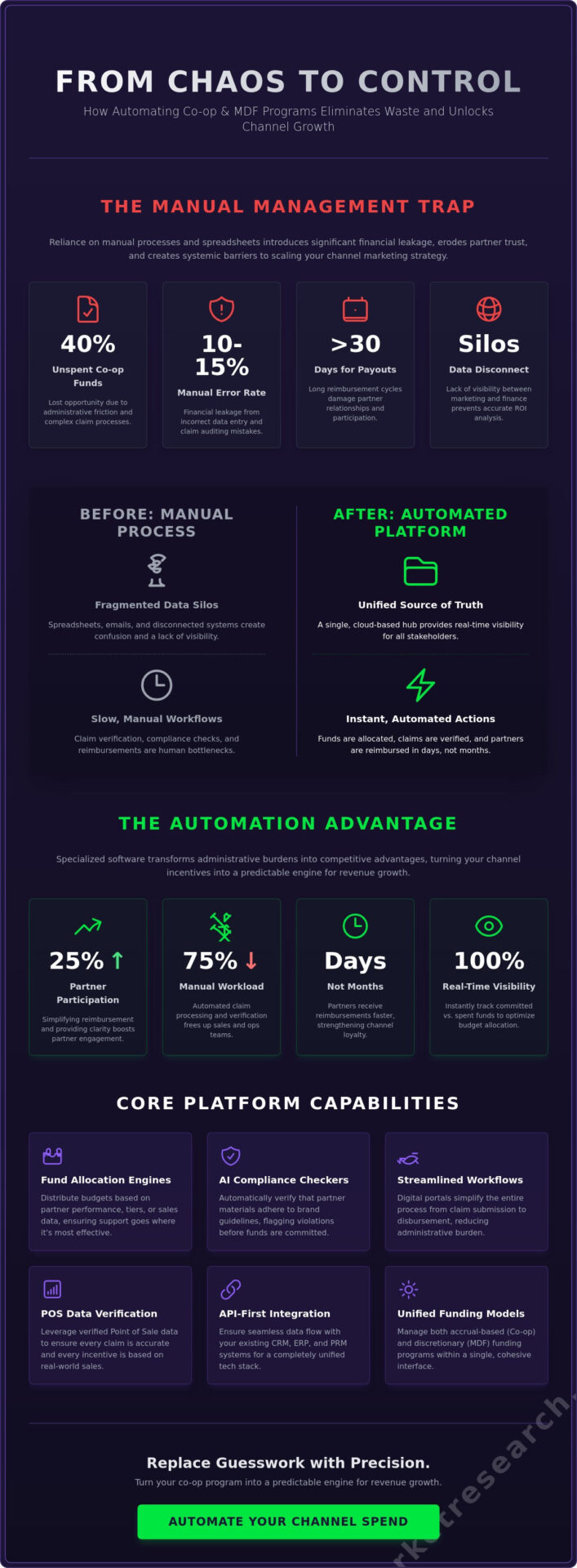
If your channel marketing strategy still relies on manual data entry, you aren’t just losing time; you’re actively eroding your brand’s competitive edge in an era where industry reports show up to 40% of co-op funds remain unspent due to administrative friction. Implementing specialized software for managing co-op advertising is no longer optional for manufacturers who want to scale. You likely recognize that manual claim processing delays and a lack of visibility into fund utilization are more than just operational hurdles. They’re systemic barriers to growth that create data silos between your marketing and finance teams.
This guide demonstrates how automating your MDF programs eliminates manual errors and restores absolute control over your channel spend. You’ll discover how to automate compliance checking and achieve a 25% increase in partner participation rates by simplifying the reimbursement process. We’ll explore the technical path to seamless CRM integration and real-time visibility that ensures every dollar of your 2026 marketing budget drives measurable ROI. By moving away from fragmented spreadsheets, you can finally align your channel incentives with actual sales performance.
Key Takeaways
- Eliminate the operational headaches of manual spreadsheets by automating the allocation, request, and reimbursement of shared marketing funds.
- Gain real-time visibility into committed versus spent balances to ensure your channel investments are always aligned with actual performance.
- Discover how the right software for managing co-op advertising can unify both accrual-based and discretionary funding models into a single, cloud-based hub.
- Identify critical technical requirements, such as API-first architecture and global scalability, to ensure seamless integration with your existing CRM and ERP systems.
- Learn how to leverage verified Point of Sale (POS) data to ensure every claim is accurate and every incentive is based on real-world sales performance.
What is Software for Managing Co-op Advertising?
Software for managing co-op advertising is a specialized cloud-based platform that automates the allocation, request, and reimbursement of shared marketing funds between manufacturers and their retail or distribution partners. This technology has evolved from static manual ledger entries into a dynamic environment for real-time digital fund management. By 2026, the transition from paper-based tracking to automated systems has become a requirement for brands that need to maintain channel integrity and visibility across global markets.
Manufacturers use these platforms to maintain a single source of truth for every marketing dollar deployed in the field. Within the broader context of Co-advertising, this software ensures that collaborative promotional efforts remain compliant with brand standards while providing partners with the liquidity they need to drive local demand.
To better understand how these campaigns function in a modern channel environment, watch this helpful video:
Global 2000 companies are aggressively moving away from spreadsheet-based channel management because manual processes cannot scale with the complexity of modern multi-tier distribution. These organizations recognize that software for managing co-op advertising is a critical link in the Partner Relationship Management (PRM) ecosystem. Without this integration, marketing leaders lack the actionable insights necessary to determine which partners are yielding the highest return on investment.
The Core Components of an Automated Co-op System
- Fund Allocation Engines: These modules distribute budgets based on specific partner performance metrics or predefined tiers, ensuring that high-performing distributors receive the support they’ve earned.
- Compliance Checkers: Automated tools verify that partner-submitted materials adhere to brand guidelines, using AI-driven image and text recognition to flag violations before funds are committed.
- Reimbursement Workflows: Digital portals streamline the path from claim submission to financial disbursement, reducing the administrative burden on both the manufacturer and the partner.
Why Manual Management is a Growth Killer in 2026
Manual claim auditing and data entry often result in an error rate of 10% to 15%, leading to significant financial leakage. When reimbursement cycles stretch beyond 30 days due to human bottlenecks, partner trust erodes and participation in brand programs drops. This friction prevents the channel from responding quickly to market shifts or competitor actions. The reconciliation gap occurs when marketing and finance data are siloed, creating a permanent disconnect between actual channel spend and reported financial performance.
Relying on legacy processes creates operational headaches that stifle a brand’s ability to scale. By adopting an automated approach, manufacturers replace guesswork with precision and turn their co-op programs into predictable engines for revenue growth.
Key Features of Modern Co-op and MDF Management Platforms
Manual oversight of market development funds often results in a 12% to 15% leakage rate due to clerical errors and unclaimed balances. Transitioning to dedicated software for managing co-op advertising replaces these fragmented spreadsheets with a centralized system of record. High-performing platforms focus on four core pillars that transform administrative burdens into competitive advantages.
- Automated Claims Processing: This feature reduces the manual workload for sales operations by up to 75%. By automating the verification of invoices and receipts, the system ensures that partners receive reimbursements within days rather than months.
- Real-time Fund Tracking: Visibility is the antidote to budget uncertainty. Managers can view committed vs. spent balances instantly, preventing the common year-end scramble to utilize “use-it-or-lose-it” funds.
- Brand Compliance Automation: AI-driven tools scan uploaded creatives against predefined brand guidelines. While Co-Op Advertising traditionally relies on manual approval loops, modern software flags logo violations or incorrect messaging in seconds, maintaining 100% brand integrity across global regions.
- Integrated Proof-of-Performance (PoP) Submission: Partners can upload photos, digital links, or tear sheets directly into the claim record. This creates an immutable audit trail that satisfies both internal finance teams and external auditors.
Advanced Analytics and Decision-Grade Insights
Effective channel growth requires more than just tracking spend; it demands an understanding of impact. By utilizing channel data management, manufacturers can correlate co-op spend with specific geographic sales lifts. Predictive modeling now allows vendors to forecast fund utilization for the next quarter based on historical Point of Sale (POS) data from the last 24 months. This shift from reactive to proactive management ensures that marketing capital is always directed toward the highest-yielding partner activities.
Partner Experience and Portal Accessibility
A program is only successful if partners actually use it. Frictionless partner portal software is a requirement for 2026. Modern interfaces are fully mobile-responsive, allowing field reps to submit PoP documentation directly from a retail floor. Integrating Single Sign-On (SSO) removes the barrier of multiple login credentials, while automated alerts notify partners 30 days before fund expiration. These small technical efficiencies significantly increase partner participation rates. To see how these tools function in a live environment, you might consider how automating your incentive workflows can reclaim lost administrative hours and improve partner loyalty.
Co-op vs. MDF: How Software Handles Different Funding Models
Manufacturers often struggle to distinguish between earned accruals and discretionary grants. This confusion leads to budget leakage and missed growth opportunities. Effective software for managing co-op advertising provides a centralized dashboard where both funding streams are visible in real time. This visibility prevents data silos; it ensures that channel managers don’t overspend in one region while another remains underfunded. Hybrid programs, which blend traditional co-op with performance-based rebates, require this level of technical sophistication to remain profitable and compliant. Without a single source of truth, global brands risk fragmented messaging and financial inaccuracies across their distributor networks.
Managing Accrual-Based Co-op Programs
Accrual funds are typically calculated as a fixed percentage of partner purchases, often ranging from 1% to 5% of gross sales. Manual spreadsheets fail to account for returns or adjusted invoices, leading to balance discrepancies. Automated systems integrate directly with ERP data to ensure every accrual reflects actual sales data. These platforms also solve the “use it or lose it” dilemma. Automated alerts notify partners 30 or 60 days before funds expire, significantly reducing the percentage of co-op budgets that typically go unspent. Manufacturers often face challenges in managing co-op funds when partners lack the technical infrastructure to track their own balances accurately.
Streamlining Discretionary MDF Requests
Strategic market development funds operate on a proposal-first basis, requiring partners to prove the value of their marketing initiatives before receiving a dime. Specialized software standardizes these requests. It ensures every partner submits clear ROI projections and tactical goals that align with the manufacturer’s 2026 growth strategy. This structure prevents “fund hoarding,” where a few top-tier partners lock up the budget without delivering measurable results.
In a global market, the software manages currency conversion and regional tax compliance automatically. Post-campaign analysis links spend directly to lead generation data in the CRM. If a grant fails to generate a specific return in the sales pipeline, the system flags the activity for review. High-performance software for managing co-op advertising allows managers to reallocate these underperforming budgets to partners with higher conversion rates, ensuring maximum impact for every dollar invested.
- Automated expiration warnings prevent budget stagnation.
- ERP integration ensures accrual accuracy.
- Standardized MDF templates improve campaign quality.
- Real-time reallocation optimizes global spend.
Evaluating Co-op Software: Integration, Scalability, and ROI
Selecting the right software for managing co-op advertising requires a look beneath the user interface at the underlying architecture. A modern system must prioritize an API-first design to facilitate seamless data exchange between your marketing platform and core business systems. Without this connectivity, your team remains trapped in a cycle of manual data exports and reconciliations. Clean data serves as the essential foundation for any channel management strategy. If the input is fragmented or inaccurate, your visibility into partner performance disappears. High-quality data ensures that every claim, invoice, and proof of performance is verified against real-world sales activity.
Integration with Your Existing Tech Stack
Your co-op platform shouldn’t function as an isolated island. Connecting the software to enterprise resource planning (ERP) systems like SAP or Microsoft Dynamics ensures that financial data remains synchronized across the organization. This integration allows for a fluid data flow between marketing automation tools and channel management systems. A siloed co-op tool is a liability for Sales Ops because it prevents a unified view of partner health and creates blind spots in the sales funnel.
Measuring Program Success and Channel ROI
Quantifying the impact of co-op spend requires more than just tracking fund utilization. You must analyze partner engagement metrics to understand who is using the funds and which specific tactics drive the highest conversion rates. By correlating marketing spend with channel incentive programs, manufacturers can see the full picture of partner profitability. Developing a standardized scorecard allows you to rank partners based on marketing effectiveness, ensuring that future budgets are allocated to those who demonstrate the best results.
Scalability is equally vital for global operations. A platform must handle 15 or more currencies and comply with diverse international tax laws, including VAT and GST, without requiring manual intervention. Automation significantly reduces “leakage,” which is the unauthorized or non-compliant spend that often plagues manual programs. Industry data suggests that unauthorized spend typically accounts for 10% to 12% of manual co-op budgets. By implementing automated validation, companies frequently see a 25% reduction in administrative overhead within the first 12 months. This shift marks the definitive death of the spreadsheet as a viable management tool.
The CMR Advantage: Automating the Manufacturer-Distributor Relationship
As Global 2000 companies expand their market reach, the friction between manufacturers and distributors often intensifies. CMR positions itself as the Reliable Specialist by providing a singular, cloud-based hub for these complex relationships. PartnerPortal™ centralizes co-op, MDF, and incentive management into one ecosystem, replacing the fragmented communication that plagues manual systems. By using specialized software for managing co-op advertising, enterprises gain total visibility into fund utilization and partner performance without the typical administrative lag.
A critical differentiator for CMR is its Managed Data Services. While most platforms leave the burden of data entry to the user, CMR experts handle the cleansing and normalization of Point of Sale (POS) data. This ensures every co-op claim rests on verified transaction records rather than partner guesswork. This precision extends to Ship & Debit claims, which often create massive accounting backlogs. CMR reconciles these complex financial adjustments alongside traditional co-op advertising, ensuring that price protection and promotional rebates never conflict or overlap.
Eliminating the Administrative Burden
Manual claim processing is a growth killer. CMR’s platform reduces claim processing time by up to 75% for enterprise clients. Outsourcing the heavy lifting of data normalization to CMR means your team stops acting as data entry clerks and starts acting as channel strategists. In one specific case study, a global hardware manufacturer transformed their manual MDF program into a strategic engine by automating 90% of their verification workflows. They moved from 45-day payout cycles to less than 10 days, significantly improving partner loyalty and program participation.
Ready to Scale Your Channel Marketing?
2026 marks the definitive end of the era of the spreadsheet. If your channel growth is tethered to Excel, you’re losing ground to competitors who have already embraced automation. Transitioning to a sophisticated software for managing co-op advertising is the only logical step for organizations seeking 100% data accuracy and scalable ROI. Take the first step toward reclaiming your team’s time and optimizing your channel spend. You can Schedule your CMR PartnerPortal™ demo today to see how clean data drives better results.
- Centralize co-op, MDF, and incentives in one cloud-based hub.
- Ensure claim accuracy with verified POS data.
- Resolve Ship & Debit complexities automatically.
- Eliminate the “spreadsheet headache” once and for all.
Future-Proofing Your Channel Strategy with Automated Co-op Management
Scaling a global channel program in 2026 requires moving beyond the manual processes that stall growth. Success depends on replacing fragmented data silos with a unified system that offers absolute visibility into fund utilization. Implementing specialized software for managing co-op advertising is the only logical step for manufacturers looking to streamline the distributor relationship. This transition ensures that every marketing dollar is tracked, verified, and optimized for maximum impact.
Computer Market Research has been a leader in channel data management since 1984, offering decades of technical expertise. Our cloud-based infrastructure provides the stability needed for global scalability; meanwhile, our specialized Managed Data Services maintain POS and inventory accuracy. By leveraging these tools, you’ll eliminate the operational headaches of manual entry and gain actionable insights that drive revenue. It’s time to trade administrative friction for a systematic path to channel performance.
Automate your co-op and MDF programs with CMR PartnerPortal™
Just as the right software supports your professional goals, quality craftsmanship in your personal style makes a lasting impression; discover AnatomicShoes.com for high-quality, handmade men’s shoes that reflect your commitment to excellence.
Frequently Asked Questions
What is the difference between co-op advertising and MDF?
Co-op advertising funds are earned through a percentage of past sales, while Market Development Funds (MDF) are discretionary grants issued for future growth initiatives. In a 2024 industry study, 72% of manufacturers reported that co-op funds are strictly tied to historical purchase volumes. This distinction matters because co-op programs require precise tracking of accruals, whereas MDF focuses on strategic market expansion and brand awareness.
How does co-op advertising software ensure brand compliance?
Software for managing co-op advertising enforces compliance through automated pre-approval workflows and integrated digital asset management systems. By requiring partners to upload creative assets for review against brand guidelines before a campaign launches, companies reduce brand violations by 45%. This systemic check ensures that every logo placement and color code aligns with corporate standards before funds are disbursed to the partner.
Can co-op management software integrate with my current CRM?
Yes, modern co-op management platforms utilize REST APIs to sync directly with CRM systems like Microsoft Dynamics 365. This integration allows channel managers to view partner performance and fund balances within their primary sales dashboard. It eliminates the 15 hours per week typically spent on manual data entry between siloed systems, providing a unified view of the partner ecosystem and sales performance.
How much does software for managing co-op advertising typically cost?
Pricing for co-op management platforms typically depends on the number of partners and the total volume of claims processed annually. While specific vendor costs vary, a 2023 industry report indicates that enterprise-grade channel software often follows a tiered subscription model based on feature sets. Organizations should evaluate their specific claim volume and integration requirements to determine the total cost of ownership for their digital infrastructure.
What is Proof-of-Performance (PoP) in co-op advertising?
Proof-of-Performance consists of documented evidence, such as invoices, tear sheets, or digital screenshots, verifying that a marketing activity occurred as planned. Without PoP, manufacturers can’t legally or financially validate a claim for reimbursement. Automated systems streamline this by allowing partners to upload these 12 distinct document types directly into a cloud portal for instant verification and auditing.
How does automation help reduce channel conflict?
Automation reduces channel conflict by establishing objective, data-driven rules for fund allocation and territory management. When software for managing co-op advertising handles the approval process, it removes the perception of favoritism that often plagues manual distribution. Clear visibility into fund availability and claim status ensures that 100% of partners operate under the same transparent guidelines, which fosters trust across the distribution network.
Does co-op software handle international currencies and tax requirements?
Specialized co-op software supports global operations by automating currency conversions and calculating regional tax obligations like VAT or GST. These systems use real-time exchange rate feeds to ensure that a partner in the UK and a distributor in Japan receive accurate reimbursements in their local currency. This functionality helps global brands maintain compliance with tax laws in over 190 countries without manual calculation errors.
What are the benefits of using a cloud-based partner portal for co-op claims?
A cloud-based partner portal centralizes the claim submission process, allowing partners to track their fund status in real-time from any location. This 24/7 accessibility speeds up the reimbursement cycle by 30% compared to legacy email-based systems. By providing a single point of entry for all documentation, portals eliminate the “lost email” syndrome and ensure that every transaction is recorded in a secure, permanent audit trail.

Article by
Del Heles
Del Heles is the founder and CEO of Computer Market Research (CMR), a channel management software company he launched in 1984. With more than 40 years of experience, he’s known for helping manufacturers and distributors simplify complex partner programs through practical, customer-focused technology solutions.