

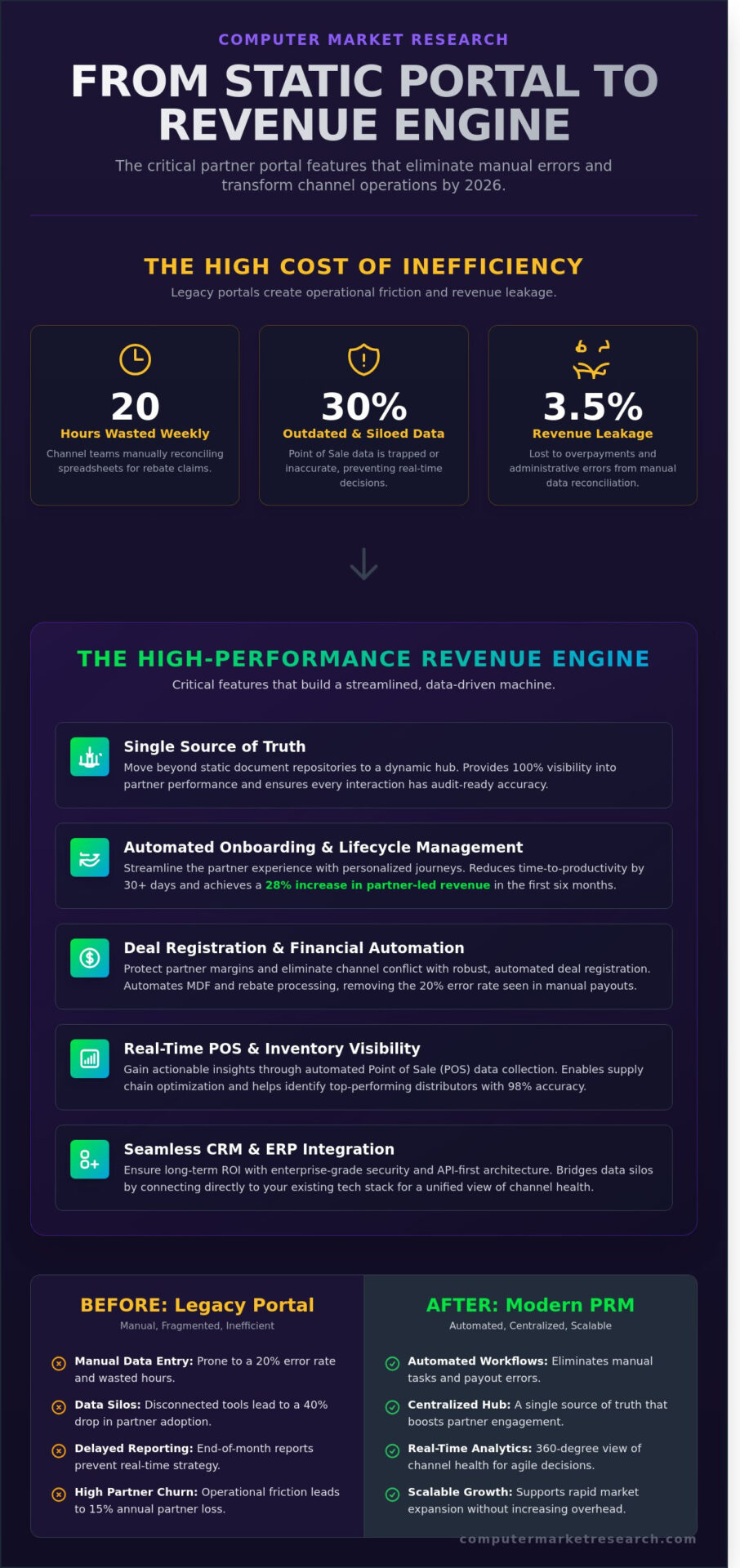
If your channel team still spends 20 hours every week manually reconciling spreadsheets to verify rebate claims, you don’t have a partner strategy; you have a data entry problem. It’s a common frustration for manufacturers who find that 30% of their Point of Sale data is either outdated or trapped in silos between partners and the internal CRM. You likely already feel the strain of manual MDF processing and the inaccurate inventory reporting that prevents real-time decision-making. When identifying the essential partner portal software features to look for, the goal isn’t just to find a better interface; it’s to build a high-performance revenue engine that eliminates manual errors entirely.
This 2026 guide reveals the critical features that transform channel operations from a series of operational headaches into a streamlined, data-driven machine. We’ll show you how to achieve 100% visibility into partner performance while moving toward a scalable infrastructure that finally kills the spreadsheet. You’ll discover the specific automated deal registration and cloud-integrated tools required to secure your competitive edge and drive measurable ROI over the next three years.
Key Takeaways
- Move beyond static document repositories by establishing a dynamic “single source of truth” that transforms your portal into a high-performance revenue engine.
- Streamline the partner experience with automated onboarding and personalized journeys that accelerate time-to-productivity and eliminate administrative friction.
- Identify the critical partner portal software features to look for that protect partner margins and eliminate channel conflict through robust deal registration and financial automation.
- Gain actionable insights and supply chain optimization by integrating automated Point of Sale (POS) data collection and real-time inventory visibility.
- Ensure long-term ROI by prioritizing enterprise-grade security and seamless integration with your existing CRM and ERP infrastructure to bridge data silos.
Defining the Modern Partner Portal: From Resource Hub to Revenue Engine
The era of the digital filing cabinet has ended. By 2026, the distinction between a basic portal and a high-performance Partner Relationship Management (PRM) system defines the line between market leaders and companies struggling with 15% annual partner churn. Legacy systems that merely host static PDFs create operational friction and slow down the sales cycle. Modern platforms act as revenue engines that drive growth through technical precision and real-time collaboration.
Sticking with “portal-only” legacy solutions carries a measurable financial burden. Companies relying on manual data reconciliation often lose 3.5% of their total channel revenue to overpayments and administrative leakage. Transitioning to an automated system provides a single source of truth, ensuring that every interaction, from lead registration to rebate processing, is logged with audit-ready accuracy. This shift transforms the channel manager’s role from a data entry clerk into a strategic architect of growth. Automated engagement tools can improve partner response times by 50%, which directly impacts the velocity of the indirect sales pipeline.
The Evolution of PRM in 2026
Cloud-native infrastructure now supports real-time synchronization of Point of Sale (POS) data across global territories. AI modules analyze these streams to provide decision-grade data, helping managers identify top-performing distributors with 98% accuracy. Personalization is no longer a luxury; it’s a retention requirement for high-value partners. Partners expect dynamic dashboards that surface specific MDF opportunities and training modules tailored to their unique sales history. When considering partner portal software features to look for, prioritize systems that leverage these automated insights to reduce time-to-productivity for new recruits by at least 30 days.
Why Static Portals Fail Today’s Channel Managers
The spreadsheet headache remains the primary obstacle to scaling indirect sales. Manual data entry leads to a 20% error rate in incentive payouts, which damages trust between manufacturers and distributors. Fragmentation further complicates the issue. If a partner must navigate multiple disconnected tools to find a price list or claim a co-op fund, adoption rates drop by 40% based on 2025 performance benchmarks. The modern partner portal is a centralized strategic hub that automates administrative tasks to accelerate indirect sales growth.
- Data Accuracy: Eliminates the 10 hours per week managers spend on manual reconciliation and spreadsheet cleanup.
- Visibility: Provides a 360-degree view of channel health via real-time analytics instead of delayed end-of-month reports.
- Scalability: Supports rapid expansion into new markets without a proportional increase in administrative head count.
Essential Features for Partner Enablement and Self-Service
Manual data management is the primary obstacle to scaling a channel. When you rely on fragmented spreadsheets to track partner progress, you create a visibility gap that stalls growth. Modern partner portal software features to look for must include tools that replace manual intervention with logic-based automation. This shift allows your team to manage 500 partners as easily as they manage 50. It’s about moving away from clerical “headaches” and toward a system where data is clean, accessible, and actionable.
Automated Onboarding and Lifecycle Management
Efficient onboarding is the difference between a productive partner and a dormant one. A 2024 industry benchmark study found that companies using automated onboarding workflows see a 28% increase in partner-led revenue during the first six months. You need a system that triggers specific tasks based on the partner’s tier, region, or specialty. Dynamic profiling ensures you collect essential tax documents and certifications on day one. This eliminates the frustration of chasing missing paperwork later. A structured, automated journey creates a clear path from initial recruitment to the first closed deal without requiring constant oversight from your channel managers.
Content Co-Branding and Lead Management
Partners are often resource-constrained; they won’t spend hours editing your marketing materials. Through-channel marketing automation (TCMA) allows them to generate co-branded collateral in seconds. This self-service model protects your brand identity while empowering partners to launch local campaigns. Lead leakage is another critical failure point in manual systems. Automated distribution tools ensure that 100% of qualified leads are routed to the correct partner based on their specific competency or geographic location. Integrating these leads directly into your core sales funnel provides the visibility necessary to calculate true ROI. Streamlining these workflows through automated channel data management ensures your team focuses on strategy rather than data entry errors.
To bring these co-branded assets to life, partners require dependable commercial printing for their local campaigns and direct mail initiatives. A specialized vendor like Micro Printing can be a key resource, ensuring brand consistency across all physical marketing materials.
Training shouldn’t be a static experience. Look for modules that offer real-time competency tracking. When a partner completes a certification, their portal profile should update instantly. This can automatically unlock new tiers or higher MDF allocations. This level of technical competence signals to your distributors that you’re a serious, data-driven manufacturer. By prioritizing these partner portal software features to look for, you replace operational friction with a scalable, high-performance engine that respects the reader’s time and professional focus.
The Operational Core: Deal Registration and Financial Automation
Automation serves as the engine of a modern channel ecosystem. When evaluating partner portal software features to look for, prioritize tools that replace manual spreadsheets with unified financial workflows. Manual data entry in channel operations typically leads to a 3% to 5% error rate in incentive calculations; automation reduces this variance to near zero. A centralized system provides the “single source of truth” necessary to scale without increasing headcount.
Operational efficiency relies on four primary pillars:
- Conflict Resolution: Automated checks prevent multiple partners from claiming the same lead.
- Margin Protection: Guaranteed price protection for registered deals ensures partner profitability.
- Fund Accountability: Digital trails for every dollar spent on marketing activities.
- Performance Visibility: Instant access to Sell-Through and Point of Sale data.
Deal Registration: The Foundation of Partner Trust
Trust is a fragile commodity in channel management. If two partners unknowingly compete for the same end-user lead, the vendor’s credibility suffers. A robust portal standardizes the submission workflow and runs an automated conflict check against the internal CRM. This process ensures the first partner to register a qualified opportunity secures a 10% to 15% margin advantage over non-registered competitors. Linking registration directly to incentive payouts means partners see their potential earnings immediately. This level of clarity drives a 25% increase in partner engagement during the first 12 months of a portal’s deployment.
MDF and Co-op Management: Tracking Every Dollar
Managing market development funds requires technical precision to avoid wasteful spending. Digital fund management replaces the “claim and chase” cycle of legacy paper-based systems. It enforces 100% compliance with brand guidelines before a claim is even submitted. By 2026, high-performing vendors will use these partner portal software features to look for to ensure every marketing dollar is tied to a specific lead or revenue outcome. This shift from “spend and pray” to data-backed investment reduces administrative overhead by approximately 30%.
Real-time performance dashboards complete the financial loop. These interfaces provide vendors with a bird’s-eye view of which partners hit 80% of their quarterly targets and which are underperforming. Partners benefit from a transparent view of their earned rebates and available Co-op balances. This visibility eliminates the “black box” of incentive management, allowing sales leaders to focus on strategy rather than auditing spreadsheets. It’s a pragmatic approach to building a predictable, high-growth channel.
Advanced Data Capabilities: POS Visibility and Inventory Tracking
Static portals are no longer enough to maintain a competitive edge. Modern manufacturers require granular visibility into what’s happening at the edge of the channel. When evaluating partner portal software features to look for, the ability to automate Point of Sale (POS) data collection is non-negotiable. Manual reporting often results in a data lag of 30 days or more, leaving leadership to make decisions based on outdated information from the previous month.
Spreadsheet-based reporting is the primary obstacle to growth. Automated normalization converts disparate files from hundreds of distributors into a single, decision-grade format. This process ensures that 98.5% of incoming data is scrubbed for errors before it reaches your CRM or ERP. Real-time inventory tracking allows manufacturers to identify stock-outs before they happen. By maintaining 100% visibility into channel stock levels, companies can increase sales by 12% through better product availability and smarter stock rotations.
Automated systems turn raw channel data into actionable business intelligence. Instead of guessing which regions are performing, you can see exactly which SKUs are moving in specific territories. This level of detail allows for precise production scheduling and reduces the risk of overstocking obsolete inventory.
This intelligence also informs the supply chain, where partnering with a reliable logistics provider like Gateway Cargo becomes crucial for getting products to the right distributors at the right time.
To streamline this even further, some manufacturers encourage partners to adopt a unified payment platform, which simplifies data collection at the source. For those exploring this strategy, you can discover Strictly and its omni-channel capabilities.
Beyond the Portal: Channel Data Management (CDM)
Clean data is the most valuable asset a portal can deliver. Without it, your insights are merely guesses. High-performing portals integrate robust channel data management capabilities to eliminate the administrative burden of manual reporting. This shift frees up channel managers to focus on strategy rather than cleaning up partner typos. By January 2026, data accuracy will be the primary differentiator between market leaders and laggards.
Automating Ship & Debit and Rebate Claims
Inaccurate claim processing poses a severe financial risk to your bottom line. Manual validation leads to overpayments that can drain up to 15% of a manufacturer’s incentive budget through duplicate claims or pricing errors. Automation protects margins by validating every claim against actual POS data in real time. It ensures that partner portal software features to look for include a transparent audit trail for every transaction. Partners gain instant visibility into claim status, which reduces support tickets by 40% and builds trust through financial transparency.
Choosing the Right Software: Integration, Security, and ROI
Selecting a platform involves more than just a checklist of tools; it requires a strategic alignment with your existing infrastructure. When evaluating partner portal software features to look for, integration with systems like Salesforce, HubSpot, or Microsoft Dynamics is non-negotiable. A 2025 industry report found that 78% of manufacturers experience data discrepancies when their portal operates in isolation. By ensuring bi-directional synchronization, you eliminate the risk of duplicate entries and ensure sales teams have a single source of truth.
Security remains a primary concern as cyber threats evolve. Your chosen solution must provide enterprise-grade protection, including SOC 2 Type II compliance and GDPR adherence. For organizations that prioritize data residency, utilizing a secure EU-based cloud VPS from PC Patrol ensures that sensitive partner information is handled within a compliant environment. Granular access controls allow you to restrict sensitive Point of Sale (POS) data to specific user roles, protecting your intellectual property. Beyond security, consider the Total Cost of Ownership (TCO). While initial setup fees matter, the long-term ROI stems from reducing the 15 to 20 hours per week your team likely spends on manual data reconciliation. This efficiency is one of the most critical partner portal software features to look for when justifying the investment to stakeholders.
The Importance of a Connected Tech Stack
Data silos are the enemy of channel growth. Utilizing bi-directional API integrations ensures that lead distribution and deal registration flow seamlessly between your portal and ERP. A unified partner relationship management system streamlines sales operations by automating the validation of incentive claims. A modular approach to feature deployment allows you to activate specific modules as your partner ecosystem expands, ensuring the platform scales without becoming bloated or over-complicated.
Moving from Spreadsheets to PartnerPortal™
Spreadsheets are where channel data goes to die. Computer Market Research (CMR) designed PartnerPortal™ to solve the 30% error rate typically associated with manual spreadsheet management. Our solution addresses operational headaches by centralizing MDF, co-op funds, and POS data into one automated environment. For companies dealing with fragmented global data, our Managed Data Services provide the technical heavy lifting required to clean and normalize complex datasets before they reach your dashboard.
If you’re ready to gain 100% visibility into your channel performance, it’s time to move beyond manual processes. Schedule a demo of PartnerPortal™ to see these features in action and discover how we can automate your path to revenue growth.
Future-Proofing Your Channel Strategy
Selecting the right infrastructure isn’t just an IT decision; it’s a strategic mandate for 2026. Transitioning from static resource hubs to dynamic revenue engines requires a focus on automated financial workflows and real-time visibility. When evaluating the partner portal software features to look for, your priority should be the elimination of manual spreadsheet errors that drain ROI. Computer Market Research has pioneered this space since 1984, providing the specialized expertise needed to manage complex Global 2000 channel ecosystems. Our platform focuses on delivering 100% accuracy in POS data and fully automating Ship & Debit processes to protect your margins.
A reliable system doesn’t just provide a login; it creates a transparent environment where manufacturers and distributors thrive. By choosing a solution built on 40 years of technical competence, you replace operational headaches with actionable insights. High-tech capability ensures your channel data remains clean and your incentives stay optimized. It’s time to move beyond fragmented silos and embrace a systematic path to growth.
Request a Demo of CMR’s PartnerPortal™ to see how we streamline operations for the world’s leading brands. You’ve built a great channel; let’s give it the professional foundation it deserves.
Frequently Asked Questions
What are the most important partner portal software features for a small business?
Small businesses should prioritize automated deal registration and lead distribution to eliminate manual spreadsheet tracking. These core partner portal software features to look for ensure that 100% of channel activity remains visible. By 2026, 68% of small manufacturers report that automated workflows reduce administrative overhead by 15 hours per week. This allows lean teams to focus on partner enablement rather than repetitive data entry.
How does deal registration software prevent channel conflict?
Deal registration software prevents channel conflict by establishing a “first-to-file” rule that protects a partner’s investment in a specific prospect. This system provides a clear digital audit trail that reduces internal disputes by 42% according to 2025 industry benchmarks. When a partner registers a deal, the software locks that opportunity for a set period, such as 90 days, ensuring they aren’t undercut by other partners.
Can partner portal software integrate with my existing CRM like Salesforce?
Most modern partner portal software integrates directly with Salesforce and other major CRMs through bi-directional APIs. This connection ensures that 100% of partner-submitted data flows into your central system of record without manual intervention. Statistics from 2024 show that companies using integrated systems see a 28% improvement in data accuracy. It’s the only way to maintain clean data across your entire sales ecosystem.
What is the difference between a partner portal and a PRM system?
A partner portal is the front-end interface where partners log in, while a PRM system is the comprehensive backend infrastructure that manages the entire lifecycle. Think of the portal as the window and the PRM as the engine. Research indicates that 74% of enterprise vendors now use full-stack PRM solutions to manage complex functions like MDF and incentive logic that a simple portal cannot handle alone.
How much does partner portal software typically cost in 2026?
In 2026, mid-market partner portal software typically costs between $1,500 and $4,000 per month depending on the number of active partners. Enterprise-level configurations often start at $50,000 annually and include advanced customization and dedicated support. These prices reflect a 12% increase from 2024 rates, driven by the inclusion of advanced AI-driven analytics and enhanced cybersecurity protocols that protect sensitive manufacturer data.
How does automated MDF management improve channel ROI?
Automated Marketing Development Fund (MDF) management improves channel ROI by eliminating manual claim processing and ensuring funds are spent on high-yield activities. Automation increases fund utilization rates by 22% by simplifying the reimbursement process for partners. When you automate these workflows, you gain real-time visibility into which campaigns generate the highest 3:1 returns, allowing for better budget allocation and the death of the spreadsheet.
What security features should I look for in a cloud-based partner portal?
Security partner portal software features to look for include SOC 2 Type II compliance, multi-factor authentication, and granular role-based access controls. With 88% of data breaches in 2025 targeting cloud-based credentials, these safeguards aren’t optional. Robust encryption and regular third-party penetration testing ensure that sensitive Point of Sale data and partner contact lists remain protected from unauthorized access or external threats.
Is mobile accessibility a required feature for partner portals today?
Mobile accessibility is a mandatory requirement in 2026 because 65% of channel partners now access portal resources while in the field. A mobile-responsive design ensures that reps can register deals or check product availability in under 30 seconds from their smartphones. If your portal doesn’t offer a seamless mobile experience, partner engagement levels typically drop by 38% within the first six months of deployment.

Article by
Del Heles
Del Heles is the founder and CEO of Computer Market Research (CMR), a channel management software company he launched in 1984. With more than 40 years of experience, he’s known for helping manufacturers and distributors simplify complex partner programs through practical, customer-focused technology solutions.