

Every time a channel manager relies on manual spreadsheets to calculate tiered rebate structures for partners, they risk losing between 3% and 10% of their total incentive budget to overpayments and administrative friction. It’s a common reality where data silos and fragmented POS files transform a strategic growth tool into a source of constant dispute. You likely agree that manual data entry is the primary obstacle to scaling your channel, especially when inconsistent reporting from diverse distributors makes it impossible to see who’s actually performing in real time.
This principle of optimizing operations extends to all parts of a partner’s business. For instance, many distributors also streamline their vehicle logistics through specialized B2B providers like Alliance Fleet Solutions to reduce costs and improve efficiency, making them stronger partners overall.
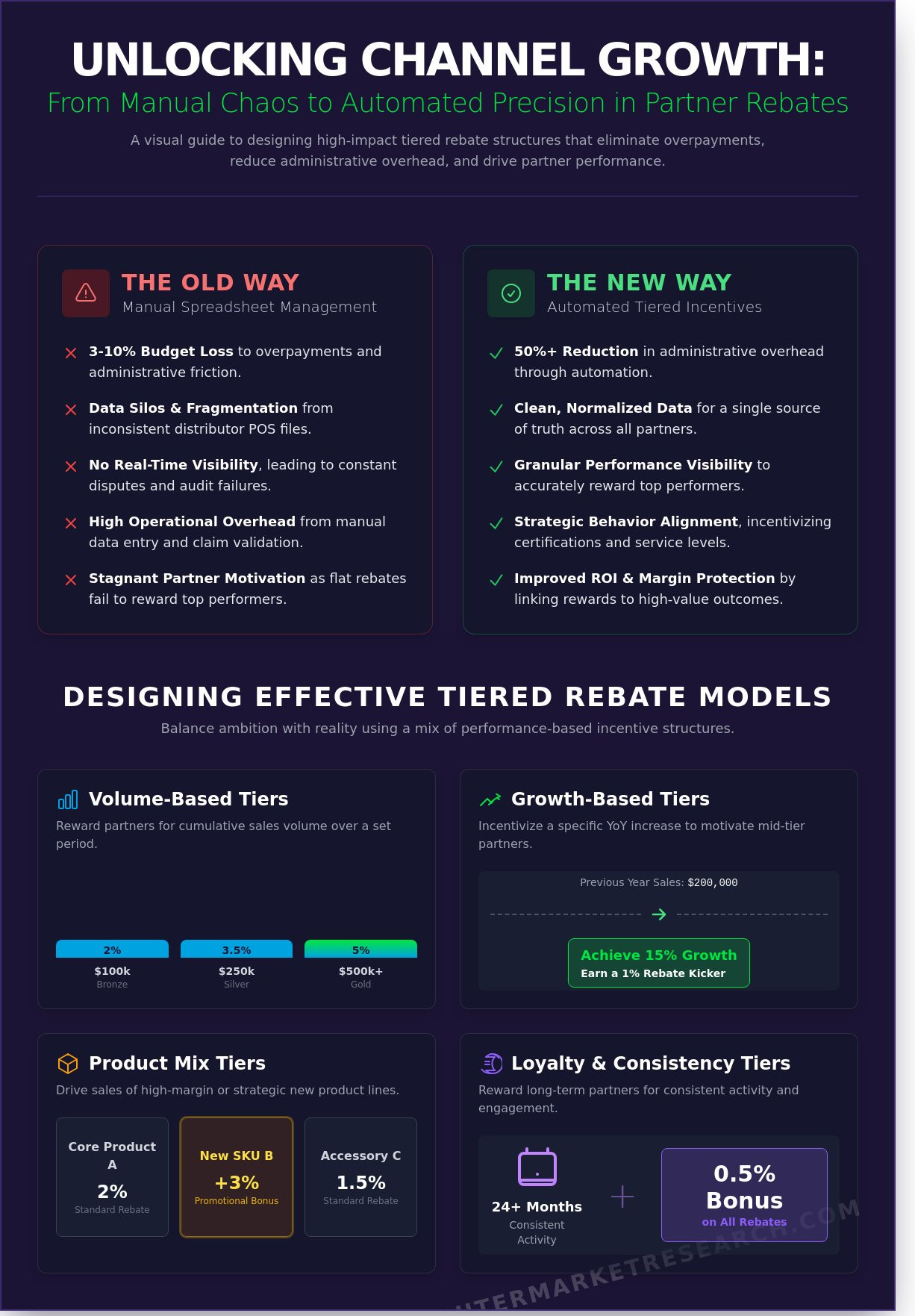
This guide provides a clear path out of these operational headaches by showing you how to implement a scalable, automated incentive framework. You’ll learn to design tiered rebate structures for partners that drive loyalty and ensure every dollar spent is backed by clean, normalized data. Our goal is to help you reduce administrative overhead by 50% or more while gaining the granular visibility needed to reward your top performers accurately. We’ll examine the technical steps to normalize diverse distributor data and build a system that replaces spreadsheet errors with automated, reliable precision.
Key Takeaways
- Understand why shifting from flat discounts to performance-based incentives is essential for aligning partner behavior with 2026 corporate growth targets.
- Learn to design high-impact tiered rebate structures for partners by leveraging volume-based thresholds and growth triggers that reward consistent performance.
- Identify the hidden operational costs of manual spreadsheet management and how to eliminate the risks of overpayments and audit failures.
- Discover best practices for data normalization and establishing clear rules of engagement to prevent channel conflict in complex, multi-partner environments.
- See how automating the incentive lifecycle with a cloud-based platform integrates POS data and claims to streamline management and improve ROI.
Why Tiered Rebate Structures are Essential for Channel Growth in 2026
The landscape of global trade has shifted. By 2026, the era of the flat discount is over. Manufacturers now prioritize precision over volume. Automated tiered rebate structures for partners represent a move toward performance-based incentives that go beyond simple transaction counts. This evolution allows brands to reward specific behaviors, such as completing technical certifications or maintaining high service levels, which directly impacts the manufacturer’s bottom line.
It’s about visibility. When a manufacturer aligns partner behavior with corporate goals, they stop guessing and start growing. Tiered structures provide a clear roadmap for the partner ecosystem. Instead of a static relationship, partners enter a dynamic environment where their effort is directly proportional to their reward. This shift moves the focus from “how much was sold” to “how much value was added.”
The psychological impact of these tiers can’t be overstated. Creating a “path to gold” motivates mid-tier partners to scale. If a reseller is only 12% away from a higher rebate bracket, their sales team will naturally prioritize your products to hit that threshold. This creates a self-sustaining cycle of growth that manual processes simply can’t replicate.
The Problem with Static Rebate Models
Static models fail because they treat every partner the same. Internal data from 2025 indicates that manufacturers using flat rebates often over-pay low-performing partners by as much as 18% while failing to motivate the mid-tier. This leads to stagnant revenue. If your incentive structure doesn’t distinguish between a high-value distributor and a casual reseller, you’re leaking margin. It’s the “death of the spreadsheet” era; manual tracking can’t handle the nuances of modern channel growth without creating operational headaches.
Defining the Strategic Value of Tiers
Tiers allow for precise ecosystem segmentation based on real-time Point of Sale data. You can protect your margins on high-volume, low-effort products while offering aggressive incentives for strategic initiatives. Aligning tiered rebate structures for partners with Market Development Funds (MDF) ensures that every dollar spent is an investment in future capability. This creates a streamlined, data-driven approach that provides visibility into exactly which partners are driving ROI. Key benefits include:
- Margin Protection: Ensuring high-tier rewards are only triggered by high-value outcomes.
- Behavioral Alignment: Incentivizing training and certifications that build long-term brand loyalty.
- Operational Efficiency: Using automated systems to eliminate manual claim errors and data silos.
By moving to a tiered model, manufacturers gain the actionable insights needed to refine their channel strategy. It’s the only logical step for businesses looking to scale their indirect sales without increasing administrative overhead.
Designing Effective Tiered Rebate Models: Volume, Growth, and Mix
Strategic incentive programs rely on precision. If a manufacturer sets a volume threshold at $500,000 when the average partner spend is only $200,000, the program fails before it starts. Effective tiered rebate structures for partners balance ambition with reality. Volume-based tiers reward cumulative spend, while growth-based incentives target a specific 10% to 15% year-over-year increase. Product mix rebates are equally critical; they push high-margin SKUs or new-to-market products that might otherwise be ignored. Loyalty tiers add another layer of stability, offering a 0.5% bonus for partners who maintain 24 months of consistent activity.
Setting Thresholds and Reward Rates
Data from the previous 12 to 24 months should dictate your tiers. A “cliff” rebate pays out only when a specific milestone is hit, such as a flat $5,000 reward at $100,000 in sales. Conversely, a sliding scale provides incremental rewards, like 2% for the first $50,000 and 3% for everything above that. Most successful programs cap rewards at a specific ceiling to protect margins. This prevents a scenario where a sudden 40% spike in partner volume creates an unsustainable financial liability. Using historical performance ensures that 70% of your partners can reach at least the first tier, maintaining engagement across the channel.
Integrating Ship & Debit into Tiered Models
Managing specialized pricing requests requires a centralized system to prevent “double-dipping.” This logic ensures that a distributor doesn’t claim a Ship & Debit credit for a discounted sale while simultaneously counting that same unit toward a volume rebate. Automated platforms solve this by subtracting Ship & Debit volume from the rebate-eligible total in real-time. Clear visibility into Point of Sale data ensures that every claim is reconciled against the actual price paid. This level of automation removes the manual errors that plague 85% of spreadsheet-based incentive programs. When your tiered rebate structures for partners are integrated with special pricing agreements, you eliminate the friction that often stalls channel growth.
The Operational Burden: Manual Spreadsheets vs. Automated Rebate Management
Relying on Excel to manage tiered rebate structures for partners isn’t just inefficient; it’s a financial liability. As we approach 2026, the industry is witnessing the definitive death of the spreadsheet in channel sales. Manual tracking carries hidden costs that often erode 3% to 5% of a program’s total value through overpayments and administrative overhead. When rewards are delayed by manual processing, partner trust evaporates. This friction turns a strategic incentive into a source of frustration, stifling the very growth the program was designed to create.
The Risks of Manual Calculation
Manual Point of Sale (POS) data aggregation is where accuracy goes to die. Market research suggests that 88% of complex spreadsheets contain significant human errors. These mistakes lead to the headache of overpayments that are nearly impossible to claw back. A channel manager might spend 15 hours every week simply validating claims and correcting data entry mismatches. Beyond the labor drain, shared incentive files lack robust version control. This creates security gaps and leads to audit failures when the “final” version of a rebate file doesn’t match the actual disbursements recorded in the ERP system.
The Benefits of Real-Time Automation
Automation transforms the manufacturer-distributor relationship by replacing guesswork with precision. Transitioning to cloud-based logic reduces rebate processing cycles from 45 days to under 10 minutes. This speed ensures that partners feel the direct impact of their performance immediately. High-performing distributors gain access to a self-service portal where they can track their progress toward the next level in your tiered rebate structures for partners. This visibility drives a 20% increase in incremental sales as partners push to hit the next threshold before the quarter ends.
- Eliminate Data Silos: Automated systems integrate directly with POS data streams to provide a single source of truth.
- Audit Readiness: Every calculation is logged with a digital paper trail, ensuring 100% compliance with financial regulations.
- Actionable Insights: Sales leadership gains instant visibility into channel ROI, allowing for data-backed adjustments to incentive tiers.
The shift to automation isn’t a luxury; it’s a requirement for scale. Organizations that automate their rebate management see a 25% reduction in administrative costs within the first year. By removing the manual burden, you free your team to focus on partner strategy rather than data entry. This transition ensures your channel remains competitive, transparent, and profitable well into the future.
Best Practices for Implementing Tiered Incentives Without Channel Conflict
Channel conflict often stems from ambiguity. When implementing tiered rebate structures for partners, clarity serves as your strongest defense against friction. Friction usually occurs when partners feel they’re competing against the manufacturer or each other for the same margin. To prevent this, you must establish “Rules of Engagement” that clearly define account ownership and lead protection. A 2023 industry benchmark report indicated that programs with documented rules see a 28% reduction in deal friction. Utilizing deal registration is a critical component here; it protects the partner’s investment in high-tier accounts by ensuring that a partner who spends six months nurturing a lead isn’t undercut by a late-arriving competitor at the finish line.
Communication is equally vital. Manufacturers must never change tier requirements mid-quarter. This practice, often called “moving the goalposts,” destroys the trust required for long-term loyalty. Provide at least 30 to 60 days of notice before any structural shifts to allow partners to adjust their sales strategies. Consistent, automated updates prevent the “end-of-quarter surprise” that leads to heated disputes and administrative headaches.
Data Normalization and POS Accuracy
Clean data is the foundation of any successful incentive program. Distributors often report the same product under five different SKU names, creating “dirty” data that leads to incorrect payouts. Manual data entry is a primary obstacle to growth; it’s estimated that 15% of all manual incentive payouts contain errors. Automated systems solve this by mapping disparate entries to a single master product list. This creates one source of truth for every calculation, ensuring that tiered rebate structures for partners are applied accurately across every region and distributor.
Managing Partner Expectations and Disputes
Transparency is non-negotiable for maintaining partner morale. Your portal should provide a visible, real-time progress bar for tier attainment so partners know exactly where they stand. If a partner believes they’ve earned a rebate that hasn’t appeared, they shouldn’t have to wait for a series of emails. Automating the dispute resolution process within the portal allows partners to flag discrepancies immediately. A digital audit trail for every claim reduces the average dispute resolution time from 14 days to less than 48 hours. This efficiency proves you value their time and their contribution to your bottom line.
Stop losing time to manual data cleanup and start scaling your program. Automate your channel data management to ensure accuracy and eliminate partner conflict.
Streamlining Your Partner Incentive Programs with CMR PartnerPortal™
Managing tiered rebate structures for partners manually is a recipe for operational friction. Many channel managers lose 15 to 20 hours per week simply reconciling disparate spreadsheets and chasing missing data. CMR PartnerPortal™ eliminates this burden by automating the entire incentive lifecycle from data ingestion to payout. Our cloud-based platform ingests Point of Sale (POS) data, inventory levels, and claims into a unified environment. This ensures that every rebate calculation is based on verified, real-time activity rather than manual guesswork. You can customize tier logic to reward specific behaviors; whether that’s volume-based growth or penetration into new market segments.
The platform acts as a single source of truth for both the manufacturer and the distributor. When data flows seamlessly into a centralized hub, disputes over payouts vanish. If a partner reaches a new volume threshold, the system triggers the appropriate rebate automatically. This level of precision allows your team to focus on strategic channel growth instead of administrative damage control. It’s the difference between reactive firefighting and proactive channel management.
The CMR Advantage: Clean Data, Clear Results
Data integrity is the foundation of any successful incentive program. Our proprietary cleansing and normalization process scrubs incoming data from thousands of global distributors, correcting errors in SKU names and addresses automatically. We integrate complex Ship & Debit and Co-op fund workflows to provide a 360-degree view of partner performance. One global tech manufacturer recently reported a 60% reduction in claim processing time after implementing our automated tiered rebate structures for partners. By achieving 99% data accuracy, they eliminated the overpayments that often plague manual systems.
Ready to Scale Your Channel?
Transitioning to an automated system is a structured, low-risk process. Our functional modules are designed for rapid onboarding; most organizations move from manual tracking to a live environment within 45 to 60 days. If you’re tired of the “spreadsheet nightmare,” it’s time to see how visibility drives ROI. You can request a custom demo of our Rebates & Incentives tool to see your specific data challenges solved in a live environment. Optimize your partner incentives today with CMR and build a scalable foundation for your channel’s future.
Future-Proof Your Channel Strategy for 2026
Transitioning to sophisticated tiered rebate structures for partners is no longer a luxury; it’s a requirement for organizations targeting Global 2000 status. Success hinges on shifting from static volume rewards to dynamic growth and product-mix models that incentivize specific behaviors. If your team still relies on manual spreadsheets, you’re likely battling the data silos that stall momentum and erode trust between manufacturers and distributors. These operational hurdles prevent you from scaling effectively in a competitive market.
Computer Market Research has led the “death of the spreadsheet” movement since our founding in 1984. With over 40 years of channel expertise, we provide a cloud-based platform that normalizes complex POS data for Fortune 500 leaders. Our technology ensures every incentive is calculated with absolute precision, allowing you to reclaim hours lost to administrative audits. You’ll finally replace guesswork with actionable insights and verifiable ROI.
Automate Your Rebate Structures with CMR PartnerPortal™
Your path to a more efficient, high-performing channel starts with better data and smarter automation. We’re ready to help you build a more profitable future today.
Frequently Asked Questions
What are the most common types of tiered rebate structures for partners?
The most common tiered rebate structures for partners include volume-based, value-based, and product-mix incentives. Volume-based tiers trigger rewards when a partner hits specific unit counts, such as a 3% rebate at 1,000 units. Value-based structures focus on gross revenue targets, often starting at $50,000 per quarter. Product-mix tiers reward partners for selling specific high-margin SKUs, ensuring a balanced portfolio that aligns with manufacturer goals.
How do I calculate the ROI of a tiered partner incentive program?
You calculate ROI by subtracting the total program costs from the net profit generated by incremental sales, then dividing by the program costs. If an automated incentive program costs $10,000 and generates $150,000 in new revenue with a 20% margin, your ROI is 200%. Accurate ROI tracking requires clean Point of Sale (POS) data to ensure you aren’t paying for sales that would’ve happened without the incentive.
Can I integrate tiered rebates with my existing CRM or ERP system?
You can integrate tiered rebate structures for partners with existing CRM and ERP systems like Salesforce or SAP through secure API connections. Automated platforms pull transaction data directly from these systems to calculate payouts without manual data entry. This integration eliminates the 10% error rate typically found in manual spreadsheets. It ensures that partner tiers reflect real-time sales performance across your entire tech stack.
How do I prevent channel conflict when using tiered rebate models?
Prevent channel conflict by implementing deal registration protocols and clear eligibility rules for each tier. Providing a 90-day protection window for registered leads ensures that partners aren’t competing for the same end-user. You should also set specific tier requirements that reward value-added services rather than just price. This strategy protects margins and reduces internal competition among your 200 plus distributor network.
What is the difference between a volume rebate and a growth incentive?
Volume rebates reward the total quantity of products sold, while growth incentives reward partners for exceeding their previous year’s performance. For example, a volume rebate might pay 2% on all sales once a partner hits 5,000 units. In contrast, a growth incentive pays a bonus only on the amount that exceeds last year’s $100,000 baseline. Growth incentives are particularly effective for revitalizing stagnant accounts and driving new business.
How does data normalization affect partner rebate accuracy?
Data normalization cleanses and standardizes messy POS files, ensuring that different naming conventions are recognized as the same entity. Without this process, your rebate calculations will be plagued by duplicates and missed thresholds. Standardizing data typically reduces overpayments by 40% and ensures every partner is placed in the correct tier. It’s the only way to maintain a single source of truth for incentive management.
Is it possible to automate Ship & Debit claims within a tiered structure?
It’s entirely possible to automate Ship & Debit claims by syncing them with your tiered rebate engine. Automated systems validate claims against authorized price lists and inventory levels within 24 hours of submission. This replaces manual verification processes that often take weeks. By automating these claims, manufacturers maintain 99.9% accuracy in their financial accruals and keep distributor cash flow consistent and predictable.
How often should I review and adjust my partner tier thresholds?
You should review your partner tier thresholds every 180 days to ensure they remain competitive and attainable. Market conditions change rapidly, and a threshold set in January might be obsolete by July. Analyzing performance data every six months allows you to adjust tiers by 5% to 10% based on actual partner output. Frequent reviews prevent your program from becoming too easy or discouragingly difficult for your top-performing distributors.

Article by
Del Heles
Del Heles is the founder and CEO of Computer Market Research (CMR), a channel management software company he launched in 1984. With more than 40 years of experience, he’s known for helping manufacturers and distributors simplify complex partner programs through practical, customer-focused technology solutions.