

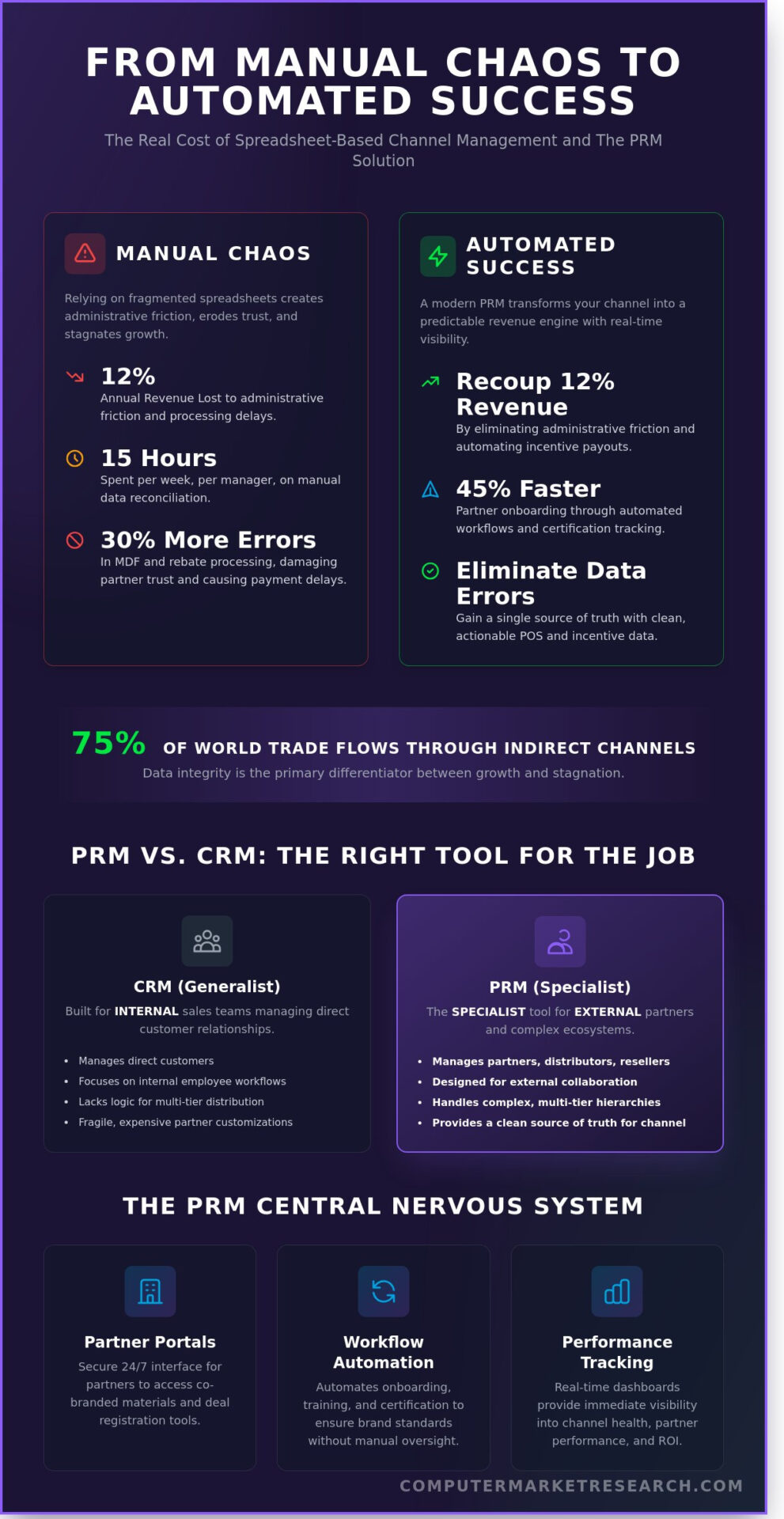
If your channel strategy still relies on manual data entry, you’re likely losing 12% of your annual revenue to administrative friction and processing delays. You know that managing a growing network of distributors and resellers shouldn’t feel like a full-time job in forensic accounting, yet finding the right partner relationship management software remains a significant hurdle for many firms. Relying on fragmented spreadsheets leads to 30% more errors in MDF and rebate processing; this ultimately damages the hard-earned trust you’ve built with your partners. It’s a common frustration for business leaders who find themselves trapped in data silos rather than focusing on strategic expansion.
This principle of using specialized software extends to other regulated industries. For example, disability support providers in Australia use dedicated NDIS Management Software to navigate complex compliance and administrative tasks that a generic CRM can’t handle.
This 2026 buying guide will show you how to eliminate spreadsheet chaos and automate your indirect sales channel for good. We’ll explore how shifting to automated incentive management and real-time visibility can accelerate your partner onboarding by 45% while providing the clean, actionable POS data your leadership team requires. We’ll break down the essential features that turn a chaotic channel into a predictable revenue engine, ensuring your sales operations remain disciplined and your partner performance stays transparent. By the end of this guide, you’ll have a clear roadmap to replace manual headaches with a scalable system built for high-performance growth.
Key Takeaways
- Understand how the evolution from simple portals to automated ecosystem management transforms your indirect sales channel into a high-performance central nervous system.
- Identify the critical automation features necessary to eliminate manual data entry and finally move beyond the operational headaches of spreadsheet-based management.
- Discover why specialized partner relationship management software is the essential “specialist” tool for external relationships that a generalist CRM cannot replace.
- Learn a proven two-step implementation strategy for auditing data silos and defining partner tiers to ensure a seamless transition to an automated workflow.
- Gain insights into centralizing the entire channel lifecycle to secure actionable data visibility and drive measurable ROI across your distributor relationships.
What is Partner Relationship Management Software in 2026?
In 2026, partner relationship management software functions as the central nervous system for a company’s indirect sales channel. It’s no longer just a digital filing cabinet for marketing assets. Modern systems provide a unified environment where manufacturers and their global partners align on strategy, lead distribution, and incentive structures. To understand the foundation of these tools, it’s helpful to review the baseline definition of What is Partner Relationship Management (PRM) and how it supports collaborative business goals.
The shift from basic portals to automated ecosystem management is now a requirement for survival. By 2026, estimates suggest that 75% of world trade flows through indirect channels. This volume makes data integrity the primary differentiator between growth and stagnation. Manual errors in Point of Sale (POS) data or miscalculated Market Development Funds (MDF) create operational headaches that stall momentum. Automation isn’t just a luxury; it’s the only way to maintain a clean source of truth across thousands of global touchpoints.
To better understand how these systems function in a modern business environment, watch this detailed overview:
Relying on legacy processes creates what we call the “spreadsheet tax.” Research indicates that channel managers spend up to 15 hours per week manually reconciling data across disconnected files. This manual approach leads to a 10% average error rate in incentive payouts. These mistakes erode partner trust and drain resources that should be used for scaling. A dedicated partner relationship management software eliminates this tax by providing a single, automated platform for all channel activities.
The Core Components of a Modern PRM
- Partner Portals: These serve as the secure interface for external collaboration, giving partners 24/7 access to co-branded materials and deal registration tools.
- Workflow Automation: This technology handles the heavy lifting of onboarding, training, and certification. It ensures every partner meets brand standards without constant manual oversight.
- Performance Tracking: Real-time dashboards provide immediate visibility into channel health. You can see which regions are performing and which distributors need more support.
Why Traditional CRM Isn’t Enough for Partners
CRMs are built for internal sales teams. They don’t account for the unique needs of external stakeholders who operate outside your corporate firewall. Trying to “bolt on” a partner module to a standard CRM usually fails because it lacks the logic for multi-tier distribution models. A specialized PRM handles complex hierarchies where a manufacturer sells to a distributor who then sells to a reseller. This level of visibility is something a standard CRM simply cannot provide without expensive, fragile customizations that often break during updates.
Critical Features to Evaluate in Your PRM Buying Process
Selecting the right partner relationship management software requires a clear distinction between basic portal functionality and a robust engine for global growth. Your baseline requirements must include secure, multi-tenant access controls that protect sensitive intellectual property while allowing diverse partner tiers to collaborate. If a platform cannot scale to support a 20% annual increase in partner headcount, it becomes a bottleneck rather than an asset. By automating administrative processes, companies move away from “complicated” manual tasks and focus on “complex” strategic expansion.
Financial Management: MDF, Co-op, and Rebates
Manual fund management typically results in a 10% leakage rate due to overpayments or unverified claims. A professional PRM automates fund allocation and claim verification, ensuring every dollar spent on Marketing Development Funds (MDF) maps directly to a pre-approved activity. Real-time ROI tracking replaces the end-of-quarter scramble, providing immediate visibility into which partners drive the highest returns. Streamlining these payouts builds partner loyalty by ensuring they receive earned rebates within days, not months.
Sales Enablement: Deal Registration and Lead Management
Channel conflict destroys partner morale and erodes trust. Automated deal registration provides a definitive timestamp and ownership record, which prevents internal sales teams from poaching partner-sourced opportunities. Intelligent lead distribution doesn’t just pass names along; it assigns leads based on a partner’s 12-month conversion rate or specific technical certifications. This logic ensures that high-intent prospects land with the partners most equipped to close the sale, maximizing the value of every marketing-generated lead.
The Data Layer: POS and Inventory Visibility
Spreadsheets are where channel visibility goes to die. Modern partner relationship management software must include automated Point of Sale (POS) data collection to eliminate the 40-hour work weeks often wasted on manual data entry and reconciliation. Normalizing data from 50 or more disparate partner systems into a single source of truth allows manufacturers to see exact inventory levels across the globe. This level of clean channel data enables precise production planning and prevents costly stockouts. Relying on 30-day-old reports is a liability in a 2026 market that demands real-time agility.
PRM vs. CRM: Choosing the Right Sales Tech Stack
Your CRM is the engine for direct sales, but it’s not a Swiss Army knife. It’s built for internal visibility and managing employees you control. When you try to force external partners into an internal system, you create friction. Partner relationship management software acts as the specialized interface for your indirect channel. It handles the nuances of multi-tier distribution that a CRM simply isn’t configured to manage without expensive, fragile customizations.
IT leaders often ask if they can just build partner modules within their existing CRM. While possible, this path usually results in a 35% increase in technical debt over the first 24 months. Standard CRMs lack the native workflows for MDF management, co-op fund tracking, and automated deal registration. Choosing a dedicated PRM ensures you aren’t constantly patching a system that wasn’t designed for external collaboration. It’s the difference between a custom-built headache and a scalable solution.
The Interoperability Framework
Data silos stall growth. A robust PRM must integrate with your CRM to maintain a single source of truth. This connection ensures that when a partner registers a deal, internal teams see it instantly, preventing double-booking and channel conflict. The Forrester Wave for Partner Relationship Management highlights that high-performing stacks prioritize bi-directional data flow. This automation eliminates the manual spreadsheet updates that consume roughly 15 hours of a channel manager’s week. Reporting also becomes centralized. If your indirect sales data lives in a separate silo, you can’t accurately forecast revenue. A synchronized stack allows you to see the 40% of your pipeline that typically originates from partners alongside your direct sales efforts.
User Experience: Partner Adoption is Everything
Partners work with multiple vendors; they’ll naturally gravitate toward the one that’s easiest to do business with. If your portal feels like a complex, internal database, adoption will fail. Research shows that intuitive, branded portals can increase partner engagement by 50% compared to generic CRM logins. By streamlining the onboarding process and providing a clean interface, you remove the operational obstacles that prevent partners from closing deals. A specialized partner relationship management software solution provides the professional, white-labeled experience that builds long-term trust. It turns a clunky administrative task into a value-added tool for your distributors.
Implementation Strategy: From Manual Chaos to Automated Success
Transitioning to a robust partner relationship management software isn’t just a technical upgrade. It’s an operational overhaul. Current industry data indicates that 62% of manufacturers still manage channel data through fragmented spreadsheets. This manual approach leads to a 12% margin of error in incentive payouts and rebate processing. To move from chaos to a streamlined ecosystem, follow a structured five-step deployment.
- Audit: Identify every data silo within your organization. Most manufacturers find critical partner information buried in legacy Excel files, isolated email chains, and disconnected accounting software.
- Define: Map out your partner tiers and program requirements. 2025 benchmarks show that clearly defined tiering increases partner engagement by 24% within the first year.
- Select: Choose a vendor with specific B2B channel experience. A generalist CRM lacks the technical depth to handle complex Point of Sale (POS) data or multi-layered distribution models.
- Migrate: Integrate the platform with your existing ERP or CRM. This ensures real-time visibility and eliminates the need for double data entry.
- Launch: Execute a phased rollout. Start with a pilot group of 10% of your top-performing partners to refine the user experience before a global release.
Avoiding Common Implementation Pitfalls
The “garbage in, garbage out” rule is the primary cause for 48% of failed PRM deployments. If you migrate unverified or duplicate data, your automated reports will be inaccurate. Cleanse your database at least 90 days before the scheduled go-live date. Global portal rollouts typically require 6 to 8 months for full adoption. Don’t rush the pilot phase; accuracy is more valuable than speed.
Managed Data Services: A Strategic Alternative
Maintaining clean data is a relentless task. 38% of channel managers spend over 15 hours a week on manual data entry and reconciliation. Outsourcing these administrative burdens to managed data services ensures professional normalization and validation. This shift allows your internal team to focus on growth strategy while the service provider handles the technical minutiae of your partner relationship management software. Precision in data management directly correlates to a 18% increase in overall channel ROI.
Ready to eliminate the headache of manual spreadsheets? Automate your channel data management with a solution built for accuracy.
Why CMR PartnerPortal™ is the Specialist Choice for 2026
Computer Market Research provides more than just a software interface. With a 40-year legacy in channel data management, the company understands the intricate friction between manufacturers and distributors. PartnerPortal™ serves as a centralized hub, managing the entire channel lifecycle from recruitment to revenue realization. Unlike generalist tools, this partner relationship management software focuses on the technical precision required for complex financial transactions and incentive programs.
The platform utilizes a modular architecture, meaning you only deploy the specific tools your channel requires. This “data-obsessed” approach ensures that every module is built for accuracy. Key solutions include:
- Ship & Debit: Automates claim validation against Point of Sale (POS) data to prevent overpayments.
- MDF Management: Tracks fund allocation and ensures 100% audit compliance.
- Co-op Funds: Streamlines reimbursement cycles and reduces administrative overhead.
- Channel Data Management: Aggregates disparate data into a single, actionable source of truth.
The CMR difference lies in its web-based, cloud-ready infrastructure. It targets the “death of the spreadsheet” by replacing manual entry with automated workflows. This shift ensures that your sales operations team spends less time on data cleanup and more time on strategic growth.
Solving the “Headaches” of Global Enterprises
Global manufacturers often lose 3% to 5% of their channel revenue to overpayments and manual errors. One Fortune 500 client reduced their rebate processing time by 75% after migrating from legacy spreadsheets to CMR. The software provides real-time visibility into POS data and inventory levels. This transparency allows leaders to optimize channel ROI by identifying high-performing partners instantly. It effectively removes the friction that traditionally plagues global enterprise operations.
Getting Started with a Proven Solution
Transitioning to a new partner relationship management software shouldn’t disrupt your existing workflows. CMR offers a low-friction implementation process led by integration experts who understand B2B complexities. We tailor the portal branding to reflect your corporate identity, ensuring a professional experience for your partners. The system is built for stability and performance. To see how we can eliminate your operational silos, Schedule a demo of PartnerPortal™ today.
Future-Proof Your Channel Strategy for 2026
Scaling a global channel program in 2026 requires a decisive shift from manual spreadsheet reliance to automated precision. By prioritizing specialized modules for MDF and Rebates, organizations can eliminate the 15% to 20% error rates common in manual data entry. Transitioning to a dedicated sales tech stack ensures your team focuses on strategic growth rather than administrative recovery. Selecting the right partner relationship management software is about securing long-term operational stability and ensuring every dollar spent is tracked with total accuracy.
Since 1984, Computer Market Research has delivered 40 years of specialized channel expertise to Fortune 500 and Global 2000 companies. Our platform transforms fragmented POS data into actionable insights, providing the visibility needed to optimize incentive programs. You don’t have to settle for data silos or the operational headaches of legacy systems. Our cloud-ready infrastructure provides a clear path toward clean data and measurable ROI.
Automate Your Channel with CMR PartnerPortal™ and gain the clarity your program deserves. We’re ready to help you build a more efficient, data-driven future today.
Frequently Asked Questions
How does partner relationship management software differ from a CRM?
PRM software manages indirect sales through third parties, while a CRM focuses on direct customer relationships. While a CRM tracks your internal team’s interactions, partner relationship management software streamlines the complex 1-to-many relationships inherent in channel ecosystems. Since 75% of global trade flows through indirect channels, a specialized system is required to manage lead distribution and deal registration that a standard CRM cannot handle effectively.
Can PRM software integrate with popular CRM platforms like HubSpot?
What are the most important features to look for in a PRM system?
The most critical features include automated deal registration, Market Development Funds (MDF) management, and robust Point of Sale (POS) data reporting. You need a system that provides 100% visibility into partner performance through real-time dashboards. Advanced platforms in 2026 also prioritize cloud-based infrastructure and secure document sharing to replace insecure email attachments and fragmented spreadsheets that hinder operational growth.
How much does partner relationship management software typically cost?
Monthly subscription costs for partner relationship management software generally range from $500 to $5,000 depending on your partner volume and required modules. Most vendors also charge a one-time implementation fee between $3,000 and $15,000 to cover custom configuration and data migration. Investing in these automated tools removes the hidden costs of manual administration, which often exceeds $20,000 annually in lost productivity per channel manager.
How long does it take to implement a new partner portal?
A standard implementation for a partner portal takes between 60 and 90 days from the initial kickoff to the full launch. While basic setups with minimal customization can go live in 4 weeks, complex environments requiring deep ERP integration often need 12 weeks for testing. Allocating 30 days for user acceptance testing ensures your data is 100% accurate before your partners begin using the system.
Does PRM software help with MDF and Co-op fund management?
PRM systems automate the entire MDF lifecycle by tracking fund allocation, claim submissions, and reimbursement approvals in one central location. This automation reduces claim processing time by 75% and eliminates the $25 average cost associated with manual invoice verification. It provides an 100% audit-ready trail for every dollar spent, ensuring compliance with corporate financial policies and reducing the risk of overpayment.
How do I encourage my partners to actually use the new portal?
High adoption rates are achieved by providing immediate value, such as single sign-on (SSO) access and 24/7 availability of sales enablement tools. Portals that utilize SSO see 40% higher engagement rates because they remove login friction for busy resellers. If a partner can’t find a marketing asset or register a deal in 3 clicks, they’ll likely revert to manual emails and phone calls.
What is the ROI of implementing a PRM system?
Companies typically realize a 20% increase in channel-driven revenue within the first 12 months of deploying a PRM system. By automating administrative tasks, you save your channel managers approximately 15 hours per week, allowing them to focus on partner recruitment and strategic planning. This shift from manual data entry to proactive management drives a 3x return on investment by the end of the second year.

Article by
Del Heles
Del Heles is the founder and CEO of Computer Market Research (CMR), a channel management software company he launched in 1984. With more than 40 years of experience, he’s known for helping manufacturers and distributors simplify complex partner programs through practical, customer-focused technology solutions.