

Endless spreadsheets, disputed claims, and delayed payments-the administrative burden of managing ship and debit programs can often overshadow their strategic value. This cycle of manual data entry and validation is a primary source of costly errors and a significant drain on resources. The key to breaking this cycle lies in establishing a clear, systematic framework. Adopting the best practices for ship and debit claims is no longer a competitive advantage; it is a foundational requirement for maintaining profitability and robust channel health.
Ensuring these elements are professionally documented is a critical step. To produce clear, standardized agreements and program materials, many businesses partner with commercial printing and communications experts like Linemark to guarantee consistency and eliminate ambiguity from the start.
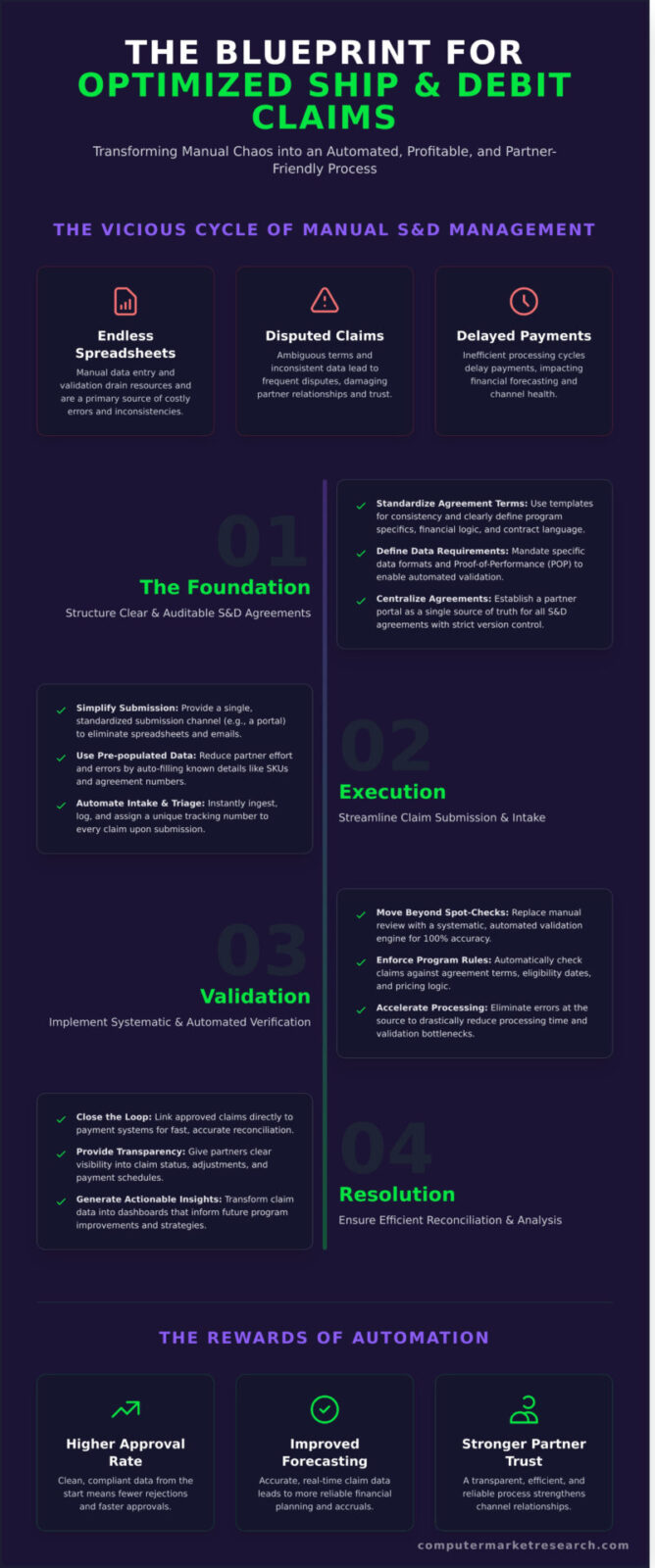
This comprehensive guide moves beyond theoretical advice to provide an actionable framework for streamlining your entire claims lifecycle. We will detail the precise steps to automate data validation, drastically reduce processing time, and transform your channel data into actionable insights. By implementing this framework, you can achieve a higher claim approval rate, improve financial forecasting, and ultimately strengthen the partner trust that is critical to your success.
Key Takeaways
- Proactive Agreement Structuring: Learn how to build clear, auditable S&D agreements that serve as the foundation for a dispute-free claims process.
- Streamlined Claim Intake: Discover how to optimize your submission process to reduce partner friction and improve the quality of initial claim data from the start.
- Systematic Validation: Move beyond manual spot-checks by implementing the best practices for ship and debit claims, focusing on automated validation to eliminate errors and accelerate processing.
- Data-Driven Resolution: Understand how to close the loop with efficient payment reconciliation and transform claim data into actionable insights for future program improvements.
The Foundation: Best Practices for Structuring S&D Agreements
Effective management of ship and debit (S&D) programs is not a reactive process; it is a discipline built on a solid, proactive foundation. Success begins long before the first claim is filed. By focusing on the creation of clear, auditable, and mutually understood agreements, manufacturers can prevent the majority of downstream disputes, payment delays, and claim rejections. This foundational step is critical among all best practices for ship and debit claims, as it establishes a single source of truth that governs the entire program lifecycle.
Standardize Agreement Terms and Eligibility Rules
Ambiguity is the primary source of claim disputes. To eliminate it, every S&D agreement must be built on a framework of absolute clarity. This involves using standardized templates to ensure consistency across all channel partners and meticulously documenting the rules of engagement. Clearly defining the calculation logic ensures that the final debit note accurately reflects the agreed-upon terms, leaving no room for misinterpretation. Key elements to standardize include:
- Program Specifics: Clearly define eligible products, valid date ranges, and qualifying partner types or tiers.
- Financial Logic: Document the exact pricing, special discount levels, and the precise calculation methodology for the claim amount.
- Contract Language: Use precise, unambiguous language to prevent conflicting interpretations of partner obligations.
Define Data Submission and Proof-of-Performance Requirements
Inconsistent or incomplete data is a leading cause of claim processing failure. The most effective best practices for ship and debit claims involve mandating specific data formats and proof-of-performance (POP) from the outset. Moving partners away from manual spreadsheets to structured data submissions is essential for automated validation and accuracy. Communicate these requirements clearly during partner onboarding to set expectations for what constitutes a valid, compliant claim submission.
Establish a Centralized, Accessible Agreement Repository
Scattered emails and disconnected spreadsheets are not a viable system for managing critical S&D agreements. A centralized repository, such as a dedicated partner portal or channel data management platform, provides a single source of truth for both you and your partners. This system should provide partners with self-service access to view their specific terms and ensure strict version control is in place for any amendments, creating a transparent and auditable record of all active programs.
Execution: Best Practices for Claim Submission and Intake
For most manufacturers, the claim submission process is the most frequent point of friction in the manufacturer-distributor relationship. A complex, manual, or ambiguous intake system creates an administrative burden on your partners, leading to submission delays, data entry errors, and unresolved disputes. To foster a healthy channel ecosystem, the focus must shift from reactive problem-solving to proactive process optimization. A streamlined, user-friendly intake process not only encourages timely and accurate claims but also signals to your partners that their operational efficiency is a priority.
Implement a Standardized and Simplified Submission Process
The foundation of an effective program is a single, standardized submission channel. Moving away from disparate spreadsheets and email chains is one of the most critical best practices for ship and debit claims. By providing a dedicated portal or a structured template, you eliminate guesswork and create a consistent data format for every claim. Key features of this approach include:
- Pre-populated Data: Reduce manual entry by automatically filling in known information such as partner details, agreement numbers, and eligible product SKUs.
- Initial Data Validation: Incorporate automated checks at the point of submission to catch common errors, like missing invoice numbers or incorrect date formats, before they enter your system.
- Clear Instructions: Provide concise guidelines and examples directly within the submission form to ensure partners understand exactly what is required.
Automate Claim Intake and Initial Processing
Once a claim is submitted, automation should take over to manage the initial intake and triage. Relying on manual review to log and route claims is an inefficient use of resources that introduces unnecessary delays. An automated system instantly ingests claim data-even from varied formats-and systematically logs each submission with an immediate acknowledgment to the partner. This system should automatically assign a unique tracking number for easy reference and route the claim to the correct internal team based on pre-set business rules, ensuring the right people review it without delay.
Establish Proactive Communication and Status Tracking
Transparency is essential for building trust with your distribution partners. Instead of leaving them to inquire about the status of their claims, provide them with direct visibility into the process. A central dashboard where partners can view the real-time status of all their submissions-from received to approved or rejected-removes ambiguity. Automated notifications at each key milestone keep partners informed, while clearly stated reasons for any rejections empower them to correct and resubmit their claims accurately, reducing back-and-forth communication. See how a partner portal can streamline claim submissions and enhance channel partner relationships.
Validation and Verification: The Core of an Accurate S&D Process
While data collection is the foundation, the validation stage is where most manual ship and debit processes break down. Reliance on spreadsheets and human spot-checks inevitably introduces errors, creates payment delays, and erodes partner trust. The objective is to transition from inconsistent manual review to systematic, automated validation. When every claim is checked against program rules with machine precision, you not only eliminate costly errors but also dramatically accelerate the entire approval lifecycle.
Automate Data Matching Against Internal Records
The first step in robust validation is to systematically match submitted claim data against your own internal records. An automated platform can execute these checks in seconds, a task that would take a channel manager hours. This process should include:
- Systematically matching claim line items against Point of Sale (POS), inventory, and final sales records.
- Verifying that product numbers, quantities sold, and invoice dates align with your master data.
- Cross-referencing the claimed unit price against the authorized special pricing agreement (SPA) on file.
- Automatically flagging any discrepancies for a targeted manual review, eliminating the need to search for errors.
Apply Rule-Based Logic for Program Compliance
Beyond simple data matching, automation allows for the consistent application of complex business rules. This layer of validation ensures every claim adheres to the specific terms of the agreement, safeguarding program integrity and providing critical financial controls. A rules-based engine can instantly verify that the claim is not a duplicate, falls within the active period of the program, and that both the claiming partner and the end-customer are eligible for the special pricing.
Develop a System for Managing Exceptions and Disputes
Even with automation, exceptions will occur. Implementing best practices for ship and debit claims requires a structured workflow for managing these flagged or rejected claims. Instead of relying on email chains, a dedicated system should provide a clear process for resolution, document all communications for a complete audit trail, and offer a structured appeals channel for partners. Analyzing common rejection reasons within this system also provides actionable insights to address underlying process or partner training gaps, further streamlining future claims. This level of control and visibility is a core function of a dedicated Channel Data Management platform.
Resolution: Best Practices for Payment, Reconciliation, and Analysis
Approving a ship and debit claim is a critical milestone, but it is not the end of the process. The true conclusion arrives only after the channel partner is paid accurately and the resulting data is analyzed for strategic value. An efficient financial resolution process is fundamental to partner satisfaction and trust, while the aggregated claim data holds the key to transforming your S&D program from a necessary cost center into a source of powerful business intelligence.
Implementing the final stage of the lifecycle with precision is one of the most important best practices for ship and debit claims, ensuring the program delivers measurable returns and strengthens your channel relationships.
Streamline Credit Memo Issuance and Financial Reconciliation
Manual payment and reconciliation processes create delays and introduce errors, frustrating partners and consuming internal resources. By integrating your claims management system with your ERP or accounting software, you can eliminate these operational headaches. This automation facilitates the instant generation of credit memos upon claim approval and provides partners with detailed remittance advice, dramatically simplifying their ability to reconcile accounts and reducing the time between approval and payment.
Conduct Regular Program Audits and Compliance Checks
To maintain program integrity and financial accuracy, you must conduct periodic reviews of claim data. These audits are essential for detecting anomalies, identifying potential fraud, and ensuring the entire process adheres to both internal policies and external regulations like ASC 606. Key activities include:
- Scheduling systematic reviews to identify outlier claims or unusual patterns.
- Verifying that all discounts are applied correctly and consistently across partners.
- Using audit findings to continuously refine program rules and validation logic.
Leverage S&D Data for Actionable Business Insights
Your ship and debit claim data is far more than a record of expenses; it is a rich source of market intelligence. By analyzing this information, you can move beyond simple reimbursement and gain a clear view of channel performance. This data allows you to track program ROI by comparing incentive spend to incremental sales, identify top-performing partners and products, and gain unprecedented visibility into end-customer pricing and competitive trends. Automate your entire S&D lifecycle and unlock the strategic insights hidden within your channel data.
Transition from Best Practices to Best-in-Class Performance
Mastering the ship and debit process hinges on a disciplined, systematic approach. From establishing clear S&D agreements to implementing rigorous validation and reconciliation protocols, a strong framework is non-negotiable. However, applying these best practices for ship and debit claims manually often leads to the very spreadsheet errors and revenue leakage they are designed to prevent. The complexity of modern sales channels demands a more robust, automated solution to achieve true operational efficiency and accuracy.
It’s time to move beyond manual processes and gain complete control. For over 35 years, Computer Market Research has been trusted by Global 2000 companies to transform their channel data management. Our solution helps you eliminate spreadsheet errors, reclaim lost revenue, and gain 100% visibility into your channel incentive programs. See how our specialized technology can enforce your business rules with automated precision. Request a demo of our Ship & Debit Automation Module today.
Take the definitive step toward flawless claim management and unlock the full potential of your channel partnerships.
Frequently Asked Questions
What is the most common reason for ship and debit claim rejections?
The most frequent cause of claim rejections is data misalignment between the manufacturer’s agreement and the distributor’s submission. This typically involves mismatched part numbers, incorrect special pricing authorization (SPA) numbers, or claim dates that fall outside the approved period. These errors are often symptomatic of manual data entry from disparate spreadsheets, where a lack of validation controls allows inaccuracies to persist through the submission process, resulting in costly rejections.
How can automation reduce disputes with channel partners over S&D claims?
Automation establishes a single source of truth by validating claim data against pre-approved agreements in real time. An automated Channel Data Management (CDM) platform flags discrepancies before a claim is even submitted, preventing the back-and-forth disputes that arise from human error. This systematic approach replaces manual reconciliation with a transparent, rules-based process, fostering trust and providing both parties with an indisputable audit trail for every transaction.
What is the difference between a ship and debit program and a standard rebate?
A ship and debit program involves a manufacturer providing a distributor with a pre-authorized, upfront price discount for a specific end-customer sale. The distributor then “claims” this debit after the product ships. In contrast, a standard rebate is a retrospective payment made to a channel partner after a specific sales volume or performance goal is achieved over a set period. The key distinction lies in the timing: ship and debit is transactional, while rebates are typically cumulative.
How does a dedicated S&D management system ensure auditability and compliance?
What key performance indicators (KPIs) should be used to measure the success of an S&D program?
To effectively measure program success, focus on KPIs that provide actionable insights into efficiency and accuracy. Key metrics include Claim Acceptance Rate, which tracks the percentage of claims approved on first submission; Claim Processing Cycle Time, which measures the duration from submission to payment; and Claim Discrepancy Rate, which identifies the volume of errors. Tracking these KPIs provides the data-driven visibility needed to streamline operations and improve partner performance.
How can we calculate the ROI of moving from spreadsheets to an automated S&D solution?
The ROI is calculated by quantifying efficiency gains and error reduction against the cost of the solution. First, measure the labor hours saved by eliminating manual data entry and reconciliation. Next, calculate the financial uplift from a lower claim rejection rate. Combining these savings demonstrates the direct financial benefit. Implementing best practices for ship and debit claims through automation delivers a clear return by converting operational overhead and lost revenue into measurable profit.

Article by
Del Heles
Del Heles is the founder and CEO of Computer Market Research (CMR), a channel management software company he launched in 1984. With more than 40 years of experience, he’s known for helping manufacturers and distributors simplify complex partner programs through practical, customer-focused technology solutions.