
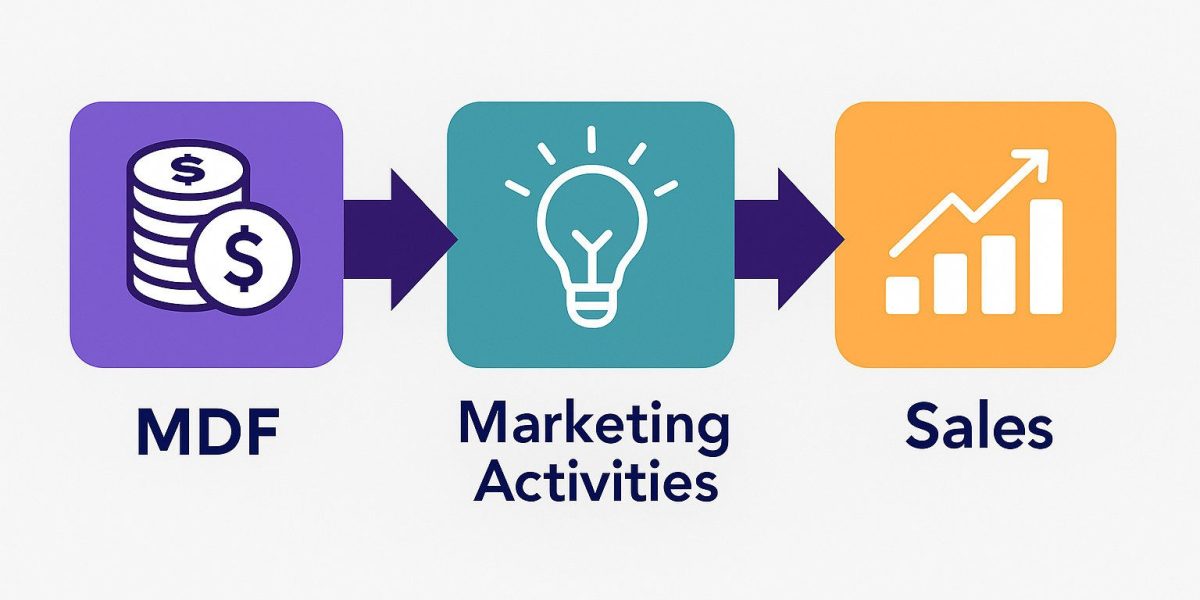
If you’re a channel marketing manager, you’ve probably heard of MDF or Marketing Development Funds. But what exactly do MDF programs do, and how can you ensure they deliver strong results? In this guide, we’ll cover the essentials—from the basic meaning of MDF to actionable strategies that help manufacturers and distributors maximize their MDF ROI.
What Is a Market Development Fund?
Marketing Development Funds (MDF) are financial incentives that manufacturers provide to their channel partners—such as resellers, VARs, or distributors—to help them financially with the marketing and selling of the manufacturer’s products.
In simple terms, MDF helps partners run demand generation campaigns. The goal is to:
- Increase product visibility
- Drive sales through indirect channels
- Support brand consistency in partner marketing
- Strengthen the manufacturer-partner relationship
When asking what is market development fund, it’s important to understand its role in amplifying brand efforts at the partner level. MDF not only boosts awareness but also provides strategic support for hyper-localized campaigns that reflect both partner and vendor goals.
Beyond the basic marketing development funds definition, many channel teams ask how MDF funding actually supports long-term partner growth. In practice, market development fund programs give manufacturers a structured way to invest in partner-led demand generation while maintaining visibility into performance and compliance. Whether you call them MDF marketing incentives or partner marketing reimbursements, the purpose remains the same: help distributors, VARs, and resellers scale localized campaigns that align with a broader channel strategy. Organizations that clearly define what MDF funds are used for — from digital campaigns to regional events — typically see higher adoption rates and stronger partner engagement.
For companies exploring MDF program management for the first time, understanding how marketing development funds fit into the overall channel lifecycle is critical. Many teams search for answers like “what are MDF funds in marketing?” or “how do marketing development fund programs work for distributors?” because they want predictable ROI, simplified workflows, and measurable outcomes. When structured properly, MDF becomes more than just a reimbursement model — it evolves into a strategic planning tool that guides budget allocation, campaign tracking, and long-term partner enablement. This is why modern MDF marketing strategies increasingly focus on automation, analytics, and scalable governance to ensure every dollar contributes to measurable channel growth.
How Do MDF Programs Work?
Here’s a typical flow:
- The manufacturer allocates funds to eligible partners (based on past sales or forecasted potential).
- The partner proposes a marketing activity (event, digital campaign, print, etc.).
- The manufacturer approves the activity and funds.
- The partner executes the campaign.
- The partner submits proof of performance.
- The manufacturer reimburses the partner.
Understanding this process is key to building effective MDF management programs that scale and perform consistently.
Successful MDF program workflows usually follow a repeatable lifecycle that balances flexibility for partners with governance for manufacturers. Most marketing development fund programs begin with budget allocation based on partner performance tiers or revenue targets, followed by proposal submission, approval, execution, and reimbursement or accrual tracking. Channel leaders often search for answers like “how do MDF funds get approved?” or “what is the MDF claim process?” because clarity at each step directly impacts adoption. When partners understand exactly how MDF marketing requests move from idea to reimbursement, participation increases and campaign execution becomes far more consistent across regions and partner types.
As MDF strategies mature, many organizations evolve from manual tracking toward structured MDF management processes supported by automation and reporting. Instead of relying on spreadsheets or email chains, modern MDF programs emphasize centralized workflows that make it easier to submit marketing plans, track fund utilization, and measure ROI across multiple campaigns. This shift helps answer common long-tail questions like “how do distributors manage MDF funds efficiently?” or “what is the best way to track marketing development fund usage?” By aligning approvals, compliance, and analytics in a single system, companies gain clearer visibility into which partner activities actually drive pipeline — turning MDF from a reactive expense into a strategic engine for scalable channel growth.
Common MDF Use Cases
MDF is typically used for activities such as:
- Co-branded digital advertising campaigns
- Trade show sponsorships
- Email marketing and lead generation
- Retail and in-store promotions
- Product training events
Many manufacturers and distributors expand their MDF marketing strategies by aligning funds with high-impact activities that directly support pipeline growth and partner visibility. Beyond traditional co-branded campaigns, common marketing development fund use cases now include digital advertising, localized SEO initiatives, virtual events, content syndication, and partner-driven demand generation programs. Channel teams frequently ask “what can MDF funds be used for?” or “which MDF activities deliver the best ROI?” — and the answer often depends on clear business goals paired with measurable outcomes. By prioritizing MDF investments that combine brand awareness with trackable performance metrics, organizations can ensure their MDF programs not only support partner marketing efforts but also contribute to long-term revenue growth and stronger channel alignment.
Common Challenges in MDF Program Management
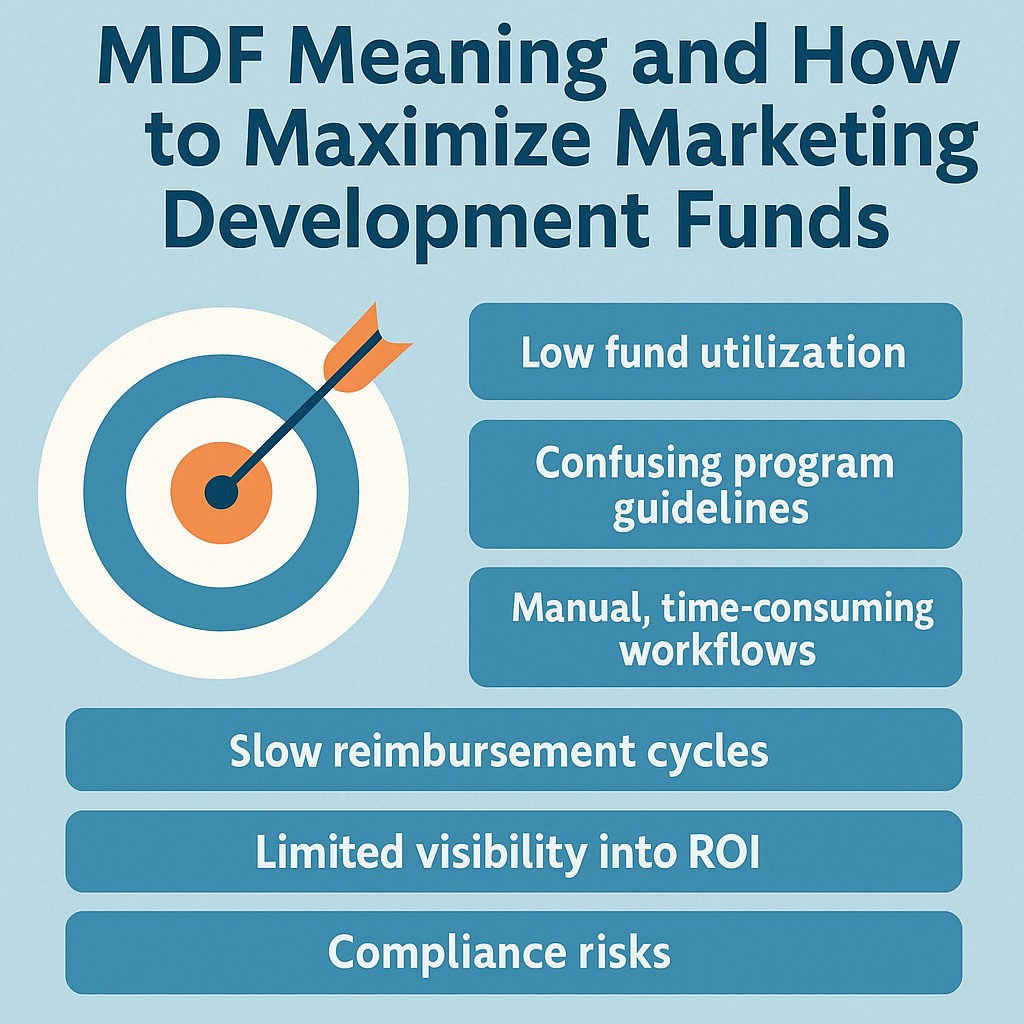
Without the right processes or tools, MDF programs often struggle with:
- Low fund utilization
- Confusing program guidelines
- Manual, time-consuming workflows
- Slow reimbursement cycles
- Limited visibility into ROI
- Compliance risks
Best Practices to Maximize MDF ROI
Here’s how manufacturers and distributors can improve MDF performance:
- Simplify Program Guidelines: Make it easy for partners to understand what qualifies, how to apply, and what’s expected.
- Automate Processes: Use software to manage fund allocation, claim submission, approvals, and payments.
- Offer Pre-Approved Campaign Kits: Help partners launch faster with ready-made marketing templates.
- Promote Visibility: Share ongoing program details and available funds through your partner portal.
- Track and Optimize: Monitor campaign success, gather feedback, and refine funding strategies.
Benefits of Automating MDF Management
By using channel management platforms like Computer Market Research (CMR), manufacturers can:
- Drive higher partner engagement
- Improve fund utilization rates
- Reduce admin overhead and manual errors
- Accelerate reimbursement cycles
- Increase compliance and auditability
- Gain real-time insights into program performance
How CMR Simplifies MDF & Co-Op Management
CMR’s Co-Op/MDF Management Platform helps manufacturers and distributors streamline every stage of MDF program execution—from fund planning to performance reporting.
- Automate workflows from request to reimbursement
- Provide an intuitive partner experience
- Improve data accuracy and reduce fraud risk
- Enable scalable growth across partner tiers
Explore how CMR’s solutions compare with legacy MDF tracking tools by requesting a demo.
Choosing the Right MDF Management Solution
When selecting MDF management tools, look for:
- Experience with large, global channel ecosystems
- Customizable workflows and approval routing
- Real-time dashboards and ROI tracking
- Scalability across geographies and partner types
- Integration with CRM, ERP, and PRM platforms
CMR delivers all of these capabilities and more, backed by decades of experience in partner incentive program automation.
Conclusion
Marketing Development Funds continue to be a cornerstone of successful channel marketing. With the right strategy and automation, MDF can be transformed from an administrative burden into a high-impact revenue driver.
Start maximizing your MDF performance today—Request a Demo of CMR’s MDF Management solution or explore Types of Cooperative Advertising for deeper partner enablement strategies.