

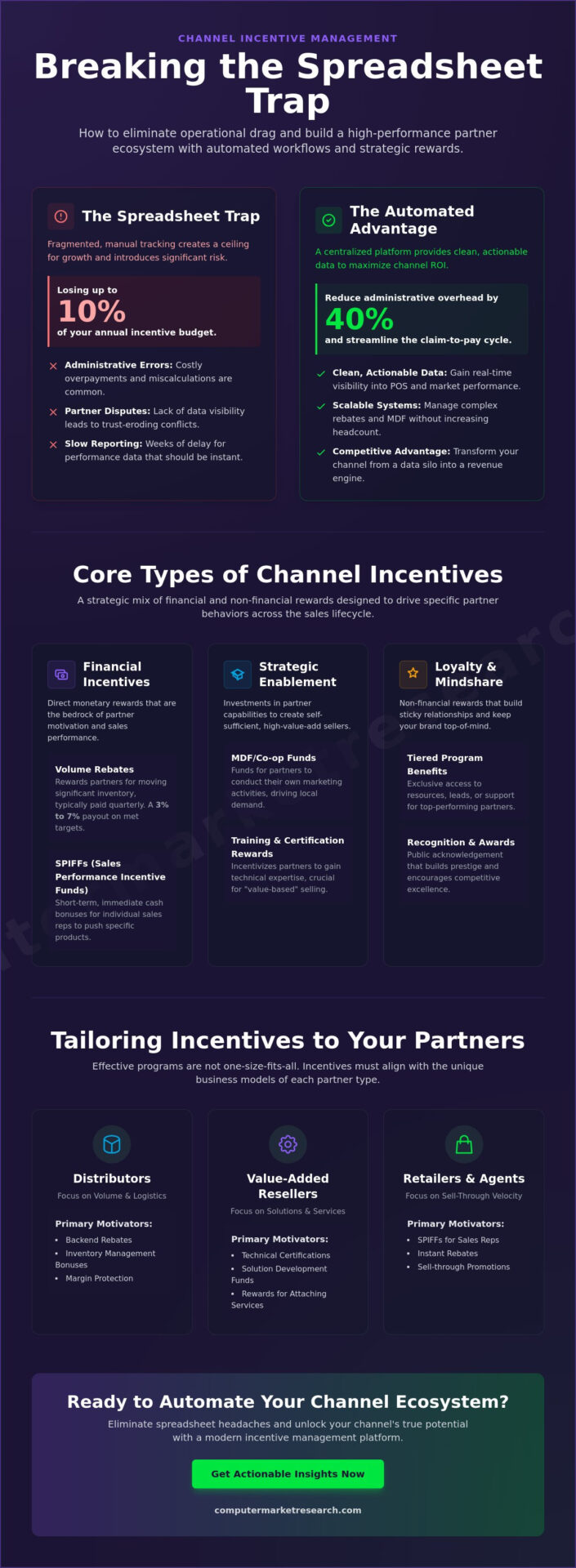
If your channel program still relies on a web of fragmented spreadsheets, you’re likely losing up to 10% of your annual incentive budget to administrative errors and overpayments. While many organizations start by asking what are channel incentives to build their first programs, the true leaders focus on how to manage them without the operational drag of manual tracking. You’ve likely felt the frustration of resolving partner disputes or waiting weeks for a performance report that should be available in seconds.
It’s a common reality that manual workflows create a ceiling for growth. This guide promises to show you how to break through that ceiling by driving partner loyalty and revenue through a strategic management framework. We’ll move beyond the headache of spreadsheets to explore automated workflows that provide clean, actionable data. You’ll learn how to implement a scalable system for managing rebates and MDF that can reduce administrative overhead by 40%, ensuring your channel remains a competitive advantage rather than a data silo.
Key Takeaways
- Understand what are channel incentives and how these strategic rewards act as a catalyst to align manufacturer goals with partner execution.
- Identify the optimal mix of financial and non-financial rewards—from SPIFFs to MDF—to drive specific partner behaviors like growth and enablement.
- Learn how to secure brand mindshare and reduce partner churn by building consistent, sticky reward structures that outperform the competition.
- Discover why manual spreadsheet tracking is a primary obstacle to growth and how to eliminate the operational “headache” of fragmented POS reporting.
- Explore how centralizing operations through an automated platform streamlines the claim-to-pay cycle and provides the visibility needed to maximize channel ROI.
What Are Channel Incentives? Defining the Indirect Sales Catalyst
Channel incentives act as the strategic engine behind indirect sales performance. At their core, asking what are channel incentives reveals a structured system of rewards, bonuses, and financial benefits designed by manufacturers to align partner actions with corporate objectives. These programs ensure that independent third parties prioritize your products over a competitor’s offerings. By 2026, the industry has moved beyond simple transaction-based models to a more sophisticated framework that rewards the entire customer lifecycle.
The role of these incentives in the value chain is critical. They connect a vendor’s high-level goals with the ground-level execution of a global partner network. This connection ensures that partners don’t just sell products; they execute the specific behaviors that drive long-term market share. To better understand how these programs function across different ecosystems, watch this helpful video:
Don’t confuse these programs with standard sales commissions. While commissions are typically direct, percentage-based payments to internal employees, channel incentives are complex B2B arrangements. They involve Market Development Funds (MDF), Co-op funds, or SPIFFs that require rigorous documentation. In the 2026 landscape, the most successful manufacturers have shifted from “volume-based” rewards to “value-based” rewards. This means paying for technical expertise and customer success outcomes rather than just shipping boxes to a warehouse.
The Purpose of Incentivizing Your Partners
Strategic incentives serve three primary functions. First, they drive short-term revenue spikes through focused promotions and seasonal rebates. Second, they secure “mindshare,” ensuring your brand remains the primary focus for a busy reseller’s sales team. Finally, they are a vital tool for gathering channel data management insights. When partners submit claims for rewards, they provide the Point of Sale (POS) data that eliminates the spreadsheet silos that often hide true market performance. If you automate this data collection, you gain visibility that manual processes can’t provide.
Who Receives These Incentives?
Incentive structures must be tailored to the specific role of the partner to be effective. The modern channel ecosystem includes several distinct groups:
- Distributors: These partners focus on volume and inventory management. Their incentives are usually backend rebates that help maintain thin margins.
- Value-Added Resellers (VARs): These partners are motivated by technical certifications, solution development funds, and rewards for attaching services to hardware sales.
- Retailers and Agents: Driven by Sales Person Incentive For Functional (SPIFFs) and sell-through velocity, these partners respond to immediate, individual rewards that keep products moving.
By understanding what are channel incentives and how they apply to each tier, manufacturers can replace operational headaches with a streamlined, high-performance sales engine.
Core Types of Channel Partner Incentives: From SPIFFs to MDF
Understanding what are channel incentives requires looking beyond simple discounts. Effective programs balance financial rewards with strategic enablement to drive specific behaviors across the distribution chain. Manufacturers typically categorize these rewards into three functional buckets: growth, enablement, and loyalty. If you rely on manual spreadsheets to track these categories, you’re likely losing 10% of your incentive budget to overpayments or unclaimed funds. Automation provides the visibility needed to scale these programs without increasing administrative overhead.
Financial Incentives: Rebates and SPIFFs
Financial rewards remain the bedrock of partner motivation. Volume Rebates reward “heavy hitters” who move significant inventory, often structured as a 3% to 7% payout once specific quarterly targets are met. While rebates drive long-term volume, Sales Performance Incentive Funds (SPIFFs) target the individual sales representative. A $200 SPIFF for every new enterprise license sold in a specific month can shift focus faster than any quarterly bonus. For high-velocity distribution, Ship & Debit is essential. This mechanism allows distributors to lower prices for competitive bidding scenarios while the manufacturer “credits” the difference back to the partner. This protects the distributor’s margin and ensures you don’t lose the deal to a lower-priced competitor due to rigid pricing structures.
Marketing and Growth Incentives
Growth incentives focus on future demand rather than past performance. Market Development Funds (MDF) are proactive grants given to partners to execute specific marketing campaigns, such as webinars or local events. Unlike Co-op funds, which partners accrue based on a percentage of total sales, MDF is discretionary and strategic. Industry data from 2024 indicates that partners using MDF effectively see a 15% higher year-over-year growth rate. High-performing vendors also use referral fees and lead generation bonuses to reward partners who identify opportunities but don’t necessarily have the technical staff to close the sale. These tools ensure your pipeline remains full throughout the fiscal year.
Non-Financial Incentives: Training and Enablement
Cash isn’t the only way to build loyalty. Non-financial incentives focus on long-term partner health and technical competency. Certification bonuses and exclusive technical support access make a partner more self-sufficient. Internal studies show that certified partners close deals 24% faster than uncertified peers. Providing Not-for-Resale (NFR) units allows partners to test solutions in their own labs, reducing the friction of the sales process. Finally, tiered programs create a “path to gold.” By moving from Silver to Gold status, partners unlock higher margins and “Partner of the Year” recognition, fostering a sense of elite community. To manage these complex tiers effectively, you should streamline your partner data management to ensure every reward is earned and verified through clean Point of Sale data.
The Strategic Value: Why Incentivizing Partners is Non-Negotiable
Manufacturers often view rewards as a line-item expense. This is a tactical error. When you understand what are channel incentives, you see them as a strategic mechanism for securing mindshare in a crowded marketplace. A typical distributor carries products from five or more competing brands. Your solution only gains priority when you provide a clear financial or professional reason for their sales team to lead with your SKU. Without this focus, your products sit in a warehouse while competitors capture the active demand.
Consistent, data-driven reward structures are the primary defense against partner churn. Industry data indicates that losing a high-performing partner can cost a manufacturer up to $100,000 in recruitment and onboarding expenses alone. Incentives build “sticky” relationships by integrating your brand into the partner’s core profitability model. This alignment is critical for effective channel management, as it transforms a transactional vendor relationship into a collaborative partnership. Additionally, targeted SPIFFs can reduce time-to-market for new launches by 30%, providing the immediate momentum needed to displace incumbents.
Measuring ROI on Incentive Spend
ROI in the context of channel incentives is the measurable return on marketing and rebate investments. To find the profitability sweet spot, sales operations teams must monitor the “Incentive-to-Sales” ratio. In high-tech manufacturing, a healthy ratio typically falls between 3% and 6% of gross revenue. If your spend exceeds this without a verified lift in incremental growth, you’re likely subsidizing organic sales that would’ve occurred regardless of the incentive. Transitioning away from manual spreadsheets to automated tracking ensures you only pay for performance that exceeds baseline expectations.
Creating Competitive Differentiation
By 2026, the standard for what are channel incentives has shifted toward “experience-based” rewards. While rebates remain a staple, top-tier partners now prioritize access to exclusive technical training, co-marketing support, and VIP product roadmaps. A well-structured program becomes a powerful recruitment tool, allowing you to penetrate new geographic or vertical markets by attracting the most capable regional players.
- Recruitment: Use transparent incentive structures to lure high-value partners away from legacy vendors.
- Market Penetration: Tie higher rebate tiers to specific under-served verticals to force market entry.
- Data Visibility: Offer cloud-based dashboards so partners can see their earnings in real-time, reducing administrative friction.
A disciplined approach to incentives ensures that every dollar spent is an investment in channel health. It’s about moving past the “gut feeling” of sales managers and utilizing Point of Sale data to drive predictable, scalable growth.
The Spreadsheet Trap: Common Pitfalls in Incentive Management
Many manufacturers still rely on manual entry to define what are channel incentives within their ecosystem. This reliance creates a primary obstacle to growth. Relying on Excel leads to fragmented Point of Sale (POS) reports that exist in isolated silos. When data isn’t centralized, visibility disappears. This lack of transparency makes it difficult to determine which partners are actually driving revenue and which are simply collecting checks.
Manual systems are prone to human error. Research from the University of Hawaii suggests that 88% of spreadsheets contain significant errors. In a channel environment, these mistakes manifest as over-payments or the approval of fraudulent claims. If a vendor can’t verify a sale against real-time inventory data, they risk losing 10% of their incentive budget to duplicate entries or “gray market” activities. Operational friction becomes the norm rather than the exception.
Channel conflict is another byproduct of manual tracking. When incentive rules are unclear or poorly enforced due to data gaps, partners often compete for the same lead. Without a “single source of truth,” resolving these disputes takes weeks. This creates a toxic environment where partners feel the system is rigged against them, eventually leading them to prioritize a competitor’s products instead.
The Hidden Costs of Manual Administration
Administrative teams often spend 25% to 30% of their work week cleansing data and verifying claims. It’s a massive drain on high-value resources. Late payouts are a direct consequence of this bottleneck. When a partner waits 90 days for a rebate that should’ve arrived in 15, trust erodes. Manual processes also lack a robust audit trail. This creates compliance risks that can lead to significant fines during internal or external financial reviews.
Why Spreadsheets Fail to Scale
Scaling a program requires handling complex, multi-tiered rebate structures that spreadsheets simply can’t manage. As a program grows beyond 50 partners, the inability to provide real-time visibility becomes a deal-breaker. Partners need to see their progress toward goals instantly to stay motivated. Furthermore, integrating manual data with an existing CRM or ERP system is nearly impossible without constant, manual intervention. This prevents the business from gaining the actionable insights needed to optimize the program.
Stop losing revenue to manual errors and fragmented data. Automate your channel data management with Computer Market Research to ensure every incentive dollar drives measurable growth.
Automating the Ecosystem: How Technology Drives Performance
Manual tracking is the primary obstacle to scaling a modern partner network. In 2026, understanding what are channel incentives in a digital context requires a shift from spreadsheets to centralized automation. A dedicated channel incentive program platform acts as a single source of truth, replacing fragmented data silos with a unified workflow. This technology doesn’t just store data; it actively drives performance by removing the administrative burden that often stifles partner engagement.
The transition to an automated claim-to-pay cycle is perhaps the most significant efficiency gain a manufacturer can achieve. While manual systems often see payment cycles stretching 30 to 45 days, automation can reduce this window to under 7 days. This immediate gratification reinforces positive sales behavior. When partners have real-time visibility through a dashboard, they can track their progress toward tiered goals. This transparency eliminates the “black hole” effect where partners are unsure of their standing or pending payouts.
CMR’s PartnerPortal™ specifically targets the 15% to 20% error rate typically found in manual Point of Sale (POS) data entry. By cleansing and normalizing data at the point of ingestion, the system ensures that every rebate and commission is based on accurate, validated sales. This level of precision protects your margins and builds trust with your distributors.
Features to Look for in an Incentive Management System
A robust system must handle the complexities of B2B relationships without requiring constant manual intervention. Look for these essential capabilities:
- Automated Rebate Calculation: Rules-based engines that apply complex logic to POS data instantly.
- MDF Approval Workflows: Digital request and approval tracks that keep Marketing Development Funds moving.
- Integrated Deal Registration: A system that timestamps and protects partner leads to prevent channel conflict.
- POS Data Normalization: Tools that automatically correct formatting errors and duplicate entries from disparate sources.
Transitioning to an Automated Portal
Moving from legacy spreadsheets to a cloud-based SaaS platform is a strategic necessity. The process begins with auditing your current data quality and mapping your existing incentive logic into the new system. Most organizations find that 78% of partners prefer using a portal over manual reporting because it simplifies their own internal accounting.
To ensure high adoption rates, the interface must be intuitive. If a portal is difficult to navigate, partners will revert to old habits. CMR focuses on a user-friendly experience that emphasizes actionable insights. This approach turns the portal into a tool partners actually want to use, rather than another administrative task they have to complete. By providing clean data and clear paths to earnings, you define what are channel incentives for your brand: a streamlined engine for mutual growth.
Streamline your channel incentives with CMR’s PartnerPortal™
Modernizing Your Partner Strategy for Sustainable Growth
Understanding what are channel incentives is only the first step toward building a high-performance partner network. As we look toward 2026, the transition from manual tracking to automated visibility is no longer optional for manufacturers. Legacy spreadsheets create fragmented data silos that stall growth; they simply can’t handle the complexities of modern MDF and SPIFF programs. By shifting to a modular SaaS architecture, you gain the ability to normalize POS data and ensure every dollar spent drives a measurable return.
Computer Market Research has spent decades refining the science of channel data management. Our systems are trusted by Fortune 500 and Global 2000 companies to deliver clean, actionable insights across the entire distribution chain. You don’t have to settle for operational headaches or inaccurate payouts. It’s time to replace guesswork with technical precision and a platform designed specifically for the manufacturer-distributor relationship.
Automate your channel incentives and eliminate the spreadsheet headache with PartnerPortal™
Building a loyal, motivated partner ecosystem is well within your reach when you lead with a data-driven strategy and reliable technology.
Frequently Asked Questions
What is the difference between MDF and Co-op funds?
MDF are discretionary funds granted upfront for market expansion, while Co-op funds are accrued based on a percentage of a partner’s historical sales. A 2024 industry report shows that 60% of MDF goes unused because of complex manual tracking. If you automate these processes, you ensure that funds are allocated to activities that drive growth rather than getting lost in administrative silos.
How do I calculate the ROI of my channel incentive program?
You calculate the ROI by subtracting the total program cost from the net profit of incentive-driven sales, then dividing by the program cost. A 2023 study by the Incentive Research Foundation found that targeted programs can boost total sales by 32%. Understanding what are channel incentives in a data-driven context helps you isolate these variables and ensures you aren’t paying for sales that would’ve happened anyway.
What are SPIFFs and when should I use them?
SPIFFs are Sales Performance Incentive Funds designed as immediate, short-term rewards for individual sales representatives rather than the partner company. You should use them to clear stagnant inventory or accelerate a new product launch within a 30 to 90 day window. Research from 2024 indicates that 70% of high-performing firms use these tactical rewards to influence behavior at the specific point of sale.
Can I use channel incentives for service-based partners?
You can use channel incentives for service-based partners by rewarding non-transactional milestones like technical certifications or high customer satisfaction scores. According to 2024 Canalys data, service-led partners now represent 60% of the channel landscape. Shifting your focus to rewarding value-add activities ensures your program remains relevant as the industry moves toward recurring revenue models and specialized consulting rather than simple hardware resale.
How do I prevent rebate fraud in my channel?
Prevent rebate fraud by implementing automated validation that cross-references every claim against verified Point of Sale data. Manual claim processing typically results in a 10% error rate due to duplicate entries or gray market sales. By moving away from spreadsheets and using a centralized data management system, you gain the visibility needed to flag inconsistencies and stop unauthorized payments before they impact your bottom line.
What is Ship & Debit and why is it important for distributors?
Ship and Debit is a financial mechanism where a manufacturer provides a credit to a distributor to bridge the gap between the standard cost and a discounted price for a specific deal. It’s vital because distributor margins often sit between 2% and 5% in the IT sector. Without this protection, distributors couldn’t offer competitive pricing to end-users while maintaining their own profitability during high-volume transactions.
Is automated channel management software worth the investment for small firms?
Automated software is a necessary investment for small firms because it prevents the administrative headache and financial leakage associated with manual data entry. Small businesses using automation reduce their operational overhead by 25% within one year. Eliminating the death of the spreadsheet allows a lean team to manage complex programs without hiring additional back-office staff to handle claim verification and data cleaning.
How often should I update my incentive program rules?
You should conduct a formal performance review of your incentive program every 90 days and implement major rule updates annually. The 2025 Channel State of the Union report notes that 45% of successful vendors adjust their incentives every 6 months to respond to market shifts. Recognizing what are channel incentives involves seeing them as dynamic tools that require regular optimization based on actionable insights and current inventory levels.

Article by
Del Heles
Del Heles is the founder and CEO of Computer Market Research (CMR), a channel management software company he launched in 1984. With more than 40 years of experience, he’s known for helping manufacturers and distributors simplify complex partner programs through practical, customer-focused technology solutions.