

A report is only as reliable as the process behind it. The most practical way to learn how to improve distributor reporting accuracy is to make reviews a consistent control point, not a last-minute check for missing or mismatched figures. Clear expectations, routine performance tracking, and follow-up on exceptions help reveal where reporting breaks down.
It is reasonable to expect distributor reports to provide a dependable view of sales and channel performance. But when definitions vary or issues surface only during review, teams can spend more time reconciling data than acting on it. Accuracy improves when partners know what to report, how results will be assessed, and how to flag problems that affect the numbers.
This article explains how to set clear targets, review performance consistently, and create a two-way feedback process with distributors. It also covers exception alerts that surface discrepancies sooner and monthly depletion reports that clarify product movement. Together, these practices create a more reliable reporting rhythm and a stronger basis for decisions.
Key Takeaways
- Track a consistent set of performance measures over time to spot reporting trends and data gaps.
- Set clear reporting expectations and review criteria so distributors understand how performance is assessed.
- Use regular two-way feedback to uncover reporting obstacles and clarify issues behind the numbers.
- Set exception alerts to flag discrepancies promptly, giving teams a chance to investigate before they affect decisions.
- Request monthly depletion reports to compare product movement with other channel data and strengthen visibility.
1. Measuring optimization outcomes over time
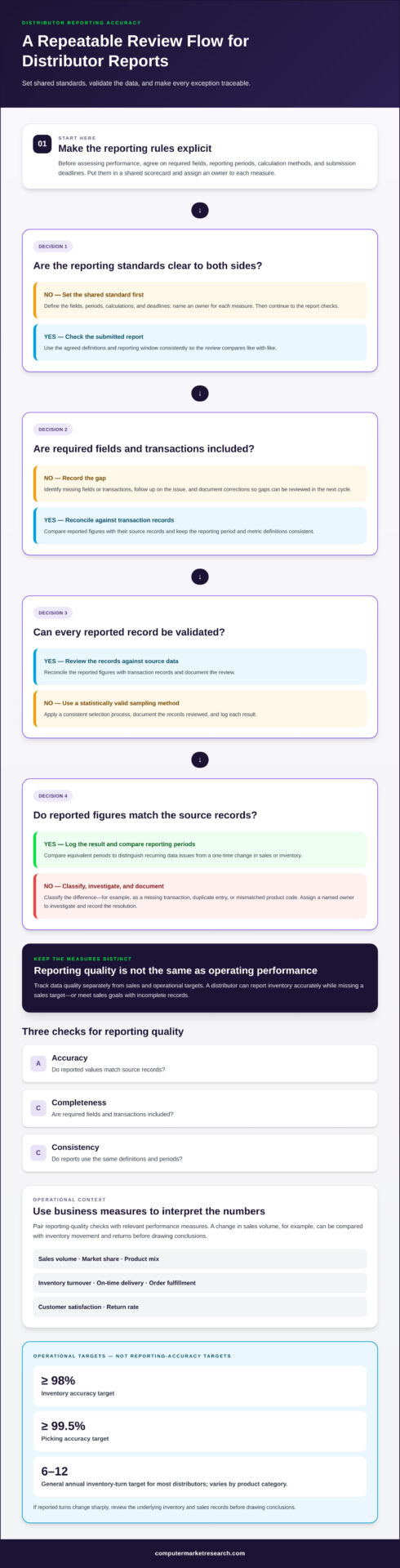
Start with a defined review cycle: establish a baseline, measure distributor reports consistently, investigate variances, and record corrective actions. Comparing equivalent reporting periods helps distinguish a persistent data problem from a one-time change in sales or inventory. Keep the reporting window and metric definitions consistent so each review supports meaningful analysis instead of another round of reconciliation.
Which KPIs measure distributor reporting accuracy and completeness? Track accuracy, completeness, and consistency, which the Centers for Medicare & Medicaid Services identifies as key indicators of reporting quality. Accuracy measures whether reported values match source records; completeness checks whether required fields and transactions are included; consistency checks whether reports use the same definitions and periods.
Pair these measures with performance metrics that put reported figures in context. Review sales volume, market share, inventory turnover, customer satisfaction, on-time delivery, order fulfillment, return rate, and product mix. A sudden change in sales volume, for example, warrants comparison with inventory movement and returns. That can help distinguish a reporting mismatch from a genuine shift in distributor activity.
Assess the review process over time. Record which fields were corrected, which discrepancies recurred, and whether distributor explanations resolved the variances. Compare findings across reporting periods. Repeatedly missing product identifiers may point to a mapping problem; differing totals may call for a closer look at the source period or calculation method. Documenting the cause makes the next review more focused.
When teams cannot validate every reported record, U.S. Department of Labor Office of Inspector General guidance says to use a statistically valid sampling method. Apply a consistent selection process, document the records reviewed, and log each result. Sampling focuses review effort while providing a traceable basis for identifying errors that may need broader investigation.
Automate repeatable comparisons where systems allow, such as matching distributor submissions against transaction records and flagging missing fields. Automation can reduce manual work, but it cannot replace clear definitions or follow-up. Assign someone to review exceptions, record outcomes, and compare results in the next reporting cycle. Over time, this creates an evidence-based view of reporting quality and shows whether process changes address root causes.
Track optimization outcomes across reporting periods, and connect data quality checks with financial review. Distributor financial reviews can assess revenue growth over time, profit margins against industry benchmarks, expense management through net margins, and inventory turnover. Most organizations should track 15 to 25 daily metrics across key distribution performance areas. Keep the set focused enough to make movements visible, then interpret each measure alongside the reporting issues and operational indicators already under review.
Within the first 30 days of CRM optimization, distributors should look for clean data, higher CRM usage, and better visibility into account history and open quotes. By 90 days of CRM optimization, distributors should see gains in reorder capture, fewer stalled opportunities, and earlier signals on margin shifts or slowing accounts. By day 180 of CRM optimization, the CRM should consistently influence revenue through stronger retention, more accurate forecasts, increased cross-sell activity, and higher overall account performance. Data-driven analytics to track distribution metrics have been associated with EBITDA gains of 15% to 25%.
2. Targets, accountability, and operational reviews
Set reporting expectations before evaluating distributor performance. Define required fields, reporting periods, calculation methods, and submission deadlines in a shared scorecard. Assign an owner to each measure so questions and corrections reach the right person. Clear definitions strengthen partner relationships by ensuring both sides interpret results consistently. A practical plan to improve distributor reporting accuracy starts with shared standards, not a later spreadsheet cleanup.
Keep reporting-quality measures separate from sales and operations targets. A distributor might report inventory accurately while missing a sales target, or meet sales goals with incomplete records. Track each issue on its own. For operational context, common targets include inventory accuracy of at least 98% and picking accuracy of at least 99.5%. These measure warehouse performance, not reporting accuracy itself.
Reconcile reported figures with transaction records, investigate mismatches, and document resolutions. Periodic audits can test whether source records support reported totals; assign follow-up actions to a named owner. For example, classify differences as missing transactions, duplicate entries, or mismatched product codes. This gives reviewers a repeatable process and helps identify the source of recurring reporting problems.
Use a channel partner scorecard to connect reporting standards with relevant business outcomes. For example, place inventory accuracy beside inventory turns while keeping the measures distinct. A general target for most distributors is 6 to 12 inventory turns annually, with variation by product category. If reported turns change sharply, review the underlying inventory and sales records before drawing conclusions.
Train distributors on field definitions, submission workflows, and correction procedures, then review sample reports together. Explain how incentive criteria relate to documented performance and accurate reporting. Training should include practical examples of common errors and how to correct them. Rebates & Incentives can support a structured approach when program criteria and reporting requirements are explicit.
Document targets and accountability in an annual plan with each distributor. Review and adjust the plan each year in person, recording decisions, owners, and follow-up actions. Operational reviews can then address progress, unresolved discrepancies, changing conditions, and improvement opportunities. This keeps discussions focused on evidence and action, rather than reconstructing earlier decisions or relying on different interpretations.
When manual reconciliation makes these reviews difficult to maintain, explore a more structured reporting workflow for distributor performance and incentive administration.
Operational reviews can also document sales targets and the cadence for reviewing them, giving each distributor a clear basis for ongoing discussion. A 95% perfect order rate is a target for high-performing distributors, while a typical distribution target for days sales outstanding is 40 to 50 days. Scorecards can define success criteria and clarify expectations.
3. Two-way feedback loops with distributors
Schedule regular conversations about reporting issues with the people closest to the source data. Monthly phone calls can keep communication active, while quarterly feedback calls give key accounts space to discuss patterns. Use each conversation to identify a specific reporting obstacle, assign an owner, and record the next action. This makes feedback an efficient part of the reporting process, not an occasional escalation.
Inaccurate sales and inventory reports can result from manual entry, inconsistent product codes, delayed updates, or differing definitions of a sale or available stock. Ask distributors to trace one example, such as a shipment recorded in one period but invoiced in another. Following that record can reveal whether the issue began in the source data, a timing rule, or a system transfer.
Standardize templates by agreeing on required fields, product identifiers, reporting periods, units, and definitions before submissions begin. Provide a data dictionary with the template, then review a sample together. For example, specify whether “sales” means orders, shipments, or invoiced transactions. Shared terms help both parties interpret each row consistently, while a documented change process prevents local edits from quietly altering the format.
EDI or API integrations can reduce rekeying by transferring structured records between connected systems. Define field mappings first, then apply validation rules to required identifiers, dates, and units. For example, a distributor’s inventory file should map its product code to the shared identifier before analysis. Integration supports consistent data transfer, but feedback is still essential when a mapping or source-system definition needs correction.
Validate distributor reports against invoices, shipment records, and payment entries for the same products and reporting period. Trace each variance from the reported total to its underlying transaction, then ask the distributor to explain differences in timing or status. Record the source, finding, and agreed correction. This keeps the discussion evidence-based and distinguishes a reporting error from a legitimate difference in transaction timing.
Sharing sales data creates risks if sensitive account details reach people without a business need or are reused outside the agreed purpose. Define which fields partners exchange, who can access them, and which approved channels to use. Limit customer-level details to what the analysis requires, and document how exceptions or corrections will be communicated. These practices support controlled collaboration without making assumptions about legal duties.
Close each feedback cycle with a written summary: issue, cause, owner, action, and follow-up date. Manufacturers report receiving feedback on only 10 to 20 percent of sales leads from distributors, so a clear route for comments can surface information otherwise absent from reports. Short surveys after major launches and regular sales meetings can capture product issues, lead problems, or process friction before they recur.
4. Exception alerts and timely corrective action
Daily operational KPIs can provide timely visibility, unlike monthly reports that may arrive too late to inform action. Configure alerts around defined exceptions, such as a missing distributor submission, an unexpected inventory change, or a sales total that differs from transaction records. Each alert should identify the affected partner, product, reporting period, and measure. This context helps the owner investigate without searching through disconnected files.
Map the reporting workflow from source entry to management review. Identify where discrepancies can arise, such as product-code mapping, shipment timing, or manual adjustments. Then connect each risk to a relevant signal. For example, compare reported shipments with recorded transactions and flag missing product identifiers before the report moves forward. A useful alert points to the specific record or field that needs attention.
Set thresholds based on business rules and normal reporting patterns, not arbitrary triggers. A sales change may reflect a real market shift, while a blank identifier may indicate incomplete data. Distinguish these cases in the alert logic. Label issues by severity and route them to the person responsible for the affected data. This helps teams prioritize errors that could distort inventory, revenue, or margin analysis.
Make every alert actionable. Include the expected value or condition, the submitted value, the source record, and the next review step. If a distributor reports units that do not match shipment records, for instance, identify the product and period. The reviewer can then determine whether the difference reflects timing, a correction, or an entry error. Record the resolution to make similar exceptions easier to diagnose.
Assign an owner and status to every exception. Useful statuses include new, under review, awaiting distributor input, corrected, and closed. A sales operations analyst might investigate a mismatched transaction, while an inventory owner handles a stock discrepancy. Keep the original report intact and record any corrected value separately. This preserves traceability and prevents a revised figure from hiding the source of the issue.
Review alert patterns during operational meetings. Repeatedly missing fields may indicate an unclear template, while recurring code mismatches can signal a mapping problem. Use these patterns to expand validation rules or revise the process causing the error. Alerts should prompt corrective action, not simply accumulate in a queue. Track whether each process change reduces repeat exceptions in later reporting cycles.
Balance speed with useful context. If every routine fluctuation generates an alert, teams may overlook discrepancies that need attention. Group related exceptions by distributor or reporting period, and provide enough detail for efficient investigation. A dashboard can surface daily exceptions while preserving the full record for analysis. Review both unresolved items and recurring causes to fix individual reports and improve the underlying workflow.
5. Monthly depletion reports
Request monthly depletion reports from distributors to see product movement beyond shipments into the channel. Shipment records show what a manufacturer sent; depletion data can show what distributors sold onward. Comparing the two helps explain whether inventory is moving, accumulating, or shifting across product lines. Keep reporting periods consistent so each monthly comparison uses the same start and end dates.
Define report fields with distributors before the first submission. Include product identifiers, units sold, reporting period, and agreed adjustments, such as returns. Clear definitions matter: a unit shipped to a distributor is not the same as a unit depleted through a sale. Shared terms help reviewers interpret changes without confusing channel shipments with downstream demand.
Use the same review sequence for each monthly file. First, confirm every expected product and period is included. Next, compare reported units with shipment and inventory records. Then investigate unusual differences with the distributor, recording the explanation and any correction. For example, low depletion beside substantial shipments may reflect inventory buildup, delayed reporting, or a genuine slowdown. Supporting records help distinguish the causes.
Analyze depletion alongside current inventory and sales trends rather than treating one report as the complete picture. If reported sales rise while on-hand inventory falls, that may indicate faster movement. If shipments rise but depletion remains steady, inventory could be building in the channel. These comparisons help teams plan replenishment and assess product performance without assuming every variance is an error.
Use product-level detail to identify where profitability or account performance merits closer analysis. A consolidated total can hide a slow-moving product among items selling steadily. Review units by product and distributor, then compare periods using consistent definitions. When a discrepancy appears, trace it to the underlying shipment, sale, return, or adjustment instead of changing the total without explanation.
Keep a record of each monthly submission, review status, and follow-up. A simple log can capture the reporting period, missing fields, reconciled differences, distributor explanation, and resolution. This history helps reveal recurring reporting gaps and distinguish a one-time correction from a repeated process issue. Use the findings to refine report instructions and improve the next cycle.
Depletion reporting also supports practical conversations with distributors. Share relevant trends and ask about product availability, customer demand, or reporting obstacles that could explain a change. If a report shows a sustained shift in movement, discuss whether replenishment plans or product support need adjusting. These conversations connect channel data to operational decisions and involve distributors in interpreting the figures.
To streamline recurring channel data reviews, explore a structured reporting workflow for distributor performance and inventory visibility.
Computer Market Research
Computer Market Research helps organizations manage channel relationships and performance data through cloud-based solutions. When reporting relies on disconnected workflows, PartnerPortal™ centralizes partner onboarding, deal registration, and performance tracking, giving channel operations a more organized foundation. Co-op/MDF Management and Rebates & Incentives also support administration of partner programs tied to reporting and performance criteria.
Consider this approach when manual processes make it difficult to maintain visibility across partner activity, reporting, and program administration. Align the platform with the workflows and data your organization needs to manage. To discuss improving distributor reporting processes, contact Computer Market Research.
Build reporting accuracy into the next operating cycle
Reliable distributor reporting is an operating discipline, not a one-time cleanup. Choose a reporting workflow where unclear ownership or manual handoffs still slow decisions, then make improvement part of its regular review. Improving distributor reporting accuracy means turning each review’s findings into a clear process adjustment and carrying that learning into the next cycle.
Start with one defined priority, such as reducing recurring data corrections or improving visibility into distributor activity. Assign an owner, document the process change, and assess whether it makes reporting easier to use. This keeps the effort focused on better decisions rather than adding checks that create work without addressing the underlying issue.
If you’re ready to strengthen channel data workflows, connect with Computer Market Research to discuss a practical next step. Consistent attention to the process can give your team a clearer foundation for action.
Frequently Asked Questions
What data should distributors report, and how often?
Distributors should report sales by product and period, inventory levels, shipments, returns, and relevant transaction adjustments. Set the reporting cadence according to how quickly the business needs to act: use monthly submissions for routine depletion visibility and more frequent operational data when timely decisions depend on it. Keep product identifiers, units, and date ranges consistent. For example, specify whether sales figures reflect orders, shipments, or invoiced transactions.
What tools and software help automate distributor reporting and data quality checks?
Channel management software connected to ERP or CRM systems can streamline data exchange and reduce spreadsheet handoffs. Look for capabilities that consolidate distributor POS or inventory information, flag missing fields, and support exception reviews. Computer Market Research’s PartnerPortal™ supports channel performance tracking, and its POS Data Management offering handles sales data administration. Define field mappings and validation rules before automating transfers so system checks reflect the organization’s reporting definitions.

Article by
Del Heles
Del Heles is the founder and CEO of Computer Market Research (CMR), a channel management software company he launched in 1984. With more than 40 years of experience, he’s known for helping manufacturers and distributors simplify complex partner programs through practical, customer-focused technology solutions.