

A partner’s name on a campaign doesn’t, by itself, create demand. Through-partner marketing is the coordinated route from a vendor, through its partners, to end customers, using partner channels and relationships to reach the right audience. To understand what through-partner marketing is, focus on how the campaign helps the partner communicate a relevant offer, not just on whose branding appears.
That distinction matters because a program can have useful assets and willing partners yet still struggle to turn activity into measurable demand. The difference often lies in how campaigns are tailored, distributed and connected to partner and sales data. This article explains how through-partner marketing works, why programs underperform, and how examples, tools and performance measures fit together. You’ll see how to connect partner participation with demand, pipeline and ROI, and where channel management processes can support clearer execution.
Key Takeaways
- Distinguish marketing to partners, through partner channels, and alongside partners so each activity has a clear audience and purpose.
- Improve underperforming programs by aligning campaign content with partner needs and making participation straightforward.
- Use partnership examples to identify approaches that fit your audience, offer, and partner relationship.
- Choose tools that organize campaign assets, partner activity, and performance data in a shared workflow.
- Connect campaign engagement to pipeline and revenue measures to understand how partnerships contribute to ROI.
1. What is Through-Partner Marketing?
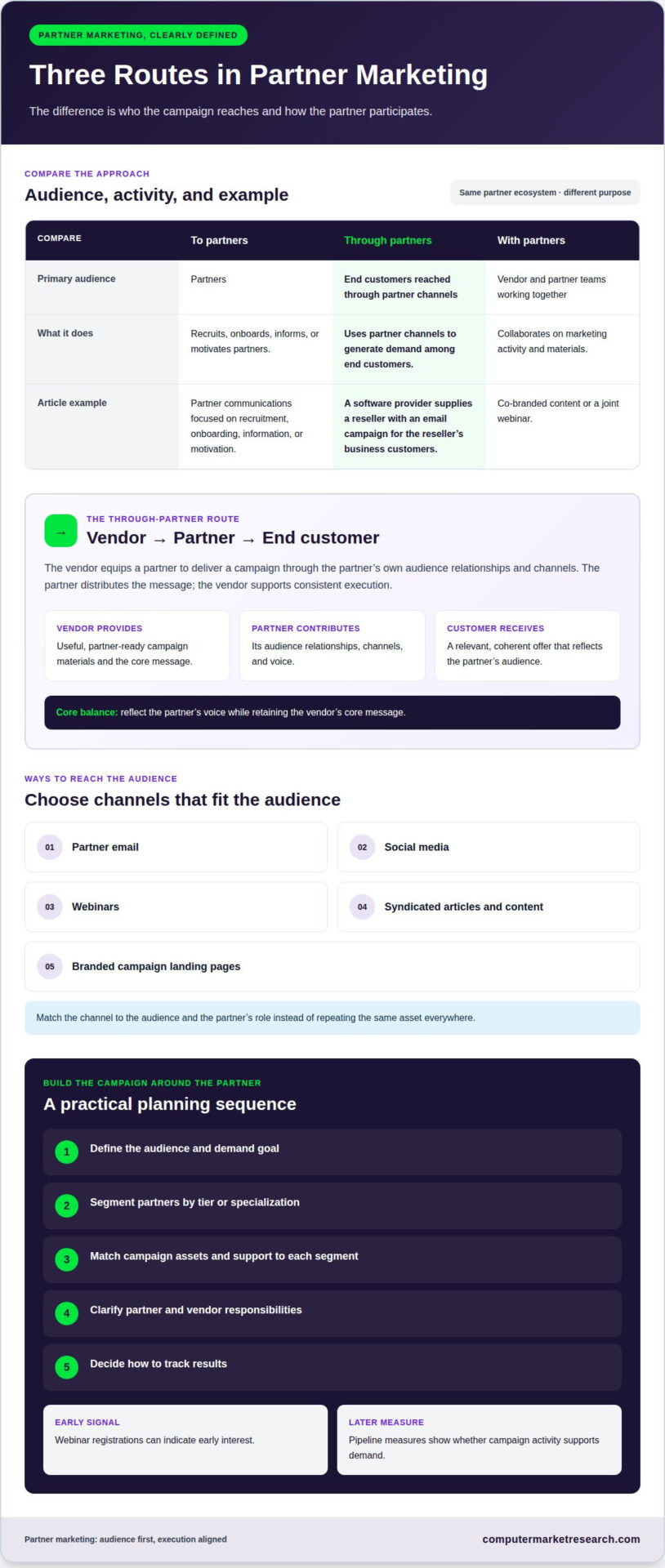
To understand what through-partner marketing is, follow the route from a vendor, through a partner, to an end customer. The vendor enables a partner to deliver branded campaigns through its own audience relationships and channels. For example, a software provider can supply a reseller with an email campaign introducing its product to the reseller’s business customers. The partner distributes the message, while the vendor supports consistent execution.
Partner marketing is the broader discipline of communicating value to, through, and with partners. These approaches serve different audiences. To-partner marketing recruits, onboards, informs, or motivates partners. Through-partner marketing uses partner channels to generate demand among end customers. With-partner marketing involves collaboration between vendors and partners, such as co-branded content or a joint webinar.
Partnership marketing uses relationships between organizations to reach audiences, create value, and support business goals. A technology company might work with a referral partner to introduce a solution to relevant prospects. These relationships can provide access to audiences and expertise that either organization may not reach as effectively alone. Channel marketing often emphasizes distributors and resellers, while partner marketing can also include technology and referral partners.
Through-partner marketing works when vendors equip partners with useful campaign materials that partners can distribute to their audiences. Materials might include email nurturing, social posts, syndicated content, or a campaign landing page. A campaign should reflect the partner’s voice while retaining the vendor’s core message, so customers receive a relevant, coherent offer.
Common channels include partner email, social media, webinars, syndicated articles, and branded landing pages. For example, a manufacturer could provide a distributor with product content and social posts for a coordinated launch. Choose channels that fit the audience and the partner’s role instead of simply repeating the same asset everywhere.
To create a strategy, first define the audience and demand goal, then segment partners by tier or specialization. Match campaign assets and support to each segment, clarify partner and vendor responsibilities, and decide how to track results. A reseller serving a specific industry may need different messaging from a technology partner reaching a broader audience.
To launch a campaign, agree on the offer and target audience, prepare partner-ready assets, and set distribution and follow-up steps. Give partners clear instructions, then track engagement and connect responses to sales opportunities. Webinar registrations, for example, can signal early interest, while later pipeline measures show whether that activity supports demand.
In the United States, campaign teams should account for applicable privacy, advertising, email, and brand-compliance considerations. Requirements depend on the channel, audience, data used, and campaign execution.
Through-partner marketing costs depend on campaign scope, partner participation, asset production, technology, media, and measurement needs. Pricing is provided after a quote request, with the specific work shaping the cost.
2. Common reasons programs underperform
A through-partner marketing program can stall when partners receive assets but lack a clear reason to use them. For example, a distributor may ignore a generic product email if it doesn’t match its customers’ needs. A campaign brief should identify the audience, offer, partner role, and next action. Without steady awareness programs, engagement drops below 15%.
Misalignment is another common challenge. A vendor may prioritize product features, while a partner needs customer-ready messages tied to business outcomes. If teams don’t develop the campaign together, the partner’s sales staff may see it as extra work. Invite partner feedback before launch and revise the messaging to fit their audience.
Unsegmented programs can also waste partner attention. A specialist reseller and a broadline distributor may need different content, timing, and calls to action. Sending both the same assets can make a campaign less relevant. Segment partners by tier and specialization, then tailor the message and support to each group’s market role.
Friction in execution can suppress participation. If partners have to search through email threads for approved copy, images, and instructions, campaigns become harder to manage. A single, organized source for current assets, campaign guidance, and reporting reduces that burden. Clear ownership matters too: partners need to know who handles distribution, lead follow-up, and campaign questions.
Benefits include broader audience access, stronger partner engagement, and campaigns informed by local customer knowledge. Challenges include coordination, consistent messaging, partner participation, and reliable attribution. For instance, a partner may generate interest through its own channels, but disconnected campaign and sales records can obscure which activity influenced an opportunity.
Common risks include outdated assets, inconsistent branding, low partner adoption, and poor data visibility. Reduce these risks by assigning asset ownership, setting a refresh process, and giving partners concise usage guidance. Before launch, align the offer and audience with partner teams. After launch, review participation and response data, then adjust the campaign where engagement is weak.
Measurement gaps can make an effective program appear unsuccessful, or an unproductive one look successful. Track campaign engagement alongside partner participation and sales outcomes, using consistent definitions across teams. If an email earns responses but produces no qualified opportunities, examine its audience, offer, and follow-up process. This helps teams improve the marketing program instead of simply adding more assets.
For transactional purchases under USD 15,000, a one-touch inbound SEO campaign may be appropriate. Through-partner programs should coordinate channels into multi-touch campaigns rather than deploy tactics in isolation.
They should be measured and adjusted, refreshed regularly, and written to sound like the partner’s message while incorporating the vendor’s. These programs should generally account for no more than 10-15% of overall channel marketing investment.
3. Examples of successful partnerships
A local bank sponsoring a 5K race shows how a partnership can connect a brand with a community audience. The bank’s logo on runners’ T-shirts puts its name alongside an event people already value. For a business audience, the equivalent might be a distributor hosting a customer workshop with a vendor. The partner contributes its customer relationships, while the vendor brings relevant expertise. The campaign works best when the event serves attendees, not simply the two organizations’ promotional goals.
Siemens reported unique open rates as high as 70% for some localized partner newsletters. The example highlights the role of audience fit: a partner can adapt a message to local customers and its established communication style. To apply the approach, provide approved product information, then let partners shape the presentation for their markets. Track engagement by partner and campaign. That view can help teams distinguish strong local execution from a message that attracts little attention.
A joint webinar can turn complementary expertise into a practical customer conversation. For example, a software vendor could explain product capabilities while a specialist partner discusses implementation needs in its sector. A shared registration campaign can introduce both organizations to relevant prospects. Afterward, the partners can follow up on attendee questions and identify qualified opportunities. The value comes from a useful discussion and coordinated follow-up, not simply from putting two logos on an invitation.
Referral partnerships create another direct route to demand. A consultant who recognizes a client need can introduce a suitable vendor, while the vendor supports the consultant with clear product information and a defined referral process. The organizations should agree on what makes a lead relevant and how they will handle follow-up. Recording referrals and resulting opportunities helps both sides see whether the relationship contributes to pipeline and where the process needs refinement.
Partnership campaigns also compete for partner attention. One partner marketer described building mindshare among partners working with 12 other vendors. That example makes consistency important: useful assets, timely communication, and follow-through help a campaign stay visible. A practical approach is to coordinate email, social content, and sales outreach around one customer need. Review participation and outcomes together, then adjust the next campaign based on partner feedback and observed results. This keeps the relationship focused on shared growth rather than isolated promotional activity.
Build the campaign around the customer need that drew the strongest response. Partner marketing teams can collaborate with product, marketing, sales, and customer success teams. Product can help review shared materials, marketing can align the message, sales can coordinate next steps, and customer success can flag recurring customer questions. Agreeing on task ownership before a campaign starts can make the partner experience more dependable and clarify where inquiries should go.
After each activity, compare partner feedback with customer questions and follow-up needs. Use those observations to refine materials, clarify responsibilities, or adjust outreach timing. Keep the process straightforward so partners can take part without unnecessary effort. A clear plan for sharing updates and handling questions can support the relationship beyond a single campaign and help both organizations decide what to improve next.
4. Partner marketing tools and platforms
The right platform depends on the audience, campaign workflow, and partner capabilities. A vendor may provide campaign technology, or partners may use their own platforms. For example, a partner with an established email system may prefer vendor-approved assets it can adapt and distribute there. Another partner may need a shared platform to access campaign materials. Choose tools based on how partners work, not on feature lists alone.
Through-channel marketing automation, also called distributed marketing or distributed marketing management, helps vendors make branded campaign assets available in on-demand packages. A partner could select an approved email, social post, or landing page, then tailor it for its audience. This reduces the need to build each campaign from scratch while helping vendors organize shared materials. Content should reflect the products and services both organizations sell together.
A partner platform can centralize campaign resources and give partners a clear place to engage with marketing programs. For example, a distributor could use one portal to find current product messaging and campaign instructions. A well-organized workspace makes the launch process easier to follow. Clear labels for audience, campaign purpose, and asset version also help partners select relevant materials instead of relying on old email attachments.
Funding workflows matter when campaigns use co-op or market development funds. A platform can make eligible campaign packages available alongside fund processes, giving teams better visibility into requests and activity. For example, a vendor might offer a partner a branded webinar package supported by an approved funding allocation. Connecting the campaign plan with the funding workflow helps teams track activity without maintaining disconnected spreadsheets.
Measurement tools should connect campaign activity with partner performance by region or segment. A team could compare email responses, webinar registrations, or landing-page engagement with opportunities recorded in its CRM. This helps show whether campaign activity is reaching the intended audience and contributing to pipeline. Consistent campaign names and partner identifiers are essential because mismatched records make analysis less reliable.
Before selecting platforms, map the workflow from asset creation through partner distribution and performance review. Identify who develops and approves content, where partners access it, and how results are recorded. For example, a campaign manager may own the approved message, while each partner chooses the right channel for its customers. Documenting these roles prevents duplicate work and keeps expertise close to the audience.
Keep the toolset focused. Adding separate systems for assets, funding, and reporting can create more manual handoffs than it removes. Prioritize shared access, usable campaign materials, clear funding processes, and reporting that supports decisions. Then review partner feedback after launch. If partners struggle to locate assets or interpret results, refine the workflow before expanding the program.
5. Partnerships as drivers of demand and ROI
Partnerships drive demand when each organization reaches a relevant audience with a coordinated message. A vendor may bring product expertise, while a reseller contributes customer relationships and local market context. Together, they can target accounts that fit the offer instead of relying on broad exposure alone. The strategic value comes from connecting partner reach to a clear next step, such as a product demonstration or sales conversation.
Co-branded campaigns can combine both organizations’ audiences through email, content, events, and follow-up. For example, a vendor and distributor might promote a webinar, then coordinate outreach to attendees who request more information. The campaign should reach suitable accounts, offer useful content, and connect responses to CRM records. This helps teams see which interactions contribute to pipeline instead of counting activity in isolation.
Measure results across the funnel. Useful KPIs include marketing-qualified leads, sales-qualified opportunities, influenced opportunities, deal registrations, and closed-won revenue. Teams can also track partner participation, campaign responses, referrals, sourced deals, and lead progression. Connecting a partner marketing touch to a CRM opportunity helps distinguish directly generated pipeline from revenue influenced by multiple interactions.
For a practical measurement process, define the target audience and campaign goal before launch. Use consistent campaign and partner identifiers, record engagement, and connect resulting opportunities to the originating activity. Then review sourced pipeline, influenced pipeline, and closed revenue alongside campaign investment. This helps leaders assess ROI and identify where leads stall, such as between an event response and sales follow-up.
Event registrations and webinar attendance can serve as early indicators when building a measurement approach. They show whether partners are promoting an offer and whether the audience is responding, but they don’t establish revenue impact on their own. Pair these indicators with lead qualification, opportunity creation, and closed-won results to see whether a campaign advances demand beyond initial interest.
Investment should reflect the partner’s role. For most partners that resell third-party products and services, suppliers should invest at least 25-30% in to-partner marketing. This supports partner awareness and readiness, while through-partner activity reaches end customers. Teams can compare participation and pipeline across partner segments, then shift campaign support toward approaches that generate qualified opportunities.
ROI improves as teams coordinate channels rather than running disconnected tactics. A webinar, partner email, and sales follow-up can reinforce one offer when timing, messaging, and CRM attribution align. Review performance with partners, identify which audience and channel combinations produce qualified demand, and refine the next campaign. Explore tools for managing partner performance data as part of that measurement workflow.
Computer Market Research
Computer Market Research helps channel teams organize partner workflows and improve visibility into program activity. When campaign execution, partner participation, and sales data sit in separate processes, PartnerPortal™ can centralize partner onboarding, deal registration, and performance tracking. Co-op/MDF Management supports the administration of partner marketing funds, while Rebates & Incentives helps manage related channel programs.
These capabilities are useful when manual tracking makes it difficult to understand partner activity or coordinate program information. Structuring partner processes can help teams manage channel data more consistently. Contact Computer Market Research to discuss your partner program needs.
Make the next partner campaign easier to measure
Understanding what through-partner marketing is gives your team a useful starting point. Make the approach repeatable by choosing a partner journey to improve, assigning ownership for each handoff, and agreeing on the signal that will show whether the work is progressing. A focused pilot can reveal where campaign coordination or data visibility needs attention before the process expands across more partners.
Keep the operating model practical. Partners need a clear role, relevant resources, and a straightforward way to share activity. Your internal teams need consistent records that connect partner engagement to sales outcomes. When those pieces work together, decisions about future campaigns can rely on shared information rather than disconnected updates.
If you’re ready to explore how PartnerPortal™ can support partner program workflows, explore the PartnerPortal™ trial. A more structured approach can give your team a clearer foundation for developing partner-led demand.
Frequently Asked Questions
What is Through-Partner Marketing?
Through-partner marketing is a way for a vendor to reach end customers through a partner’s established audience and communication channels. For example, a manufacturer might equip a distributor with product information for a customer newsletter. The distributor delivers the message in its own market context, while the vendor supports the campaign. This approach works best when the partner has a clear role and the offer fits its customers.
How is through-partner marketing different from channel marketing, affiliate marketing, and partner marketing?
Partner marketing is the broad category; through-partner marketing is one approach within it. Channel marketing usually focuses on reseller and distributor relationships, while partner marketing can also include technology and referral relationships. Affiliate marketing is a specific model in which external marketing partners drive traffic, leads, or sales to a merchant’s website. A reseller’s customer campaign, by contrast, may generate demand through its existing sales and marketing channels.
What tools and platforms support through-partner marketing?
Useful tools include through-channel marketing automation platforms, partner portals, campaign asset libraries, and CRM systems. For example, a vendor can use a partner platform to organize approved campaign materials, while CRM records connect partner activity with sales opportunities. Select tools based on whether partners need vendor-provided technology or can use their own systems. Clear campaign identifiers and current assets help teams coordinate execution and evaluate results.

Article by
Del Heles
Del Heles is the founder and CEO of Computer Market Research (CMR), a channel management software company he launched in 1984. With more than 40 years of experience, he’s known for helping manufacturers and distributors simplify complex partner programs through practical, customer-focused technology solutions.