

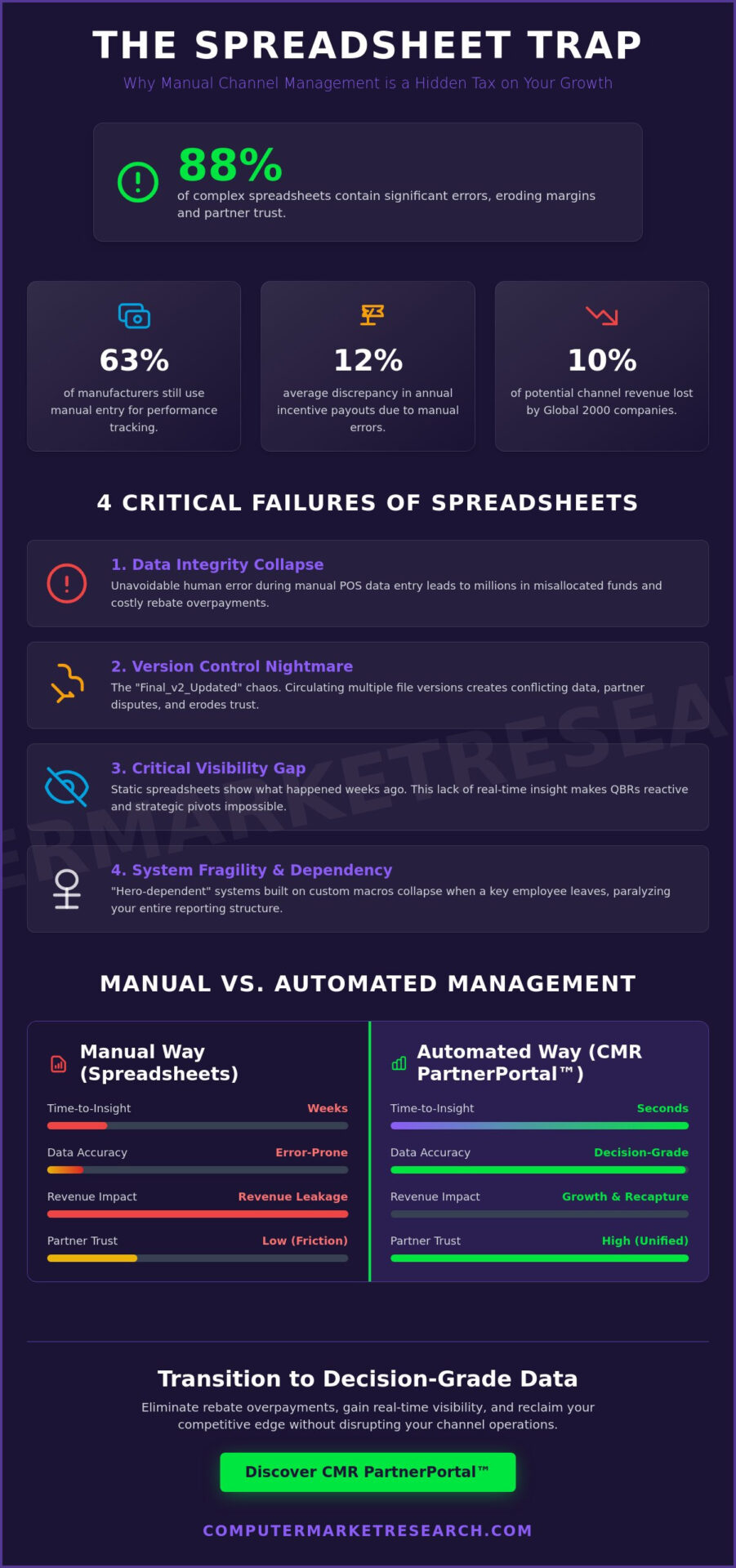
Did you know that 88% of complex spreadsheets contain significant errors as of April 2026? For manufacturers, these inaccuracies aren’t just minor inconveniences; they represent a “hidden tax” on growth. Recent data shows that 63% of manufacturers still rely on manual entry for performance tracking, which leads to a 12% average discrepancy in annual incentive payouts. If you’re struggling with these challenges with spreadsheet-based channel management, you’re likely seeing your margins erode through rebate overpayments and partner friction caused by data silos.
While clean data provides the visibility needed for growth, a robust logistics partner ensures that your physical products move as smoothly as your information. Silicon Valley Direct specializes in eCommerce order fulfillment for manufacturers; you can visit their website to learn how they can support your 3PL needs.
It’s understandable why you’ve stuck with familiar tools, but Global 2000 companies are now losing 10% of their potential channel revenue due to fragmented reporting. You deserve a system that offers stability instead of operational headaches. This guide will reveal why manual processes are sabotaging your ROI and how to transition to automated, decision-grade data management. We’ll examine the path toward clean data and show you how to gain real-time visibility into partner inventory and POS insights to reclaim your competitive edge.
Key Takeaways
- Understand why the “illusion of free” in manual tracking masks significant labor costs and operational vulnerabilities that drain your bottom line.
- Identify the four critical challenges with spreadsheet-based channel management that compromise your data integrity and create version control nightmares.
- Learn how to eliminate “double-dipping” and fraudulent rebate requests by automating your MDF and incentive tracking for better ROI.
- Compare the efficiency of manual systems against automated solutions that reduce your time-to-insight from weeks to mere seconds.
- Discover a clear path to transition toward decision-grade data using CMR PartnerPortal™ without disrupting your existing channel operations.
The Spreadsheet Trap: Why Manual Channel Management Is a Financial Liability
Spreadsheet-based channel management is the manual tracking of partner performance through offline, disconnected files like Excel or CSVs. While these tools are ubiquitous, they create a fragmented view of the Marketing channel, where data exists in isolated silos rather than a unified ecosystem. Many manufacturers fall into the “illusion of free,” assuming that because there are no licensing fees, the cost of management is zero. This perspective ignores the massive labor costs associated with manual data entry and the inevitable error correction that follows. These inefficiencies lead to administrative leakage, where your potential profit disappears into the cracks of unoptimized workflows.
To better understand the limitations of these tools in a professional environment, watch this helpful video comparing common spreadsheet platforms:
The primary challenges with spreadsheet-based channel management emerge as your network grows. In 2026, the complexity threshold for manual tracking is exactly 10 partners. Once a manufacturer exceeds this number, the sheer volume of Point of Sale (POS) data and rebate claims becomes mathematically impossible to manage with high accuracy. Relying on manual processes at this scale isn’t just slow; it’s a financial liability that compromises your ability to make data-driven decisions and maintain partner trust.
The Illusion of Flexibility vs. Operational Rigidity
Excel’s infinite customization is often cited as a benefit, but it’s actually a barrier to standardization. When every partner submits data in a unique format, you’re forced to build custom macros or manual workarounds. This creates “hero-dependent” systems that only one specific employee understands. If that person leaves your organization, your entire reporting structure often collapses. The complexity threshold is the specific point, typically reached at 10 active partners, where the volume of manual data points exceeds a human’s ability to maintain 99% accuracy.
The 12% Revenue Leakage: A 2026 Reality Check
Industry data from April 28, 2026, indicates that manual errors cost manufacturers an average of 12% of their indirect revenue. These losses stem from overpaid rebates, fraudulent claims, and missed sales opportunities that go unnoticed in crowded cells. These data silos prevent you from scaling your channel management strategy effectively. Delayed reporting also makes Quarterly Business Reviews (QBRs) reactive rather than proactive. If your data is three weeks old by the time it’s cleaned, you’re looking in the rearview mirror instead of steering your partners toward growth.
Structural Failures: The 4 Critical Challenges of Spreadsheet-Based Systems
Manual tracking doesn’t just slow your team down; it creates structural vulnerabilities that threaten the stability of your entire distribution network. These challenges with spreadsheet-based channel management manifest in four primary ways that compromise your operational integrity:
- Data Integrity: The “human error” factor is unavoidable during manual POS data entry. When sales operations teams transcribe data from partner reports into a master file, the financial impact of spreadsheet errors can be devastating, often resulting in millions of dollars in misallocated funds.
- Version Control: You’ve likely experienced the “Final_v2_Updated” nightmare where multiple versions of a report circulate through email threads. This lack of a single source of truth leads to conflicting data and partner disputes.
- Visibility Gap: Spreadsheets are static tools that show you what happened weeks ago. They can’t provide the “decision-grade” real-time insights required to pivot strategies in a fast-moving market.
- Security and Compliance: Relying on unencrypted email attachments to transport sensitive partner pricing and inventory data is a major liability. It leaves your organization vulnerable to data breaches and regulatory non-compliance.
The Technical Nightmare of Data Normalization
Merging disparate partner formats like CSV, PDF, and Excel into a single, cohesive view is a hurdle most manual systems can’t clear. This process, a core component of channel data management, is vital for accurate forecasting. Unfortunately, internal teams often spend 80% of their time “scrubbing” dirty data instead of analyzing it. If your staff is stuck fixing formatting errors, they aren’t identifying the market trends that drive growth. This inefficiency turns your highly-paid analysts into data entry clerks, stalling your strategic initiatives.
Scalability vs. Administrative Burden
Adding a new partner to your network shouldn’t translate to an additional 10 hours of manual labor every month. As your channel grows, spreadsheet performance inevitably breaks down. Files that grow into the hundreds of megabytes become sluggish, prone to crashing, and nearly impossible to share. This administrative burden inhibits the speed of your go-to-market strategies, making it difficult to maintain the 10-partner complexity threshold mentioned earlier. Transitioning to automated POS data management ensures your infrastructure supports growth instead of hindering it.
The Financial Impact: Rebate Overpayments and MDF Waste
Financial mismanagement is the most immediate consequence of the structural failures inherent in manual tracking. When manufacturers rely on disconnected files, they open the door to “double dipping,” a scenario where a partner claims multiple incentives for the same transaction. This issue isn’t always a result of bad faith; it’s often a byproduct of the version control issues discussed earlier. These challenges with spreadsheet-based channel management make it nearly impossible to cross-reference claims against actual POS records in real time, leading to significant revenue leakage.
By 2026, the bar for financial transparency has been raised significantly. Enterprises now require automated “clean data” to satisfy rigorous internal and external audits. If your rebate payouts can’t be traced back to a single source of truth, you risk compliance penalties and financial friction with your most valuable partners. Moving away from manual entry ensures that your financial reporting is stable, accurate, and defensible under scrutiny.
Ship & Debit: The High Stakes of Accurate Claims
The Ship & Debit process is a critical mechanism for protecting distributor margins, yet it remains the most error-prone manual task in the channel. These claims rely on specific price protection agreements and volume thresholds that are difficult to track across hundreds of spreadsheet rows. A single typo or an outdated price list can trigger an overpayment that directly erodes your net margin. Automated validation stops revenue leakage at the point of claim by instantly cross-referencing distributor submissions against pre-approved contract terms. Without this automation, manufacturers often lose 3% to 5% of their total incentive budget to simple processing errors.
MDF and Co-op Funds: Tracking the Untrackable
Managing market development funds (MDF) in a manual environment is notoriously difficult. Verifying “proof of performance” usually involves digging through fragmented email threads and disconnected PDF attachments. Spreadsheets fail to link this marketing spend to actual POS sales results, leaving manufacturers with no way to calculate true ROI. A centralized portal streamlines these fund request and approval workflows, ensuring every dollar spent is backed by verifiable data. This visibility allows you to stop funding underperforming activities and redirect resources toward partners who consistently drive growth.
Benchmarking Your Maturity: Manual vs. Automated Channel Management
Evaluating your current operational maturity requires a direct comparison between legacy manual habits and modern automated frameworks. The challenges with spreadsheet-based channel management become most visible when you measure “Time-to-Insight.” In a manual environment, it often takes weeks to collect, scrub, and aggregate partner reports. In contrast, automated systems provide these insights in seconds. This speed is critical for maintaining market agility in 2026. Data accuracy levels shift from an estimated 70% in manual environments to 99.9% with automation, according to industry benchmarks from February 6, 2026.
A 3-year Total Cost of Ownership (TCO) analysis often reveals that while spreadsheets appear free, the labor costs of manual intervention are unsustainable. When you factor in the 12% revenue leakage caused by payout discrepancies, the transition to a dedicated platform becomes a logical financial step. You can request a consultation with CMR to evaluate how automation can stabilize your specific channel operations.
The Partner Experience (PX) Factor
Your partners are businesses too; they value their time as much as you do. Top-tier distributors gravitate toward manufacturers who offer easy-to-use portals rather than forcing them to fill out outdated manual templates. This friction often leads to reporting delays and data gaps that irritate your most productive partners. Automation creates “preferred vendor” status by providing partners with transparency into their own performance and incentive payouts. If you make it easy for a partner to do business with you, they’ll prioritize your products over competitors who still rely on the spreadsheet crutch.
Decision-Grade Insights: From Hindsight to Foresight
Spreadsheets are tools of hindsight; they tell you what happened last month. Modern channel incentive programs require foresight. By utilizing predictive analytics, you can shift from reacting to market changes to anticipating them. Real-time inventory visibility prevents the stockouts and overstock scenarios that plague manual systems. As of April 2026, relying on fragmented data leads to a 15% to 20% margin of error in forecasting. Automation eliminates this uncertainty, providing the clean data necessary for strategic growth and long-term stability.
The Path Forward: Transitioning to CMR PartnerPortal™
The transition from manual tracking to a sophisticated, automated environment is a strategic necessity for manufacturers aiming to scale. While the challenges with spreadsheet-based channel management are significant, moving away from the “spreadsheet crutch” doesn’t have to disrupt your daily operations. A structured migration allows you to maintain business continuity while gradually decommissioning the fragmented files that have historically hindered your growth. By centralizing partner onboarding, deal registration, and performance tracking, you create a stable foundation that supports both your internal team and your external partners.
One of the primary barriers to adoption is the state of existing data. Many organizations fear that their “dirty data” is too disorganized to move into a new system. CMR’s Managed Data Services solve this problem by acting as a specialized extension of your team. Our experts cleanse and normalize your legacy data during the transition, ensuring that the information entering your new ecosystem is accurate and “decision-grade.” This process eliminates the “garbage in, garbage out” risk that often plagues DIY automation attempts.
Centralization is the ultimate antidote to the chaos of manual management. When you consolidate POS Data Management, Lead Management, and Ship & Debit processing into a single web-based infrastructure, you eliminate the data silos that cause payout errors. This shift typically reduces the administrative burden on sales operations teams by 50% to 70%, allowing them to focus on strategic partner development rather than manual data entry. According to industry data from January 8, 2026, 54.2% of finance teams remain only partially automated; jumping ahead of this curve provides a distinct competitive advantage.
Automation Without the Headache
CMR’s approach focuses on seamless ERP and CRM integration, ensuring that your channel data flows naturally into your existing business systems. We recommend a modular implementation strategy, which allows you to start with high-impact areas like Co-op/MDF Management or POS data. This modularity ensures you aren’t overwhelmed by a massive “all-at-once” rollout. Clean data serves as the foundation for all channel growth, providing the visibility you need to manage your incentives with quiet confidence.
Next Steps for Sales Operations
To begin your journey toward operational order, start by conducting a comprehensive channel data audit. This audit will help you identify exactly where revenue leakage is occurring and which manual processes are causing the most friction. Once you’ve identified these pain points, you can visualize a better way forward by seeing your own data requirements in a professional environment. Discover how PartnerPortal™ eliminates spreadsheet chaos. Requesting a live demo allows your team to see how real-time tracking can replace the weeks of “scrubbing” that currently define your month-end reporting cycles.
Scaling Beyond Manual Constraints in 2026
Adopting a modern infrastructure is no longer optional for manufacturers seeking margin durability in an increasingly complex landscape. You’ve seen how manual silos compromise security and lead to financial friction with distributors. By centralizing your operations, you replace the “hero-dependent” model with a systematic framework designed for scale. These challenges with spreadsheet-based channel management won’t disappear on their own; they require an intentional shift toward automated visibility and decision-grade data.
Since 1984, Computer Market Research has helped Fortune 500 and Global 2000 companies navigate this transition with quiet confidence. Our modular SaaS architecture grows alongside your partner ecosystem, while proprietary data cleansing algorithms ensure 99.9% accuracy across your POS and rebate reports. You don’t have to manage the operational headaches of manual data entry alone. Ready to kill the spreadsheet? Schedule a demo of PartnerPortal™ today. Regaining control of your channel data is the first step toward predictable, long-term profitability and stronger partner relationships.
Frequently Asked Questions
Why is managing channel data in spreadsheets considered a risk in 2026?
Spreadsheets lack the robust audit trails and encryption required by 2026 data privacy regulations like GDPR. Storing sensitive partner pricing or customer details in unencrypted files makes your organization vulnerable to data breaches and significant regulatory fines. These manual tools also fail to provide the “hyperautomation” now required to connect finance with procurement and supply chain departments.
How much does manual data entry error typically cost a manufacturer?
Beyond direct payout discrepancies, 60% of financial professionals reported in February 2026 that manual data entry leads to critical operational errors. These inaccuracies frequently result in a 15% to 20% margin of error in forecasting. This level of uncertainty makes it impossible for sales operations to allocate market development funds or inventory with any degree of precision.
Can spreadsheets handle complex Ship & Debit claim processing?
No, spreadsheets generally fail when tasked with the multi-variable logic required for modern Ship & Debit validation. As the volume of data and the number of assumptions increase, 45% of financial professionals find that spreadsheets become unmanageable. Manual systems simply cannot cross-reference real-time contract terms with distributor inventory levels at the speed required by today’s market.
What are the first signs that my company has outgrown spreadsheet-based channel management?
The clearest indicator is a “time-to-insight” that stretches into weeks, leaving your team reacting to old data. You’ve likely outgrown manual systems if your staff spends 75% of their time on data processing rather than strategic analysis. Frequent partner friction regarding slow claim processing or opaque incentive payouts is another definitive signal that your current infrastructure is failing.
Is it difficult to migrate from Excel to a Partner Relationship Management (PRM) system?
Migration is a structured undertaking that doesn’t have to be overwhelming when you use a modular approach. By focusing on one high-impact area, such as POS data or MDF management, you can stabilize your operations before scaling. CMR’s managed services handle the technical heavy lifting by cleansing legacy files to ensure your new system starts with a foundation of clean data.
How does automated channel management improve partner relationships?
Automation builds trust by ensuring partners are paid accurately and promptly without the need for constant manual intervention. Providing a centralized portal where partners can track their own claims in real time reduces the administrative burden on both sides. This transparency eliminates the friction caused by slow processing and helps you maintain “preferred vendor” status in a competitive landscape.
What is the ROI of switching from spreadsheets to a channel management portal?
Switching allows your organization to recover the 10% of potential revenue typically lost to fragmented reporting and data silos. By automating repetitive administrative tasks, you significantly reduce the labor costs associated with the challenges with spreadsheet-based channel management. This shift allows your sales operations team to focus on high-value activities that directly drive channel growth.
Does CMR offer services to help clean my existing spreadsheet data?
Yes, CMR provides specialized Managed Data Services designed to normalize and cleanse legacy channel data during your transition. Our team utilizes proprietary algorithms to identify and correct the 88% of errors typically found in complex spreadsheets. This ensures your move to an automated system is built on decision-grade information rather than existing inaccuracies.

Article by
Del Heles
Del Heles is the founder and CEO of Computer Market Research (CMR), a channel management software company he launched in 1984. With more than 40 years of experience, he’s known for helping manufacturers and distributors simplify complex partner programs through practical, customer-focused technology solutions.