

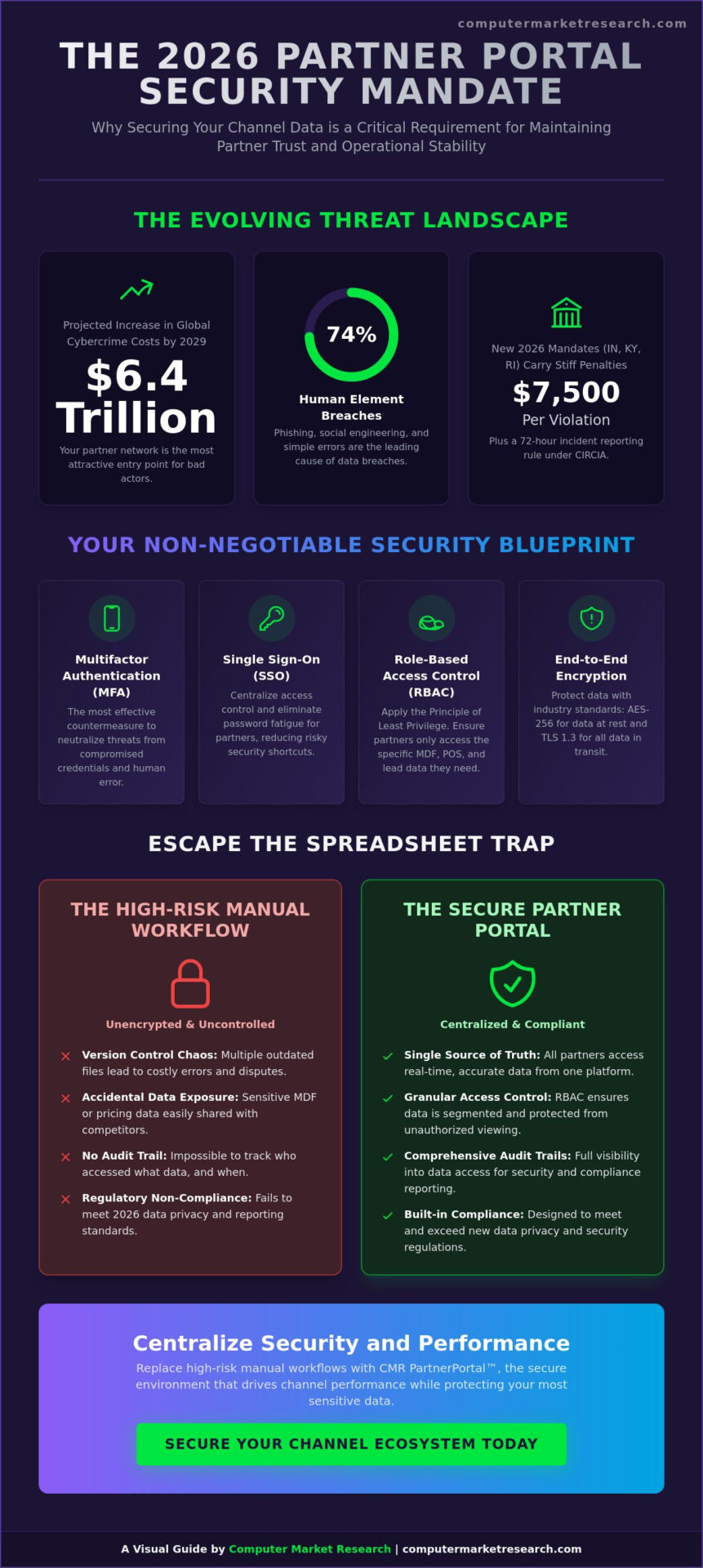
With global cybercrime costs projected to increase by $6.4 trillion by 2029, the margin for error in your channel ecosystem has effectively vanished. Securing sensitive data in a partner portal is no longer just an IT checkbox; it’s a fundamental requirement for maintaining partner trust and operational stability. Since January 1, 2026, new privacy mandates in Indiana, Kentucky, and Rhode Island have raised the stakes, imposing penalties up to $7,500 per violation for mishandled information.
You don’t have to face these evolving regulatory challenges alone. Computer Market Research, a trusted partner of Fortune 500 companies, offers support in our software solutions. Our infrastructure utilizes enterprise-grade AES-256 encryption to ensure your information remains protected at every touchpoint. This level of stability allows your team to focus on performance and ROI rather than data silos and security headaches. Accuracy and order are the only logical paths forward for a growing business.
You’re likely tired of the spreadsheet nightmare where manual data sharing leads to version control chaos and the constant risk of exposing sensitive MDF or pricing data to competitors. We understand that managing hundreds of disparate logins shouldn’t feel like a security liability. This guide provides the technical and strategic framework you need to protect your channel data while ensuring your partners enjoy seamless, secure access. We’ll examine how to automate data sharing, meet 2026 compliance standards like the Indiana Consumer Data Protection Act, and replace manual workflows with a secure environment that drives performance.
Key Takeaways
- Identify the evolving 2026 threat landscape and learn how to quantify the financial and reputational costs of a channel data breach.
- Discover the essential technical requirements for securing sensitive data in a partner portal, including the mandatory implementation of Multifactor Authentication (MFA) and Single Sign-On (SSO).
- Learn how to apply Role-Based Access Control (RBAC) and the Principle of Least Privilege to ensure partners only access the specific MDF and POS data they need.
- Master a four-step framework to audit your current data workflows and transition away from high-risk manual spreadsheet sharing.
- Explore how centralizing your channel operations within a secure environment like CMR PartnerPortal™ leverages AES-256 encryption to protect your corporate network.
Why Securing Sensitive Data in a Partner Portal is Critical in 2026
Industrial espionage doesn’t just live in the pages of a spy novel; it’s a daily reality for manufacturers in 2026. Your partner network has become the most attractive entry point for bad actors. Securing sensitive data in a partner portal is critical because these platforms house the blueprint of your market strategy, from competitive pricing to future product roadmaps. When these portals are left under-protected, you aren’t just risking a single file; you’re handing over the keys to your entire indirect sales engine.
Relying on legacy systems creates a “glass house” effect where one compromised credential can shatter your entire operation. Since 74% of data breaches involve a human-like social engineering, the vulnerability isn’t just in your code, but in your partner’s habits. If you don’t have a centralized, secure environment, you’re essentially trusting hundreds of external entities to maintain your corporate security standards on your behalf.
The High Value of Channel Data
Your Point of Sale (POS) data and inventory reports are gold mines for both your business and your competitors. If a rival gains access to your MDF allocation or lead distribution patterns, they can systematically underbid your partners or poach your high-value prospects. Unauthorized access to these records doesn’t just lose a single deal. It erodes the competitive advantage you’ve spent years building. Protecting proprietary lead data from unauthorized partner access is the only way to prevent internal channel conflict and external data poaching.
Regulatory Pressure and the Spreadsheet Trap
The financial fallout of a breach is now compounded by aggressive state-level enforcement. As of January 1, 2026, laws in Indiana and Kentucky mandate opt-in consent for sensitive data, with civil penalties reaching $7,500 per violation.
The Cyber Incident Reporting for Critical Infrastructure Act (CIRCIA) final rule, effective May 2026, requires reporting cyber incidents within 72 hours. This regulatory pressure makes the “spreadsheet trap” a liability you can’t afford. Manual data sharing via unencrypted files is a security nightmare that lacks version control, encryption, and audit trails. It’s the primary obstacle to achieving clean, actionable insights.
Moving Beyond Perimeter-Based Security
Traditional firewalls stop at your office door, but your data lives in a decentralized ecosystem. You need a model that protects the data itself rather than just the network it sits on. Implementing Role-based access control (RBAC) ensures that a distributor in Rhode Island can’t view the rebates meant for a partner in California. This granular visibility is the cornerstone of securing sensitive data in a partner portal today. Channel Data Security is the strategic intersection of PRM and cybersecurity that ensures only verified users interact with specific data tiers.
Foundational Security Measures for Modern Partner Portals
Building a secure channel ecosystem starts with a robust foundation that doesn’t compromise the partner experience. While some organizations focus solely on administrative access, true security requires a universal approach for every user in the chain. Securing sensitive data in a partner portal starts with Multifactor Authentication (MFA). It’s the most effective way to neutralize the 74% of breaches caused by human error, such as phishing or social engineering.
Security shouldn’t be a burden. Implementing Single Sign-On (SSO) integration centralizes your access control while eliminating the “password fatigue” that often leads partners to take dangerous shortcuts.
Encryption standards are equally critical. Protecting your data requires AES-256 encryption for information at rest and TLS 1.3 for all portal communications. These protocols ensure that even if data is intercepted, it remains unreadable to unauthorized parties. To further mitigate risk, automated session management prevents unauthorized access from abandoned portal tabs by terminating idle connections. This proactive stance ensures that sensitive records aren’t left exposed on shared workstations at a distributor’s office.
Identity and Access Management (IAM)
Federated identity models allow you to streamline partner onboarding by trusting the partner’s own identity provider. This reduces administrative overhead and ensures that when an employee leaves a distributor’s firm, their access to your portal is revoked automatically. You should also consider “Just-in-Time” (JIT) access, which grants permissions only when needed for a specific task. This approach follows NIST Cybersecurity Best Practices for third-party risk management, significantly shrinking your digital attack surface.
Encryption and Data Integrity
Data must be shielded at every stage of its journey. High-performance channel data management relies on encrypted data pipelines to maintain the integrity of Point of Sale data and inventory reports. To verify that reports haven’t been tampered with during transmission, digital signatures provide an immutable layer of authenticity. This ensures that the actionable insights you receive are accurate and trustworthy, which is the only logical path for a growing business.
Moving away from manual processes is the first step toward this level of control. If you’re ready to see how an automated environment can replace your current “spreadsheet silos,” you can explore our secure infrastructure to understand the difference between basic gatekeeping and true data protection.
Granular Visibility: Protecting MDF and POS Data with RBAC
Role-Based Access Control (RBAC) in a channel context is the digital equivalent of a “need-to-know” basis. It’s the mechanism that prevents a reseller in one territory from viewing the proprietary pricing or inventory levels of a competitor in another. Securing sensitive data in a partner portal depends on this granular control to ensure that information doesn’t leak horizontally across your ecosystem. This approach treats Data Privacy as a Strategic Imperative, allowing you to build deeper trust with partners who know their data is shielded from their rivals.
The Principle of Least Privilege gives partners only the specific data points they need to perform their roles, you minimize the potential damage of a compromised account. Dynamic data masking further strengthens this by showing the “what” without revealing the “who.” For example, a regional manager might see that sales are up 12% without seeing the specific customer PII behind those transactions. Combined with comprehensive auditing that tracks every view and modification, you create a transparent yet secure environment. With over 245,000 software supply chain attacks detected recently, having a clear audit trail is no longer optional.
Segmenting Partner Access
Different partners require different levels of visibility. A service partner needs technical documentation, but they shouldn’t have access to your market development funds (MDF) allocation strategies. Restricting MDF visibility to approved regional managers prevents budget leaks and ensures that financial incentives remain confidential. This segmentation eliminates the risk of horizontal data leaks, ensuring that competing partners in the same portal remain isolated from each other’s proprietary information.
Securing Point of Sale (POS) Data
POS data is often the most sensitive information you share. Automating the collection and cleansing of this data is essential to remove PII and maintain compliance with 2026 regulations like the RIDTPPA in Rhode Island. Decision-grade insights require a secure, normalized environment where inventory dashboards are set to “view-only” for most users. This prevents accidental modifications while providing the visibility needed to manage stock levels effectively. By securing sensitive data in a partner portal through these specific technical steps, you turn your channel data into a protected asset rather than a liability.
How to Implement a Secure Partner Data Strategy: A Step-by-Step Guide
Transitioning from a fragmented, manual environment to a centralized system is a strategic necessity for any manufacturer scaling their indirect sales. Securing sensitive data in a partner portal involves a logical progression from auditing current vulnerabilities to implementing automated, data-centric defenses. This journey replaces the “headaches” of manual oversight with a systematic framework designed for long-term stability and accuracy.
Step 1: Audit your current data sharing workflows. You must identify where sensitive information currently resides. If your team still relies on “spreadsheet silos” or unencrypted email attachments to share POS reports, you have an immediate security liability. Use this audit to map how data flows between your CRM, ERP, and external partners.
Step 2: Define your data sensitivity tiers. Not all information requires the same level of protection. Categorize your assets into four tiers: Public, Internal, Confidential, and Restricted. For example, marketing collateral is public, but your regional market development funds (MDF) allocations should be restricted to specific financial controllers.
Step 3: Select a secure partner relationship management (PRM) system. Choose a platform built with a “security-first” architecture. Look for native support for AES-256 encryption and seamless integration with your existing identity providers.
Step 4: Configure RBAC and MFA. Once your platform is live, enforce Multifactor Authentication for every user. Apply the Principle of Least Privilege by configuring Role-Based Access Control so that partners only see the data essential to their specific territory or product line.
Step 5: Establish a monitoring and incident response plan. With the CIRCIA final rule effective May 2026, you must be prepared to report cyber incidents within 72 hours. Automated logging ensures you have the audit trail necessary to meet these strict federal deadlines.
Auditing Your Channel Ecosystem
Identifying where data “lives” is the first step toward reclaiming control. Many organizations find that 60% of their channel data is scattered across local drives and legacy portals that lack modern encryption. Conduct a gap analysis against 2026 security standards, such as the new CCPA/CPRA regulations effective January 1, 2026. This process ensures your infrastructure can handle the expansion of cybersecurity audits and risk assessments required by law.
Continuous Security Optimization
Security is a process, not a one-time event. Schedule quarterly access reviews to de-provision inactive partner users, which reduces the risk of credential theft. Automated “heartbeat” checks on your API integrations ensure that data pipelines remain secure and functional. By educating your partners on their role in this ecosystem, you transform security from a technical hurdle into a shared value that strengthens the manufacturer-distributor relationship. If you’re ready to eliminate manual errors, request a security-focused consultation to begin your migration with one of our experts.
Centralizing Security and Performance with CMR PartnerPortal™
CMR’s PartnerPortal™ serves as the definitive solution for manufacturers who have outgrown the risks associated with manual channel management. By centralizing your operations within a single, secure environment, you eliminate the fragmentation that leads to data leaks and operational headaches. Securing sensitive data in a partner portal is a standard feature of our architecture, utilizing AES-256 encryption and advanced RBAC configurations to protect your intellectual property from the moment it enters the system. This technical competence ensures that your competitive pricing and market strategies remain confidential while your partners gain the visibility they need to succeed.
Scalability is a core requirement for global organizations. Our platform is engineered to secure thousands of partners across multiple regions without degrading performance or compromising security standards. If your business operates across borders, you need a system that can handle diverse regulatory requirements while maintaining a unified security posture. CMR provides this stability by offering real-time visibility and “clean data” to the right users, ensuring that your decision-grade insights are never compromised by unauthorized access or manual errors.
Automated Compliance and Reporting
Maintaining an audit-ready environment is essential as federal and state regulations tighten. CMR simplifies the Managed Data Services burden by generating comprehensive reports on partner data access and MDF usage automatically. This functionality ensures you’re prepared for the strict 72-hour reporting windows mandated by the CIRCIA final rule effective May 2026. Our cloud-ready infrastructure marks the final “death of the spreadsheet” in your organization, replacing high-risk manual entry with a secure, automated pipeline that keeps you ahead of 2026 data protection mandates.
Next Steps: Securing Your Channel Future
Modernizing your partner ecosystem requires a clear path from your current state to a secure, automated future. CMR integrates seamlessly with your existing tech stack, including your CRM and ERP systems, to ensure data flows securely across your entire enterprise. This integration eliminates data silos and ensures that your POS and inventory records are always accurate and protected. To move beyond the limitations of manual processes, you can schedule a demo of PartnerPortal™ to see our security architecture in action. A specialized consultant can help you conduct a security audit of your current processes and identify the most efficient route to a fully secured channel environment.
Future-Proofing Your Channel Ecosystem
The shift toward a secure, automated channel environment is no longer a luxury for manufacturers; it’s a prerequisite for sustainable growth. By moving away from high-risk manual processes and implementing granular access controls, you transform your portal from a potential liability into a strategic asset. Securing sensitive data in a partner portal requires a blend of technical competence and a deep understanding of the manufacturer-distributor relationship. This transition ensures your proprietary information remains protected while providing partners with the seamless experience they expect in 2026.
You don’t have to face these evolving regulatory challenges alone. With 40 years of channel data expertise, Computer Market Research is a trusted partner for Fortune 500 and Global 2000 organizations. Our infrastructure utilizes enterprise-grade AES-256 encryption to ensure your information remains protected at every touchpoint. This level of stability allows your team to focus on performance and ROI rather than data silos and security headaches. Accuracy and order are the only logical paths forward for a growing business.
Secure your channel data today with CMR’s PartnerPortal™.
Taking the first step toward a centralized, secure ecosystem is a vital move for any scaling organization. We’re here to help you build a more resilient and profitable channel future.
Frequently Asked Questions
What is the most common cause of data breaches in partner portals?
The human element, specifically compromised credentials, remains the leading cause of security failures. Phishing and social engineering target your partners’ employees to gain unauthorized entry. Securing sensitive data in a partner portal requires moving beyond simple passwords to a system that doesn’t rely on human memory or discretion. Implementing automated defenses reduces the risk that a single stolen credential can compromise your entire corporate network.
How does Zero Trust architecture apply to partner relationship management?
Zero Trust architecture operates on the principle of “never trust, always verify.” Every request for data access is authenticated and authorized regardless of the user’s location or previous activity. In a partner ecosystem, this means continuous verification of device health and user identity before granting access to sensitive POS or inventory records. It’s a shift from perimeter security to granular, per-session validation that protects your core assets.
Can I restrict specific partners from seeing my pricing strategy in a shared portal?
You can absolutely restrict visibility using Role-Based Access Control (RBAC). This allows you to define specific permissions for different partner tiers, ensuring a reseller in one region can’t view the pricing strategies or rebates meant for another. By segmenting your portal, you maintain a competitive advantage and prevent horizontal data leaks. This level of control is essential for managing complex global distribution networks without exposing proprietary financial data.
Is MFA really necessary for all partner users, or just administrators?
Universal MFA is mandatory for all partner users to prevent lateral movement within your network. While administrators hold more power, standard users often possess the credentials that attackers use as an initial entry point. Securing sensitive data in a partner portal is only effective if every access point is protected. Requiring MFA for all users prevents a catastrophic breach of your channel data. One extra layer of security can mean the difference between safety and data breaches.
How do I ensure my partner portal is compliant with GDPR and other 2026 regulations?
Compliance requires a combination of technical encryption and rigorous data management practices. You must implement features that support the California Delete Act’s DROP platform requirements, which became operational on January 1, 2026. Ensuring your portal supports data minimization and provides automated audit trails will help you meet the evolving standards of GDPR and new state laws. Regular updates to your security protocols are necessary to stay aligned with these mandates.
What happens to a partner’s data access if they leave their organization?
Access is terminated immediately through automated de-provisioning or federated identity integrations. When a partner’s employee leaves their firm, your system should sync with their internal directory to revoke portal permissions in real-time. This prevents “zombie accounts” from becoming easy targets for hackers. Maintaining a clean user list is a critical component of a proactive security strategy.
How often should I audit my partner portal’s security logs?
You should conduct comprehensive security audits at least once every quarter. While automated systems provide real-time alerts for suspicious activity, a scheduled manual review helps identify long-term patterns or configuration gaps. These audits ensure that your RBAC settings still align with your business goals and proper removal of inactive users. Consistent monitoring is the only way to maintain the integrity of your channel data over time.
Can smart data masking prevent partners from seeing end-customer details?
Smart data masking hides Personally Identifiable Information (PII) while still providing the actionable insights your partners need. For example, a distributor can see that a specific product sold 500 units without seeing the names or addresses of the end customers. This allows for effective inventory and lead management without violating privacy regulations. It’s a balanced approach that protects consumer privacy while supporting the transparency required for successful channel partnerships.

Article by
Del Heles
Del Heles is the founder and CEO of Computer Market Research (CMR), a channel management software company he launched in 1984. With more than 40 years of experience, he’s known for helping manufacturers and distributors simplify complex partner programs through practical, customer-focused technology solutions.