

A large partner roster can mask an underperforming program. Designing a scalable partner program means measuring whether partners activate, contribute to deal flow and revenue, and remain engaged over time, not simply counting sign-ups.
It may seem that recruiting more partners should create more opportunities. But without clear performance measures and consistent tracking, it is difficult to see which relationships produce results or where processes slow down. Sustainable growth depends on reliable data.
This guide explains how to measure partner program success and build repeatable processes for recruitment, onboarding, engagement, and growth. You’ll learn which indicators reveal partner contributions, how to structure onboarding and support, and how deal tracking, incentives, and performance reviews can help refine the program as it expands. The goal is an operation that can grow without relying on manual work or fragmented information.
Key Takeaways
- Measure partner contribution through activation, deal flow, revenue, and ongoing engagement, not recruitment totals alone.
- Structure partner relationships around recruitment, onboarding, engagement, and growth, with clear milestones for each stage.
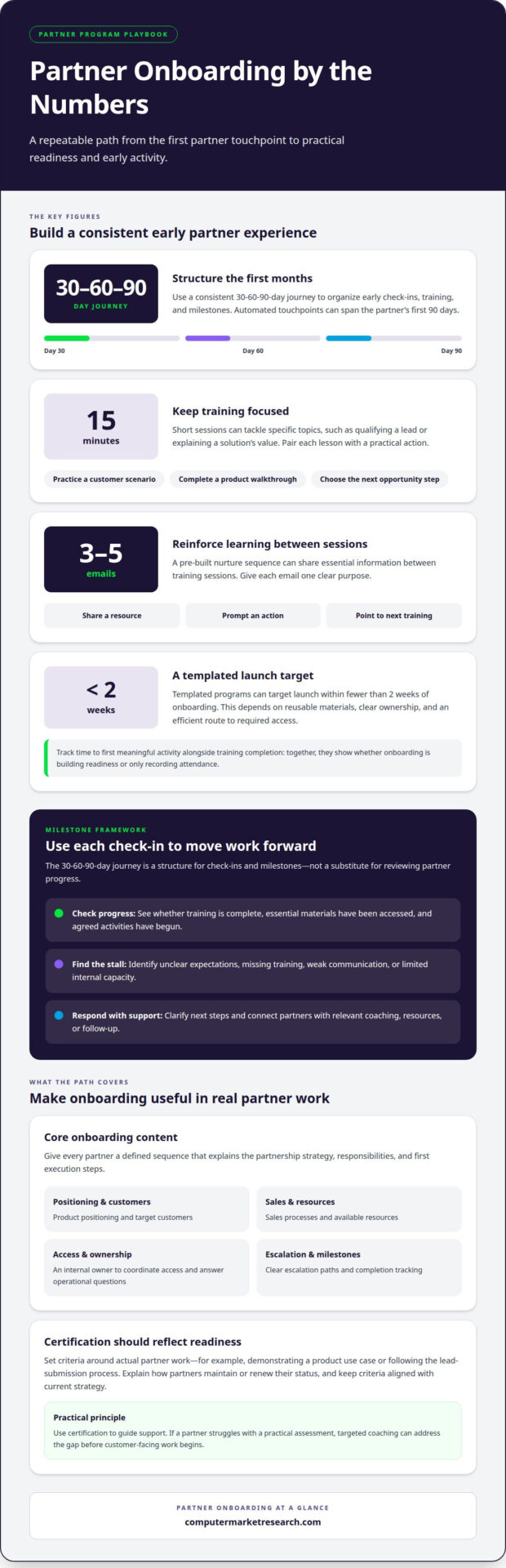
- Use a consistent 30-60-90-day onboarding journey to guide training, check-ins, and early partner activity.
- Match support and service levels to partner needs, so strategic relationships receive focused attention while repeatable processes support broader reach.
- Review program data and partner feedback regularly to identify bottlenecks and refine processes as the program grows.
Recruitment, onboarding, engagement, and growth stages
Build the program around four connected stages: recruitment, onboarding, engagement, and growth. Give each stage clear ownership and measurable milestones.
Recruitment and Onboarding Stages
Recruit partners against an ideal profile that reflects your target customers, markets, and sales approach. Then standardize onboarding so every new relationship receives the same core information, enablement, and next steps. A 30-60-90-day journey can structure early check-ins and milestones. As the program grows toward the 25-50-partner scaling stage, consistent processes help prevent recruitment volume from overwhelming partner support.
Partner Engagement Stages
Engagement should continue beyond onboarding, with regular communication shaped by partner activity and needs. Set clear next steps for partners who register deals, share leads, or join joint initiatives. Review progress at each stage, then address delays with relevant training or follow-up. When designing a scalable partner program, use a consistent engagement framework while tailoring support to partner performance and business priorities.
Structured Growth Opportunities
Partnership teams also need defined growth opportunities for their employees. Map roles to business goals, then show how team members can take on greater responsibility as the program expands. For example, an employee who supports onboarding could progress to managing partner strategy. Structured career paths connect individual development with program needs and can help reduce stagnation and turnover as responsibilities evolve.
Forecast partner-sourced revenue by estimating contributions from active partners, deal flow, and conversion through the sales process. Forecast program costs by mapping the resources needed for recruitment, onboarding, enablement, and ongoing partner support, then compare those costs with expected revenue.
A predictable growth model links each stage to a decision: recruit against the partner profile, onboard to defined milestones, sustain engagement, and expand relationships that show measurable contribution. Review partner revenue alongside activity. A large roster without active deal flow points to a different issue than strong deal flow with slow conversion.
Find gaps by identifying where partners stop progressing, then determine whether the cause is unclear expectations, insufficient training, weak communication, or limited internal capacity. Common failure points include recruiting partners who don’t fit business goals, inconsistent onboarding, and tracking activity without acting on it. A regular review of stage progress can show where the process needs adjustment.
Partner onboarding, training, and certification
Partner onboarding turns a recruitment decision into a working relationship. A consistent process gives each partner the information, access, and guidance needed to take action.
Build a repeatable onboarding path
Start with a defined sequence covering the partnership strategy, responsibilities, and first execution steps. Include product positioning, target customers, sales processes, available resources, and escalation paths. Assign an internal owner to coordinate access and answer operational questions, then track completion against clear milestones.
Automated onboarding touchpoints can span a partner’s first 90 days, including check-ins and performance-review triggers. Use these moments to identify stalled actions, clarify expectations, and connect partners with relevant support. A simple status view can show whether each partner has completed training, accessed essential materials, and begun agreed activities.
Make training practical and consistent
Training works best when partners can apply it directly to customer conversations. Break complex material into focused sessions, demonstrations, and reusable reference content. Short training sessions lasting 15 minutes can make it easier to address specific topics, such as qualifying a lead or explaining a solution’s value.
Pair each lesson with an action: rehearse a customer scenario, complete a product walkthrough, or identify the right next step for a sample opportunity. Follow up to find out where partners need clarification. This connects learning with execution instead of treating course completion as proof of readiness.
A pre-built nurture sequence can include 3-5 emails that reinforce essential information between sessions. Each message should have one clear purpose, such as sharing a resource, prompting a specific action, or directing the partner to the next training module.
Use certification to clarify readiness
Certification can define the knowledge or skills required for specific partner activities. Set criteria that reflect actual work, such as demonstrating a product use case or following the lead-submission process. Explain how partners maintain or renew their status, and keep the criteria aligned with current strategy.
Certification should guide support, not become a disconnected administrative hurdle. If a partner struggles with a practical assessment, targeted coaching can address the gap before customer-facing work begins.
Templated programs can target launch within fewer than 2 weeks of onboarding. This depends on having reusable materials, clear ownership, and an efficient route to required access. Track time to first meaningful activity alongside training completion; the two measures reveal whether onboarding is creating readiness or merely recording attendance.
For a structured way to support partner onboarding and execution, explore a partner onboarding workflow built around centralized partner processes.
Partner portals, deal registration, and lead sharing
A shared partner portal gives organizations a consistent place to submit leads, register deals, and track progress. Clear roles and data-handling procedures make these workflows easier to manage as participation grows.
Partner Roles and Lead Handoffs
Define who identifies an opportunity, submits its details, follows up, and owns the next customer interaction. For example, a partner can submit a lead while an internal sales representative accepts it and records the next action. Set handoff criteria, status definitions, and an escalation path so partners know what to expect when ownership changes.
Deal registration documents an opportunity and its assigned owner. A consistent process shows whether a submission is new, under review, or progressing through sales. Record the decision and next step in the same workflow. This gives both organizations a shared reference point and helps prevent duplicate outreach.
Content, Leads, and Sales Support
Give partners practical materials they can adapt for customer conversations. Useful assets include emails, solution briefs, ebooks, and landing pages. Reusable content can be tailored to a campaign, industry, region, or partner while keeping the core value proposition consistent. Pair each asset with a clear use case and next action.
Lead sharing works best when submission fields capture the details needed for follow-up, such as customer context and opportunity information. Use centralized tracking to show receipt, assignment, and progress. Give partners visibility into status and an efficient way to raise questions. These steps connect content, leads, and sales support to measurable program success.
Compliance and Data Sharing
For a United States partner program, document what data partners may share, why it is shared, who can access it, and how it moves between organizations. Define retention and escalation procedures, then map applicable federal and state requirements to the data and activities involved.
Before launch, align partner agreements, portal permissions, and sales workflows with those documented rules. For example, limit lead details to users handling that opportunity, and provide a process for correcting or removing inaccurate records. Clear ownership helps teams apply consistent controls across partner relationships.
Review lead tracking for completeness and actionability: every accepted submission should have an owner, a status, and a next step. If records stall after handoff, find out whether unclear roles, missing details, or delayed follow-up caused the gap. Resolve the process issue before adding more submissions to the same workflow.
Deal Registration can support this structure by recording opportunities and making their progress easier to track. A centralized workflow helps teams manage partner submissions, internal ownership, and status updates without relying on scattered spreadsheets or email threads.
Partner tiers and matching service levels to partner needs
Partner tiers link support levels to partner contribution, capability, and growth potential. A clear model helps channel teams allocate their time without treating every relationship identically.
One proposed segmentation model assigns 20% of partners to the top tier, 60% to the middle tier, and 20% to the bottom tier. Use these proportions as a planning framework, then assess actual partner activity and strategic fit. Tier placement should reflect measurable criteria, such as revenue contribution, deal flow, market reach, and capacity to execute.
Match service to the relationship’s needs. A one-to-one model suits 3-5 strategic partners through customized programs, dedicated resources, and joint planning. A one-to-few approach can support 10-25 growing, regional, or vertical-specialist partners. For 50+ long-tail, reseller, or emerging partners, a one-to-many model makes repeatable resources and self-service more practical.
- Strategic partners: Coordinate joint plans, executive alignment, and tailored support.
- Growth partners: Provide shared playbooks, focused enablement, and regular progress reviews.
- Long-tail partners: Use standardized resources, clear workflows, and self-service access.
Partner type also affects tiering. Referral partners introduce prospective customers, while resellers take a more direct role in selling or distributing the offering. Integration partners connect complementary solutions, so their needs may focus on technical coordination and joint value messaging. Set service levels around each partner’s role, contribution, and customer-facing responsibilities.
A self-service portal can help a broad partner ecosystem access current materials, submit opportunities, and review program information without requiring individual support for every routine task. Standardize reusable assets, then adapt them for industries, regions, campaigns, and partner needs. A reuse rate above 70% is a target for programs using shared infrastructure rather than custom builds. This can help teams scale support while preserving consistent channel messaging.
Plan service and training costs by identifying the resources each tier requires. Dedicated planning, customized content, and direct support demand a different level of internal effort than shared training and self-service materials. Track staff time, content production, and operational work by tier, then compare that effort with partner activity and outcomes. This makes the trade-offs visible without assuming every partner needs the same investment.
Structure incentives around defined outcomes, such as qualified referrals, completed sales, or agreed joint activity. State eligibility, measurement, payment timing, and review procedures clearly, and keep the rules consistent within each partner tier. Commissions and rewards should reflect the partner’s role and contribution, while remaining simple enough to administer accurately. A well-designed partner incentive strategy helps connect reward decisions with program goals.
Partner program performance optimization
Optimization starts by connecting partner activity to business outcomes, then changing processes that limit performance. A useful review examines whether partners launch, generate qualified opportunities, influence revenue, and receive support suited to their contribution.
Begin with an audit of active partner programs from the past 12 months. Review onboarding, training and certification, co-marketing, business plans, deal and lead flow, commissions, partner agreements, and the technology stack. For each area, identify the current process, its owner, the available data, and the operational gap. This creates a clear baseline for prioritizing improvements instead of changing workflows without evidence.
Use a consistent set of measures to connect activity with outcomes. For example, compare enabled partners with partners who launch, then assess whether launched partners generate deal flow or revenue. More than 50% of enabled partners launching programs is a suggested benchmark. Treat it as a signal to investigate activation, not as a complete measure of program success.
- Activation: Track whether enabled partners begin agreed program activities.
- Opportunity flow: Review lead submissions, registered deals, and progression.
- Business contribution: Connect partner activity with influenced revenue and program objectives.
- Operational friction: Identify delays, incomplete records, and repeated manual work.
Build two views of performance. Run executive partner-marketing dashboards monthly to connect program results with business priorities. Review operational partner-marketing dashboards weekly to spot stalled leads, incomplete actions, or process errors. Separate these views so executives can assess direction while operators can act on current workflow issues.
Automation helps make those reviews actionable. Route a record for follow-up when a deal lacks an owner, or flag a partner whose submitted opportunities remain inactive. Keep definitions consistent so teams interpret statuses and outcomes the same way. When a process changes, compare subsequent results with the baseline and document the change. This links insights to execution instead of leaving findings in a dashboard.
As partner activity grows, evaluate whether manual administration still supports accurate reporting. A partner relationship management system may be worth considering when 20+ partners are driving real value. Assess whether it can centralize the workflows and data your team actually uses. Then prioritize the gaps with the greatest impact on partner progress, revenue visibility, and operational control.
Use a partner program performance workflow to bring tracking and review processes into a more consistent operating rhythm.
Computer Market Research: PartnerPortal™
Computer Market Research offers PartnerPortal™, a cloud-based platform that centralizes partner onboarding, deal registration, and performance tracking. It helps organizations bring key channel workflows together as partner activity grows, improving visibility into submissions and program performance.
When managing partner funds or rewards is part of the operational challenge, Co-op/MDF Management and Rebates & Incentives support those processes. These offerings address common administrative needs while complementing the performance measures and partner stages established for the program.
Consider this next step when fragmented records, manual tracking, or disconnected workflows make it harder to understand partner contribution. Contact Computer Market Research to discuss how PartnerPortal™ may fit your partner program.
Put Your Next Growth Decision Into Motion
The next step is to turn your program’s priorities into an operating plan. Choose the process that most limits progress, assign an owner, and define what evidence will show whether a change is working. That focus helps teams improve with discipline instead of adding complexity for its own sake.
Designing a scalable partner program is an ongoing management practice, not a one-time setup. As partner needs and business goals shift, revisit the assumptions behind your workflows and tie decisions to measurable outcomes. A steady improvement cycle gives your team a clearer basis for allocating effort and expanding what works.
Computer Market Research can help organizations align partner operations with their growth plans. If you’re ready to discuss a practical next step for your program, connect with Computer Market Research. A more structured approach can give your team a sound foundation for the next stage of growth.
Frequently Asked Questions
How can businesses measure the success of their partner programs?
Measure partner contributions against defined business outcomes, such as qualified opportunities, revenue, retention, and program costs. Separate partner-sourced revenue from partner-influenced revenue to distinguish who originated an opportunity from who helped advance it. Compare results with a baseline from before a program change, then review performance by partner type or market. This shows whether improvements are broad or driven by a small number of relationships.
What makes a channel partner program scalable?
A scalable channel partner program uses repeatable workflows, consistent data definitions, and support levels suited to partner needs. It also makes ownership clear, so teams know who handles recruitment, approvals, partner questions, and performance reviews. For example, an exception process can route unusual deal requests to an assigned owner instead of relying on informal messages. These operating rules help the program expand without making every partner interaction a custom process.
What are the 4 stages of partnership?
The four stages are recruitment, onboarding, engagement, and growth and optimization. Recruitment establishes fit and expectations; onboarding prepares partners to act. Engagement sustains activity through communication and relevant support. Growth and optimization improve productive relationships and refine the program. Define a transition point between stages, such as agreed onboarding milestones, so partners and internal teams understand what progress looks like.
What are the key components of a scalable partner program?
Core components include program goals, an ideal partner profile, defined partner roles, enablement, operational workflows, and performance measures. Add a documented value proposition that explains why partners should participate and how customers benefit. For example, a distributor-facing program may need clear rules for deal ownership and incentive eligibility. Align these components before launch, then revisit them as the company enters new markets or partner needs change.
How do you define partner tiers and qualification criteria?
Define tiers using criteria tied to program goals, such as partner capabilities, market fit, customer access, activity, and contribution. Set observable qualification rules and apply them consistently rather than relying on informal assessments. For instance, a partner’s ability to support a target industry may justify a different service level from one focused on referrals. Review tier placement as performance and business priorities evolve.
What technology and tools are needed to manage a partner program at scale?
Choose tools that support essential workflows, including partner access, opportunity records, communication, incentive administration, and reporting. A partner relationship management platform can centralize these tasks, while ERP or CRM integrations can reduce duplicate data entry. Define which system owns each record and how updates move between systems. The right configuration depends on existing processes, data quality, and reporting needs.
How do you recruit, onboard, and train partners efficiently?
Recruit against a written partner profile, then use a consistent selection process to assess strategic fit and operating capability. During onboarding, provide the resources and access required for the partner’s role, along with a clear internal contact for operational issues. Focus training on tasks partners perform, such as presenting a solution or submitting an opportunity. Review early activity to identify where additional guidance could improve execution.
Which KPIs measure partner program performance and ROI?
Useful KPIs include partner activation, qualified opportunities, deal progression, partner-sourced revenue, partner-influenced revenue, retention, and program operating costs. Define each metric before reporting begins, especially the distinction between sourced and influenced opportunities. To assess ROI, compare attributable returns with program investment using consistent time periods and cost categories. Review results by partner segment to see where investment supports contribution and where processes need refinement.

Article by
Del Heles
Del Heles is the founder and CEO of Computer Market Research (CMR), a channel management software company he launched in 1984. With more than 40 years of experience, he’s known for helping manufacturers and distributors simplify complex partner programs through practical, customer-focused technology solutions.