

The custom software you built to control your channel ecosystem might be the very thing strangling its growth. It’s understandable why many organizations choose to develop internal tools; you want a system that fits your specific workflow perfectly. However, as the global PRM market reaches $116.2 billion in 2026, the risks of using an in-house prm solution have shifted from minor inconveniences to major operational bottlenecks. You’ve likely felt the frustration of manual data entry or the friction of slow partner onboarding. These aren’t just growing pains. They’re symptoms of a legacy approach that can’t keep pace with modern data demands.
In this guide, you’ll discover the hidden technical, financial, and operational pitfalls that come with building your own portal versus adopting a specialized SaaS solution. We’ll examine why fragmented data silos and high maintenance costs are common for internal software. You’ll learn how to move toward a scalable ecosystem that offers real-time visibility into POS and inventory data. Transitioning away from manual tracking isn’t just about saving time. It’s about securing the accuracy and transparency your partners expect in a competitive 2026 market.
Key Takeaways
- Understand why custom-built portals often become operational liabilities as your partner ecosystem expands and evolves beyond initial design.
- Evaluate the hidden financial impact of maintenance debt and the high opportunity cost of diverting internal IT resources away from core business initiatives.
- Analyze the specific technical risks of using an in-house prm solution, particularly regarding security vulnerabilities and the struggle to maintain global compliance standards.
- Identify how “dirty data” and fragmented silos in custom systems lead to inaccurate POS reporting and diminished partner adoption rates.
- Discover how centralizing operations with PartnerPortal™ ensures real-time visibility and provides decision-grade insights through specialized managed data services.
The Hidden Risks of Using an In-House PRM Solution
Many organizations fall into the “In-House PRM Trap” by assuming that internal engineering teams can replicate the functionality of a specialized platform. While a custom build might satisfy immediate needs, it often becomes a static liability. By 2026, the channel landscape has moved beyond the basic document repositories common in 2024. Modern ecosystems require dynamic data handling that legacy custom builds weren’t designed to manage. This leads to operational stagnation, where your growth is limited by the rigidity of your own tools rather than market potential.
It’s vital to distinguish between a simple login portal and a comprehensive Partner relationship management (PRM) system. A portal is often just a front-end interface for file sharing. A true PRM system, however, integrates complex workflows like deal registration, automated MDF management, and real-time POS data normalization. Relying on a simplified internal version creates significant risks of using an in-house prm solution, as these systems lack the architectural depth to handle high-volume B2B data administration. Without this depth, companies struggle to maintain a single source of truth across their partner network.
Why Companies Choose the In-House Path
Decision-makers often favor internal development due to perceived cost savings. They believe that utilizing existing IT resources is more efficient than a recurring SaaS subscription. Additionally, the desire for hyper-specific customization frequently drives these projects. Companies with strict internal security mandates might also resist cloud-based hosting, preferring to keep sensitive channel data within their own firewalls. While these intentions are logical, they often overlook the long-term technical debt associated with maintaining a specialized software category. Systems that seem “free” because they’re built internally actually drain resources through constant patching and manual updates.
The Reality of Scope Creep in Channel Management
What starts as a basic login page quickly evolves. As your channel strategy matures, you’ll find you need integrated Co-op/MDF Management and inventory tracking. This evolution places an immense drain on IT resources that were meant for core product development, not administrative infrastructure. PRM Scope Creep is the gradual expansion of technical requirements that consumes internal development budgets and stalls organizational progress. When your internal team is forced to pivot from core business goals to fix a broken rebate calculator, the true cost of an in-house build becomes clear. Using a channel partner management software solution allows you to bypass this cycle entirely.
Technical Debt and Security Risks in Custom Portals
One of the most significant risks of using an in-house prm solution is the rapid accumulation of technical debt. Building the initial portal is often the easiest part of the lifecycle. The real challenge lies in the years that follow. Every time your CRM provider updates its API, your custom-coded integration risks breaking. This creates a cycle where your developers spend more time “keeping the lights on” than building new functionality for your channel partners. Without constant oversight, these systems quickly become outdated and inefficient.
The Burden of Constant Maintenance
Custom software frequently falls victim to the “Legacy Code” problem. If the lead developer who architected your portal leaves the organization, your IT team inherits a complex system without adequate documentation. Routine maintenance, such as ensuring browser compatibility or updating the underlying operating system, can eat up hundreds of development hours annually. Unlike a SaaS platform that offers a continuous roadmap of feature updates, an in-house build remains frozen in time. This lack of agility introduces operational and reputational risks when partners find the system slow or incompatible with modern workflows.
Connecting in-house code to modern ERP systems also presents a recurring friction point. Specialized platforms are architected to integrate seamlessly with existing CRM and ERP infrastructures. In contrast, custom builds require manual API mapping that’s prone to error and difficult to scale. When your partner count doubles, a custom system often fails to handle the increased data load, resulting in performance lag and fragmented records. This technical friction directly impacts your ability to provide real-time visibility into channel performance.
Compliance and Data Security Challenges
Internal teams often lack the specialized bandwidth to manage global compliance requirements such as GDPR, CCPA, and emerging state-level privacy laws. Managing partner data across multiple jurisdictions is a high-stakes task that requires constant legal and technical alignment. Non-specialized internal infrastructures are prime targets for cyber threats because they may lack the rigorous, multi-layered security protocols found in dedicated solutions. Implementing robust Channel Data Management practices is essential to prevent data breaches that could compromise your entire ecosystem.
If your organization is currently struggling with the maintenance of an aging internal tool, you can exit the build cycle today with a 90-day free trial of a modernized, secure platform.
Operational Risks: Data Inaccuracy and Partner Friction
Operational efficiency relies on the quality of information flowing through your channel. One of the primary risks of using an in-house prm solution is the inevitable degradation of data integrity over time. Custom systems are typically built on rigid database structures that struggle to adapt to the varied reporting formats used by global distributors. This leads to “dirty data,” which complicates everything from inventory tracking to financial reconciliation. When your data is fragmented, your ability to respond to market shifts is severely compromised.
Why In-House Systems Fail at Data Normalization
Processing fragmented reports from hundreds of distributors requires sophisticated logic that generic internal tools lack. When POS data arrives in multiple formats, internal teams often resort to manual cleansing. This manual intervention is slow and prone to error, which significantly delays ship & debit claims. Common data challenges in custom systems include:
- Inconsistent product naming conventions across disparate distributor files
- Overlapping sales territories that lead to data double-counting
- Missing fields in inventory reports that stall rebate processing and financial audits
Utilizing Managed Data Services ensures that this information is normalized and accurate, providing a stable foundation for decision-making. Without specialized normalization, your reporting remains reactive rather than proactive.
The Impact of Poor Partner User Experience
Partner Experience (PX) is a critical driver of channel revenue. Partners often manage relationships with multiple vendors and will naturally gravitate toward the easiest tools to use. If your custom portal is clunky or requires excessive manual entry, partners will ignore it in favor of competitor SaaS platforms. There’s a direct correlation between portal ease-of-use and revenue growth within the channel. Partner adoption is the only true metric of PRM success. A portal that isn’t used provides no value, regardless of how much was spent on its development.
Manual processing of Co-op/MDF Management and rebate programs introduces significant financial risk. A single calculation error can lead to overpayments or frustrated partners who feel they haven’t been fairly compensated. Many organizations underestimate these operational risks of using an in-house prm solution until they face a significant audit or a loss in partner loyalty. In-house solutions often lack the real-time visibility required to generate decision-grade insights into channel ROI. Transitioning to a specialized PartnerPortal™ eliminates these manual errors and provides the transparency needed to build trust with your partners.
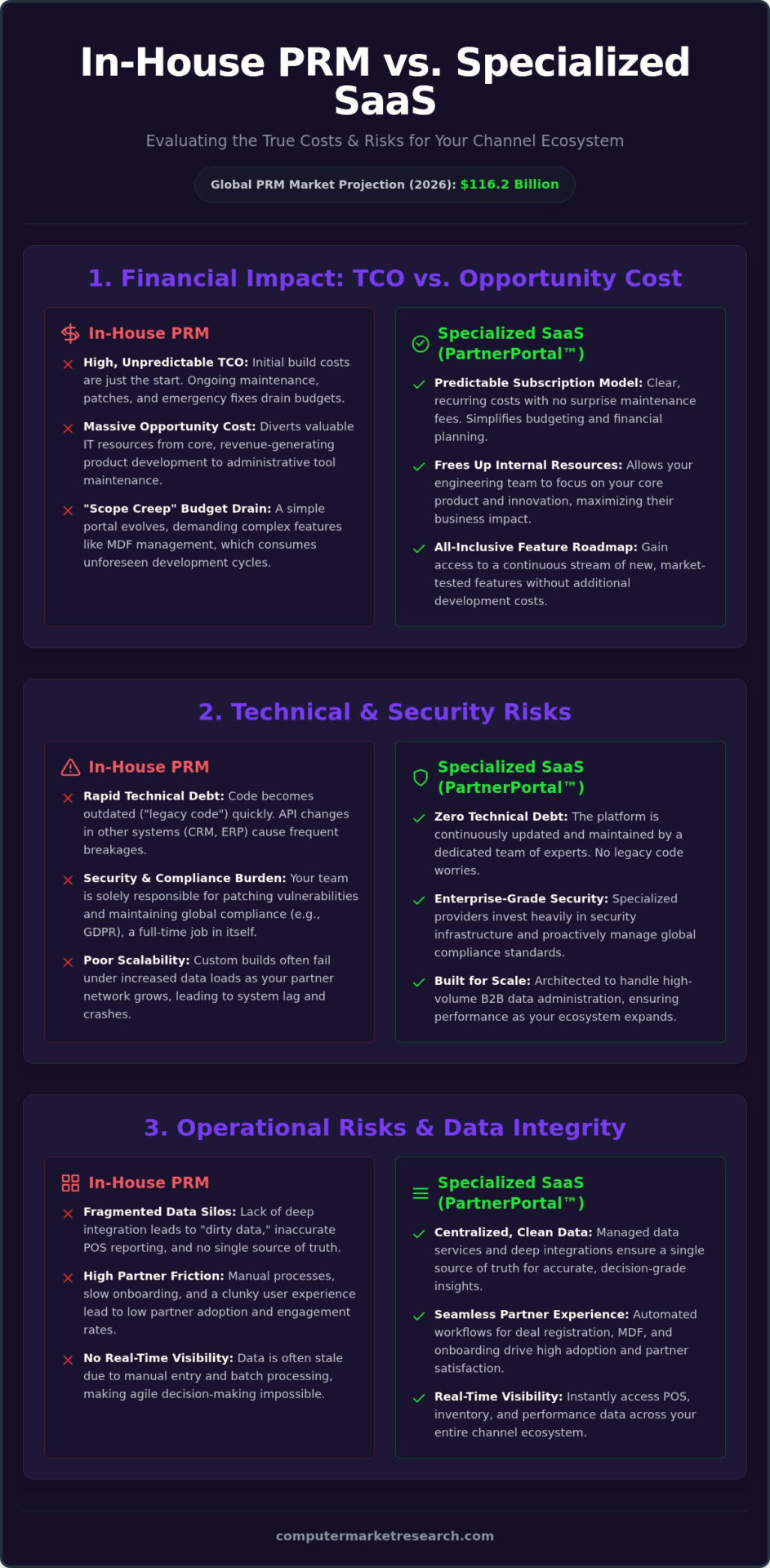
The Financial Reality: TCO vs. Opportunity Cost
The decision to build a partner portal often starts with a desire to avoid recurring subscription fees. However, the financial risks of using an in-house prm solution become clear when you look at the total cost of ownership (TCO) over several years. Research conducted for 2026 indicates that for an organization with 50 to 150 users, a five year projection for an in-house or on-premise solution ranges from $553,000 to $1,138,000. In contrast, specialized cloud solutions for the same period typically cost between $350,000 and $820,000. This data suggests that the “free” internal build is often the most expensive option in the long run.
Calculating the True Cost of Your Build
A custom system’s initial development is just the tip of the iceberg. Ongoing support tickets, bug fixes, and the need for dedicated IT salaries create a persistent drain on your budget. When your internal developers are busy patching security vulnerabilities or updating browser compatibility, they aren’t working on your core product. This creates a massive opportunity cost. If a major product launch is delayed because your internal PRM infrastructure can’t support new SKU logic, the lost revenue can be staggering. Efficient Channel Sales Management requires a system that scales automatically without taxing your engineering resources.
MDF and Rebate Leakage
Manual and in-house systems are prone to financial leakage through overpayments and administrative errors. Without automated auditing and real-time compliance checks, it’s easy to approve incentive claims that don’t meet your program’s criteria. Automated platforms provide a layer of precision that manual tracking simply cannot match, ensuring every dollar spent on channel incentives is verified. For a deeper dive into protecting your margins, see our Market Development Funds (MDF) Guide.
Channel conflict also carries a heavy price. In-house tools often lack the sophisticated deal registration logic needed to prevent multiple partners from claiming the same lead. This friction doesn’t just damage partner relationships; it creates administrative chaos that slows down the sales cycle. The ROI of automation becomes evident when you eliminate these manual mistakes and reclaim the time your team spends on data reconciliation. You can exit the high-cost build cycle today with a 90-day free trial of a modernized platform.
Future-Proofing with PartnerPortal™
Transitioning away from a legacy system is a strategic pivot that secures your organization’s future growth. While the risks of using an in-house prm solution often stem from the technical and financial debt explored in previous sections, the path forward involves adopting a platform designed specifically for the complexities of B2B channel management. PartnerPortal™ centralizes your operations within a secure, cloud-based environment, effectively eliminating the data silos that hinder visibility. This modernization allows your team to focus on strategic expansion rather than maintaining fragile internal code.
A primary differentiator of this platform is the inclusion of Managed Data Services. This service goes beyond simple software by providing normalized, decision-grade insights into your POS and inventory data. Unlike custom tools that struggle with fragmented distributor reports, this systematic approach ensures that your POS Data Management is accurate and actionable. By automating high-friction processes like onboarding and Deal Registration, you create a seamless environment that encourages high partner adoption rates.
Why SaaS Outperforms Custom Builds in 2026
Specialized SaaS platforms offer a continuous roadmap of features driven by global industry best practices. When you use PartnerPortal™, you benefit from instant scalability and enterprise-grade security that would be cost-prohibitive to develop internally. Your ecosystem gains access to sophisticated PartnerPortal™ Features, such as automated ship & debit and rebate processing, which are updated automatically as market regulations evolve. This ensures your infrastructure remains compliant with global standards without requiring additional IT overhead.
Claim Your 90-Day Free Trial
Choosing to move away from a custom build shouldn’t be a high-risk decision. Computer Market Research offers a 90-day free trial to allow you to test the platform directly against your current in-house solution. This trial period provides a clear window into how easily the system integrates with your current CRM or ERP stack. You can experience the immediate reduction in administrative burden and the clarity of real-time reporting before making a long-term commitment. Claim your 90-day free trial of PartnerPortal™ now to begin normalizing your channel data and reclaiming your internal resources.
Securing Your Channel Infrastructure for 2026
The decision to maintain a custom-built system often hinges on a desire for control, but the long-term risks of using an in-house prm solution outweigh the initial benefits. You’ve seen how technical debt, security vulnerabilities, and fragmented data can stall your channel’s momentum. Transitioning to a specialized platform isn’t just a software upgrade; it’s a strategic move toward operational stability and accurate reporting. You deserve a system that scales with your ambition rather than one that drains your IT budget.
With over 40 years of channel management expertise, CMR has built a reputation for solving the industry’s most complex data challenges. Trusted by Fortune 500 companies, our PartnerPortal™ includes comprehensive managed data services that turn inconsistent reports into decision-grade insights. You don’t have to navigate this transition alone. By choosing a partner that understands the nuances of B2B relationships, you ensure your ecosystem is ready for the future. Start your 90-day free trial of PartnerPortal™ today and experience the clarity of a centralized channel. It’s time to trade operational bottlenecks for sustainable growth.
Frequently Asked Questions
What are the main risks of using an in-house PRM solution?
The primary risks of using an in-house prm solution involve technical debt and operational stagnation. Custom tools often lack the architectural depth to manage high-volume B2B data, resulting in fragmented information silos. These systems require constant manual updates to remain compatible with evolving infrastructure, which drains internal IT resources. Without specialized logic for POS normalization, organizations face significant inaccuracies in their channel reporting and strategic decision-making.
Is it cheaper to build or buy a partner relationship management system?
Buying a specialized SaaS solution is generally more cost-effective. Research indicates that the five-year total cost of ownership for an in-house solution can reach $1.1 million for mid-sized organizations. In contrast, cloud-based systems typically cost significantly less over the same period. This calculation includes hidden expenses like developer salaries, server maintenance, and the high opportunity cost of diverting engineering talent away from core product development.
How does an in-house PRM affect partner adoption rates?
In-house portals frequently suffer from poor user experience, which directly lowers partner adoption rates. Partners manage relationships with multiple vendors and prioritize platforms that offer the least friction. If your internal tool is clunky or requires excessive manual entry, partners will naturally gravitate toward competitor systems. High adoption is the only true metric of success, and specialized platforms are engineered specifically to maximize ease of use.
Can an in-house PRM handle complex MDF and rebate programs?
Most internal builds struggle with the sophisticated logic required for automated Co-op/MDF Management. These programs involve complex auditing, compliance checks, and financial reconciliations that generic software handles poorly. Manual processing in custom tools often leads to financial leakage through overpayments or administrative errors. Specialized systems provide the transparency and automation needed to ensure every incentive dollar is verified and accurately distributed across your global channel.
What is the average maintenance cost of a custom partner portal?
Maintenance for a custom portal usually accounts for 15% to 25% of the original development cost annually. This includes patching security vulnerabilities, ensuring browser compatibility, and updating API mappings. These recurring expenses contribute to the risks of using an in-house prm solution by often exceeding the cost of a SaaS subscription. When you factor in the salaries of dedicated IT staff, the financial burden becomes a primary obstacle to growth.
How do SaaS PRMs handle data security compared to in-house builds?
SaaS providers invest heavily in multi-layered security protocols and global compliance certifications like SOC 2 Type II. Internal teams often struggle to maintain these standards while managing core business applications. Specialized platforms offer enterprise-grade protection against data breaches and ensure adherence to evolving privacy laws like GDPR and CCPA. This specialized focus provides a level of security and compliance that is difficult to replicate with a non-specialized internal infrastructure.
What happens to my data if I migrate from an in-house PRM to CMR?
Your data undergoes a rigorous normalization and cleansing process during migration to Computer Market Research. We specialize in taking fragmented legacy information and converting it into decision-grade insights. Our technical experts manage the integration with your existing CRM and ERP infrastructure to ensure a seamless transition. You gain a centralized source of truth without losing the historical records necessary for tracking long-term partner performance and overall channel ROI.
Why do custom partner portals often lead to channel conflict?
Channel conflict occurs when in-house tools lack robust Deal Registration logic. Without sophisticated tracking, multiple partners might claim the same lead, creating administrative friction and damaging trust. Specialized platforms provide clear, real-time visibility into deal ownership and lead status. This transparency prevents overlapping claims and ensures that your partners are fairly compensated, which is essential for maintaining a healthy and cooperative ecosystem that drives revenue growth.

Article by
Del Heles
Del Heles is the founder and CEO of Computer Market Research (CMR), a channel management software company he launched in 1984. With more than 40 years of experience, he’s known for helping manufacturers and distributors simplify complex partner programs through practical, customer-focused technology solutions.