

Telecom channel complexity isn’t the problem; unmanaged complexity is. For organizations evaluating prm for telecommunications industry, the key question is which capabilities can bring partner workflows under control without adding another disconnected tool. When onboarding, deal registration, fund administration, and performance data are spread across teams and systems, manual work grows and leaders lose a consistent view of channel activity.
Start your PRM selection with the workflows your organization needs to manage, not a checklist of features detached from your operating model. This guide explains how to assess telecom-relevant capabilities, connect partner processes to business needs, and evaluate integrations and reporting for reliable visibility. It covers onboarding, deal workflows, co-op and MDF, rebates and incentives, and channel data management, with practical steps for comparing platform fit, partner adoption, and performance reporting.
Key Takeaways
- Map each partner workflow to its owners, users, approval stages, source data, and visibility needs before comparing platforms.
- Assess prm for telecommunications industry against your partner ecosystem and operating model, rather than assuming every platform covers every workflow.
- Compare platforms using consistent criteria, including workflow coverage, partner experience, integration, configurability, and implementation.
- Use representative partner journeys and approval paths in demonstrations to identify dependencies and gaps before making a decision.
- Evaluate how PartnerPortal centralizes channel workflows, integrates with ERP and CRM systems, and supports visibility through reporting.
Why PRM for the Telecommunications Industry Must Fit a Complex Partner Ecosystem
Telecom services can reach customers through carriers, distributors, agents, resellers, and service partners. Each route may involve different responsibilities, handoffs, and information needs. A distributor might manage downstream resellers, while an agent introduces opportunities or a service partner supports delivery. These relationships create distinct workflows rather than one universal partner journey.
When partner records, program rules, approvals, and activity updates are scattered across spreadsheets and separate systems, teams can struggle to see who owns the next step or how partner activity connects to channel results. Define the operational problem before choosing software. A useful partner relationship management fundamentals framework starts with the actual partner structure and the work required to manage it.
What makes partner management distinctive in telecommunications?
Indirect routes to market can add layers between an operator and the end customer. Depending on the organization, the ecosystem might include master agents and sub-agents, managed service providers (MSPs), value-added resellers (VARs), or distributors. These are examples, not a standard roster. Some organizations work through a smaller set of direct partners; others coordinate multiple partner types with different agreements and responsibilities.
That variation affects what teams need to track. An agent may need a clear process for submitting or progressing an opportunity. A distributor may need visibility into downstream activity, while a service partner may need program or enablement information relevant to its role. If every partner receives the same workflow, it may not reflect how work is assigned. If each process is managed separately, leaders may lack a consistent view across the ecosystem. Design workflows around how your organization sells, supports, and measures partner contributions.
What should a telecom PRM be responsible for?
PRM, or partner relationship management, refers to software and processes that organize partner interactions, enablement, programs, and performance information. For a concise overview, see What is Partner Relationship Management (PRM)? In the prm for telecommunications industry context, a PRM supports channel-facing work such as maintaining partner information, coordinating onboarding, managing deal workflows, and providing visibility into partner program activity.
A PRM should not automatically be treated as the system responsible for network provisioning, service activation, or carrier billing. Commission calculation and settlement may also belong to separate tools or processes, depending on the organization’s operating model. A platform can coordinate partner-facing steps without replacing the systems that operate the network or handle financial settlement.
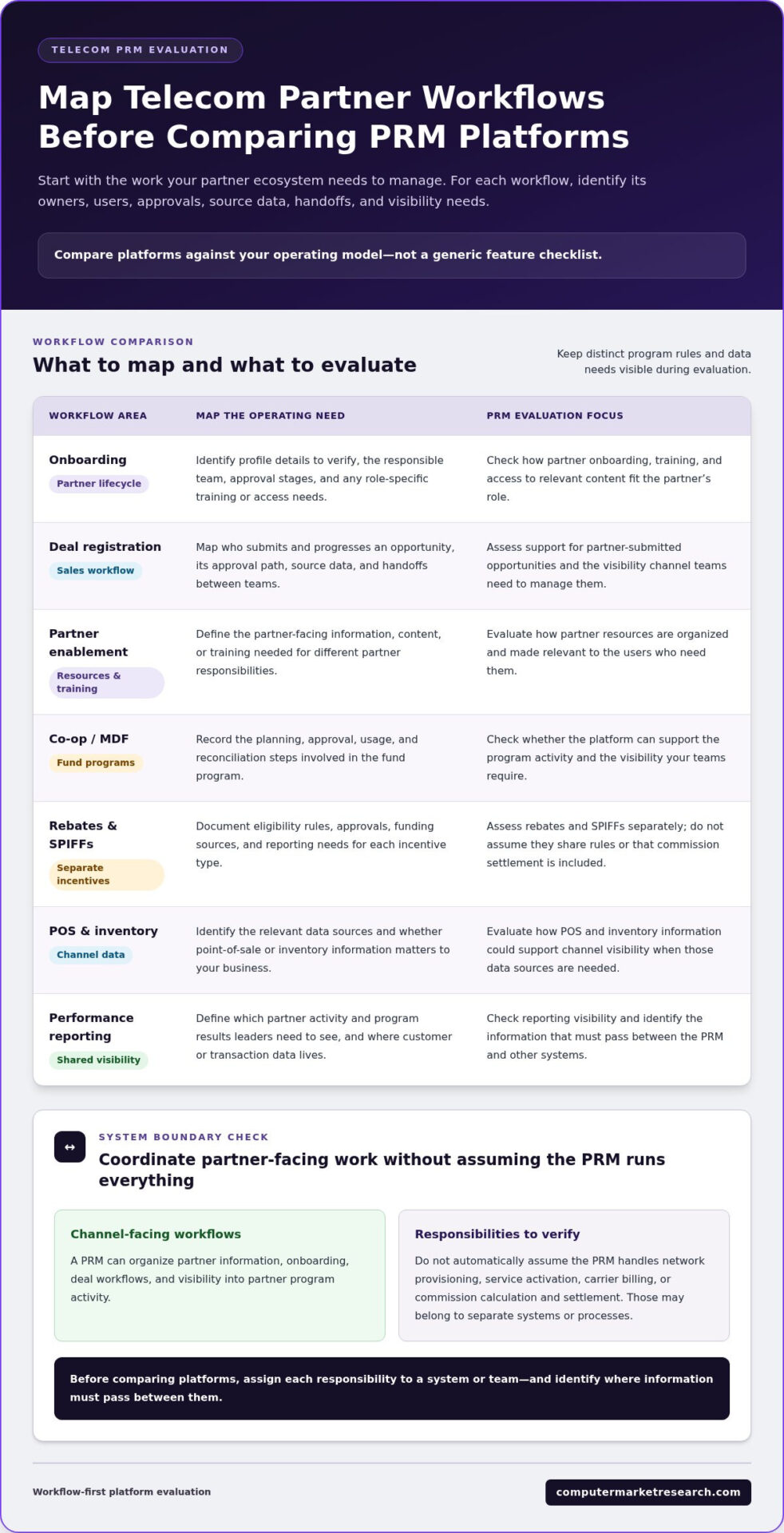
Before evaluating platforms, assign each responsibility to a system or team. Identify where partner profiles are maintained, where opportunities are approved, which system holds customer or transaction data, and how program results are reported. Then note where information must pass between systems. This boundary map helps you assess whether a PRM can organize the relevant channel workflows and where integrations or complementary systems are needed.
Map Telecom Partner Workflows to PRM Capabilities Before Comparing Platforms
Before reviewing platforms, turn the partner program into a workflow inventory. This keeps your evaluation grounded in the work teams and partners actually perform, rather than a generic feature checklist. For each workflow, record the business owner, partner users, approval stages, source data, handoffs, and visibility needed to manage it. For example, a reseller’s deal registration may pass through channel sales and finance, while onboarding may require partner operations to verify profile details and provide role-specific training.
Telecom organizations operate within a broad policy and business environment. The National Telecommunications and Information Administration (NTIA) is a U.S. government agency focused on telecommunications and information policy. Each organization should still define its own partner responsibilities and workflows before selecting technology.
Which partner-facing workflows should the evaluation cover?
Start with the partner lifecycle: onboarding, training, access to relevant content, and performance tracking. Then assess the sales and program workflows that apply to your model. Deal registration and opportunity management are useful evaluation areas when partners originate or influence sales. Partner marketing and fund programs may involve separate planning, approval, usage, and reconciliation steps.
Keep incentives distinct. Co-op/MDF, rebates, and SPIFFs can have different eligibility rules, approvals, funding sources, and reporting needs. Document each separately instead of treating them as a single “incentives” function. Commission settlement may be handled through a separate process or system, so don’t assume it is included in a PRM.
Computer Market Research provides deal registration, partner enablement, co-op/MDF, rebates, POS data, and inventory management capabilities. Tie each to a specific operating need: deal registration for managing partner-submitted opportunities, enablement for organizing partner-facing resources, and fund workflows for managing program activity. POS and inventory information can support channel visibility when those data sources matter to your business.
How should telecom teams assess channel data and reporting?
Define the views required to manage the program. These may include POS activity, inventory, pricing adjustments, fund usage, and partner engagement. For each view, identify the source system, refresh expectations, responsible owner, and decision it should inform. A channel manager may need to review opportunity progress, while finance may need to reconcile fund usage. Executives may need a consolidated view of partner activity and performance.
Specify who needs dashboards and what action each report supports. A report without a defined decision can add noise rather than control. Document whether leaders need timely operational status, trend analysis, or a record for approval and reconciliation. Then note which information must move between the PRM and other systems.
Channel data management connects reporting needs with the underlying data structure. Map the sales process as well, including where channel sales management depends on partner-submitted opportunities and performance information. With the inventory in place, compare platform capabilities against actual requirements. A structured platform evaluation, including a 90-day platform evaluation, can help teams test workflows against representative partner scenarios.
How to Compare PRM Platforms for Telecom Fit, Integration, and Control
A useful comparison turns each requirement into evidence, not a broad capability claim. For every criterion, record the proof you need, the business owner who will assess it, the impact on partners, and any dependency on another system. This helps distinguish a demonstrated workflow from an assumption and verify which platform or module provides each function.
Workflow coverage
Evidence: a walkthrough of your selected partner journeys, including handoffs and approvals. Owner: channel operations. Partner impact: fewer unclear steps or duplicate submissions. Dependency: source data and connected sales or program systems.
Partner experience
Evidence: partner-facing examples for deal submissions, claims, resource access, and status tracking. Owner: partner enablement. Partner impact: clear tasks and progress visibility. Dependency: partner roles, permissions, and content ownership.
Data visibility
Evidence: sample dashboards and reports using agreed definitions. Owner: channel leadership or analytics. Partner impact: relevant status information. Dependency: data sources, update processes, and reporting ownership.
Integration
Evidence: a documented account of required data exchanges and records. Owner: IT and business-system owners. Partner impact: fewer repeated data requests. Dependency: ERP, CRM, and other systems in the workflow.
Configurability
Evidence: a demonstration of approval paths, roles, and notifications aligned to your programs. Owner: program management. Partner impact: processes that reflect partner responsibilities. Dependency: defined rules and governance.
Implementation
Evidence: an explanation of scope, responsibilities, data preparation, and rollout steps. Owner: project lead. Partner impact: clarity during transition. Dependency: internal resources and integration readiness.
What integration and data questions should buyers ask?
Start with the ERP and CRM systems that must exchange information. List the records involved, such as partner profiles, accounts, opportunities, transactions, or program activity, and identify which system owns each one. Then trace a representative record from its source through the partner workflow to a dashboard or report. This exposes gaps in data ownership and helps you ask how updates, corrections, and inconsistencies are handled.
For prm for telecommunications industry, follow the business process during integration review instead of stopping at a connector list. If a partner submits an opportunity, determine what information enters the workflow, where approvals occur, and how the resulting status becomes visible to the teams that need it. CMR’s platform integrates with ERP and CRM systems. PartnerPortal brings together relevant partner workflows, including deal registration, performance tracking, and channel data workflows.
How can buyers judge usability, workflow control, and scalability?
Use the same scenarios for each demonstration. Ask a partner to submit a deal, access a resource, or review a claim status, then examine the internal approval path. Check whether roles and notifications can reflect your program rules, and whether different partner types see information relevant to their responsibilities. A master agent, reseller, and service partner need not follow the same hierarchy or process. Evaluate scalability by testing the range of roles, workflows, and reporting views your organization expects to manage, rather than relying on general claims about growth.
A Practical PRM Evaluation Plan for Telecom Teams
A disciplined evaluation starts with operating requirements, not a vendor presentation. Teams assessing prm for telecommunications industry should use the same workflows, data questions, and success measures to compare each shortlisted platform. This creates a fair basis for discussion and makes gaps easier to document.
- Prioritize workflows. Select the partner processes that create the most operational friction or visibility gaps, such as onboarding, deal review, or fund administration.
- Define data needs. Identify the records, source systems, owners, and reports each workflow depends on.
- Map integrations. Trace information between the PRM, CRM, ERP, and any other systems involved in the process.
- Set evaluation measures. Establish a baseline and define what you want to assess, such as manual handoffs, time spent locating partner status, or report completeness. These are evaluation criteria, not promised outcomes.
- Test and document. Use consistent scenarios with each platform, then record evidence, dependencies, usability observations, and unresolved gaps.
What should a telecom PRM demonstration prove?
Ask for a live walkthrough of a representative partner journey: onboarding, a deal submission, an internal approval, and the partner’s ability to see submission status. Add a reporting scenario, such as reviewing channel activity, fund utilization, or available partner data. Have the presenter show the workflow and the data it uses, including relevant handoffs. A feature label alone doesn’t show how the process works in practice.
Use the same scenario for each shortlisted platform. Record where the process is clear, where a team member must intervene, and what information is missing or depends on another system.
How should teams test implementation readiness?
Before rollout planning, document internal owners, partner groups, workflow decisions, and integration dependencies. Invite sales, channel operations, marketing, IT, and finance stakeholders to assess the steps they own or rely on. Ask how onboarding and implementation are structured around business requirements and integrations, and capture assumptions that need resolution. This gives the project team a grounded view of responsibilities and preparation needs.
How can an evaluation trial reduce decision risk?
Keep the scope focused. Choose representative users, workflows, and data scenarios in advance, then agree on what the team will observe. Assess whether partners can complete key tasks, internal approvals reflect program needs, and reports provide the visibility stakeholders require. Compare observations with your defined requirements rather than relying on broad promises or a polished demonstration alone.
Computer Market Research offers a 90-day free trial for organizations evaluating the platform. Use a defined test plan to make the evaluation evidence-led.
- Priority workflows and participating partner roles are documented.
- Data sources, system dependencies, and reporting needs are identified.
- Success measures and baseline observations are agreed upon.
- Demonstration scenarios are consistent across shortlisted platforms.
- Findings, assumptions, and open gaps are recorded for review.
How Computer Market Research Supports Telecom Channel Operations
After defining workflows, data requirements, and evaluation criteria, telecom teams can assess how a platform aligns with their channel operations. Computer Market Research (CMR) is a channel-management software company founded in 1984. Its flagship PRM platform, PartnerPortal, centralizes partner and channel workflows. It supports channel operations, not telecom network operations or carrier billing.
Which documented PartnerPortal capabilities align with channel operations?
PartnerPortal brings together partner onboarding, deal registration, co-op/MDF, rebates and incentives, partner performance tracking, and channel data management. Their relevance depends on how a telecom organization works with its partners. For example, a team managing partner-submitted opportunities can assess deal registration against its sales process, while a channel program owner can compare co-op/MDF and rebate workflows with the organization’s funding and approval requirements.
CMR’s channel sales management solution supports coordination of channel sales activity. Map its capabilities to your existing journey, including the partner’s submission, internal review, and status visibility. This helps assess fit with the channel process without assuming the platform performs telecom-specific provisioning, commission settlement, or network and billing functions.
CMR’s platform integrates with ERP and CRM systems and provides real-time dashboards, reporting, and analytics. Evaluate these capabilities against practical requirements: which partner or sales records need to be visible, which system supplies them, and what decisions the reports must support. A telecom team might assess whether channel leaders can review partner activity alongside relevant sales information. The value depends on the organization’s data, workflows, and reporting needs.
How can telecom buyers take the next step with CMR?
Use the workflow inventory and comparison criteria developed earlier as the basis for evaluation. For each requirement, distinguish documented capability from an assumption, identify data dependencies, and consider the effect on partner users and internal owners. Test fit against representative journeys, such as onboarding a partner or reviewing an opportunity, and examine how reporting supports the decisions your team needs to make.
CMR brings over 40 years of experience in channel-management software and works with Fortune 500 and Global 2000 companies. Consider that background alongside your workflow and integration requirements when assessing fit. A focused review can help stakeholders identify where PartnerPortal aligns with existing processes and where connected systems or separate operational responsibilities remain part of the picture.
To evaluate the platform against your organization’s requirements, start a 90-day free trial and use agreed scenarios, users, and observations to guide the assessment.
Turn Your Evaluation Into a Clear Next Step
The strongest prm for telecommunications industry decision is one your teams can put into practice. Once you’ve identified a suitable platform, assign workflow owners, agree on how partner information will be maintained, and set a review cadence for channel reporting. Clear ownership helps keep new processes aligned as partner programs and business priorities change.
Computer Market Research brings over 40 years of experience and serves Fortune 500 and Global 2000 companies. Use your organization’s requirements to assess how PartnerPortal’s channel capabilities fit, including where connected systems remain part of the process. A focused platform evaluation gives stakeholders a practical basis for deciding what to adopt and where to refine workflows.
Evaluate PartnerPortal against your channel requirements with a defined, evidence-based plan. Assign owners, test representative workflows, and use what you learn to guide your next step.
Frequently Asked Questions
What is PRM in the telecommunications industry?
For the prm for telecommunications industry, PRM is a system for coordinating partner-facing processes and information. A carrier, for example, might use a PRM to give a reseller a consistent way to access resources, submit a sales opportunity, and follow its progress. Internal teams can use it to coordinate partner programs and review activity. It supports channel operations rather than running the telecommunications network itself.
How is telecom PRM different from CRM?
PRM focuses on the organization’s relationships and workflows with external partners, while CRM primarily organizes customer and prospect relationships and sales activity. The systems may share information: a partner-submitted opportunity could be managed through a PRM workflow and associated with an account or opportunity in the CRM. Defining which system owns each record helps teams avoid duplicate updates and inconsistent status information.
Can a PRM manage master agents, sub-agents, distributors, and resellers?
A PRM can support multi-tier partner structures when its roles, permissions, and workflows fit the organization’s model. During evaluation, test a realistic example, such as a master agent submitting an opportunity involving a sub-agent, and identify who can view or update each step. Platforms can handle tiers differently. Confirm how the workflow represents partner relationships and keeps activity attributable to the right participants.
Does PRM software manage telecom commissions and settlements?
Not necessarily. PRM platforms may support partner incentives or program administration, but commission calculations and settlement are distinct operational requirements. Map commission rules, approval steps, payment records, and reconciliation to the systems responsible for them. If a PRM is expected to contribute data, test how that information connects to the settlement process. Don’t treat rebate, SPIFF, or fund workflows as proof of commission settlement functionality.
Can PRM integrate with telecom companies’ ERP and CRM systems?
Yes, PRM can integrate with ERP and CRM systems, and Computer Market Research’s platform does. For a useful evaluation, identify the records that need to move between systems, such as partner details or opportunity information, and specify which application owns each record. Then trace an update through the workflow and report. This helps reveal whether integration supports the decisions teams need without creating conflicting records.
What should a telecom company test during a PRM trial?
Test the tasks partners and staff will perform regularly, using representative roles and realistic information. For example, have a partner submit a deal, follow its status, and access a relevant resource, then have internal users review the submission and examine the resulting report. Observe where instructions, approvals, or data are unclear. Compare findings with agreed requirements, and record limitations, dependencies, and questions for stakeholders to resolve.
How does PRM support partner onboarding and enablement in telecom?
PRM can organize onboarding steps and provide a shared place for partners to access training materials and relevant content. A practical workflow might guide a new reseller through profile setup, required information, and role-specific resources, while internal teams track progress. Partner enablement tools can also support ongoing training and performance tracking. The process should reflect partner responsibilities, so an agent and a service partner aren’t automatically assigned identical steps.
How long does PRM implementation take for a telecommunications company?
Implementation timelines vary because scope depends on business requirements and integrations. A rollout involving several partner groups, workflows, and connected systems may require different planning from a narrower deployment. Before setting a schedule, document process owners, data dependencies, configuration decisions, and stakeholder availability. Computer Market Research structures implementation around business requirements and integrations, so defining those needs early gives the project team a clearer basis for planning.

Article by
Del Heles
Del Heles is the founder and CEO of Computer Market Research (CMR), a channel management software company he launched in 1984. With more than 40 years of experience, he’s known for helping manufacturers and distributors simplify complex partner programs through practical, customer-focused technology solutions.