

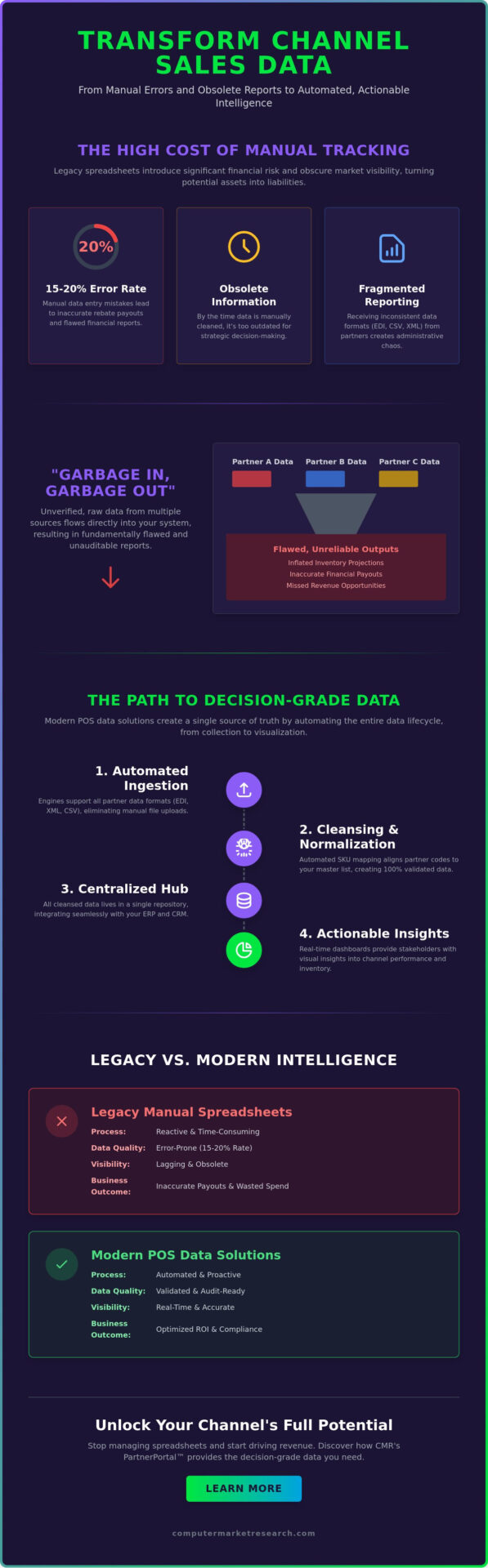
Did you know that manual data entry is associated with error rates between 15% and 20%, often turning your channel reports into a financial liability rather than a strategic asset? You likely already deal with the frustration of receiving inconsistent data formats from various distributors, only to find that by the time you’ve manually cleaned the spreadsheets, the information is already obsolete. This lag time doesn’t just obscure your view of the market; it leads to inaccurate rebate payouts and wasted incentive spend.
It’s time to move beyond the limitations of legacy tracking. This guide explores how modern pos data management solutions transform fragmented channel sales reports into actionable, decision-grade insights that drive revenue. We’ll show you how automated data normalization eliminates manual errors and provides real-time visibility into channel inventory. By the end of this article, you’ll understand how to leverage these systems to improve the ROI of your incentive programs and maintain compliance with mandatory standards like PCI DSS 4.0. We will outline the precise steps to transition from messy spreadsheets to a streamlined, manufacturer-centric data ecosystem.
Key Takeaways
- Gain real-time visibility into indirect sales channels by moving from fragmented reports to a systematic data collection process.
- Eliminate the “Garbage In, Garbage Out” cycle by implementing automated SKU mapping and normalization for partner-specific data.
- Replace error-prone manual spreadsheets with modern pos data management solutions to recover lost time and reduce financial inaccuracies.
- Identify the critical selection criteria for enterprise-grade tools, focusing on seamless integration with your existing CRM and ERP infrastructure.
- Discover how centralized hubs like PartnerPortal™ and managed data services remove the heavy administrative lifting from your operations team.
What Are POS Data Management Solutions in 2026?
While a traditional Point of Sale (POS) system focuses on the hardware and software used to record a transaction at the terminal, manufacturers look at the landscape through a much wider lens. In 2026, pos data management solutions represent the specialized discipline of collecting, cleansing, and normalizing sales information from an entire network of indirect partners. These solutions act as a bridge between the manufacturer and the end-user sale, providing a level of transparency that was previously impossible. It’s not just about tracking a sale; it’s about transforming raw, messy data into a standardized format that your ERP and CRM systems can actually use.
Manufacturers often struggle with a lack of visibility into their indirect channels, which leads to overstocking or missed revenue opportunities. By implementing dedicated software, organizations can move away from reactive reporting. When retail partners use specialized tools like Datascan Pharmacy Software, manufacturers can more easily access proactive intelligence instead of waiting for a distributor to send a monthly spreadsheet. This allows your team to see inventory levels and sales velocity across different regions in real time, ensuring that your production and marketing efforts align perfectly with actual market demand.
To better understand how transaction data can be used to optimize operations, watch this helpful video:
The Evolution of Channel Data Management
A modern framework for pos data management solutions must be built on a foundation of technical versatility. This starts with ingestion engines that support a wide variety of formats, from traditional EDI to modern XML and CSV files. Once the data is in the system, normalization protocols take over. These protocols map disparate partner product codes to your internal master SKUs, creating a single source of truth. Finally, centralized dashboards translate these technical processes into visual insights. This level of channel data management ensures that every stakeholder, from the warehouse to the C-suite, is looking at the same accurate, real-time performance metrics.
The Critical Role of Data Cleansing and Normalization
The “Garbage In, Garbage Out” principle remains the most significant hurdle in channel management. When raw sales data flows in from hundreds of different sources, it arrives in a chaotic mix of file formats, naming conventions, and incomplete records. If your pos data management solutions don’t prioritize rigorous cleansing, the resulting reports will be fundamentally flawed. Relying on unverified data leads to inflated inventory projections and, more dangerously, inaccurate financial payouts. Decision-grade data is information that is 100% validated and ready for financial auditing.
A primary challenge involves mapping partner-specific SKUs to a manufacturer’s master SKU list. Partner A might record a sale using an internal part number, while Partner B uses a legacy shorthand. Without a systematic way to align these disparate codes, you lose the ability to track product performance accurately across your network. Modern systems solve this by creating a persistent mapping layer that recognizes these variations and translates them into your internal language automatically. This level of precision is what separates high-performing organizations from those still struggling with manual reconciliation.
Automating the Normalization Process
Moving from manual spreadsheet mapping to automated cloud-based ingestion can reduce administrative overhead by up to 80%. This efficiency gain is vital for global enterprises dealing with regional data variations and multiple currencies. Automated normalization protocols ensure that a sale in London and a sale in Tokyo are recorded with consistent units of measure and converted to a base currency for unified reporting. By standardizing these variables at the point of entry, you eliminate the need for your operations team to spend days “fixing” data before it can be presented to leadership.
Validation: Ensuring Data Integrity for Financial Compliance
Validation goes beyond simple formatting; it is a defensive measure against fraud and operational waste. Sophisticated channel data management platforms cross-reference every entry to check for duplicate sales reports. This prevents the common issue of double-paying rebates or incentives on the same transaction. Additionally, verifying end-user information helps identify potential channel conflict where multiple partners might be claiming the same deal. When your data is clean and validated, your financial reporting becomes audit-ready, providing the quiet confidence needed to scale your incentive programs. If you’re ready to see how clean data impacts your bottom line, consider how you might optimize your reporting with a specialized trial of modern automation tools.
Why Manual Spreadsheets Are Obsolete for POS Tracking
Many organizations still cling to the belief that they can manage complex channel sales through basic spreadsheets. While Excel is a powerful tool for isolated calculations, it was never designed to serve as a backbone for global trade. Relying on manual tracking creates a massive volume of “dark data.” This is information that is technically collected but remains buried in disparate files, never utilized for strategic decisions. Modern pos data management solutions eliminate this visibility gap by centralizing information into a single, accessible source. Transitioning away from legacy methods isn’t just an IT upgrade; it’s a prerequisite for any manufacturer looking to scale a global partner program without increasing administrative headcount.
The cost of manual entry isn’t just about the time spent typing; it’s about the inherent unreliability of the process. As documented by industry research, manual data entry carries an error rate of 15% to 20%. For a manufacturer managing millions in channel incentives, a 20% error rate in sales reporting isn’t just a minor administrative headache; it’s a significant financial risk that compounds over time. Automated systems remove this human element, ensuring that every data point is verified before it ever reaches your dashboard.
The Hidden Cost of Inaccurate Channel Data
Inaccurate reporting leads directly to overpayments in rebates and incentives. When sales reports aren’t verified against a master database, you risk paying for duplicate claims or transactions that never actually occurred. Beyond financial leakage, manual methods create inventory blind spots. If you don’t have a clear view of what’s currently on the shelves of your distributors, your production planning becomes guesswork. This data lag prevents competitive agility. By the time you realize a product is trending, your competitors have already adjusted their supply chain because they have real-time visibility.
Scalability: Moving Beyond the ‘Spreadsheet Ceiling’
There is a distinct “spreadsheet ceiling” that occurs once a partner network exceeds 50 entities. At this scale, the sheer volume of incoming files makes manual normalization impossible. Trying to reconcile 50 different formats every month consumes hundreds of man-hours that should be spent on growth. Transitioning to a centralized partner management system allows your organization to break through this barrier. Automated pos data management solutions handle the heavy lifting of data ingestion and cleansing. This shift frees your channel managers from the drudgery of data entry, allowing them to focus on building relationships and developing high-impact sales strategies. Scaling a global program requires an infrastructure that grows with you, not one that acts as a bottleneck.
Selecting the Right POS Data Management Solution
Evaluating enterprise-grade pos data management solutions requires a focus on both technical architecture and operational support. You need a platform that doesn’t just store data but actively protects and validates it. Security is paramount; any vendor you consider must demonstrate SOC 2 compliance and adhere to the mandatory PCI DSS 4.0 requirements that are now standard for all organizations handling transaction data. This ensures that sensitive partner information and financial records remain secure against evolving digital threats. A steady, expert-led approach to selection will help you avoid the operational bottlenecks common with lower-tier providers.
Beyond the software itself, look for a partner that offers Managed Data Services. Many organizations have sophisticated growth goals but lack the internal headcount to manage the daily influx of complex distributor files. A provider that acts as an extension of your team can handle the technical cleansing and partner outreach, ensuring your data remains decision-grade without taxing your internal resources. This combination of robust technology and expert oversight creates the stability needed to scale global programs.
Use the following criteria when vetting potential vendors:
- Native integration capabilities with major ERP and CRM systems.
- Automated validation protocols specifically designed to support Ship & Debit and rebate programs.
- SOC 2 Type II certification and full PCI DSS 4.0 compliance.
- A disciplined implementation framework with a clear partner onboarding timeline.
Essential Features for Global Enterprises
International operations demand multi-language and multi-currency support to provide a unified view of market performance. Your solution should allow you to set granular access controls, ensuring that different tiers of channel partners only see the data relevant to their specific territory or agreement. Robust reporting engines are equally critical. These tools should provide customizable KPIs that track the specific ROI of your channel incentive programs, moving beyond generic metrics to show the true impact on your bottom line. When you have this level of control, you can adjust your strategy based on facts rather than intuition.
Integration and Implementation Considerations
A solution is only as effective as its ability to communicate with your existing technology stack. Whether your organization relies on Salesforce, SAP, or Microsoft Dynamics, the synchronization must be seamless to avoid creating new information silos. During the evaluation process, ask for a detailed roadmap regarding partner onboarding. Standardizing data flows across a diverse network requires a systematic approach; you need a vendor with proven professional services and technical competence. If you’re ready to evaluate a system that meets these rigorous standards, you can start with a 90-day trial of our specialized platform.
CMR PartnerPortal™: The Future of Channel Intelligence
Computer Market Research provides a definitive answer to the complexities of channel administration through PartnerPortal™. This centralized hub acts as the foundation for all channel operations, ensuring that data is not just collected but utilized to its full potential. By consolidating your disparate sales feeds into a single environment, you eliminate the fragmentation that typically plagues manufacturer-distributor relationships. This platform is the logical next step for organizations that have outgrown manual processes and require professional-grade pos data management solutions to maintain their competitive edge. It provides the quiet confidence that comes from knowing your numbers are accurate and your systems are scalable.
Managed Data Services: We Do the Heavy Lifting
One of the most significant barriers to implementing a new data strategy is the lack of internal bandwidth. CMR addresses this through its Managed Data Services, where our team of experts acts as a direct extension of your operations department. We take on the responsibility of collecting, cleansing, and validating every line item of incoming sales data. This approach removes the heavy administrative lifting from your staff, allowing them to focus on high-level strategy rather than data repair. Having a single point of truth managed by experts ensures that your reports are always accurate, audit-ready, and delivered on time. It’s a partnership built on technical competence and a deep understanding of the nuances of B2B data relationships, providing a clear path out of operational bottlenecks.
Driving Revenue with Integrated Channel Solutions
The true power of high-quality POS data is realized when it’s integrated with other critical channel modules. For instance, linking sales insights to Market Development Funds allows for more precise allocation based on actual partner performance rather than estimated projections. When you have 100% visibility into what’s selling and where, you can direct your MDF spend toward the territories and partners generating the highest returns.
Similarly, this data flows seamlessly into Ship & Debit processes, ensuring that claims are verified against actual end-user sales instantly. This level of integration prevents overpayments and improves the overall ROI of your incentive programs. By using real-time inventory data, you can proactively address potential stockouts before they impact your revenue. The result is a streamlined, optimized ecosystem where every dollar spent is backed by verified information. To see how these systems can transform your workflow and provide a stable path to growth, you should Partner Smarter with Computer Market Research.
Securing Your Competitive Advantage in 2026
Managing a global partner network requires more than just high-level strategy; it demands a technical infrastructure that can withstand the complexities of modern commerce. Moving away from the “spreadsheet ceiling” is the only way to eliminate the error rates common in manual entry. By implementing specialized pos data management solutions, you ensure that your sales reporting is 100% validated and ready for financial auditing. This transition provides the transparency needed to optimize your ROI across every channel territory.
Since 1984, Computer Market Research has served Fortune 500 and Global 2000 companies by providing stability and precision. Our Managed Data Services eliminate the manual cleansing burden while integrating seamlessly with your existing ERP and CRM platforms. You don’t have to navigate these operational bottlenecks alone. You can transform your data into a strategic asset with a partner who values order and performance above all else. Schedule a Demo of PartnerPortal™ Today to begin your transition toward decision-grade intelligence.
Frequently Asked Questions
What is the difference between POS data and channel data management?
POS data refers to individual transaction records captured at the point of sale, while channel data management is the holistic discipline of standardizing this information across a multi-tier distribution network. Manufacturers use pos data management solutions to bridge the gap between raw terminal logs and strategic business intelligence. This ensures that disparate reports from various distributors are unified into a single, cohesive view of market activity.
How do POS data management solutions handle different file formats from partners?
Modern platforms utilize versatile ingestion engines that process a wide array of formats, including EDI, CSV, XML, and legacy flat files. Once the data enters the system, automated mapping protocols translate partner-specific identifiers into your internal master SKU list. This systematic approach ensures that regardless of how a partner submits their sales reports, the information is normalized and ready for immediate analysis without manual intervention.
Can POS data management software help reduce rebate fraud?
These solutions significantly reduce rebate fraud by cross-referencing incentive claims against verified end-user transaction records. By validating that a sale actually occurred and checking for duplicate entries, the software prevents overpayments and double-dipping. This level of oversight protects your marketing budget and ensures that incentive payouts are only issued for legitimate, documented performance within your channel.
Is it possible to integrate POS data with our existing Salesforce CRM?
Enterprise-grade systems are designed to sync seamlessly with Salesforce and other major CRM or ERP platforms like SAP and Microsoft Dynamics. Cleansed and normalized data is pushed into your CRM to provide your sales team with an accurate view of customer purchasing patterns. This integration eliminates information silos, ensuring that every department works from the same set of validated, decision-grade facts.
What are the benefits of outsourcing POS data cleansing to a managed service?
Outsourcing to a managed service removes the entire administrative burden of data collection and cleansing from your internal team. Professionals handle the technical nuances of mapping disparate files and chasing down missing partner reports, ensuring 100% data accuracy. This allows your channel managers to focus on building relationships and driving revenue rather than spending their time reconciling spreadsheets and fixing manual entry errors.
How long does it typically take to implement a POS data management solution?
The implementation timeline depends on the complexity of your partner network and the quality of existing data flows. A phased approach is typically used to onboard key distributors first, followed by smaller resellers. While the initial setup of the core platform is relatively quick, standardizing data from dozens of unique partners requires a disciplined onboarding process to ensure long-term system integrity and reporting accuracy.
What security standards should I look for in a channel data provider?
You should prioritize providers that maintain SOC 2 Type II certification and full compliance with PCI DSS 4.0 standards. These frameworks ensure that your sensitive channel data and partner information are protected by rigorous security controls. As data privacy regulations evolve, working with a provider that adheres to these global benchmarks is essential for maintaining trust and protecting your organization from potential liabilities.
How does real-time POS data improve inventory management for manufacturers?
Real-time visibility allows manufacturers to monitor stock levels across the entire distribution network, preventing both stockouts and costly overproduction. When you can see exactly how quickly products move off the shelves, you can adjust production schedules and logistics in response to actual demand. This agility reduces carrying costs and ensures that your channel partners always have the right inventory to meet end-user needs.

Article by
Del Heles
Del Heles is the founder and CEO of Computer Market Research (CMR), a channel management software company he launched in 1984. With more than 40 years of experience, he’s known for helping manufacturers and distributors simplify complex partner programs through practical, customer-focused technology solutions.