

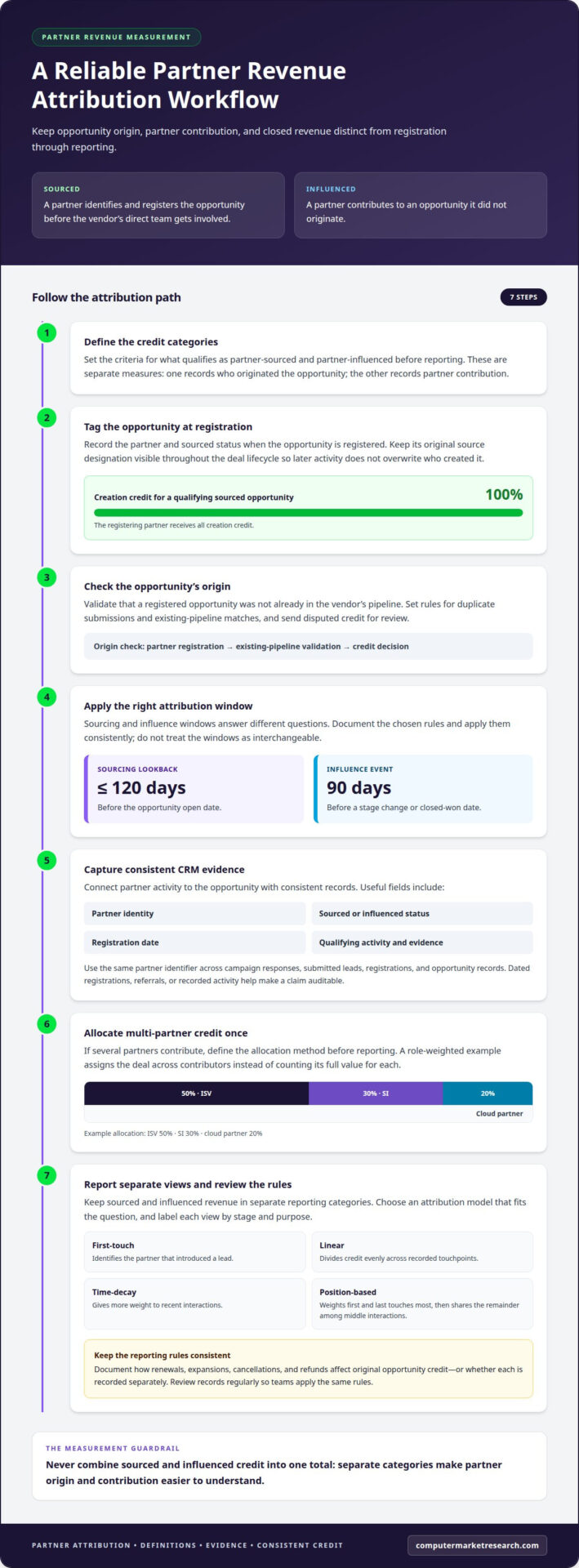
Clear attribution starts with a firm distinction: partner-sourced revenue comes from opportunities a partner identifies and registers before the vendor’s direct team gets involved, while partner-influenced revenue captures a partner’s contribution to opportunities it didn’t originate. To understand how to measure partner-sourced revenue, tag the opportunity at registration, retain that designation through the deal, and count its closed-won revenue separately from influenced revenue. The registering partner receives 100% of the creation credit for a sourced opportunity.
It’s easy to see why teams want one number that captures the value of partner activity. But combining sourced and influenced credit can inflate results and obscure what is creating pipeline or helping deals progress.
This article explains how to track partner impact from campaigns and leads through pipeline and closed revenue while keeping attribution consistent across teams. Documented definitions, clear credit rules, and regular data reviews are essential: reliable measurement depends not just on a dashboard, but on governance that partners and internal teams can understand and apply consistently.
Key Takeaways
- Set clear criteria for what counts as a sourced opportunity and what qualifies as partner influence before reporting results.
- Track partner activity from campaign engagement and lead submission through pipeline progression and closed revenue.
- Choose a consistent attribution window and reporting period so teams apply credit rules the same way across deals.
- Review pipeline coverage, conversion, revenue share, and partner concentration to understand performance beyond a single total.
- Use PartnerPortal™ and Deal Registration to organize partner opportunity submissions and support more consistent attribution records.
Partner-sourced vs partner-influenced revenue: what is the difference?
Partner-sourced revenue credits opportunities partners originate; partner-influenced revenue records their contribution to opportunities they didn’t originate. For renewals, expansions, cancellations, and refunds, document whether each changes the original opportunity’s credit or is recorded separately, then apply that rule consistently to reported revenue.
Attribution Rules and Double Counting
Attribution rules assign partner credit to an opportunity or revenue event and prevent multiple claims from inflating totals. A sourced opportunity is identified and registered by a partner before the vendor’s direct team becomes involved. Tag it at registration, retain the tag through the deal lifecycle, and validate that it wasn’t already in the vendor’s pipeline. The registering partner receives 100% of creation credit for a qualifying sourced opportunity.
Keep influenced revenue in a separate reporting category. A deal can be partner-influenced without being partner-sourced, such as when an integrator supports technical validation after direct sales opens the opportunity. If several partners contribute, define a credit-allocation method before reporting. For example, a role-weighted split of 50% to an ISV, 30% to an SI, and 20% to a cloud partner allocates the deal once instead of counting its full value for each.
CRM Attribution Methods and Data Quality
A CRM attribution method defines how partner interactions connect to an opportunity and its revenue. Configure fields for partner identity, sourced or influenced status, registration date, qualifying activity, and supporting evidence. Keep the original source designation visible as the opportunity moves through stages, so later activity doesn’t overwrite who originated it.
Reliable records also depend on consistent field use. Require the same partner identifier across campaign responses, submitted leads, registrations, and opportunity records. Set rules for duplicate submissions and matches to existing pipeline, then route disputed credit for review. Missing dates or inconsistent partner names can break attribution across the funnel, even when campaign and sales records are individually accurate.
Attribution Windows and Evidence
An attribution window sets the period in which partner activity can qualify for sourcing or influence credit. A recommended sourcing lookback is no more than 120 days before the opportunity open date. For influence, a qualifying event should occur within the 90 days before a stage change or closed-won date.
These windows answer different questions, so don’t treat them as interchangeable. A 30-day or six-month influence window may be used as a program example, but the chosen rule should be documented and applied consistently. Evidence can include a dated registration, referral, or recorded partner activity tied to the opportunity. The event date and partner identity make a claim auditable.
Funnel-Stage Attribution Models
An attribution model determines how credit is assigned across tracked interactions. Choose one that matches the question at each funnel stage. First-touch attribution can identify the partner that introduced a lead, while linear attribution divides credit evenly across recorded touchpoints. Time-decay attribution gives more weight to recent interactions.
Position-based attribution assigns most credit to the first and last touches, then shares the remainder among middle interactions. Use the same model within each reporting view, and label the view by stage and purpose. Campaign performance may require touchpoint-level insight, while closed-revenue reporting needs a clear rule for recognizing the originating partner. Comparing separate views helps teams avoid combining unlike measures.
Definitions of partner-sourced and partner-influenced revenue
Partner-sourced revenue tracks deals that originate through a channel partner. Partner-influenced revenue captures a partner’s contribution to deals that began elsewhere.
Partner-Sourced Revenue
Partner-sourced revenue is income from deals a channel partner originates and registers. It identifies partner-led demand, rather than a later contribution to an existing opportunity. For example, a reseller discovers a new prospect, submits the opportunity, and helps advance the sale. Recording that origin gives channel teams a direct view of partner pipeline creation and distinguishes partner-generated demand from direct sales activity.
Partner-Influenced Revenue
Partner-influenced revenue recognizes a channel partner’s material contribution to an opportunity the partner didn’t originate. A systems integrator might help a direct sales team validate a technical design, plan implementation, or address buyer requirements. The opportunity remains direct-sourced, while the integrator’s role receives influence credit. Reporting both measures separately shows partner contributions beyond initial demand without recategorizing the deal’s origin.
The two measures describe different parts of partner attribution. Sourced revenue answers, “Who brought this opportunity into the pipeline?” Influenced revenue answers, “Which partner activities helped it progress or close?” For example, a cloud partner might introduce a prospect, making the opportunity sourced. If another partner later provides technical validation, that activity may qualify for influence under the program’s rules.
Channel programs measure influenced revenue to understand partner value across the buyer journey. Sourcing alone can miss demand generation, technical validation, implementation support, and ongoing service. A partner may contribute through a co-hosted campaign, then help a buyer assess fit before purchase. Separating these contributions helps program teams evaluate enablement and identify where partner support is associated with pipeline advancement.
Influence credit needs evidence tied to a specific opportunity, not just a general partner relationship. Useful records include a dated campaign response, partner referral, meeting participation, technical validation, or documented implementation planning. Each event should identify the partner, opportunity, activity, and timing. For example, a meeting note linking an integrator’s validation session to a named deal is more actionable than a broad account-level tag.
Define qualifying activities before reporting influenced revenue. A campaign click may show engagement, while a documented introduction or technical review can demonstrate a clearer contribution. Keep these event types distinct in CRM records and connect each to the relevant opportunity stage. This lets teams compare the original source with later partner participation without presenting influence as proof that the partner created the deal.
Campaign, lead, pipeline, and revenue measurement
Measure partner contribution across the funnel, from campaign response to closed revenue. A quarterly view shows where partner activity creates demand, advances opportunities, and converts into results. A consistent funnel view also clarifies how to measure partner-sourced revenue without treating early engagement as a sale.
Start with campaign execution and lead outcomes. Record campaign participation, partner identity, responses, and resulting leads. Then connect each qualified lead to its opportunity so the path from partner activity to pipeline remains visible. If a campaign generates engagement but no qualified leads, that distinction matters: activity alone isn’t pipeline contribution. Compare campaign outcomes by partner and program to see where leads progress or stall.
At the opportunity stage, report partner-sourced pipeline separately from partner-influenced pipeline. Include open opportunity value and stage, then compare partner-sourced conversion rates with direct-sourced conversion rates. This comparison can show whether partner-originated opportunities progress at a similar pace or need different enablement. A common partner-sourced pipeline coverage benchmark is 3x the partner-sourced revenue target. Treat coverage as a planning measure, not as closed revenue.
Closed revenue needs both a dollar amount and a share of total company revenue for the same period. For example, one worked example reports $700,000 in partner-sourced revenue against $4,000,000 in total revenue, or 17.5%. Keep influenced revenue separate. A complete view of how to measure partner-sourced revenue follows the opportunity through closure, then applies the same reporting basis across the included deals.
Use complementary measures to explain performance, rather than relying on one revenue total:
- Pipeline: Compare the value and stage of sourced opportunities across reporting periods.
- Win rate: Compare partner-sourced opportunity conversion with direct-sourced conversion.
- ACV: Review average contract value for closed partner-sourced deals alongside the overall sales mix.
- Cycle time: Compare time to close across partner-sourced and direct-sourced opportunities.
Review these measures together. A higher win rate with lower ACV, for example, signals a different performance pattern than growth in both measures.
To assess partner-sourced revenue ROI and program profitability, compare revenue or contribution margin with program costs. Include campaign spending, enablement resources, and incentives, using the same reporting period for costs and revenue. Evaluate rebates and incentives alongside the partner activity and outcomes they support, not as unrelated expenses.
Quarter-over-quarter movement adds context: a rising partner-sourced revenue share can indicate progress even if its current share remains modest. Also track the proportion of sourced revenue from the top 10% of partners. A concentrated ecosystem may depend heavily on a small group, while broader contributions show how results are distributed.
What is partner attribution and why does it matter?
Partner attribution connects a referral or other partner activity to a lead, opportunity, and eventual closed revenue. Consistent records help teams distinguish partner contribution from direct sales activity.
Tracking Referrals and UTMs
Referral tracking records who introduced a prospect, while UTM parameters identify the source and campaign behind digital visits. Together, they help connect a partner campaign to measurable lead activity.
For example, a co-branded campaign can use consistent source, medium, and campaign values. The CRM can capture those values when a prospect submits a form. Preserve the partner identifier as the lead becomes an opportunity, rather than relying on a spreadsheet or a sales representative’s memory. If a referral arrives by email or in a meeting, record the partner and referral date in the same lead record.
Submitted Opportunities and Validation
A submitted opportunity is a partner’s documented claim that it identified a potential deal. Validation establishes whether the opportunity is genuinely new and eligible for partner-sourced credit.
The vendor’s channel operations team should compare the submission with existing CRM accounts, contacts, and open opportunities. For example, a partner may submit a prospect already being worked by direct sales. Review that record before assigning attribution. Capture the submission date, account, opportunity details, and partner identity, then document the validation outcome. A clear reason for acceptance or rejection supports consistent reporting and gives teams a basis for resolving later disputes.
Attribution also helps identify strategic co-selling opportunities. If a partner refers a prospect and a direct account executive owns the relationship, both teams can see the handoff and coordinate next steps. For example, the partner may contribute industry expertise while the vendor leads product demonstrations. Recording both roles against the same opportunity makes each contribution visible without changing the original source.
Keep referral, campaign, and opportunity records connected through CRM integration. A UTM-tagged campaign response can create a lead, but the partner relationship must remain attached as the lead converts. If systems use different partner names or campaign identifiers, reporting may fragment one contribution across multiple records. Use shared identifiers and defined field mappings so campaign performance can be compared with submitted opportunities and closed outcomes.
Separate attribution views by purpose. Campaign reporting can show which partner activities generated responses; opportunity reporting can show which submissions passed validation; closed-revenue reporting can show the commercial outcome. For example, a campaign may produce several leads but no accepted opportunities. Reporting each stage separately reveals where the process needs attention, instead of crediting early engagement as closed revenue.
Review records with channel and sales teams when a referral overlaps with an active account or co-selling motion. Document the decision and link it to the relevant CRM record to preserve the reasoning behind the final credit. Connecting referral evidence with opportunity reporting gives teams a traceable account of partner contribution.
Partner revenue measurement governance
Governance defines who owns attribution rules, how teams resolve disputes, and when metrics change. Without shared decisions, sales and channel teams can assign different credit to the same prospect. A written framework makes partner revenue reporting repeatable instead of a case-by-case negotiation.
Start with documented definitions for sourced and influenced revenue, qualifying events, attribution windows, and reporting periods. Assign an internal owner to each decision, such as channel operations for partner claims and RevOps for CRM logic. Revisit the definitions quarterly so changes in partner models, product portfolios, or market conditions don’t leave outdated rules embedded in reports.
Settle partner-credit disputes through a defined workflow. The recommended RevOps service-level agreement for adjudicating disputes is 5 business days. A useful record includes the partner submission, opportunity history, dated activity, and the reason for the final decision. For example, if a prospect already appears in an active sales opportunity, reviewers can compare timestamps and activity before deciding whether the partner influenced later progress.
Governance also means deciding what success looks like before launching a partner-influenced revenue program. Choose metrics tied to the program’s purpose, such as campaign execution, lead generation, pipeline contribution, or revenue attribution. If the goal is qualified pipeline, a campaign response alone won’t demonstrate success. Align channel marketing, finance, and sales on metric definitions before investing resources or setting partner rewards.
Keep operational controls close to the data. Hold a monthly review for missing partner fields, broken UTM links, and CRM logic that no longer matches attribution rules. For instance, if a campaign records a partner name but the opportunity record drops it, the report may undercount contribution. Assign an owner to each data issue and document its resolution in the internal process.
Update program rules when commercial conditions change. A new co-selling model may require different qualifying influence events; a revised product portfolio may change which activities matter. Record the effective rule, affected metrics, and how existing opportunities will be treated. This prevents teams from applying new criteria selectively to a prospect or reporting period.
Transparent rules also affect partner behavior. When partners understand how registration and influence claims are evaluated, they have a clearer basis for participating and contesting errors. Make definitions accessible, explain decisions with evidence, and use the same process across the ecosystem. Reliable governance helps leaders determine where to invest, what to reward, and which program changes improve measurable contribution.
Use a structured platform to support these governance workflows and keep partner activity aligned with revenue records. Explore partner revenue tracking options for a more controlled approach to attribution management.
Computer Market Research: PartnerPortal™
Computer Market Research offers PartnerPortal™, a platform that centralizes partner onboarding, deal registration, and performance tracking. It supports teams that need clearer records of partner activity across the revenue funnel, especially when manual processes make attribution difficult to maintain.
PartnerPortal™ is part of a broader channel management approach that includes Deal Registration, Co-op/MDF Management, and Rebates & Incentives. These offerings connect partner opportunity records with related program administration, helping teams organize channel operations and improve visibility into partner data.
If fragmented partner records or manual workflows are limiting your ability to manage channel activity, contact Computer Market Research to discuss your requirements.
Make attribution part of your operating rhythm
Turn attribution from a reporting exercise into an operating policy. Assign ownership for rule changes, make the decision trail accessible to internal teams, and keep partner credit understandable as opportunities move through the funnel. That foundation lets leaders apply what they’ve learned about how to measure partner-sourced revenue to future planning, partner investment, and program decisions.
As your channel ecosystem changes, revisit whether your definitions and data workflows still reflect how partners create value. New campaigns or co-selling motions can expose gaps in activity records. Treat those gaps as signals to refine the process, not reasons to abandon measurement.
Computer Market Research offers PartnerPortal™, Co-op/MDF Management, and Rebates & Incentives to support channel program operations. Explore a next step for your partner revenue process and build a measurement approach your teams can use with confidence.
Frequently Asked Questions
What evidence qualifies as influence?
Evidence should show a specific partner activity connected to a named opportunity. Examples include a recorded referral, technical session, campaign response linked to the prospect, or documented implementation planning. A general partner relationship or account-level tag alone doesn’t show what the partner contributed. Keep the activity date, partner identity, opportunity link, and a brief description together so reviewers can assess the claim consistently.
What’s the simplest way to separate sourced from influenced?
Use separate CRM fields for opportunity origin and partner influence. Set the source field when the opportunity enters the pipeline, then record qualifying partner activities independently as the deal progresses. For example, a direct sales lead can remain direct-sourced even after a partner supports a technical review. This structure lets reports show both origin and partner contribution without treating one as a substitute for the other.
What counts as partner-sourced revenue?
Partner-sourced revenue is closed-won revenue from an opportunity the partner originated, rather than one the partner joined after the vendor’s sales process began. A submitted claim should identify the prospect and show that the partner initiated the opportunity. If direct sales already had an active deal with that prospect, review the claim before classifying the revenue as partner-sourced.
How do you calculate partner-sourced revenue?
Sum the closed-won revenue from eligible partner-originated opportunities for your organization’s reporting period. Keep open pipeline separate from closed revenue, and apply the same revenue basis across included deals. For example, if a contract contains several product lines tied to one qualifying opportunity, define whether the report includes all associated lines. Report the result alongside its share of company revenue for the same period.
What CRM fields and attribution rules are needed to track partner-sourced deals?
Capture the partner name or identifier, opportunity source, registration or submission date, account, opportunity status, and supporting evidence. Add fields for influence activity when partners contribute after opportunity creation. Define how teams handle duplicate submissions, existing pipeline matches, credit disputes, and changes through the deal lifecycle. For example, preserve the original source field when ownership or opportunity stage changes.
How do you distinguish partner-sourced from partner-influenced revenue?
Classify revenue as partner-sourced when the partner originated the opportunity; record partner influence separately when the partner materially contributed to an opportunity it didn’t originate. Imagine a direct sales representative opens a deal, then a reseller supports buyer evaluation. The reseller’s activity may qualify for influence, but it doesn’t change the original source. Keeping the labels distinct gives leaders a clearer view of partner roles.
How should revenue be attributed when multiple partners or sales channels contribute?
Assign a single, documented origin for sourcing, then record other partners’ qualifying contributions separately. If your program distributes influence credit across several partners or sales channels, define the allocation method before reporting and ensure combined credit doesn’t exceed the deal’s value. For example, a partner may originate an opportunity while a cloud provider supports technical validation. Track each role without counting the same revenue more than once.
Should partner-sourced revenue use bookings, recognized revenue, or contract value?
Choose the measure that matches the question your report needs to answer, then label it clearly. Bookings show newly secured business, recognized revenue reflects revenue recorded over time, and contract value describes the agreement’s stated value. These measures aren’t interchangeable. For example, partner program performance may be reviewed using closed bookings, while finance reporting follows recognized revenue. Keep the chosen basis consistent across periods and reconcile it with internal reporting definitions.

Article by
Del Heles
Del Heles is the founder and CEO of Computer Market Research (CMR), a channel management software company he launched in 1984. With more than 40 years of experience, he’s known for helping manufacturers and distributors simplify complex partner programs through practical, customer-focused technology solutions.