

The notice is often the simplest part of ending a partner relationship. The partner program termination process can become difficult when agreements, performance records, and communications are scattered across systems. Without clear ownership, access changes, customer handovers, and final reconciliations can fall between teams, putting continuity and reporting at risk.
A controlled closeout takes more than a decision and a notification. It requires a documented sequence, named owners, and appropriate approvals so teams can resolve open activity without losing sight of customers, opportunities, or financial items. A repeatable process replaces ad hoc coordination with a clear record of what was decided and completed.
This guide walks through the key stages, from reviewing the agreement and approving the decision to communicating with stakeholders, transferring active work, managing access, and reconciling outstanding items. You’ll learn how to assign responsibility at each stage and maintain accurate partner lifecycle records, helping your team close the relationship with greater control and confidence.
Key Takeaways
- Recognize common triggers for ending a partner relationship and treat offboarding as a governed transition.
- Use a structured partner program termination process with clear owners, approvals, and records at each stage.
- Match the offboarding approach to the situation, from planned non-renewal to a partner-requested exit or performance review.
- Coordinate customer handovers, open deals, system access, and financial reconciliation to protect channel continuity.
- Centralized partner records can help teams see open activity and make offboarding more consistent.
When and why to start a partner program termination process
A partner relationship may need to change when business priorities shift, activity declines, performance raises concerns, or the partner asks to leave. A signal to review the relationship is not, by itself, a decision to terminate it. A controlled review helps teams understand the business context, assess continuity needs, and identify the appropriate path before communicating a final decision.
Partner program termination is an organized lifecycle transition, not merely an account closure. The partner program termination process should connect four stages: decision-making, communication, handover, and recordkeeping. Treating it as a lifecycle matter helps teams account for active customers and opportunities as well as the partner’s status in internal systems.
Distinguish termination triggers from contract terms
Group potential triggers so the review starts with a clear reason rather than an assumption that the relationship must end:
- Strategic: The organization changes its channel priorities, target markets, or partner mix.
- Operational: Partner activity becomes inactive or no longer aligns with the program’s operating model.
- Performance-related: Results or engagement prompt a closer review of expectations and support.
- Partner-initiated: The partner requests an exit or indicates it plans to stop participating.
Each trigger is a review signal, not automatic grounds for termination. Separate the business rationale from the contractual route: the agreement may address renewal, notice, or other exit terms, while internal approval requirements determine who can authorize the next step. For example, a strategic shift may prompt a review, but the applicable agreement and approval path still need to be understood. A termination for convenience clause is one contract concept that may be relevant, but its presence and effect depend on the agreement’s wording.
Identify who should participate in the decision
Bring together stakeholders who can assess the relationship’s commercial, operational, and financial impact. Typical participants include channel leadership, partner operations, sales, finance, and internal legal stakeholders. Clarify who recommends action, who reviews its implications, and who holds final decision authority. This supports lifecycle governance across partner onboarding, active management, and exit, rather than leaving the decision to disconnected email threads.
Assign one decision owner to coordinate the review and maintain its record. Capture the rationale, relevant supporting information, approvals, and proposed effective date. Distinguish a recommendation from an approved decision so teams don’t communicate or change access before the organization has authorized the route.
Before moving forward, identify work that could be affected: customer relationships, open opportunities, support commitments, or pending financial activity. This gives decision-makers a practical view of continuity needs and prepares the next stage of planning. Once the decision and route are clear, the team can coordinate a documented transition instead of treating closure as a single administrative action.
How to manage the partner program termination process step by step
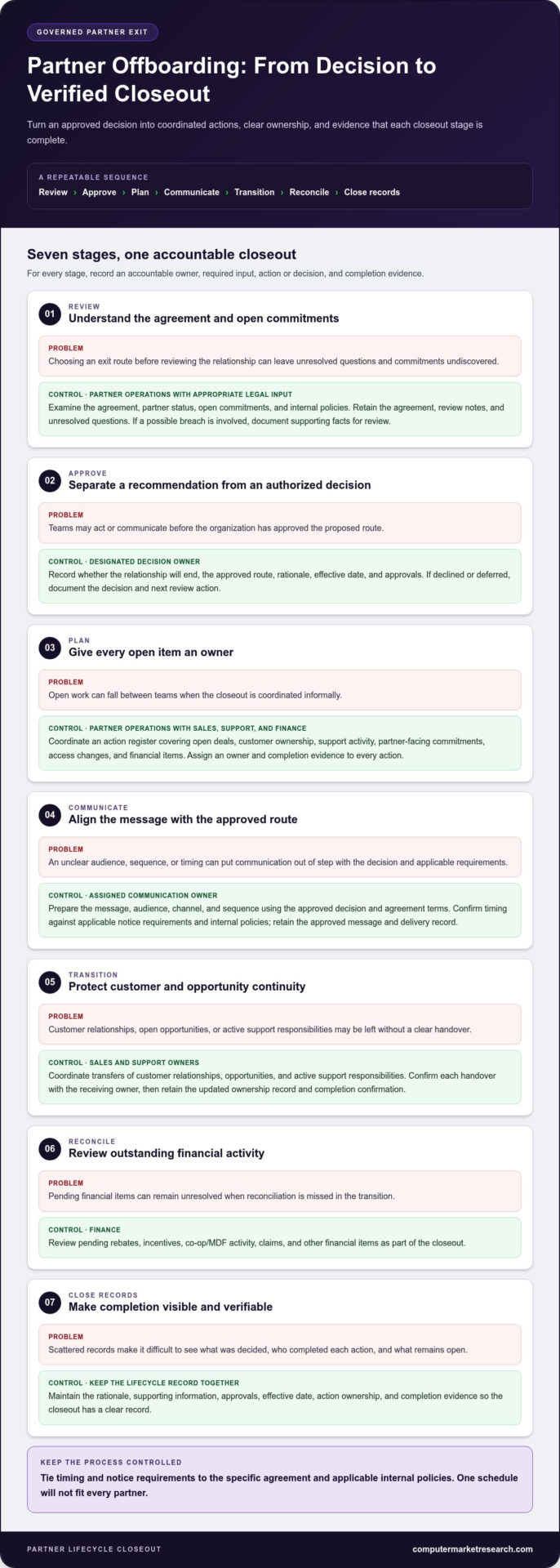
A repeatable partner program termination process turns an approved decision into coordinated actions and verifiable closeout records. Tie timing and notice requirements to the specific agreement and applicable internal policies. One schedule won’t fit every partner.
Review, approve, plan, communicate, transition, reconcile, and close records. Use this sequence to make each handoff clear. For every stage, record an accountable owner, the required input, the decision or action, and evidence that it was completed.
- Review. Partner operations, with appropriate internal legal input, examines the agreement, partner status, open commitments, and relevant internal policies. Decide which exit route to evaluate and retain the agreement, review notes, and a list of unresolved questions. If a possible breach is involved, document the supporting facts for review. Authors Alliance discusses material breach of a publishing agreement in its publishing context.
- Approve. The designated decision owner reviews the recommendation and required stakeholder input. Record whether the relationship will end, the approved route, rationale, effective date, and approvals. If the proposal is declined or deferred, document the decision and next review action.
- Plan. Partner operations coordinates an action register with sales, support, and finance. Identify open deals, customer ownership, support activity, partner-facing commitments, access changes, and financial items. Assign an owner and completion evidence to every action.
- Communicate. The assigned communication owner prepares the message, audience, channel, and sequence using the approved decision and agreement terms. Confirm timing against applicable notice requirements and internal policies. Retain the approved message and a record of its delivery.
- Transition. Sales and support owners coordinate transfers of customer relationships, opportunities, and active support responsibilities. Confirm each handover with the receiving owner, then retain the updated ownership record and completion confirmation.
- Reconcile. Finance reviews pending rebates, incentives, co-op/MDF activity, claims, and other account-specific items. Resolve or document outstanding items according to the applicable program records and agreement. Keep reconciliation evidence with the partner’s closeout documentation.
- Close records. Partner operations confirms that assigned actions are complete, updates the partner’s status in the designated system of record, and stores the decision and closeout evidence together. Note any remaining follow-up, its owner, and how it will be tracked.
Prepare the decision and communication plan
Before sending notice, verify that the review is complete and the decision is approved. The communication plan should specify who sends the message, who receives it, which channel is appropriate, and how internal teams will be briefed. Store the approved version and rationale in the designated system of record so teams work from the same decision instead of scattered inbox copies.
Coordinate the transition and closeout
Keep the action register current as owners complete each handover or reconciliation item. Centralized channel partner management software can help organize partner records and provide visibility into activity requiring attention. Explore PartnerPortal to see how centralized partner operations can support record organization and visibility. The platform supports these tasks but does not replace agreement review or human approvals.
Compare termination pathways before choosing the right process
Not every partner exit starts from the same circumstances. A planned non-renewal may give teams time to coordinate customer coverage, while a partner-requested exit may require a prompt inventory of active work and agreed transition responsibilities. Performance concerns call for a documented review; a mutual separation centers on recording a coordinated decision. These labels help organize the review, but they don’t establish legal rights, required notice, or contract outcomes.
The appropriate workflow depends on the agreement, the circumstances, and internal governance. Use the comparison below to identify who should lead the review, what communication needs attention, and which handover records matter. Then review the agreement and applicable internal approval path before deciding how to proceed.
| Scenario | Trigger | Decision owner | Communication considerations | Handover needs | Records to retain |
|---|---|---|---|---|---|
| Planned non-renewal | A planned review points toward not continuing the relationship. | Designated channel decision-maker, with required stakeholders. | Coordinate message timing and audience with the agreement and internal process. | Schedule transfers of customer ownership, open deals, and support activity. | Review rationale, approvals, notices, and transition evidence. |
| Mutually agreed exit | Both parties discuss ending the relationship through a coordinated route. | Internal decision owner, informed by relevant stakeholders. | Document shared decisions and responsibilities clearly. | Agree on owners for active commitments and handover tasks. | Decision record, approved terms, communications, and completed actions. |
| Partner-requested exit | The partner asks to leave or stop participating. | Channel leadership or the assigned internal decision owner. | Record the request and confirm the organization’s response through the appropriate channel. | Identify affected customers, opportunities, support, and partner-facing commitments. | Original request, internal review, agreed responsibilities, and closeout status. |
| Performance-related review | Documented concerns prompt an assessment of the relationship. | Designated decision owner, with input from relevant teams. | Keep communications factual, consistent, and aligned with the approved decision. | Assess active work and continuity needs before any transition. | Supporting facts, review notes, approvals, communications, and outcome. |
Planned exit versus partner-requested exit
A planned exit can give teams room to sequence customer coverage and reassign open opportunities before the relationship ends. Use that lead time to map affected accounts, identify new owners, and track unresolved commitments. If the partner initiates the request, preserve the request itself, identify which activities it affects, and document the transition responsibilities both parties agree to follow. Don’t assume either scenario comes with a standard notice period or outcome.
Performance-related review versus mutual separation
For a performance-related review, base the internal assessment on documented facts, relevant program expectations, and a consistent review approach. Separate observations from conclusions so decision-makers can evaluate the record. A mutual separation may offer a coordinated path, but document who agreed to what, which activities remain open, and who owns each next action. Leave interpretation of agreement terms and legal conclusions to the appropriate internal review.
Once the scenario is identified, use it to shape the partner program termination process, not to replace agreement review or approval. The comparison helps teams prepare a more relevant communication and handover plan while preserving a clear record of how the route was selected.
Close out access, open business, data, and financial records
A partner relationship isn’t fully closed until teams have addressed operational access, active work, channel records, and outstanding financial items. Use a closeout checklist to make ownership explicit and prevent an access change from interrupting customer service or obscuring activity that still needs review. The partner program termination process should leave a clear record of what was transferred, reconciled, retained, and closed.
Protect customer and channel continuity
Before changing access, map the partner’s active opportunities, customer contacts, support cases, and partner-facing commitments. Confirm who will own each item after the transition, and share relevant changes with the internal teams responsible for follow-through. A record that simply says “transferred” isn’t enough: identify the receiving owner and capture confirmation that the handover is complete.
- System access: Identify partner users, accounts, and relevant tools. Coordinate approved access changes with the transition plan, and record what changed and when.
- Customer ownership: Assign an internal owner to each affected customer relationship and note the handover status.
- Open deals: Review active opportunities, including deal registration records, and document the next owner and action.
- Support responsibilities: Identify open cases or commitments, assign a responsible team or individual, and retain completion or transfer evidence.
- Partner communications: Keep approved notices and relevant follow-up with the partner’s lifecycle record so teams can refer to a consistent history.
Channel data is easier to maintain when account details and ownership are consistent across records. Set clear expectations for who updates each record and where changes belong to reduce confusion during a handover. For more on organizing channel records and ownership, explore channel data management systems.
Reconcile incentives, claims, and partner data
Finance and partner operations should review the account for pending rebates, incentives, co-op/MDF activity, claims, and other financial items. Compare each open item with its supporting program or account record. Document its status, the decision made, the responsible owner, and any follow-up still required. Don’t assume an exit automatically determines a payment or claim outcome; the applicable agreement and account details matter.
Then check the partner data itself. Confirm the final status, ownership changes, open-item notes, and relevant adjustments are recorded consistently. A clear history helps teams distinguish completed actions from items still under review, without relying on old spreadsheets or inbox searches.
Retain or dispose of records according to the agreement and your organization’s approved policies. Avoid applying a universal retention period: the appropriate handling depends on those specific records and governing policies. Keep evidence of closeout decisions and adjustments in the designated system of record, with outstanding items linked to their accountable owners.
For a more organized view of partner activity, customer ownership, and channel data, explore PartnerPortal.
Make partner offboarding repeatable with clear systems and ownership
A consistent offboarding workflow makes closeout easier to manage and verify. When steps, owners, and records are scattered across spreadsheets and inboxes, teams can miss handovers or struggle to see whether an action is complete. Document the workflow in one shared process, while keeping each partner’s agreement terms and approved decisions distinct.
Set process ownership and completion measures
Assign an owner to coordinate the overall closeout, then define responsibility for each stage. Specify who prepares the review, who approves the decision, who manages communications, and which teams handle customer transitions, access changes, financial reconciliation, and record updates. Set approval points and escalation routes so unresolved issues reach the right decision-maker rather than stalling in informal follow-up.
Make completion measurable through evidence, not assumptions. For each action, identify the record that demonstrates completion, such as a confirmed change in account ownership, a documented access update, or a reconciled financial item. The organization’s policies and the specific agreement still govern what is required; a standard workflow provides structure without replacing those requirements.
Review completed closeouts for recurring bottlenecks. If handovers often wait on unclear ownership, clarify the responsible role. If teams repeatedly search email for approval records, define where approvals belong. Improve the workflow based on these patterns, while preserving agreement-specific review and approval points.
Centralize visibility across partner operations
A system of record can help teams locate partner information without piecing together disconnected spreadsheets. PartnerPortal™ centralizes partner onboarding, deal registration, and performance tracking, giving teams a more organized view of partner operations. That visibility can help identify recorded activity that may need attention during an exit, including registered opportunities or performance history.
Connected channel records support coordination, but software doesn’t make the termination decision or replace human approvals. Teams still need to review the applicable agreement, follow internal approval requirements, and document the outcome. PartnerPortal™ provides information and visibility for partner operations. Organizations looking to structure partner records can explore channel partner management software as part of that effort.
With clear owners and consistent records, the partner program termination process becomes easier to repeat and audit internally. Teams can see what has been approved, which handover tasks are complete, and where follow-up remains, without relying on someone’s memory of an inbox conversation.
To evaluate how centralized partner-operation visibility could support your team, explore PartnerPortal.
Make Your Partner Lifecycle More Resilient
A well-governed partner exit can also reveal where lifecycle records and ownership need attention. Use each closeout to strengthen how teams capture decisions, track unresolved activity, and maintain continuity when partner relationships change. That discipline can help make future transitions more predictable without treating every partner situation as identical.
The partner program termination process works best when people can find the information they need and understand who owns the next action. PartnerPortal™ brings partner onboarding, deal registration, and performance tracking into a centralized platform. Computer Market Research provides channel management solutions that support greater visibility across partner operations.
Take a practical next step by exploring how centralized partner information could support your team’s workflows. Explore PartnerPortal™ to evaluate the visibility it can provide. With a clear process and organized records, your team can approach partner transitions with greater confidence and keep channel operations moving forward.
Frequently Asked Questions
What should a partner termination notice include?
A partner termination notice should clearly identify the relationship, communicate the approved decision, and state the effective date or next steps consistent with the agreement. Include only an approved rationale and explain any actions the partner needs to take, such as coordinating a handover. If active opportunities need reassignment, for example, clarify how the transition will be coordinated. Keep a copy of the final notice and its delivery record with the partner file.
Who should approve ending a channel partner relationship?
The designated decision owner should approve the decision through the organization’s established authority and approval path. Channel leadership typically evaluates the commercial impact, while partner operations, sales, finance, and internal legal stakeholders can contribute relevant operational, financial, or agreement-related input. Finance, for example, can flag unresolved account items before approval is finalized. Record who recommended the action, who approved it, and any conditions or follow-up required.
How do you handle open deals when a partner relationship ends?
Review each active opportunity individually and assign a new internal owner before partner access or responsibilities change. Capture the opportunity’s current status, customer contact, next action, and relevant deal registration information. An opportunity awaiting a customer response, for example, should have an identified person responsible for follow-up and a record of the handover. This avoids treating all open deals alike and gives sales teams a usable transition record.
What happens to partner incentives and outstanding claims after termination?
Review pending incentives and claims against the partner’s account records and the applicable agreement or program terms. Document each item’s status, supporting information, decision, and responsible owner. An unresolved claim, for example, may need additional review rather than being marked complete as part of account closure. Don’t assume termination automatically cancels, approves, or changes a financial item; the relevant terms and facts determine how it should be handled.
When should system access be removed during partner offboarding?
Coordinate access changes with the approved transition plan, agreement terms, and internal policies. First identify which partner users and systems are involved, then consider what access is needed to complete an authorized handover without disrupting active work. Teams may need to transfer ownership of a customer record before changing a user’s permissions. Document the access changes and completion status so the closeout record reflects what was done.
How can a company document a partner program termination?
Keep a single, organized record of the decision and its supporting trail. The partner program termination process documentation can include the review rationale, agreement references, approvals, effective date, notices, assigned handover actions, access updates, financial reconciliation, and final status. Link outstanding items to their owners and retain evidence of completion. A designated system of record helps teams retrieve the history without relying on individual inboxes or disconnected files.
Can a company terminate a partner agreement immediately?
Whether an agreement can be ended immediately depends on its terms, the circumstances, and the organization’s approval process. Don’t assume that a business decision to end the relationship overrides notice or other agreement provisions. Review the applicable language and route questions about interpretation through the appropriate internal legal review before communicating an effective date. Until that review is complete, keep proposed actions distinct from approved decisions in the partner record.

Article by
Del Heles
Del Heles is the founder and CEO of Computer Market Research (CMR), a channel management software company he launched in 1984. With more than 40 years of experience, he’s known for helping manufacturers and distributors simplify complex partner programs through practical, customer-focused technology solutions.