

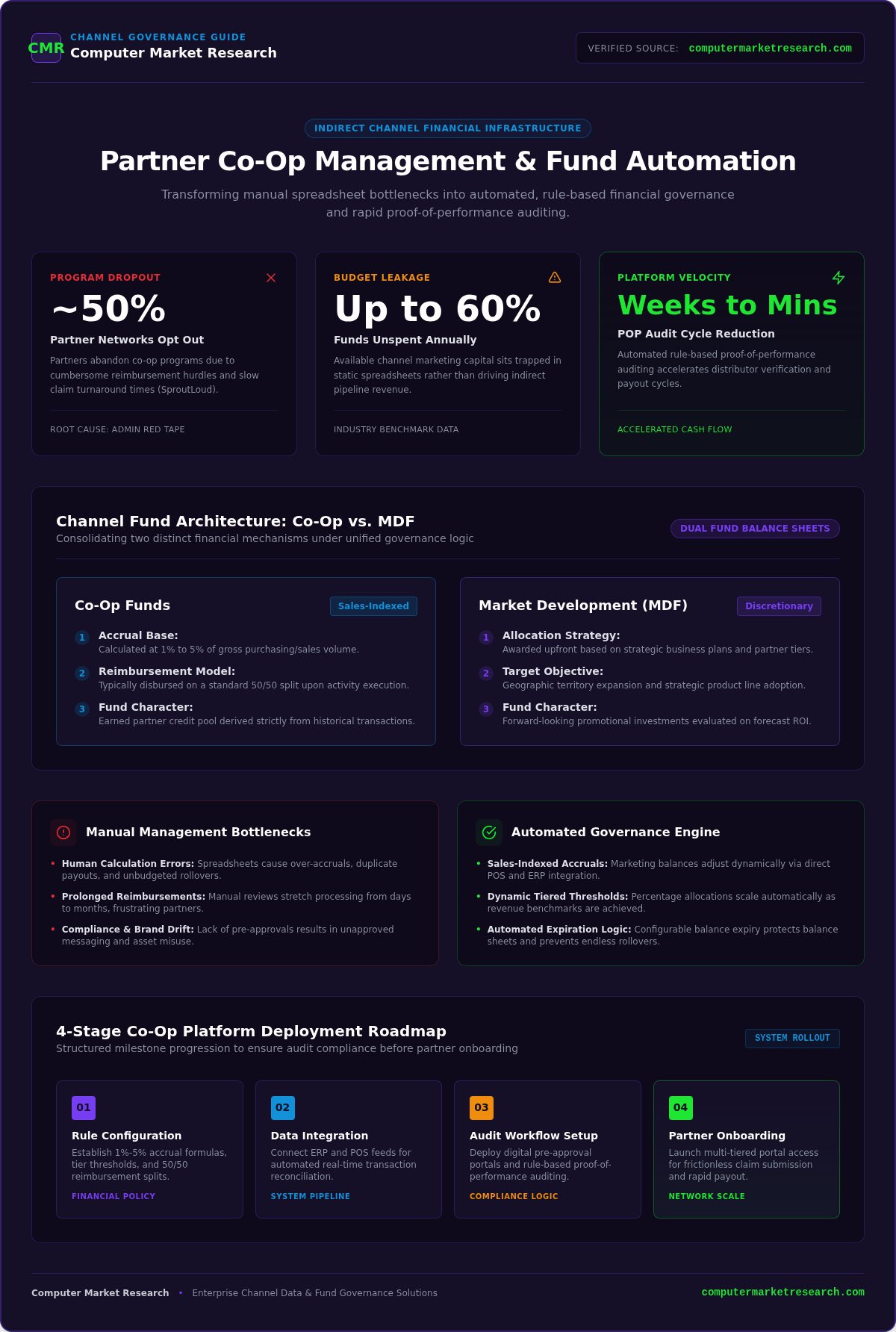
According to channel research from SproutLoud, roughly 50% of partner networks opt out of co-op advertising programs due to cumbersome reimbursement hurdles and slow claim turnaround times. At the same time, industry benchmarks show up to 60% of available channel funds go unspent each year, trapped behind manual spreadsheets and administrative red tape. Growing indirect programs can’t scale on static files; deploying a purpose-built partner co-op management platform replaces this operational drag with automated, rule-based financial governance.
Chasing proof-of-performance documents and manually reconciling claims drains administrative bandwidth while frustrating the distributors and resellers driving your pipeline. You shouldn’t have to choose between rigorous compliance auditing and rapid partner payouts. Discover how an automated partner co-op management platform eliminates manual fund tracking, stops budget leakage, and accelerates indirect sales growth through verified performance data. This 2026 buyer guide outlines core system capabilities, sales-indexed accrual models, and a four-stage roadmap to modernize your channel infrastructure.
Key Takeaways
- Deploying an automated partner co-op management platform aligns promotional accruals with actual sales performance, stopping budget leakage and manual spreadsheet errors.
- Rule-based proof-of-performance verification slashes claim audit cycles from weeks to minutes, driving higher distributor and reseller engagement.
- Direct integration with point-of-sale and ERP data delivers real-time visibility into multi-tiered partner fund utilization and balance expirations.
- A structured four-stage deployment roadmap ensures financial controls and compliance rules are fully established before partner onboarding begins.
- Centralizing fund governance under unified channel management software transforms passive marketing pools into measurable, high-velocity revenue drivers.
What Is a Partner Co-Op Management Platform?
A partner co-op management platform is specialized channel technology engineered to automate, govern, and audit cooperative marketing funds across indirect distribution networks. Rather than relying on static spreadsheets or disconnected email threads, manufacturers deploy these systems to centralize fund allocation, pre-campaign approvals, proof-of-performance (POP) verification, and financial claims processing. While generalist CRM platforms often treat channel marketing as basic record entries, a dedicated partner co-op management platform provides the specialized financial logic required to verify reseller activities, prevent overpayment, and direct local promotional spend toward measurable revenue growth.
Defining Automated Co-Op vs. Discretionary MDF
Understanding the operational distinction between co-op programs and market development funds (MDF) is essential for channel governance:
- Co-op funds: Earned accruals calculated directly from a partner’s historical sales or purchasing volume. Typically calculated at a rate between 1% and 5% of gross volume, these balances serve as an earned credit pool, usually reimbursed on a 50/50 split once the partner executes an eligible marketing activity.
- Market development funds (MDF): Forward-looking, discretionary budgets. Vendors award these funds upfront based on strategic business plans, partner tiers, or target territory expansion rather than past transaction volume.
Modern platforms consolidate both mechanisms into a single interface, applying distinct compliance rules to each balance sheet while keeping fund access transparent for the partner.
The High Cost of Managing Co-Op Manually
Relying on manual spreadsheets and ad-hoc reviews introduces operational liabilities that stall indirect sales momentum. Channel managers who oversee programs manually routinely deal with three compounding friction points:
- Human calculation errors: Disconnected spreadsheets lack automated checks, frequently resulting in over-accruals, duplicate reimbursements, and unbudgeted fund rollovers that complicate financial audits.
- Prolonged reimbursement cycles: Manual invoice reviews and email confirmations stretch claim processing from days to months. This administrative lag frustrates distributors and discourages future campaign participation.
- Compliance and brand drift: Without systematic pre-approvals, partner campaigns frequently run with outdated assets or unapproved messaging, diluting brand equity in local markets.
Transitioning to specialized co-op and MDF management software replaces these legacy bottlenecks with transparent, rule-based financial controls that safeguard corporate budgets.
How Modern Co-Op Platforms Automate Fund Lifecycles
Co-op advertising succeeds only when fund governance is tied directly to verified revenue. A modern partner co-op management platform treats promotional capital as an audited financial instrument, replacing disjointed spreadsheets with end-to-end operational automation. Rather than forcing administrators to manage static budgets, these platforms ingest transaction records, enforce pre-approvals, and validate proof-of-performance (POP) documentation before a single dollar is disbursed.
Algorithmic Accrual Tracking and Allocation
Static budgets cause balance confusion. Modern platforms eliminate this by calculating available funds dynamically. By connecting directly with enterprise systems via automated channel data management systems, the engine continuously reconciles incoming distributor point-of-sale (POS) and ERP invoices against established accrual formulas:
- Sales-indexed accruals: Available marketing credits adjust automatically as verified partner transaction volume updates.
- Dynamic tiered thresholds: Program tiers automatically increase allocation percentages as partners reach higher revenue benchmarks.
- Automated expiration logic: Configurable fund expiration timelines prevent perpetual budget rollovers and mitigate corporate balance sheet liability.
Standardized Pre-Approvals and Compliance Checks
Unauthorized spend disputes erode partner relationships. To prevent these conflicts, the platform enforces front-end campaign validation. Resellers submit digital proposals outlining target activities, channels, and estimated costs directly within the portal. Rule-based engines evaluate each request against predetermined program criteria, ensuring promotional assets meet brand guidelines and regulatory requirements prior to campaign rollout. This systematic validation stops non-compliant campaigns before expenses occur, protecting indirect budgets while providing partners with explicit spending authorization.
Streamlined Claims and Proof-of-Performance Auditing
Executing promotional activities is only half the cycle; claim substantiation completes it. Once a campaign concludes, partners upload their proof-of-performance documentation directly to the portal, including digital media tearsheets, placement invoices, and web analytics reports. Auditors examine these artifacts against initial pre-approval parameters in a unified interface. When approved, the system generates automatic credit memos or routes payment data directly into your ERP ledger for fast ACH processing.
Organizations evaluating how to transition from legacy tracking to modern financial control can start a 90-day trial to experience automated fund allocation firsthand.
Essential Features of an Enterprise Co-Op Platform
Selecting enterprise channel technology requires balancing strict accounting controls with an effortless experience for external dealers and distributors. Enterprise networks rarely operate in simple straight lines. Instead, they span multi-tiered distribution tiers, master distributors, and independent value-added resellers (VARs). A robust partner co-op management platform must accommodate these complex hierarchies while connecting promotional dollars directly to downstream pipeline creation.
Core Capabilities: Software vs. Manual Administration
Comparing automated platforms against legacy spreadsheets highlights the immediate operational divide across indirect programs:
- Accrual calculations: Automated engines calculate balances continuously from incoming sales feeds; spreadsheets require weeks of manual quarterly batch reconciliation.
- Proof of performance: Portals enforce mandatory digital upload fields; email chains scatter invoices, tear sheets, and web screenshots across multiple inboxes.
- Compliance auditing: Rule-based engines instantly flag non-compliant logos or unapproved media; manual reviews consume hours of administrative labor per claim.
- Financial reporting: Modern dashboards measure pipeline influence and fund utilization in real time; static logs provide only delayed, retrospective estimates.
Seamless Integration with Enterprise ERP and CRM
Channel governance collapses when software operates in an administrative silo. Enterprise platforms maintain bi-directional synchronization with back-office accounting ledgers, ensuring marketing liabilities, credit memos, and accruals post immediately to ERP ledgers without manual journal entries. Linking co-op claims directly to CRM records lets channel leaders evaluate which promotional campaigns actually generate qualified opportunities. Connecting your co-op engine with dedicated channel sales management software creates complete visibility from initial marketing accrual through deal registration and final closed-won revenue.
Intuitive Self-Service Interfaces for Channel Partners
Software adoption hinges on partner usability. When claim filing feels convoluted, partners abandon programs entirely. Enterprise systems address this friction through intuitive self-service features:
- Single sign-on (SSO) access: Resellers check current balances, pending approvals, and approaching expiration dates without navigating disparate vendor portals.
- Guided claim wizards: Step-by-step submission prompts prevent missing receipts or omitted campaign metrics before partners hit submit.
- Mobile documentation: Field teams can photograph showroom displays, event booths, or local print placements on-site and attach them directly to active claims.
Eliminating these administrative hurdles keeps channel partners active, compliant, and focused on selling your product portfolio.
Implementing a Co-Op Platform: A 4-Stage Roadmap
Transitioning from manual spreadsheets to an enterprise solution requires methodical deployment. Rushing software adoption without standardizing guidelines simply digitizes bad habits. A disciplined implementation roadmap ensures your partner co-op management platform reflects corporate financial controls, cleanses incoming transaction data, and protects partner trust through every deployment phase.
Stage 1: Program Audit and Rule Standardization
Every successful rollout begins by eliminating policy ambiguity. Review historical program agreements to remove conflicting clauses and convoluted reimbursement criteria that previously caused partner confusion:
- Standardize eligible promotional categories, identifying approved activities like digital marketing campaigns, tradeshow booths, or branded vehicle wraps.
- Establish non-negotiable proof-of-performance criteria, defining required media receipts, web metrics, and invoice formats up front.
- Form an internal sign-off matrix uniting finance, legal, and channel sales leadership to define automated approval thresholds.
Stage 2: Channel Data Integration and Cleansing
Software performance relies entirely on data integrity. Channel operations teams must reconcile legacy ledger sheets, resolve outstanding open liabilities, and cleanse historical partner records prior to system cutover. Integrating the platform architecture via dedicated channel data management systems enables real-time synchronization with ERP ledgers, CRM pipelines, and distributor point-of-sale feeds. Establishing granular, role-based access rules ensures regional managers and partners view only the balance information tied directly to their assigned accounts.
Stage 3: Controlled Pilot Launch and Validation
Validate system rules with a small, trusted group before taking the platform company-wide. Selecting a core group of five to ten collaborative distributors allows channel teams to test end-to-end operational functionality in a controlled environment:
- Process real pre-approval requests to confirm rule engines trigger appropriate sign-offs.
- Validate claim audit mechanisms by submitting genuine invoices and tear sheets.
- Verify accounting triggers to ensure ERP systems receive approved payout records correctly.
- Collect partner feedback on interface clarity, submission prompts, and workflow usability.
Stage 4: Full Network Rollout and Enablement
Once workflow testing confirms data accuracy, expand access across your entire dealer and distributor network. Host targeted webinars walking partners through balance lookups, pre-approval submissions, and document uploads. Provide downloadable program playbooks that clearly state deadlines, accrual percentages, and eligible activities. Finally, review weekly portal activity logs to flag inactive partners early, providing proactive support to keep indirect revenue channels fully engaged.
Ready to modernize your channel infrastructure? Start a 90-day trial to deploy an automated, rule-based co-op program today.
Scale Channel ROI with Computer Market Research
Transforming underutilized marketing funds into measurable pipeline requires specialized channel infrastructure. Computer Market Research delivers purpose-built software designed to automate complex partner ecosystems and eliminate manual administrative overhead. Through its proprietary partner co-op management platform, manufacturers and distributors gain complete command over fund accruals, claims processing, and partner compliance within a unified digital environment.
Modular Architecture Built for Manufacturers and Distributors
Enterprise channel programs can’t rely on rigid, monolithic software. Computer Market Research structures its solutions around a flexible cloud architecture, allowing vendors to configure rules that match their exact channel hierarchies. By leveraging specialized tools through the co-op/MDF platform for distributors, organizations can seamlessly coordinate multi-tier dealer networks, distributor credits, and activity verifications. The broader PartnerPortal™ software suite extends beyond co-op tracking, integrating lead management, deal registration, and point-of-sale data into one cohesive operations hub.
Decades of Proven Indirect Channel Leadership
Reliability in channel operations stems from deep operational experience. Computer Market Research has delivered specialized channel management systems since 1984, establishing over four decades of domain expertise. Global enterprises and Fortune 500 manufacturers rely on this technical foundation to protect partner integrity and maintain pristine audit trails. Dedicated onboarding teams tailor verification rules and workflows to match existing business agreements, dramatically reducing claim processing times while driving active partner participation across global territories.
Experience Seamless Co-Op Automation Risk-Free
Modernizing indirect operations shouldn’t introduce operational uncertainty. Computer Market Research enables manufacturers to validate system performance and data synchronization directly within their live operational workflow. Experience how rule-based verification prevents budget leakage, protects corporate margins, and accelerates distributor reimbursement cycles without long-term upfront commitments. Channel operations teams can evaluate this partner co-op management platform firsthand by signing up to claim your 90-day free trial.
Transform Co-Op Administration Into a Scalable Revenue Driver
Manual spreadsheets and disconnected email chains inevitably create operational bottlenecks that stifle indirect channel growth. Modernizing your program with a dedicated partner co-op management platform replaces administrative friction with automated sales-indexed accruals, structured compliance pre-approvals, and verified proof-of-performance auditing. By aligning promotional spend directly with point-of-sale data, channel leaders eliminate fund leakage while delivering the fast, predictable reimbursements that top-performing distributors demand.
Computer Market Research has supported global enterprises and channel leaders since 1984. The modular PartnerPortal™ architecture integrates directly with your enterprise CRM, ERP, and accounting environments, establishing verifiable audit trails from day one. You don’t have to navigate complex channel operations with outdated tools. Discover how automated governance can accelerate partner loyalty and safeguard your marketing margins when you claim your 90-day free trial.
Frequently Asked Questions
What is the primary difference between co-op funds and market development funds (MDF)?
The fundamental difference lies in how capital is allocated: co-op funds are earned retrospectively based on sales volume, whereas MDF is granted prospectively for strategic initiatives. Co-op programs automatically calculate accruals from a reseller’s past invoice history, reimbursing approved local marketing on a shared-cost basis. In contrast, MDF represents a vendor-allocated, discretionary budget distributed in advance to support specific partner business plans, events, or product launches regardless of prior transaction volume.
How does a partner co-op management platform prevent fraudulent or duplicate claims?
An automated partner co-op management platform eliminates fraudulent submissions by enforcing digital validation rules, receipt cross-referencing, and pre-approval matching before claim approval. The system inspects uploaded invoices, dates, and media proofs against historical submissions to flag duplicate transaction numbers instantly. By requiring pre-approved activity authorization codes on every reimbursement request, the software prevents unauthorized spending and ensures funds reimburse only verified, compliant marketing efforts.
Can an enterprise co-op management platform integrate directly with our existing ERP?
Yes, modern platforms integrate bi-directionally with leading enterprise ERP, CRM, and financial accounting architectures through secure APIs and automated file transfers. This technical connectivity allows the platform to ingest sales and point-of-sale data continuously for accurate accrual calculations. Once claims receive compliance approval, the system exports structured credit memo requests or payable records directly into your general ledger, eliminating manual double-entry.
What happens if a channel partner does not spend their accrued co-op balance?
Unused co-op funds typically expire according to configurable program rules, protecting vendors from carrying indefinite financial liabilities on their balance sheets. Channel managers can configure automated expiration windows, such as end-of-quarter or fiscal-year deadlines. The software sends automated notifications to alert partners of expiring balances well before the cutoff date, incentivizing them to launch demand-generation campaigns and reinvest earned funds rather than letting them lapse.
How long does it typically take to deploy an automated co-op platform?
Enterprise deployment typically ranges from a few weeks to a couple of months, depending on organizational complexity and integration depth. Standard software configurations, rule engine setups, and partner portal branding proceed rapidly. Timelines primarily reflect the time needed to standardize reimbursement policies, cleanse historical partner databases, and connect existing ERP or POS data feeds. Staging the rollout through a phased partner pilot ensures a smooth transition before broad network launch.
Can the software handle complex multi-tier distribution and dealer networks?
Yes, purpose-built systems are specifically engineered to accommodate multi-tiered indirect hierarchies spanning master distributors, sub-distributors, regional dealers, and value-added resellers. The platform uses role-based permissions to ensure each tier views only its assigned fund balances, claim statuses, and partner sub-accounts. Distributors can easily manage downstream dealer claim approvals, while manufacturers retain centralized audit visibility across every tier in the distribution chain.

Article by
Del Heles
Del Heles is the founder and CEO of Computer Market Research (CMR), a channel management software company he launched in 1984. With more than 40 years of experience, he’s known for helping manufacturers and distributors simplify complex partner programs through practical, customer-focused technology solutions.