

The global outsourcing market has surged past $1 trillion in 2026, yet many Global 2000 firms still leak revenue because their high-value analysts are trapped in burdensome manual data administration. You’ve likely seen the frustration firsthand when inaccurate POS and inventory data lead to incentive overpayments or missed market trends. Many leaders are now turning to outsourced channel data management to stop their most expensive talent from spending forty hours a week manually cleansing rows of data. We understand that fragmented information isn’t just an administrative headache; it’s a barrier to scalable growth.
This guide demonstrates how to reclaim those lost hours and secure decision-grade insights by modernizing your data handling. You’ll learn how to eliminate manual errors and build a robust infrastructure that evolves with your partner portal. By 2026, channel management has moved from simple transactional relationships to complex, data-driven ecosystems that require a seamless flow of information. By following this framework, you’ll transform messy, fragmented inputs into clean, normalized data ready for executive reporting and improved channel ROI.
Key Takeaways
- Learn how to identify and quantify the spreadsheet trap that drains your high-value staff’s time with manual data cleansing.
- Understand why outsourced channel data management is a strategic infrastructure upgrade that provides decision-grade insights beyond basic software capabilities.
- Discover the systematic mechanics of automated data collection and the normalization protocols required for accurate executive reporting.
- Gain full visibility into your multi-tier distribution channels to optimize incentive tracking and eliminate costly overpayments in your MDF programs.
- Explore how to build a scalable data ecosystem using PartnerPortal™ to centralize operations across your entire global partner network.
The Hidden Costs of In-House Channel Data Management
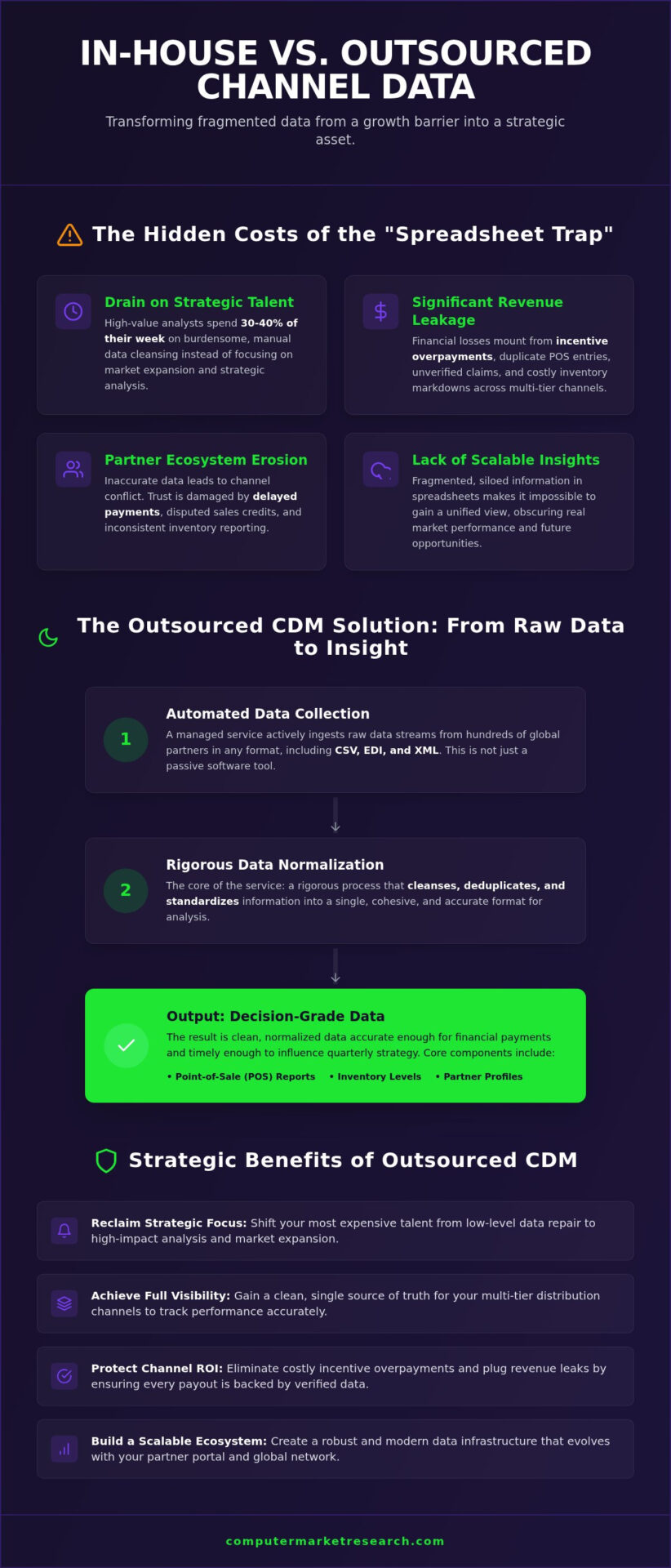
Many organizations fall into the spreadsheet trap, where they believe manual data cleansing is a viable long-term strategy. This approach fails rapidly as distribution networks expand. Relying on high-value staff to sift through thousands of rows of CSV files creates a massive administrative burden that obscures real market performance. It’s a reactive cycle that keeps your team looking backward instead of identifying future opportunities. When operations are manual, the cost of administrative overhead often exceeds the perceived savings of keeping the process in-house.
To better understand this concept, watch this helpful video:
Beyond the time lost, in-house management carries significant regulatory risks. In 2026, new US state privacy laws in Kentucky and Rhode Island have introduced unique compliance obligations for businesses handling resident data. Adhering to these while following foundational data management principles is nearly impossible when your information is siloed in fragmented spreadsheets. Inaccurate records often lead to channel conflict. Partners feel the sting of delayed payments, disputed sales credits, and inconsistent inventory reporting, which erodes the trust required for a healthy ecosystem.
The Drain on Strategic Human Capital
Revenue Leakage from Data Inaccuracies
Duplicate POS entries and unverified claims are the primary drivers of financial loss in indirect sales. Without real-time visibility, companies often suffer from inventory markdowns because they can’t accurately track stock levels across multi-tier channels. Revenue leakage is the measurable loss of capital resulting from paying out incentives on unverified, duplicate, or fraudulent channel claims. Relying on outsourced channel data management providers who utilize professional channel data management systems helps plug these gaps. This ensures every dollar spent on rebates or MDF is backed by normalized, accurate data, protecting your bottom line from unforced errors.
What is Outsourced Channel Data Management?
Defining outsourced channel data management requires looking beyond simple software subscriptions. While many vendors offer tools to host data, true outsourcing involves a managed professional service that takes ownership of the entire data lifecycle. This discipline moves the responsibility of data integrity from your internal team to a specialized partner. It isn’t just about having a repository; it’s about the active administration of complex information streams coming from hundreds or thousands of global partners.
A critical distinction exists between data collection and data normalization. Collection is the passive act of receiving files in various formats like CSV, EDI, or XML. Normalization is the rigorous process of cleansing, deduplicating, and standardizing that information into a single, cohesive format. Core components of this process include:
- Point-of-Sale (POS) Reports: Detailed records of who bought what, where, and for how much.
- Inventory Levels: Real-time visibility into stock held by distributors and resellers.
- Partner Profiles: Verified metadata about channel entities to ensure incentive eligibility.
The ultimate goal of outsourcing is to produce decision-grade data. This is information that is accurate enough to trigger financial payments and timely enough to influence quarterly strategy. If you’re ready to see how this works in practice, you can explore our managed services with a 90-day trial.
Managed Data Services vs. SaaS-Only Solutions
The primary gap in the current market is the confusion between SaaS platforms and managed services. Think of software as the engine and managed services as the fuel. A SaaS-only solution provides the portal but leaves the “heavy lifting” of partner chasing and data cleansing to your staff. In contrast, outsourced channel data management provides the administrative support to contact partners, resolve reporting errors, and ensure 100 percent compliance. Choosing a partner that offers both the PartnerPortal™ and dedicated data administrators ensures that your technology doesn’t become another empty shell that your team has to manage manually.
Decision-Grade Data: The New Gold Standard
Data only becomes “decision-grade” when it meets three criteria: accuracy, timeliness, and depth. Normalized data is essential because it feeds directly into your CRM and ERP systems, providing a single source of truth for the entire organization. When your systems speak the same language, executive reporting becomes an automated byproduct rather than a manual project. For a deeper look at the technical architecture required for this level of integration, review our guide on channel data management systems. This structural alignment ensures that your channel insights are as reliable as your direct sales data.
The Mechanics of Outsourced Data Normalization
The transition from manual data handling to a systematic workflow requires a disciplined approach to information architecture. Effective outsourced channel data management isn’t a single event but a recurring cycle of five distinct stages. This process ensures that raw, often chaotic partner inputs are transformed into a refined dataset that can support multi-million dollar incentive programs. The mechanics of outsourced channel data management involve more than just technical ingestion; they require a deep understanding of industry-specific SKU variations and partner behaviors.
- Step 1: Automated Collection: Ingesting data from diverse partner formats including EDI, XML, and non-standard spreadsheets.
- Step 2: Cleansing and Deduplication: Identifying and removing redundant entries to prevent the overpayment of claims.
- Step 3: Normalization: Mapping disparate partner information against a master product and partner database to ensure SKU consistency.
- Step 4: Validation: Resolving errors directly with partners to maintain high data integrity standards.
- Step 5: Real-time Reporting: Delivering clean, actionable insights via the PartnerPortal™ for executive review.
Handling Diverse Global Data Formats
Multi-tier distribution creates a complex web of data sources with varying levels of technical maturity. A Tier 1 distributor might provide clean EDI feeds, while a smaller reseller relies on manual Excel files. CMR manages this disparity by utilizing flexible ingestion methods that accommodate diverse formats without forcing partners to change their existing workflows. This approach is essential for maintaining high partner participation rates while ensuring data completeness across the entire ecosystem.
Normalization and Enrichment Processes
Mapping partner SKUs to your internal master list is the cornerstone of reporting accuracy. Without this alignment, you can’t see which products are truly moving in specific regions or through specific partners. Enrichment adds another layer of value by appending geographic and demographic insights to partner profiles. This level of detail is particularly critical when managing ship and debit management software, where financial consistency across POS claims and rebate requests is mandatory. By standardizing these disparate data points, you create a transparent environment where every transaction is verified against a single source of truth.
Strategic Benefits: Why Enterprises Outsource CDM
Enterprises that adopt outsourced channel data management gain a significant competitive advantage by converting raw partner inputs into a strategic asset. While the previous section detailed the technical mechanics, the business value lies in the resulting clarity. Achieving 100 percent visibility into indirect sales channels allows you to identify exactly where your products are landing and which partners are driving the most value. In 2026, where channel management has shifted toward complex, data-driven ecosystems, this visibility is a requirement for operational survival. This transparency reduces channel conflict by providing verified deal registration data, ensuring that sales credits are awarded fairly based on actual performance rather than disputed claims.
Effective outsourced channel data management also empowers your logistics and supply chain teams. When you have a real-time view of inventory levels across the entire multi-tier distribution network, you can optimize demand forecasting and logistics planning. This precision reduces the high costs associated with emergency shipments or excess stock markdowns. By aligning your supply chain with actual market demand, you ensure that the right products are in the right place at the right time.
- Market Development Funds (MDF): Allocate funds based on hard data to ensure resources support high-performing regions and partners.
- Audit Integrity: Maintain a verifiable data trail that simplifies compliance with internal financial audits and regional privacy regulations.
- Strategic Agility: Pivot your channel strategy based on real-time insights rather than waiting for quarterly post-mortems that rely on outdated information.
Maximizing ROI on Incentive Spend
Managing incentive budgets requires absolute precision to avoid the common pitfall of overpayment. When data is fragmented, companies often pay rebates on duplicate entries or unverified sales. Clean, normalized data acts as a financial safeguard, allowing you to justify every dollar of the incentive budget to the C-suite. By demonstrating a direct link between spend and verified sales, you transform the channel department from a cost center into a predictable revenue driver. For a deeper look at these financial frameworks, review our guide on maximizing channel ROI.
Preventing Ship & Debit Revenue Leakage
Ship and debit programs are notoriously prone to revenue leakage due to the lag between the initial sale and the claim submission. Without real-time validation against actual POS data, manufacturers often approve claims that don’t match distributor inventory levels. Implementing professional ship and debit management software through an outsourced model ensures that every claim is cross-referenced against normalized records. This rigorous validation process identifies discrepancies before they impact the bottom line, preserving margins that are otherwise lost to administrative errors. If you’re ready to secure your channel margins, start your 90-day free trial of our managed services today.
Scaling Your Ecosystem with CMR Managed Services
Computer Market Research (CMR) brings a 40-year legacy to the discipline, having specialized in channel complexity since its founding in 1984. For Fortune 500 and Global 2000 companies, the challenge isn’t just finding a tool; it’s finding a partner who understands the nuances of global distribution. Our outsourced channel data management model combines the technical power of PartnerPortal™ with specialized managed services to offload your administrative burden entirely. This dual approach ensures that you don’t just have a repository, but a fully functional data ecosystem that supports your specific business rules. We focus on removing the “manual data burden” that prevents high-performing teams from reaching their full potential.
By leveraging our specialized services, organizations can ensure that POS data management and inventory tracking are handled with precision. Our team acts as an extension of your own, managing the collection, cleansing, and normalization of data so your analysts don’t have to. This systematic approach creates a stable foundation for executive reporting, ensuring that every decision is backed by verified, high-quality information. It’s a pragmatic solution designed for businesses that value order and performance above all else.
A Seamless Path to Modern Infrastructure
Transitioning to a modernized data environment shouldn’t disrupt your existing operations. We prioritize the integration of CMR with your current CRM and ERP systems, creating a unified flow of information across the organization. Our professional services team handles the initial data configuration, ensuring that your master SKU lists and partner profiles are accurately mapped from day one. This standardized workflow extends to global partner onboarding, making it easy to bring new distributors into the network without manual intervention. By centralizing these processes, you eliminate the friction that often stalls international expansion. It’s a methodical journey that replaces legacy obstacles with a clear path to operational stability.
Future-Proofing Your Channel Strategy
The ultimate benefit of outsourced channel data management is the shift from reactive troubleshooting to proactive scaling. Instead of spending weeks fixing errors in last month’s reports, your team can leverage real-time statistics to analyze emerging market trends as they happen. This agility is critical in 2026, where data-driven ecosystems are the standard for successful channel programs. With clean data as your foundation, you can confidently pilot new incentive programs or adjust inventory allocations based on verified performance metrics. It’s time to stop managing spreadsheets and start managing growth. Discover how CMR’s PartnerPortal™ transforms channel data to build a more resilient distribution network. This strategic upgrade ensures your infrastructure grows alongside your partner portal, providing the stability required for long-term success.
Transitioning to a Data-Driven Channel Future
The path to scalable growth in 2026 requires moving beyond the limitations of manual spreadsheets. As distribution ecosystems grow more complex, the ability to maintain decision-grade information becomes a primary competitive differentiator. By adopting outsourced channel data management, you shift the administrative burden to experts who ensure your POS and inventory records are normalized and audit-ready. This transition doesn’t just save time; it protects your margins by eliminating overpayments and identifying revenue leakage in real-time.
Computer Market Research has served Fortune 500 and Global 2000 companies since 1984, providing the specialized expertise needed to navigate multi-tier channel complexity. Our combination of PartnerPortal™ technology and managed services provides the visibility you need to optimize every incentive dollar. It’s time to replace legacy bottlenecks with a modern, automated infrastructure that supports your long-term vision. Ready to see the impact of clean data on your ROI? Schedule a Demo of CMR’s PartnerPortal™ and Managed Data Services to begin your journey toward operational excellence. Your team’s strategic potential is waiting to be unlocked.
Frequently Asked Questions
What is the difference between channel data management and standard CRM?
Standard CRM systems focus on direct relationships with end users and internal sales pipelines. In contrast, outsourced channel data management specifically addresses the complexities of indirect sales across multi-tier distribution networks. While a CRM tracks who your sales team calls, CDM tracks what your partners sell, how much inventory they hold, and whether they qualify for incentives. This specialized discipline provides the granular visibility into third-party transactions that standard CRM platforms simply aren’t built to handle.
How does outsourcing help with POS data cleansing?
Outsourcing removes the administrative burden of chasing partners for missing files or fixing corrupted spreadsheets. Specialized providers use a combination of automated ingestion and manual validation to normalize disparate formats like EDI, XML, and Excel. This ensures that every row of POS data is mapped to your master SKU list and deduplicated. By shifting this task to experts, your internal team avoids data-entry fatigue and focuses on strategic analysis rather than technical repair.
Can outsourced CDM help prevent channel conflict?
Verified data is the most effective tool for reducing friction within a partner ecosystem. When you have a single source of truth for POS and deal registration, disputes over sales credits or territorial overlaps disappear. Outsourced channel data management provides the objective audit trail needed to reward partners fairly. This transparency builds trust across the network, ensuring that incentives are paid based on verified performance rather than anecdotal claims or unvalidated reporting.
What are the security risks of outsourcing channel data?
While any data transfer involves risk, professional providers often maintain higher security standards than internal departments. In 2026, compliance with new state privacy laws in Indiana, Kentucky, and Rhode Island is mandatory for businesses handling resident data. Specialized firms implement rigorous encryption and access controls to protect sensitive partner information. Beyond these measures, utilizing cside to monitor for client-side script attacks and account takeover attempts helps ensure the integrity of the partner interface. They also stay current on evolving regulations like the CPRA updates, ensuring your channel operations remain compliant without requiring constant legal oversight from your staff.
How much can a company save by outsourcing data management?
Financial gains are achieved through both direct cost reductions and the prevention of revenue leakage. Research suggests that outsourcing data functions can save 30 percent to 50 percent compared to the fully loaded annual cost of an in-house team. These savings are compounded by the elimination of incentive overpayments and duplicate rebate claims. By ensuring that every dollar spent on MDF or co-op programs is backed by accurate data, companies significantly improve their overall channel ROI.
Is outsourced CDM suitable for small partner programs?
Scalability is a primary benefit of managed services, making them valuable for programs of various sizes. Even smaller programs with high transaction volumes or complex multi-tier structures can struggle with manual data cleansing. Implementing a managed service early creates a robust data infrastructure that grows alongside your organization. It ensures that your partner portal remains a strategic asset rather than an administrative bottleneck as you add more resellers and distributors to your global network.
How long does it take to implement a managed data service?
The implementation timeline depends on the complexity of your partner network and existing technical stack. The process includes the initial setup, branding of the PartnerPortal™, and technical integration with your CRM or ERP systems. Professional services teams manage this transition to ensure that data configuration and partner onboarding workflows are standardized from the start. This structured approach minimizes disruption to your current operations while establishing a clear path toward decision-grade reporting and improved channel visibility.
What types of reports are available with PartnerPortal™?
Users have access to a wide range of decision-grade reports designed for executive reporting and strategic planning. These include real-time POS performance metrics, multi-tier inventory visibility, and detailed tracking of MDF and co-op fund utilization. You can also monitor rebate and incentive performance to see which programs drive the highest returns. These reports transform raw data into actionable insights, allowing you to identify market trends and partner performance gaps across your entire global distribution network.

Article by
Del Heles
Del Heles is the founder and CEO of Computer Market Research (CMR), a channel management software company he launched in 1984. With more than 40 years of experience, he’s known for helping manufacturers and distributors simplify complex partner programs through practical, customer-focused technology solutions.