

A PRM vendor is only as valuable as the accuracy of the data it processes. If your current system cannot distinguish between a legitimate rebate claim and a manual processing error, your channel strategy is essentially built on guesswork. Understanding how to choose a prm vendor is the first step toward correcting the friction caused by inaccurate POS reports and the operational bottlenecks that arise when MDF management remains a manual task. These inefficiencies don’t just waste time; they erode the trust your partners have in your program.
You recognize that legacy processes are primary obstacles to growth, yet finding a solution that offers stability and accuracy can feel daunting. This guide promises to help you master the selection process with a data-driven framework that ensures long-term channel ROI and operational scalability. You deserve a system that replaces fragmented information with stable, decision-grade insights. By moving beyond manual workflows, you can finally achieve the data transparency required for high-performance growth.
We’ll provide a structured methodology for selecting a partner who understands the nuances of B2B data administration. This guide covers the essential technical criteria for centralizing partner data, automating complex incentive programs, and deploying a PartnerPortal™ that drives adoption. You’ll gain a clear path toward a modernized infrastructure that turns your channel into a predictable engine for revenue.
Key Takeaways
- Identify specific operational bottlenecks in registration or reporting to ensure your PRM selection aligns with long-term scalability needs.
- Evaluate technical criteria like bi-directional CRM integration and SOC2 compliance to maintain a secure, centralized source of truth.
- Master how to choose a prm vendor by assessing their ability to provide managed data services for POS and inventory accuracy.
- Draft a comprehensive RFP that prioritizes your specific pain points and uses discovery calls to vet vendor expertise over simple feature lists.
- Transition from manual workflows to automated systems like PartnerPortal™ to streamline MDF management and incentive processing for global growth.
Defining Your Channel Goals Before Selecting a PRM Vendor
Successful channel leaders don’t buy software; they solve operational bottlenecks. Before you begin the evaluation process, you must audit the “manual debt” currently weighing down your team. This debt is the total number of hours lost each month to managing Co-op/MDF Management through spreadsheets or manually verifying deal registration claims. If your staff spends more time reconciling data than driving strategy, your primary goal is automation and accuracy. Identifying whether your friction lies in partner onboarding, incentive processing, or inaccurate reporting will define your technical requirements.
When determining how to choose a prm vendor, your ecosystem’s maturity dictates your requirements. A growing program might prioritize lead management, while a mature global network needs a robust PartnerPortal™ to centralize complex data sets. Establish clear KPIs before your first demo. Focus on measurable outcomes like reducing time-to-first-deal or increasing partner engagement rates. These metrics provide a baseline to judge every vendor’s technical capability and ensure the solution can scale alongside your revenue goals.
To better understand how a modern portal is configured, watch this helpful video:
Aligning Stakeholders Across Sales and Marketing
Setting a Realistic Implementation Timeline
A common mistake when learning how to choose a prm vendor is underestimating the transition period. You must distinguish between “out-of-the-box” functionality and the custom configurations required for your unique business logic. Data migration is frequently the most technical hurdle. Moving historical records from legacy spreadsheets into a modernized system requires a disciplined approach to ensure data integrity. Finally, include a buffer for partner training. High adoption only happens when your partners feel confident using the new interface from day one.
Essential Technical Criteria for PRM Software Evaluation
- Bi-directional CRM Sync: Real-time data exchange ensures deal registration and inventory levels remain accurate across all departments.
- Security Compliance: Adherence to GDPR and SOC2 standards with full encryption at rest and in transit is non-negotiable.
- Access Management: Single Sign-On (SSO) capabilities allow partners to enter the portal without managing additional credentials.
- Mobile Accessibility: A responsive design ensures partners can update leads or check rebates while in the field.
Security standards provide the foundation for professional data administration. Beyond protecting sensitive information, consider the partner experience. High adoption rates depend on accessibility. Customizable branding is also vital; it maintains your corporate identity and makes the portal feel like a natural extension of your business. This synchronization prevents the manual errors that lead to channel conflict and missed revenue opportunities.
Integration Capabilities and API Flexibility
A robust API is necessary for syncing with existing financial systems. You should verify whether a vendor offers pre-built connectors or requires extensive custom development. Real-time data flow is the only way to maintain a single source of truth for your channel operations. If the system relies on batch processing, your data is already outdated by the time it reaches your sales team. This lag creates friction and undermines the decision-grade insights you need. If you want to see how a modernized system handles these complexities, you can explore our PartnerPortal™ capabilities to see these integrations in action.
Scalability for Global Channel Operations
Your partner ecosystem will likely evolve. A scalable system must support multi-currency and multi-language requirements for international expansion. Role-based access controls are equally vital. These allow you to manage complex organizational structures without compromising data security. You need the ability to define what specific partners or regional managers can see and edit. Look for a modular architecture that lets you add features like Ship & Debit or advanced Lead Management as your program matures. This flexibility ensures your investment remains viable for years to come, providing a clear path out of operational bottlenecks.
Beyond Features: Evaluating Data Cleansing and Managed Services
The “Garbage In, Garbage Out” risk is the single greatest threat to channel reporting accuracy. Most businesses focus on the user interface during their evaluation, yet they overlook the quality of the information feeding that interface. If your partners provide inconsistent POS reports or fragmented inventory data, even the most expensive software will produce flawed analytics. When you are determining how to choose a prm vendor, look beyond the basic feature list. You must evaluate how the platform handles data normalization from disparate partner sources and whether it ensures the integrity of your financial tracking.
Data accuracy isn’t just a technical preference; it’s a financial necessity. Automated rebate and incentive processing only works if the underlying sales data is verified. Without a systematic way to cleanse this information, your organization faces significant financial exposure from overpayments or disputed claims. A professional solution should provide a clear path out of these operational bottlenecks by offering robust data validation rules that catch errors before they impact your bottom line. This level of precision is what transforms raw data into decision-grade insights for leadership.
The Critical Role of Channel Data Management
Reliable channel data management systems serve as the foundation for any successful PRM deployment. These systems automate the collection and cleansing of POS data reports, ensuring that every transaction is mapped correctly to your internal product codes and partner profiles. This process is vital for reducing financial risk, particularly when managing complex ship and debit management programs. By automating these workflows, you eliminate the manual errors that typically occur when staff members attempt to reconcile spreadsheets by hand. Accuracy becomes a built-in feature of your infrastructure rather than a constant administrative struggle.
Managed Services vs. Self-Service Software
Software alone cannot always solve the complexities of global channel data. You should consider whether the vendor offers managed data services to handle the administrative burden of data cleansing. For Global 2000 leadership, the cost-benefit analysis often favors managed services that guarantee data quality. Outsourcing the tedious task of verifying partner reports allows your team to focus on strategic growth rather than data entry. Understanding how to choose a prm vendor requires an honest assessment of your internal capacity. If your team is already stretched thin, a vendor that provides both the software and the managed services to maintain it will offer the highest long-term ROI and operational stability.
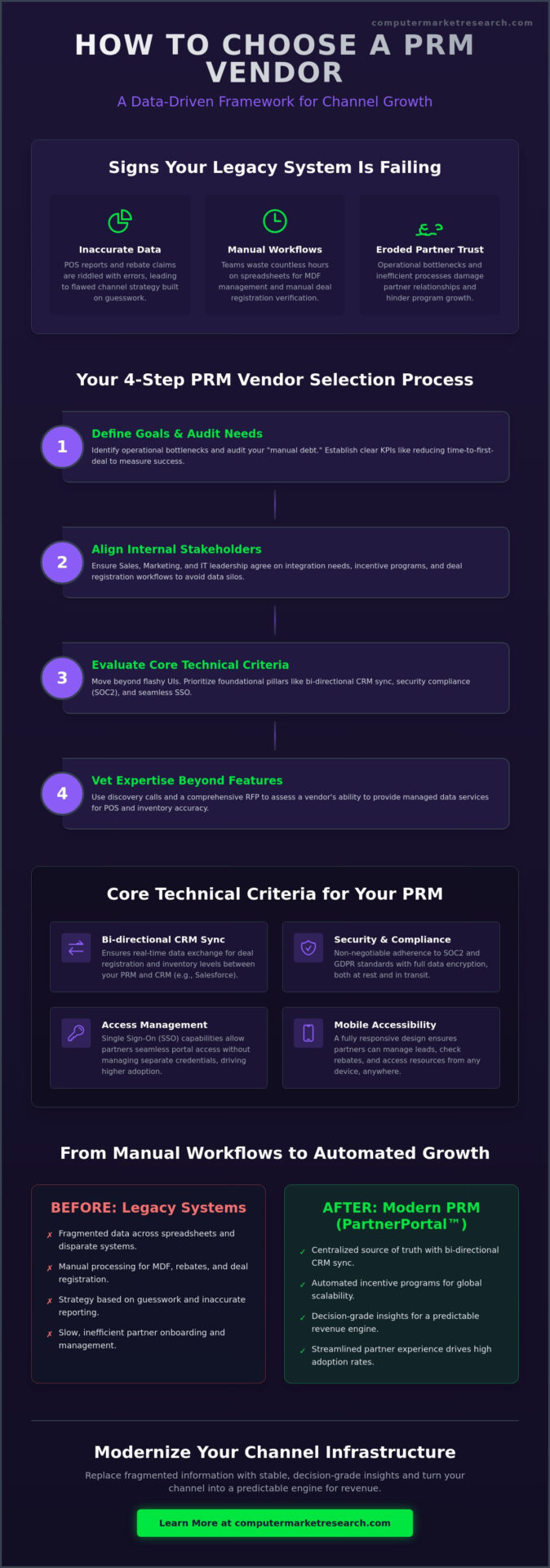
A Step-by-Step Framework for the PRM Vendor Selection Process
Transitioning from manual tracking to a modernized system is a technical evolution that requires a structured methodology. Determining how to choose a prm vendor begins with drafting a Request for Proposal (RFP) that prioritizes your specific operational bottlenecks rather than a generic list of features. Instead of asking if a vendor has a portal, ask how their system handles the reconciliation of Co-op/MDF Management claims when partner data is incomplete. This shift in focus ensures you select a solution built for your actual challenges.
The discovery call serves as your first opportunity to vet the vendor’s technical competence. You aren’t just buying a software license; you’re entering a partnership for B2B data administration. Use this time to evaluate their understanding of complex industry relationships. If the vendor cannot explain how they maintain data integrity during a CRM sync, they likely lack the expertise to solve your fragmented information issues. Once you’ve narrowed your list, request a customized demo. Insist on using a sample of your actual channel data to see how the system processes real-world scenarios. For high-risk modules like Ship & Debit, a Proof of Concept (POC) is essential to verify accuracy before signing a long-term contract.
To begin your transition from manual tracking to a modernized infrastructure, you can claim your 90-day free trial and test our framework in your own environment.
Vetting for Industry-Specific Expertise
Experience in your specific vertical is a strong indicator of future success. Ask for case studies that demonstrate how the vendor has managed channel data for companies with similar partner structures. You should evaluate the vendor’s history and their post-launch service record. A vendor who has spent decades refining channel data management systems will be better equipped to handle the nuances of your financial tracking. Checking references for implementation support is also critical; you need to know how they respond when technical hurdles arise during the migration from legacy spreadsheets.
Calculating Total Cost of Ownership (TCO)
A professional evaluation must account for more than just the monthly subscription fee. Your TCO calculation should include implementation, integration, and staff training fees. You also need to understand how costs scale as your partner volume increases. It’s helpful to compare these SaaS fees against the current cost of manual errors and lost productivity. When you factor in the financial risk of inaccurate POS and inventory reports, the investment in a stable, automated platform often pays for itself through efficiency gains and improved returns. This logical journey from manual debt to modernized systems is the only sustainable path for a growing organization.
Why PartnerPortal™ is the Strategic Choice for Global Brands
Global brands require more than a basic interface; they need a system capable of managing the specialized nature of B2B data administration. When you evaluate how to choose a prm vendor, the depth of industry experience becomes a critical differentiator. Computer Market Research (CMR) brings over 40 years of channel data management expertise to the table. This longevity has allowed us to build PartnerPortal™, a solution designed to alleviate the frustrations of fragmented information and manual processing errors. By centralizing partner onboarding, deal registration, and performance tracking, we provide the stability and accuracy required for long-term scalability.
Efficiency in incentive management is a primary focal point for high-growth organizations. Our platform provides industry-leading co-op and MDF management automation, ensuring that marketing funds are allocated and tracked with precision. Built-in modules for rebates, incentives, and inventory tracking eliminate the need for disconnected third-party tools. This unified approach ensures that your financial tracking remains disciplined and results-driven, providing a clear path out of operational bottlenecks that often stall channel growth.
A Holistic Approach to Channel Management
Modern channel operations have evolved beyond simple communication. A basic portal is no longer sufficient to manage the nuances of global distribution. PartnerPortal™ functions as a comprehensive channel sales management engine that optimizes every stage of the partner lifecycle. Automated deal registration is a core component of this system, effectively eliminating channel conflict by providing a transparent, real-time record of every opportunity. This transparency extends to POS data management and inventory tracking, giving leaders decision-grade insights into global stock levels and sell-through rates. When data is centralized and accurate, your team can pivot from administrative damage control to strategic growth.
Proven Implementation for Fortune 500 Companies
Large-scale organizations often struggle with the technical hurdles of digital integration. CMR handles the “heavy lifting” of data migration and system synchronization, ensuring that your transition from legacy processes is seamless. We understand that your internal operations team is already managing complex responsibilities. Our goal is to reduce their administrative burden by providing a modernized infrastructure that manages the nuances of financial tracking and incentive programs automatically. This commitment to technical capability and reliability is why leading global brands trust us when deciding how to choose a prm vendor for their most sensitive channel information. If you are ready to move beyond manual workflows, it is time to Partner Smarter with Computer Market Research and secure the future of your channel ROI.
Modernizing Your Channel for Scalable Growth
The transition from fragmented spreadsheets to a centralized system is the only logical step for a growing organization. By defining your operational goals and vetting for technical competence, you ensure your infrastructure supports rather than hinders your revenue objectives. Data integrity remains the foundation of any successful program. Software alone cannot fix inaccurate reporting. You need a partner who understands the nuances of B2B data administration.
Learning how to choose a prm vendor requires a disciplined approach to evaluating both technical criteria and managed service capabilities. Computer Market Research was founded in 1984. We provide a comprehensive cloud-based SaaS modular architecture designed to solve these specific challenges. Trusted by Fortune 500 and Global 2000 enterprises, we bring over 40 years of expertise to every implementation. Our systems are built to eliminate the manual debt that slows your team down.
Take the next step in your operational journey. Schedule a Demo of CMR’s PartnerPortal™ Today to see how we transform your channel data into a strategic asset. You have the tools to build a more efficient, data-driven future.
Frequently Asked Questions
Average PRM implementation timeline?
Implementation typically ranges from 30 to 90 days depending on the complexity of your data migration. The timeline is largely determined by the maturity of your current partner ecosystem and the depth of bi-directional integration required for your CRM and ERP systems. A disciplined approach to auditing your manual debt before launch can significantly accelerate this process.
Enterprise PRM software pricing?
Pricing for enterprise platforms varies based on partner volume and the specific modules your organization requires. Most professional solutions follow an annual subscription model that scales as your channel grows. When you are researching how to choose a prm vendor, it’s vital to factor in implementation and training fees to understand the true total cost of ownership.
Integrating PRM with your existing CRM?
Modern PRM systems offer bi-directional integration with your CRM to ensure a seamless flow of information. This connectivity is essential for maintaining accurate deal registration and lead management workflows across both platforms. Real-time synchronization prevents data silos and eliminates the manual errors that typically lead to channel conflict and fragmented reporting.
Essential features in a partner portal?
A high-performance PartnerPortal™ must prioritize data accuracy and user experience to drive adoption. Critical features include automated incentive processing, POS Data Management, and real-time inventory tracking. These tools provide the decision-grade insights necessary for business leaders to manage complex industry relationships with quiet confidence and technical precision.
Managing MDF and co-op funds with PRM?
A PRM vendor streamlines Co-op/MDF Management by replacing manual spreadsheets with automated validation workflows. The system handles fund allocation, claim submissions, and financial reconciliation within a single interface. This modernization reduces the administrative burden on your operations team while ensuring that every incentive payment is backed by verified sales data.
Niche PRM vs. CRM-based solutions?
Niche vendors often provide deeper specialized expertise in B2B data administration than generalist CRM-based providers. While a large CRM platform might offer basic portal functionality, specialized vendors focus on the nuances of data cleansing and process optimization. Choosing a dedicated partner ensures your infrastructure is built to handle the technical depth of financial tracking and incentive programs.
Measuring the ROI of a PRM system?
ROI is measured by improvements in partner activation rates and reduced deal velocity. Industry data from early 2026 shows that companies using a modernized PRM typically see partner activation increase from 40% to 65%. Furthermore, reducing the time-to-first-deal from 90 days to 35 days provides a clear measurable outcome that justifies the transition from legacy manual tracking methods.

Article by
Del Heles
Del Heles is the founder and CEO of Computer Market Research (CMR), a channel management software company he launched in 1984. With more than 40 years of experience, he’s known for helping manufacturers and distributors simplify complex partner programs through practical, customer-focused technology solutions.