

The fairest-looking channel budget can be the least effective one. A practical starting point for budget allocation for channel marketing is the 70/20/10 rule: put about 70% into proven channels, 20% into promising channels still being evaluated, and 10% into experiments. The split gives dependable activity room to perform while creating space to test new opportunities.
Choosing where each share goes takes more than dividing funds evenly. Assess each channel against your goals, audience behavior, conversion performance, and the quality of the data used to measure results. Protect foundational efforts before testing new ones, so experiments don’t undermine channels already supporting demand.
This guide explains how to build a channel budget, compare performance, and balance proven efforts with controlled tests. You’ll also learn how to review results and adjust allocations over time, keeping spending decisions tied to measurable outcomes rather than assumptions.
Key Takeaways
- Match your budget model to business priorities, growth stage, and the reliability of your marketing data.
- Use quarterly reviews and incrementality tests to distinguish genuine channel impact from activity that would have happened anyway.
- Compare cost per lead, conversion rates, and channel returns, while accounting for how channels work together.
- Fund dependable channels first, then run controlled experiments without destabilizing core demand generation.
- When partner marketing funds and performance data are difficult to manage, PartnerPortal™ and Co-op/MDF Management can support a more structured process.
How Should You Allocate a Marketing Budget?
Start with business priorities, then allocate the annual budget to channels that support them. A sound budget allocation for channel marketing reflects your growth stage, audience behavior, and the quality of your performance data.
-
Align Budgets with Business Priorities
Set the budget toward a specific objective, such as entering a market, generating demand, or retaining customers. Then map campaigns to that objective and identify measures that will show progress. Gartner’s 2026 survey found marketing budgets averaged 7.8% of company revenue, but that figure is a benchmark, not a target for every business. Revenue, growth plans, margins, and audience behavior all influence the allocation.
-
Adjust Budgets for Business Goals
When priorities change, shift spending and document the reason for each adjustment. A company focused on brand awareness may invest more in brand activity, while one prioritizing near-term pipeline may emphasize demand capture. Consider annual commitments and campaign timing before moving funds. Review your budget allocation for channel marketing against each channel’s assigned goal, rather than cutting foundational activity after one early result.
-
Allocate Limited Budgets Across Business Types
Adapt the mix to your business model. The U.S. Small Business Administration reports average marketing investment of 6.3% of revenue for B2B product businesses and 6.9% for B2B service businesses, compared with 9.6% for B2C product businesses and 11.8% for B2C service businesses. These figures describe different categories, not a required channel split. Small businesses can concentrate limited funds on priority campaigns instead of spreading them thinly. For SEO, weigh audience search behavior, competition, and the time needed to build organic visibility against immediate campaign needs.
-
Match the Model to Growth and Data Maturity
Choose a model that fits both the company’s stage and its ability to measure results. A growing business with limited tracking can begin with a few channels and clear campaign goals. As attribution becomes more reliable, use channel-level results to refine the mix. The 70/20/10 model offers one structure: allocate about 70% to proven channels, 20% to promising channels, and 10% to experiments.
-
Set a Baseline, Then Refine It
Set a baseline using revenue goals, campaign commitments, and channel performance. Maintain enough investment in activities that support essential demand, then direct flexible funds to the highest-priority opportunities. For example, a business entering a new market could fund awareness while preserving resources for campaigns that capture active demand. Revisit the allocation as goals and evidence change.
Quarterly budget reviews and incrementality testing
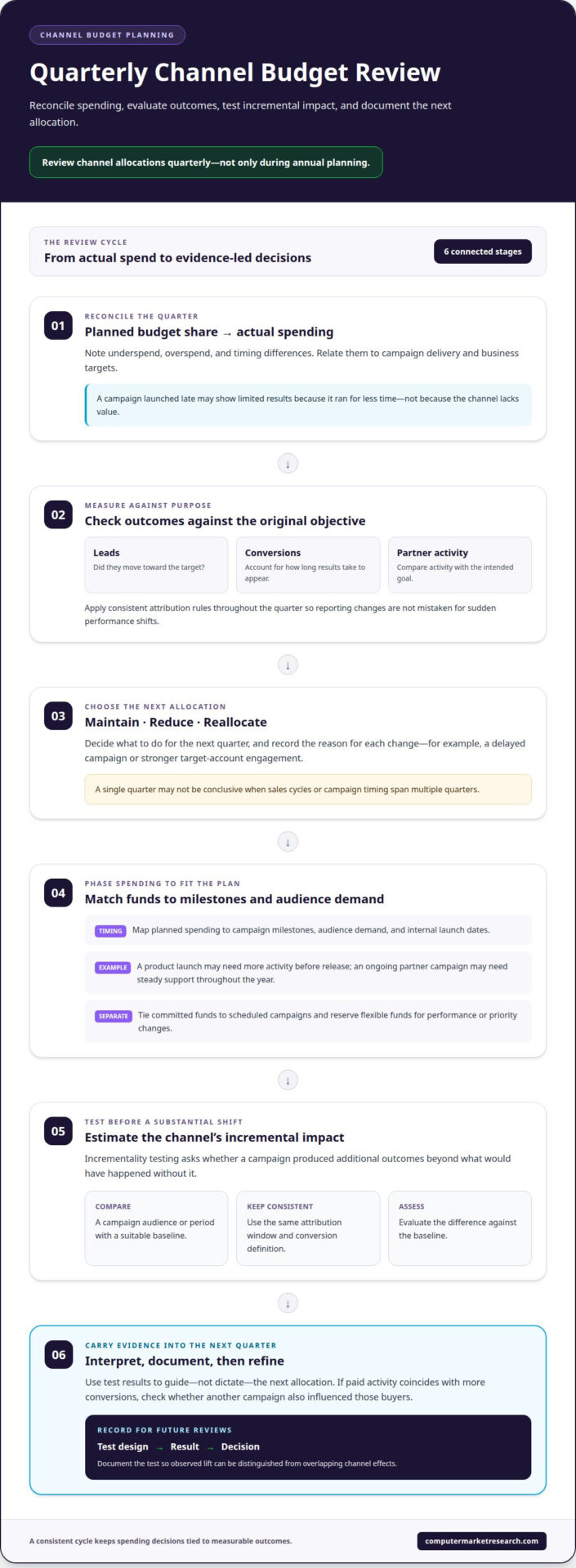
Review channel allocations quarterly, not only during annual planning. Assess pacing, attribution, and whether spending is producing results beyond existing demand.
Review Channel Allocation Quarterly
- Compare each channel’s planned budget share with actual spending for the quarter. Note underspend, overspend, and timing differences, then relate them to campaign delivery and business targets. For example, a social media campaign launched late may have limited results because it ran for less time, not because the channel lacks value.
- Review channel outcomes against the original objective. Check whether leads, conversions, or partner activity moved toward the target, and account for how long those outcomes take to appear. Apply consistent attribution rules throughout the quarter so reporting changes aren’t mistaken for sudden performance shifts.
- Decide what to maintain, reduce, or reallocate for the next quarter. Record the reason for each change, such as shifting funds from a delayed campaign or supporting a channel with stronger target-account engagement. Don’t treat one quarter’s result as conclusive when sales cycles or campaign timing span multiple quarters.
Plan Quarterly Budget Phasing
- Map planned spending to campaign milestones, audience demand, and internal launch dates. A product launch may need more activity before release, while an ongoing partner campaign may require steady support throughout the year. Align quarterly spending with when the audience can act, rather than dividing the annual budget evenly by default.
- Separate committed spending from flexible funds in the quarterly plan. Tie committed funds to scheduled campaigns, then reserve flexible funds for adjustments based on performance and changing priorities. This makes it easier to respond when a campaign slips without disrupting other channels.
- Test incrementality before shifting substantial budget to a channel. Incrementality testing estimates whether a campaign produced additional outcomes beyond what would have happened without it. Compare a campaign audience or period with a suitable baseline, using the same attribution window and conversion definition to assess the difference.
- Use test results to guide the next quarter’s allocation, not as a standalone verdict. If paid activity coincides with an increase in conversions, check whether another campaign also influenced those buyers. Document the test design, result, and decision so future reviews can distinguish observed lift from overlapping channel effects.
How do you know if a marketing channel is worth the spend?
Assess each channel against its assigned business outcome, using consistent definitions for leads, conversions, and return. For partner programs, allocate support according to the roles of MDF, co-op funds, incentives, and enablement, then assess results by partner tier and performance.
-
Measure Cost per Lead, Conversion, and Return
Use a consistent definition of qualified leads when comparing channel efficiency. Measure conversion from a lead to the next meaningful outcome, such as an opportunity or sale. For example, compare paid search and partner webinars over the same reporting period. Assess return against attributable revenue and campaign costs, not lead volume alone.
-
Assess Attribution and Cross-Channel Interactions
Use one attribution model across channels so each touchpoint is evaluated consistently. A prospect might discover a product through social media, return through email, and convert after a partner referral; last-click reporting would credit only the final interaction. Small businesses with limited data can begin using channel attribution after 60-90 days of reliable tracking. Record the model and conversion window.
-
Divide Funds Across Channel Support
Assign MDF and co-op funds to partner marketing activity, incentives to defined outcomes, and enablement to the capabilities partners need to execute campaigns. Evaluate each category against its purpose rather than comparing every dollar as if it served the same function. Rebates & Incentives can support an incentive strategy, while campaign participation or partner readiness may inform other allocations.
-
Set Budgets by Partner Tier and Performance
Set a baseline for each tier, then adjust support using comparable measures such as qualified pipeline, conversion, revenue contribution, and campaign execution. A high-performing partner may merit additional funds when results align with strategic goals; a newer partner may need enablement before performance can be fairly assessed. Don’t rank partners on raw sales alone when territories or opportunity volumes differ.
Reviewing performance across the previous six to twelve months can help distinguish a durable result from a short-lived fluctuation. Businesses can compare cost per lead, conversion rate, and channel return over that period when assessing current marketing spend, using consistent definitions and attribution rules. A channel that appears inexpensive may still underperform if its leads rarely progress, while a higher-cost channel may justify investment when it contributes to valuable outcomes. Email generates $36-$42 for every dollar spent on email marketing, but that benchmark is a point of comparison, not a guarantee; the channel’s value depends on the business’s own audience, campaign costs, and measured results.
Prioritizing foundational and experimental channels
Protect channels that reliably support demand before funding new ideas. A defined testing reserve lets you explore opportunities without disrupting established performance.
- Identify foundational channels by linking each to a proven business outcome. Review consistent measures such as qualified pipeline, conversion, and partner engagement, not activity numbers alone. For example, if a partner webinar reliably generates sales opportunities, preserve its core funding before shifting money to an untested platform. A channel is foundational when it serves a necessary role and its performance is understood.
- Set aside a testing reserve before assigning flexible funds elsewhere. One practical guideline is to reserve 10% of the marketing budget for experiments; another recommends 10-15% for testing initiatives. Choose a percentage that fits your resources and ability to measure results. Keep the reserve distinct from core campaign funding, so an experiment doesn’t quietly consume money needed for established programs.
- Write a clear question for every test, such as whether a new partner event can generate qualified opportunities. Define the audience, channel, success measure, and review point before launch. A test without a specific question can produce clicks or activity without demonstrating business value. Record the starting conditions so later comparisons reflect the campaign, not changes to measurement rules.
- Run experiments with a controlled scope and a defined decision process. For example, test a new digital platform with one audience segment while maintaining the proven campaign elsewhere. Compare outcomes with the stated target, including lead quality and conversion, not impressions alone. Continue, revise, or stop based on measured results. Don’t divert foundational-channel funding until the experiment demonstrates value.
- Use quarterly reviews to rebalance proven activity and testing. If a test performs well, decide whether to scale it gradually, repeat it, or gather more evidence. If results are weak, retain the learning but stop further spending. Keep the allocation rationale with campaign results so the next review can distinguish a successful channel from a one-time outcome.
Allocating spending across marketing channels
Build the channel mix around how buyers discover, evaluate, and purchase. A disciplined budget allocation for channel marketing funds both demand creation and demand capture, then evaluates their combined contribution.
- Map each channel to a role in the buyer journey before setting its budget share. For example, content can build awareness, while paid search captures existing demand. Social media may support discovery and reinforce other campaigns. Define each channel’s expected outcome, such as qualified inquiries or conversions, so spending reflects its contribution rather than its format.
- Use business objectives to set an initial mix, then check whether the total supports different needs. One suggested allocation assigns 40% to demand generation, 25% to lead conversion, 20% to customer retention, and 15% to testing. Treat these percentages as a planning framework, not a fixed formula. Adjust shares when revenue priorities, audience behavior, or campaign commitments change.
- Assess how spending is distributed across channels and formats. Gartner’s 2025 survey reported that paid media accounted for 30.6% of marketing spend. Use this figure as context, not as a target for your company. Compare paid search, social, partner, and content investment against each channel’s role, results, and time to impact before shifting funds.
- Match funding to purchase timing and measurement horizons. Paid search can capture active interest, while SEO and content build visibility over time. Don’t judge both using the same short-term measure. For example, evaluate paid search by qualified conversions and content by its contribution to discovery and later engagement. Apply consistent attribution across campaigns.
- Review the combined mix for overlap and gaps before finalizing allocations. If paid search and a partner campaign reach the same prospects, assess whether each adds distinct value or shares credit. If awareness activity generates interest but few conversions, strengthen the capture path instead of automatically increasing reach. Review budget allocation for channel marketing across channel roles, results, and dependencies before shifting funds.
Computer Market Research
Computer Market Research can help when channel spending is difficult to track across partners, programs, and performance data. Its channel management solutions organize partner activity and provide visibility into information that supports allocation decisions. This is especially useful when fragmented records make it hard to understand fund management or partner performance.
Use a consistent view of partner activity to connect marketing programs with business outcomes. PartnerPortal™ centralizes partner onboarding, deal registration, and performance tracking, helping teams work with organized channel information instead of scattered records. The platform supports, but doesn’t replace, the need to define goals and evaluate results. It provides a data and workflow foundation for those decisions.
When partner marketing funds are difficult to administer, Co-op/MDF Management helps manage those programs. A clear fund management process makes it easier to track activity and organize program information. Rebates & Incentives can also support partner incentive program administration. These offerings are useful when manual workflows create visibility gaps or make program oversight cumbersome.
Deal Registration organizes registered opportunities as part of channel operations. Managing partner opportunity information alongside performance data gives teams a clearer picture of partner activity. That context can inform budget discussions, including how funds support partner programs and what information teams need for future reviews. Allocation decisions still depend on business priorities, campaign goals, and measured results.
Consider Computer Market Research when manual tracking, disconnected data, or complex partner programs make it difficult to maintain a reliable view of channel activity. Its tools support channel management, fund administration, and partner performance workflows, rather than offering a universal budget formula. Start with the operational issue affecting your ability to manage channel programs and assess the information behind spending decisions.
Contact Computer Market Research to discuss your channel management needs.
Frequently Asked Questions
How Should I Split My Budget Across Channels?
Allocate the budget according to each channel’s role, audience, and evidence of contribution. For example, a business selling through resellers might separate partner campaigns from direct digital activity, then track both against the same pipeline goals. Include operating costs and campaign commitments in the plan so channel percentages reflect the spending the team can actually deploy. Revisit the mix when buyer behavior or sales priorities shift.
What Tools Help You Split the Budget?
Use a planning sheet to document allocations, a CRM to connect campaigns with pipeline, and analytics tools to review engagement and conversions. Finance records help reconcile planned and actual spending. PartnerPortal can integrate with ERP and CRM systems to sync channel data, reporting, and financial workflows. A shared view of these records makes allocation decisions easier to trace and explain.
How Do You Get Finance to Sign Off on the Allocation?
Present a clear business case linking each requested amount to a goal, planned activity, and measurement method. Separate committed spending from flexible investment, and explain how you’ll handle underperformance or timing changes. For example, show which campaigns support a launch and how you’ll report results. Finance can assess the plan more readily when assumptions, owners, and review points are clear.
How Do You Get Honest About What’s Actually Working?
Reconcile campaign records with CRM outcomes and finance spend before drawing conclusions. Check whether leads became qualified opportunities, duplicate records inflated counts, or campaigns overlapped. For example, a webinar may appear to drive a conversion that began with a partner referral. Document attribution rules and review source data alongside reported results. If the numbers conflict, resolve the data mismatch before reallocating funds.
How Should This Change As My Business Grows?
As the business grows, base more allocation decisions on comparable channel and partner data. A small team may start with a few clearly defined campaigns, while a larger operation may need consistent naming, ownership, and reporting across business units. Add investment where teams can execute and measure effectively. Growth may also bring new partner segments, so account for their different needs rather than applying one uniform plan.
How much spend should go towards marketing efforts?
Set marketing spend by working backward from business goals, available revenue, margins, and the activity needed to reach the target audience. Distinguish the overall marketing budget from the portion assigned to channel programs, campaigns, and partner support. A launch or market expansion may require a different plan from maintaining existing demand. Document the rationale and expected contribution for each major allocation before approving spend.
What is a typical channel marketing budget as a percentage of revenue?
There isn’t one universal revenue percentage for channel marketing specifically. The U.S. Small Business Administration’s general rule for businesses with under $5 million in revenue is to allocate 7 to 8 percent of revenue to marketing, assuming a margin of 10 to 12 percent after all expenses, including marketing. Treat that as an overall marketing reference, then determine the channel share based on business priorities and partner strategy.
How should companies allocate channel marketing budgets across partners and channels?
Set allocation criteria before assigning funds, using partner role, market opportunity, execution readiness, and contribution to business priorities. Record each partner’s planned support by program and channel so overlapping requests are visible. For example, distinguish funds for joint campaigns from incentives tied to defined outcomes. Review the rationale alongside results, then adjust future allocations as partner capacity or strategic importance changes.

Article by
Del Heles
Del Heles is the founder and CEO of Computer Market Research (CMR), a channel management software company he launched in 1984. With more than 40 years of experience, he’s known for helping manufacturers and distributors simplify complex partner programs through practical, customer-focused technology solutions.