

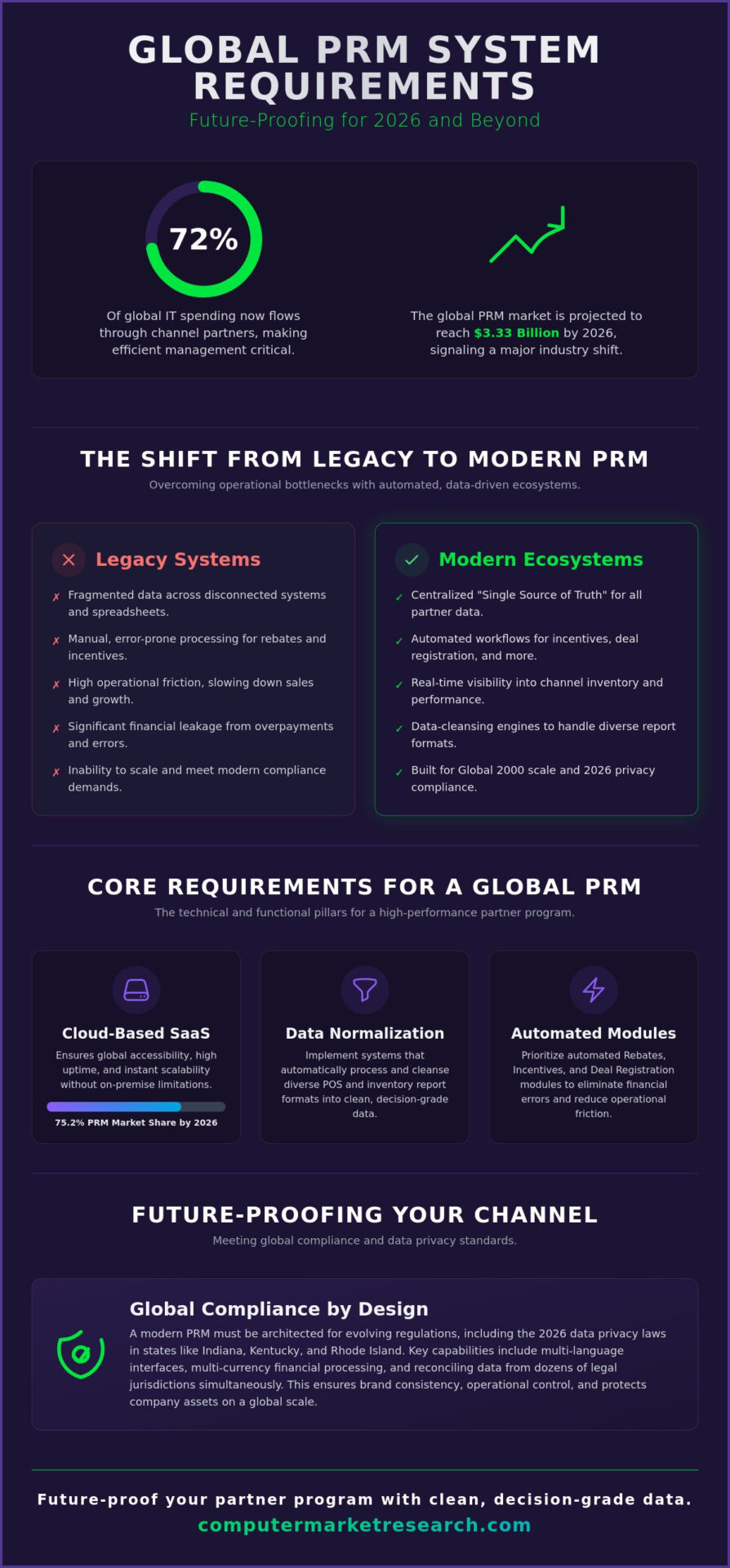
Did you know that 72% of global IT spending now flows through channel partners? While these relationships are the primary engine for scale, they often introduce significant operational friction when managed through disconnected legacy systems. If you’re currently battling fragmented data across regions or manual, error-prone rebate processing, you’ve likely realized that your current infrastructure is a bottleneck. Meeting modern global prm system requirements is no longer about just having a portal; it’s about building a data-cleansing engine that provides real-time visibility into channel inventory.
We recognize the challenge of maintaining order across a sprawling ecosystem while ensuring compliance with new 2026 privacy laws in states like Indiana, Kentucky, and Rhode Island. This guide promises to help you master the technical and functional criteria necessary to centralize partner management and automate financial incentives. You’ll gain a clear path out of operational bottlenecks by understanding the shift toward agentic orchestration and clean, decision-grade data foundations. We’ll preview the specific architecture, security standards, and integration strategies required to transform your partner program into a high-performance, automated asset.
Key Takeaways
- Transition from static login portals to automated, cloud-based ecosystems that eliminate the high costs of manual tracking.
- Identify the core global prm system requirements for 2026, centering on a single source of truth to bridge regional data silos.
- Prioritize automated modules for Rebates & Incentives and Deal Registration to reduce operational friction and eliminate financial errors.
- Overcome the challenge of non-normalized channel data by implementing systems that process diverse POS and inventory report formats.
- Future-proof your partner program by adopting infrastructure built for Global 2000 scale and 2026 data privacy compliance.
Defining Global PRM System Requirements for 2026
Many enterprises mistake a basic login screen for a comprehensive channel strategy. True Partner relationship management (PRM) is a technical discipline that orchestrates every touchpoint between a brand and its third-party sellers. In 2026, the shift from legacy manual tracking to automated SaaS systems is no longer a luxury. It’s a baseline requirement for Global 2000 companies managing complex cross-border architectures that demand high uptime and instant scalability.
Mastering global prm system requirements ensures that your organization remains compliant with evolving international trade standards while maximizing partner engagement. These systems don’t just store data; they actively drive revenue through automated workflows that replace the slow, error-prone processes of the past. With the global PRM market projected to reach approximately $3.33 billion by 2026, the transition to high-performance infrastructure is a clear industry priority. Companies that fail to modernize find themselves trapped in a cycle of reactive management and missed market opportunities.
To better understand this concept, watch this helpful video:
Global vs. Local PRM: The Strategic Difference
Managing partners across different time zones and regional laws requires more than just a translated interface. It demands a system designed for multi-language and multi-currency support by default. A local PRM might handle a single region’s tax laws, but a global solution must reconcile data from dozens of jurisdictions simultaneously. This level of complexity is why a unified architecture is vital for maintaining brand consistency and operational control. You can explore these distinctions further in our complete guide to partner relationship management.
The Cost of Inadequate PRM Infrastructure
Spreadsheets are the primary obstacle to global scale. When organizations rely on manual data entry, they invite human error into their most sensitive financial calculations. Manual errors in rebates lead to massive financial leakage, where overpayments or missed incentives damage both the bottom line and partner trust. These inaccuracies aren’t just minor inconveniences; they represent a systemic failure to protect company assets. Operational friction in a global channel context is the accumulation of manual delays and data discrepancies that prevents a program from scaling efficiently.
Without a robust system, your team spends more time auditing data than they do building strategic relationships. This administrative burden slows down deal registration and stunts growth. High-quality information is the only way to ensure your global operations remain agile and profitable in a competitive market.
Technical Architecture and Global Integration Needs
Cloud-based SaaS is the backbone of global accessibility. By 2026, cloud deployment is estimated to hold a 75.2% market share in the PRM space. This isn’t just a trend; it’s a functional necessity for organizations that can’t afford the downtime associated with on-premise legacy software. A centralized system ensures that partners in Singapore see the same inventory levels as those in London. Modern global prm system requirements demand a “Single Source of Truth” to eliminate the regional silos that lead to data discrepancies. Standalone systems that don’t communicate with your primary business applications are obsolete obstacles to growth that create unnecessary manual work for your operations team.
Scalability is equally critical. As you build an unbeatable partner ecosystem, your infrastructure must support thousands of concurrent users without performance degradation. This requires a headless architecture that allows tools to be embedded directly into partner workflows, reducing portal fatigue. A modular approach ensures that as your partner count increases, the system’s responsiveness remains stable across all geographic zones, preventing the technical lag that often discourages partner engagement.
CRM and ERP Integration Requirements
Enterprise operations rely on bi-directional synchronization between the PRM and core business platforms. It’s vital for the PRM to pull financial data directly from ERPs to ensure the accuracy of POS Data Management. Without this link, financial teams are forced into manual reconciliations that invite error and delay incentive payouts. Robust APIs act as the connective tissue, allowing for a modern channel tech stack where data flows seamlessly across the organization without manual intervention. This synchronization ensures that your sales data is always “AI-ready,” supporting the predictive analytics that modern channel leaders demand.
Enterprise Security and Global Compliance
Security isn’t optional for global organizations. Requirements for Single Sign-On (SSO) and Multi-Factor Authentication (MFA) are now baseline standards to protect sensitive channel data. Role-based access control (RBAC) ensures that regional managers only see data pertinent to their territory, maintaining strict internal governance and data privacy.
Compliance needs have intensified for 2026. Beyond GDPR and CCPA, systems must now accommodate new state privacy laws in Indiana, Kentucky, and Rhode Island. Oregon’s 2026 updates even mandate the recognition of universal opt-out signals and place new restrictions on geolocation data. Ensuring your global prm system requirements include these regional data residency and deletion capabilities is the only way to avoid significant legal risks. If you’re ready to see how a modernized architecture simplifies these complexities, you might want to explore our platform’s capabilities through a trial.
Essential Functional Requirements for Global Scale
Global 2000 enterprises require more than just features; they need a synchronized ecosystem of automated modules. While the technical architecture provides the foundation, the functional layer determines how effectively you can drive indirect revenue. According to the Gartner Market Guide for PRM applications, the market is shifting toward systems that orchestrate the entire partner lifecycle. Meeting modern global prm system requirements means ensuring that every module operates as a single, cohesive unit rather than a collection of isolated tools.
High-priority modules for global scale include:
- Automated MDF and Co-op management with multi-currency support.
- Conflict-free deal registration and intelligent lead routing.
- Tiered rebate structures powered by decision-grade data.
- Seamless integration with price protection and debit systems.
Automation is the core requirement across all functional areas. Without it, your staff is bogged down in administrative tasks that prevent strategic growth. A portal that partners actually want to use must be intuitive and fast, reducing the portal fatigue mentioned in previous sections. When functional modules work together, they create a frictionless experience that encourages partner loyalty and increases participation rates.
Global MDF and Co-op Fund Management
Managing market development funds across multiple regions is a logistical nightmare without automated fund allocation and claim processing. Your system must handle regionalized tax requirements and currency conversions within your MDF programs automatically. This ensures compliance while providing real-time ROI tracking on marketing spend. When financial data is transparent and accessible, leaders can make informed decisions about where to allocate future resources for maximum impact.
Deal Registration and Lead Management
Channel conflict is a primary source of partner dissatisfaction. Robust global prm system requirements must include automated deal registration to protect partner investments and prevent internal sales teams from competing with the channel. Global lead distribution should be handled intelligently across time zones, ensuring that a lead generated in Tokyo is routed to the right partner instantly. Automated approval workflows are essential; if a partner has to wait three days for a deal approval, they’ll likely lose the deal to a more agile competitor.
Automated Rebates and Incentives
Incentive structures often vary by partner tier and geographic location, making manual calculations nearly impossible at scale. You need decision-grade data to calculate complex rebates accurately and avoid the financial leakage discussed earlier. Integrating these incentives with ship and debit management ensures that price protections and credits are handled without manual intervention. This level of automation builds trust with partners, as they know their rewards are calculated fairly and paid promptly.
Data Normalization and Global Compliance Standards
Dirty data is the primary obstacle to achieving a measurable channel ROI. While technical architecture provides the frame, the quality of information flowing through it determines the system’s success. Gartner predicts that through 2026, 60% of AI projects will fail because of a lack of “AI-ready” data foundations. For organizations aiming to meet global prm system requirements, this means implementing a unified data layer that cleanses information at the point of entry. Without automated deduplication and normalization, your global intelligence remains clouded by regional discrepancies.
Data transparency is no longer a luxury; it’s a requirement for executive-level reporting. Leaders cannot make informed decisions about market expansion or incentive spend if their visibility is blocked by fragmented data. A standardized approach ensures that every transaction is verified, allowing for a clear view of performance across all territories. This level of precision is the only way to move from reactive troubleshooting to proactive channel orchestration.
POS and Inventory Data Management
Collecting POS data from thousands of global resellers presents a massive logistical challenge. Each partner uses different regional systems, resulting in a chaotic mix of file formats and naming conventions. A robust PRM must handle these diverse inputs while maintaining data integrity. Effective POS Data Management requires more than just storage; it requires a system that can translate regional product codes into a single, global SKU list. This level of normalization is essential for accurate inventory tracking and ensures that your supply chain remains responsive to actual market demand.
The Role of Managed Data Services
Software alone often fails to achieve total data accuracy in complex global environments. High-stakes financial claims, such as those found in Ship & Debit or complex rebate programs, frequently require human-in-the-loop validation. This hybrid approach ensures that anomalies are caught before they trigger incorrect payments. Managed services provide the oversight necessary to turn raw channel reports into decision-grade insights. Decision-grade insights represent the ultimate data requirement, where information is sufficiently accurate to drive multi-million dollar executive strategies without hesitation.
Maintaining compliance with 2026 data privacy laws in states like Indiana, Kentucky, and Rhode Island further complicates data handling. Your system must be able to identify and protect personal data according to these specific regional standards while still providing the transparency your business needs. If your current infrastructure is struggling with fragmented information or manual errors, you can start your 90-day free trial to see how our data-cleansing engine operates in real-time.
Future-Proofing Global Operations with PartnerPortal™
PartnerPortal™ by CMR isn’t just another platform; it’s a specialized response to the 2026 global prm system requirements. While some providers focus on trendy, unproven features, CMR prioritizes the stability and accuracy required by Global 2000 enterprises. We’ve built an infrastructure that directly addresses the frustrations of fragmented information and manual errors. This transition from manual workflows to modernized systems is the only logical step for organizations aiming for sustainable, global growth. Choosing a pragmatic, data-focused partner ensures that your channel operations remain a source of intelligence rather than a source of friction.
The ROI of a modernized PRM extends beyond simple efficiency gains. It’s about building trust with your partners through total transparency and financial accuracy. When your financial tracking and incentive programs are automated, you eliminate the delays that cause partners to disengage. CMR acts as a seasoned consultant in this journey, providing a systematic way to solve data challenges that have plagued the industry for decades. This authoritative approach ensures that your global prm system requirements are utilized as a strategic competitive advantage rather than a checklist of obstacles.
Scaling Your Global Partner Ecosystem
Scaling a global ecosystem requires a modular approach that allows for regional expansion without constant technical overhauls. You don’t want to rebuild your infrastructure every time you enter a new market or adjust to a new set of privacy laws. PartnerPortal™ allows for this gradual, structured expansion, ensuring that your technical foundation remains solid while your reach grows. Real-time visibility is no longer a luxury for the Global VP of Sales; it’s a fundamental requirement for steering the organization through rapid market shifts. You’re invited to partner smarter by leveraging a system that values order and performance above all else.
Measuring Success and Global ROI
Success in the channel is measured by more than just top-line revenue. A sophisticated system tracks complex KPIs like Partner Lifetime Value (PLV) to identify which relationships are truly driving long-term profitability. Automation significantly reduces the administrative burden on your channel teams, often cutting down the time spent on manual reconciliations by hours each week. This allows your team to focus on strategic development rather than data entry. By choosing a partner who understands the nuances of financial tracking, you ensure your operations are resilient and ready for the future. If you’re ready to see how a systematic approach can solve your data challenges, you should request a demo of the PartnerPortal™ today.
Securing a Competitive Edge in the Global Channel
Modernizing your partner infrastructure is the only logical step to eliminate the friction of regional silos and manual errors. By prioritizing clean data normalization and automated financial incentives, you ensure your program is ready for the 2026 regulatory landscape across all territories. Meeting global prm system requirements isn’t just about deploying software; it’s about establishing a foundation of technical trust and accuracy that empowers your partners to scale effectively. When data flows seamlessly between systems, your team can pivot from administrative troubleshooting to high-level strategic orchestration.
We’ve been serving Global 2000 companies since 1984, offering a comprehensive suite of automated channel modules built for the complexities of modern commerce. Our expert managed data services provide the human-in-the-loop validation necessary for 100% accuracy, turning fragmented reports into decision-grade insights. This systematic approach allows you to focus on growth while our technology handles the operational heavy lifting. It’s time to leave the obsolescence of manual tracking behind and embrace a resilient, data-driven future for your ecosystem.
Schedule a demo of CMR’s PartnerPortal™ to automate your global channel.
Your path to a frictionless, high-performance partner program starts with a commitment to better information. We’re ready to help you build it.
Frequently Asked Questions
What is the difference between a global PRM and a standard CRM?
A global PRM orchestrates complex third-party partner ecosystems across multiple regions, while a CRM manages direct customer relationships. Standard CRM systems lack the specialized architecture for multi-tier incentive tracking and regional POS data normalization required for indirect sales. A PRM acts as a technical extension that focuses on partner engagement and channel-specific financial automation.
Can a PRM system integrate with multiple regional ERP systems simultaneously?
Yes, modern enterprise PRM solutions use robust APIs to synchronize with disparate regional ERP systems like Oracle or SAP. This capability is essential for maintaining a single source of truth for global financial data. It allows for the accurate reconciliation of payments and inventory levels without requiring manual data transfers between regional offices.
How does a global PRM handle different currencies and tax laws for rebates?
A global PRM automatically converts currencies based on real-time exchange rates and applies regional tax rules for every incentive claim. This automation ensures that your global prm system requirements for financial compliance are met without manual intervention. By calculating rebates at the local level before consolidating reports, the system prevents the financial leakage associated with manual spreadsheet errors.
What are the most important security requirements for a partner portal?
Enterprise security depends on Single Sign-On (SSO), Multi-Factor Authentication (MFA), and granular Role-Based Access Control (RBAC). These features ensure that partners only access the data pertinent to their specific region and tier. Additionally, compliance with SOC 2 Type II and ISO 27001 standards is a baseline requirement to protect sensitive channel data from AI-driven cyber threats.
How long does it typically take to implement a global PRM system?
Implementation timelines vary based on integration complexity, but most enterprise deployments take between three to six months. This period includes the configuration of automated modules, bi-directional CRM synchronization, and the establishment of a unified data layer. A phased rollout by region often helps manage the transition while ensuring that data normalization processes are functioning correctly.
What is POS data normalization and why is it a requirement for PRM?
POS data normalization is the process of converting diverse regional sales reports into a standardized global format. It’s a fundamental requirement because resellers often use different product codes and file types for their inventory reports. Without this automated cleansing, your channel intelligence is compromised by “dirty” data, making it impossible to calculate accurate rebates.
Can we automate MDF and Co-op fund management across different regions?
Automation of MDF and Co-op funds is standard in high-performance PRM systems, allowing for regionalized allocation and claim processing. The system handles the entire lifecycle, from fund requests to proof-of-performance validation and final payout. This level of automation ensures that marketing spend is tracked against actual ROI, providing visibility that manual tracking methods simply can’t offer.
How does a PRM system help prevent channel conflict in global markets?
PRM systems prevent conflict through automated deal registration and intelligent lead distribution rules. When a partner registers a deal, the system locks that opportunity to prevent internal sales teams or other partners from competing for the same business. This transparency builds trust within the ecosystem and ensures that global prm system requirements for partner protection are strictly enforced across all territories.

Article by
Del Heles
Del Heles is the founder and CEO of Computer Market Research (CMR), a channel management software company he launched in 1984. With more than 40 years of experience, he’s known for helping manufacturers and distributors simplify complex partner programs through practical, customer-focused technology solutions.