

Reducing administrative burden for channel managers starts with practical changes: automate repeatable workflows, simplify forms, review administrative effort, measure where work accumulates, and improve how data moves between systems. The aim is to reduce manual work while keeping channel information organized and usable.
When partner, deal, incentive, and performance details are spread across forms and platforms, routine administration can take time away from higher-value channel work. Adding another process layer rarely solves the underlying problem. Clearer workflows and less duplicate data entry can.
This article explains how to identify repetitive tasks worth automating, make forms easier to complete, assess administrative effort, and measure whether changes are helping. Use those findings to prioritize practical improvements that make channel operations easier to manage without sacrificing visibility or control.
Key Takeaways
- Map repetitive channel tasks and handoffs to identify where automation can reduce duplicate entry and manual follow-up.
- Simplify forms by removing unnecessary questions, using clear language, and showing only fields relevant to each submission.
- Review where staff time goes before prioritizing administrative spending changes.
- Trace each burden to its source, then measure the work involved to see whether process changes are helping.
- Use centralized channel workflows to improve visibility across partner programs, deal registration, and incentives.
1. Automation benefits for providers, staff, and organizations
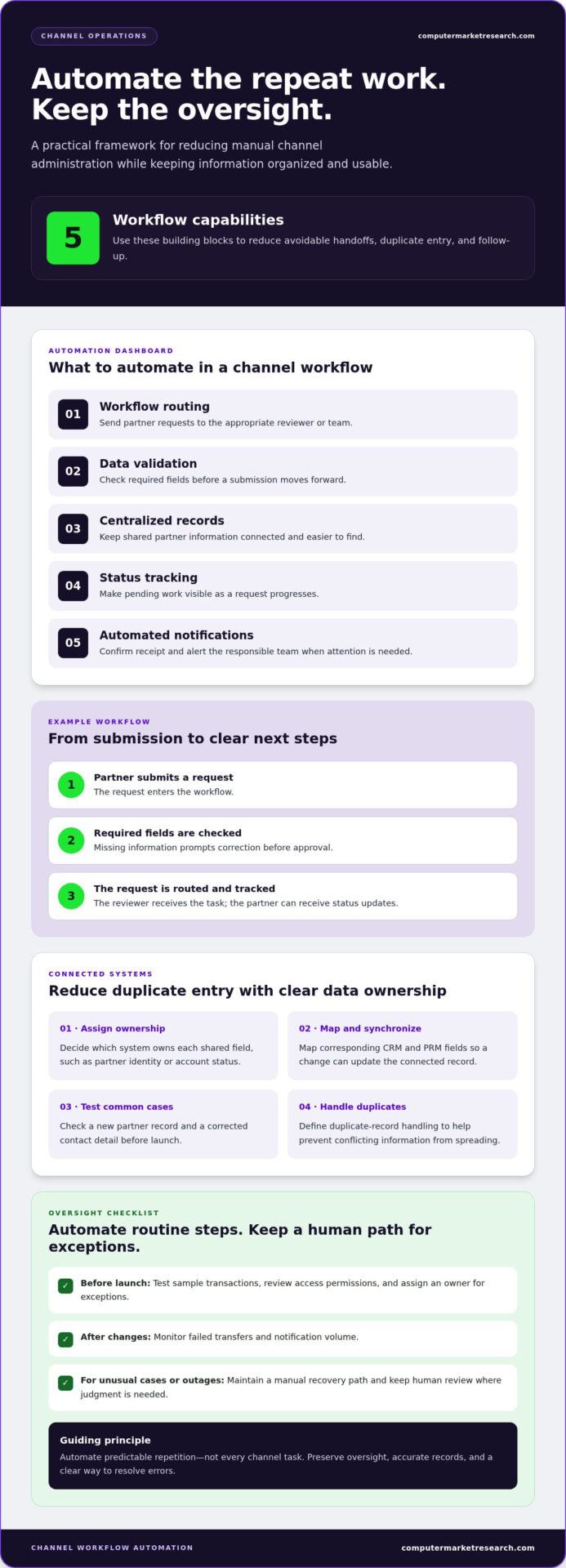
Automation can reduce repetitive work when a task follows a consistent rule. In channel operations, a system can route a partner request, validate required fields, and update a status automatically. Staff spend less effort copying details between records and can focus on exceptions that need judgment. For providers, the equivalent is a cleaner handoff: the right information reaches the next person without another manual transfer. Start by mapping one workflow, such as partner onboarding, from submission through approval. Mark every repeat entry, handoff, and follow-up before automating the steps.
What channel management software features reduce administrative burden? Look for workflow routing, data validation, centralized records, status tracking, and automated notifications. For example, a deal registration submission can go to the appropriate reviewer, while a missing field prompts correction before approval. These features reduce avoidable back-and-forth and make pending work easier to track. Set rules for routine cases and define an exception path for unusual submissions, so automation does not treat every partner request the same way.
Structured notifications can also improve communication. A partner can receive an automatic confirmation when a request arrives, followed by a status update as it progresses. Internally, an alert can notify the responsible team when an approval or missing document needs attention. Choose the channel to suit the action: email may work for a formal update, while an in-platform alert keeps a task connected to its record. Review timing and ownership to avoid repeated alerts that create noise or leave partners unsure about what happens next.
How can CRM and PRM systems integrate to reduce duplicate data entry? Decide which system owns each shared field, such as partner identity or account status, then map the corresponding fields and synchronize updates through an integration. A change entered once can then update the connected record automatically, rather than requiring staff to retype it. Test common cases first, including a new partner record and a corrected contact detail. Clear ownership and duplicate-record handling help prevent conflicting information from spreading across systems.
Healthcare workflow automation offers examples of handling documentation-heavy tasks. An EHR can populate repeated patient details in a note template, route an incomplete note for review, or flag a required field before submission. For documentation and compliance workflows, use checks based on the organization’s approved process and retain human review for decisions requiring clinical judgment. Other examples include routing an intake form to the right team and sending an appointment reminder automatically. These steps reduce clerical effort without making software the decision-maker.
Automation also brings operational risks. Incorrect source data can spread through connected records, and poorly designed rules can misroute valid requests. Before launch, test sample transactions, review access permissions, and assign an owner to handle exceptions. Monitor failed transfers and notification volume after each workflow change. Keep a manual recovery path for outages or unusual cases. The goal is not to automate every channel task, but to remove predictable repetition while preserving oversight, accurate records, and a clear way to resolve errors.
2. Simplifying and standardising application forms
Channel managers can streamline partner onboarding and contract management by standardizing forms, removing unnecessary fields, and routing completed submissions through a consistent review process. For example, use one onboarding form for core partner details, then show program-specific questions only when relevant. Keep contract documents connected to the partner record so reviewers can find the current version without searching through separate email threads.
Start by reviewing each application field. For every question, identify the decision it supports and who uses the answer. If a field does not affect eligibility, approval, reporting, or a later workflow, remove it or make it optional. A partner’s sales region may support territory assignment; requesting the same address twice may only add paperwork. Simplify labels, explain unfamiliar terms, and use consistent formats for dates and organization names.
Next, standardize the structure of forms used for similar partner processes. Keep shared fields in the same order, use consistent terminology, and distinguish required information from optional details. For example, a channel manager reviewing co-marketing requests should see the partner, proposed activity, requested support, and relevant dates in a predictable layout. Consistency makes submissions easier to compare and reduces the effort spent interpreting different formats.
Conditional logic can make a form shorter without losing necessary detail. Ask an initial question about the request type, then display only the fields that apply. A partner applying for a marketing program might see campaign details, while a partner submitting a sales-related request sees different prompts. Grantmaking foundations use the same principle: removing unnecessary questions, writing clearly, and tailoring forms with conditional logic can reduce review effort. Apply that approach to partner paperwork, and validate each path before launch.
Contract management also benefits from structured inputs. Use standard templates for recurring partner agreements, with defined fields for names, program terms, and review ownership. Route exceptions, such as a requested change to a standard term, to an appropriate reviewer instead of letting them disappear in a manual inbox. Give each agreement a clear status, such as draft, under review, or complete, and store supporting documents with the corresponding partner record.
Finally, test forms with the people who complete and review them. Ask a partner-facing colleague to submit a sample application, then have an internal reviewer process the resulting record. Note unclear questions, repeated data entry, missing context, and fields that do not support a decision. Revise the form based on these observations, then explain the updated process to staff. A concise, well-structured form can improve submission quality and clarify the next administrative step.
3. Administrative spending and potential savings
Employee time is a significant business expense, so administrative work has an operational cost even when it does not appear on a separate invoice. Start by identifying recurring tasks that consume channel team capacity: reconciling partner records, checking submissions, correcting data, and preparing reports. For each task, note who performs it, what triggers it, and what information they need. This inventory helps distinguish necessary controls from unnecessary repetition without assuming every administrative task should be removed.
Use a simple effort log to connect work with its business purpose. Note the time spent reviewing a partner request, resolving missing information, and entering the result into another system. Then classify each step as required review, avoidable rework, or waiting time. This separates the work of sound oversight from effort caused by fragmented processes. If staff manually transfer the same data, consider whether a shared record or integration could eliminate that repetition.
A grantmaking example makes the burden visible: staff may manually review 500 paper applications, scan and file documents, then route them between departments. That workflow uses staff time at several handoffs before a decision is ready. Channel teams can apply the same analysis to partner program requests. Trace a submission from arrival to completion, then mark each transfer, duplicate entry, and follow-up. The map shows where a simpler collection process or structured routing could reduce effort.
Administrative work can also take resources away from revenue-producing activities. This healthcare example is not a channel-management benchmark, but it illustrates why organizations examine the administration attached to routine transactions. In channel operations, compare the effort needed to process a partner request with the purpose and value of the activity it supports.
To assess potential savings, compare the current process with a defined alternative. For example, estimate staff effort to collect information by email, then compare it with a structured submission and consistent review route. Include time spent on corrections and follow-up, not just initial processing. Account for the work needed to maintain the new process, too. Compare total administrative effort before and after the change, alongside any control or service requirements the workflow must preserve.
Prioritize changes that remove repeated work without weakening essential review. If several teams re-enter the same partner details, assign ownership of the shared record and consider automated data transfer. If teams do not use information requested for reports, review why it is collected and how often reports are needed. Track staff effort and rework over time to identify where administrative work is concentrated and which process changes deserve attention next.
4. Identifying the legal or operational source of burdens
Before changing a channel workflow, identify what created each step. Separate external legal or contractual requirements from internal habits, system limits, and duplicate reviews. A partner tax form, for example, may support a documented business requirement, while re-entering its address into another system may be an operational choice. Record the source, owner, and purpose of each task. This helps teams preserve necessary controls while removing avoidable work that has become routine.
For U.S. federal agencies, the Paperwork Reduction Act governs how agencies collect information from the public. It applies to federal agency collections, not every private channel-management process. Use it as a boundary when assessing public-sector workflows, rather than assuming it governs a company’s partner forms. In commercial settings, examine the agreement, policy, or process owner behind each requested field. If there is no clear purpose, investigate whether the requirement is an outdated operational convention.
Privacy obligations also shape what information an organization collects and retains. The Privacy Act is codified at 5 U.S.C. § 552a. It applies in its relevant context to federal records, so channel teams should not treat it as a universal rule for private partner data. Instead, map each data field to its purpose, access, and retention process. For example, distinguish information needed to administer a partner program from details copied into a record without a defined use.
Use consultation to find burdens that process maps may miss. The U.S. Administrative Conference recommends that agencies consult members of the public, including people who may face disproportionate barriers. A channel team can apply the practical lesson by asking partners and internal reviewers where instructions, forms, or handoffs create friction. Include partners operating across different states or using different business processes. Compare their feedback with actual workflow steps, then identify barriers that affect completion or create repeated follow-up.
For federal agency processes, Executive Order No. 13,985 is cited as an authority relevant to identifying and reducing administrative burdens. Its presence does not make every channel procedure a legal requirement. First establish whether a task comes from a governing authority, a contract, an internal policy, or a system design. Then assign an owner to interpret that source and document which steps are essential. This distinction helps teams streamline operations without confusing an internal approval preference with an external obligation.
Close the review with a burden register. For each task, note its source, affected group, information collected, and operational consequence. A partner application might require a field because a contract sets a reporting condition; a second approval might exist only because teams lack shared visibility. Record each reason accurately. Preserve controls tied to a clear requirement, then redesign the operational steps around them. This gives channel leaders a sound basis for reducing administrative effort while keeping required records and reviews intact.
5. Measuring and implementing burden reduction
Best practices for managing channel partner data and reporting include clear data ownership, consistent definitions, and scheduled quality reviews. Trace each requested field to its source, keep partner records aligned, and collect only information that supports a defined operational or reporting purpose. For example, assign a team to update partner status, then use that same status in performance reports.
Start measuring with one workflow, such as processing a partner program request. Record the steps from submission to completion, including staff time, handoffs, corrections, and waits for missing information. Use the same method before and after an update. The comparison shows where effort shifts, instead of relying on an impression that the new workflow feels faster.
Choose measures that connect to specific burdens. For a partner data update, track how often staff correct records, follow up for missing details, or enter the same information in multiple places. For reporting, note which fields require manual preparation and which reports teams actually use. These measures help distinguish reduced administrative work from tasks that have simply moved to another team.
Pair operational measures with feedback from channel managers and partners. Ask where submissions cause frustration, which instructions are unclear, and what information is difficult to provide. Compare responses with process records. If partners repeatedly submit incomplete enrollment details, for example, review the wording and order of those fields before adding another review step.
Implement changes in a controlled sequence. Document the current workflow, agree on the intended process, and assign an owner to each step. Test the revised process with representative partner records, including a complete submission and one that needs correction. Record issues, update instructions or routing rules, then communicate the change to everyone handling the workflow. Keep an established route for exceptions.
After implementation, review the same measures used at baseline. Check whether duplicate entry, corrections, and follow-up have changed, and ask staff whether the revised process creates new work elsewhere. If reports depend on updated data, verify that field definitions and ownership remain consistent. Regular reviews help teams catch outdated steps as programs, partner requirements, and reporting needs change.
Use findings to guide the next improvement, rather than automating every task. If a process still requires repeated data handling, identify the handoff or system gap responsible. If a required review remains time-consuming, check whether reviewers receive complete, well-organized information. This evidence-based cycle helps channel leaders prioritize changes, monitor their effects, and keep partner data dependable.
Computer Market Research: PartnerPortal™
Computer Market Research offers PartnerPortal™, a platform that centralizes partner onboarding, deal registration, and performance tracking. It can be a practical next step when channel teams have identified repetitive administrative work and need more organized partner workflows. Related offerings include Co-op/MDF Management and Rebates & Incentives, which support administration of channel programs. Consider how these workflows align with your priorities, such as managing registrations or improving visibility into partner activity. The operational review in this guide can help clarify which processes need attention and what information your team needs to manage them. To discuss channel administration needs, contact Computer Market Research or visit computermarketresearch.com.
Build a more manageable channel operation
Make process improvement part of routine channel operations, rather than a one-time cleanup. Assign an owner to review workflow changes, record decisions, and flag new sources of administrative work. This helps keep procedures aligned as partner programs and reporting needs evolve.
Reducing administrative burden for channel managers depends on choosing improvements that fit the way your teams work. A focused pilot can show whether a revised process supports staff and partners, and whether new handoffs or data issues have emerged. Use the findings to refine the workflow before applying it to other channel activities.
Computer Market Research can help organizations explore channel management workflows through PartnerPortal™. If you’re considering a platform as part of your next process improvement, contact Computer Market Research to discuss your channel operations. A clear next step can turn administrative improvement from an ongoing frustration into a practical, managed part of channel growth.
Frequently Asked Questions
What administrative tasks take up the most time for channel managers?
Partner onboarding, deal reviews, incentive claims, and channel reporting often require substantial coordination. The workload grows when requests need clarification, supporting documents, or input from several teams. For example, a manager may need to match partner-submitted sales details against internal records before approving a program request. The effort depends on program complexity, data quality, and how many exceptions staff must resolve.
How can channel managers automate routine administrative work?
Automate predictable actions that follow clear rules, while keeping human review for exceptions. For example, a system can flag an incomplete incentive claim, route a complete request to its reviewer, and notify the submitter when its status changes. Connecting recurring data updates to reporting workflows can also reduce repeated handling. Start with a process that has stable requirements and a clear owner for resolving errors.
How much time and money can channel management automation save?
Savings depend on the current workload, how often tasks occur, and how much rework the process creates. Before making a change, record task frequency and handling time to estimate effort, then measure them again afterward. To estimate labor value, apply your organization’s internal labor rate to the hours saved. Include the resources needed to operate the revised workflow, so the comparison reflects the full process.
What steps should a business take to reduce administrative burden for channel managers?
A practical approach to reducing administrative burden for channel managers is to select a recurring workflow, identify its required controls, and record its handoffs and rework. Ask the staff and partners who use it where instructions or data requirements cause friction. Assign an owner to test a revised process, then compare its results with the original. Use the findings to decide whether to refine the process or apply the approach elsewhere.

Article by
Del Heles
Del Heles is the founder and CEO of Computer Market Research (CMR), a channel management software company he launched in 1984. With more than 40 years of experience, he’s known for helping manufacturers and distributors simplify complex partner programs through practical, customer-focused technology solutions.