

A distributor record can look complete and still contain errors that disrupt decisions. Distributor data quality issues include inaccurate, incomplete, duplicated, inconsistent, or outdated information across supplier, inventory, shipment, and procurement records. When teams combine data from disconnected systems, these defects can distort reports and make it harder to act with confidence.
If you’re dealing with fragmented records or repeated manual corrections, the problem may go beyond a few bad entries. Teams and systems may use different definitions, formats, and validation practices. This article covers common causes and operational effects, then explains how governance, validation, and deduplication can improve reliability. You’ll also learn how to assess accuracy, completeness, consistency, and timeliness so supply chain data is more useful for planning and execution.
Key Takeaways
- Spot how duplicate, incomplete, outdated, and inconsistent records can undermine supply chain decisions.
- Trace the operational effects of unreliable supplier information, from procurement delays to inventory and fulfillment problems.
- Set shared definitions, formats, ownership, and monitoring rules to create clearer data governance.
- Use validation and deduplication workflows to catch errors early and improve the reliability of incoming data.
- Assess data quality across accuracy, completeness, consistency, and timeliness to identify where improvements matter most.
1. So, what are data quality issues?
Distributor data quality issues are defects that make records unreliable for reporting or operational decisions. A record may contain incorrect details, missing fields, inconsistent formats, or information already stored elsewhere. For example, procurement may list a distributor under its legal company name, while another platform uses a shortened trading name. Each record may look plausible, but together they can misrepresent account coverage, purchasing activity, or performance.
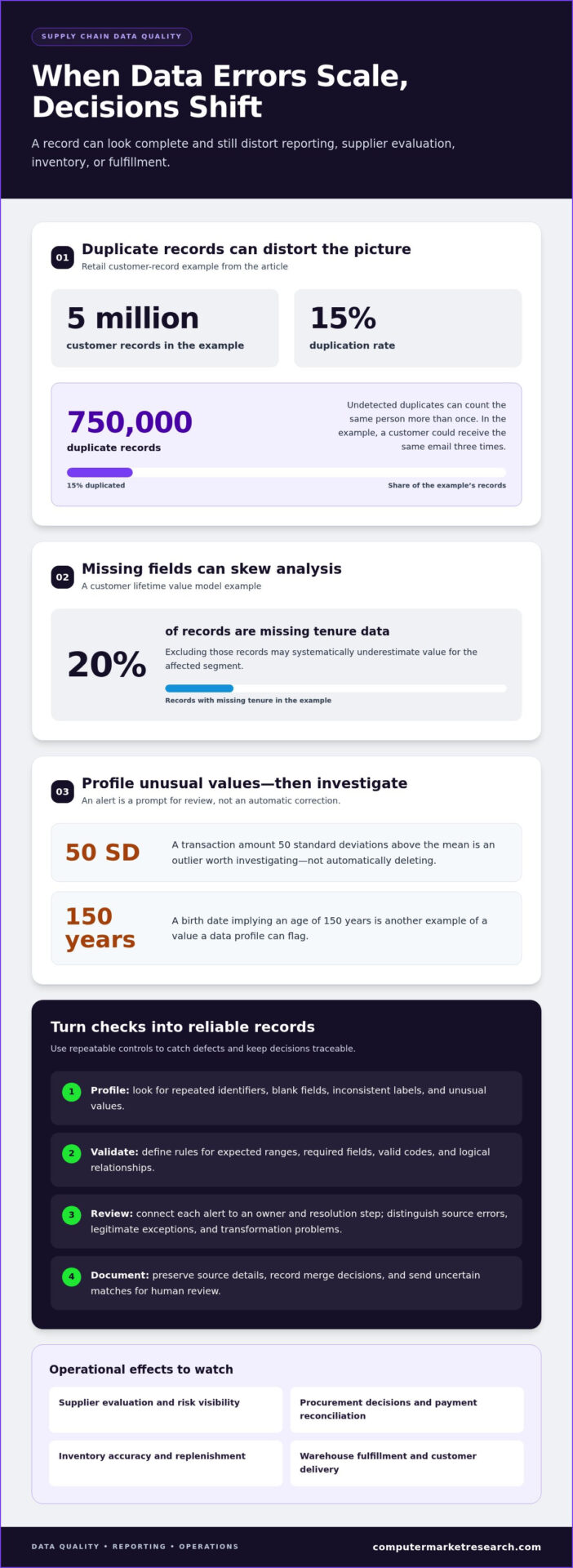
Duplicate data is a frequent problem after an organization connects information from siloed systems. Consider a retail organization with 5 million customer records and a 15% duplication rate: 750,000 records are duplicates. If the duplicates go undetected, analysis can count the same person more than once and distort customer insights. In the same example, duplicate records could cause a customer to receive the same email three times. Distributor data can create similar confusion when the same business appears in separate sales, procurement, and inventory platforms.
Duplicate vendors can be hard to spot when records use different names, addresses, or identifiers. One entry might list “Northstar Components LLC,” while another says “Northstar Components” and has a different remittance address. Treating them as separate vendors can split purchase history, complicate payment reconciliation, and obscure total spend. Before merging records, compare tax or vendor IDs, addresses, contact details, and transaction history. A shared name alone is not enough to show that two records represent the same entity.
Entity resolution helps determine whether similar records refer to the same distributor, supplier, or location. First standardize fields that commonly vary, including capitalization, punctuation, abbreviations, and address formats. Then compare stable identifiers and combinations of attributes. Group exact matches for review; seek additional evidence for near matches. Keep a traceable link between the original records and the resolved entity so teams can see which entries were connected and why.
Misclassified spend creates a related data problem. A distributor’s freight charge, for instance, might be coded as product spend in one system and logistics spend in another. Each record may be accurate on its own, but inconsistent categories make comparisons and budget analysis misleading. Define shared categories and map incoming codes to them before reporting. Review exceptions with the teams responsible for the transactions instead of changing categories just to force a match.
Start cleanup by profiling the data: look for repeated identifiers, blank fields, inconsistent labels, and unusual values. NIST describes data cleaning as including the handling of missing values and the construction and selection of features. For duplicate resolution, preserve source details, document merge decisions, and send uncertain matches for human review. This distinguishes confirmed duplicates from records that merely look alike.
2. Effects of inaccurate and incomplete supplier data
Inaccurate supplier records can distort sourcing decisions before a purchase order is placed. If a defect rate is recorded incorrectly, a business may divert resources from a capable supplier or miss a genuine quality concern. Missing corrective-action details or contact information can also slow investigations by leaving teams without the context to resolve a problem. The result may be delayed decisions, contract discrepancies, higher procurement costs, and weaker visibility into supplier risk.
Inventory and product errors have direct operational consequences. An incorrect product SKU can send warehouse staff to the wrong item, delaying fulfillment and customer delivery. Missing inventory adjustments can leave recorded stock above or below the physical count, prompting unnecessary replenishment or a stockout. Inaccurate demand planning compounds the problem: teams may order excess stock when demand is overstated or fail to replenish items customers need.
Incomplete fields also skew analysis. If a customer lifetime value model excludes the 20% of records missing tenure data, it may systematically underestimate value for the affected segment. In supplier reporting, absent defect rates or delivery updates can similarly leave teams comparing vendors on partial evidence. Before drawing conclusions, measure which fields are missing and identify whether omissions cluster by supplier, source system, or reporting period.
Data variety can create errors even when each source looks internally consistent. A spreadsheet might store dates as month-day-year, while an export uses day-month-year; combining them can misrepresent transaction timing. Mixing metric and imperial volume measurements can also produce incorrect totals. Standardize formats and units during ingestion, but preserve original values for traceability. Analysts can then compare records without silently changing their meaning.
Automated profiling can surface suspicious values before they shape reports. For example, a transaction amount 50 standard deviations above the mean is an outlier worth investigating, not automatically deleting. A birth date implying an age of 150 years is another value a profile can flag. Define rules around expected ranges, required fields, valid codes, and logical relationships. A negative inventory level, for instance, should trigger review when the system’s business rules prohibit it.
Connect each alert to an owner and a resolution step. Determine whether an unusual value reflects a source error, a legitimate exception, or a transformation problem. Record the decision, correct the original entry where possible, and monitor whether the pattern returns. This makes automated checks a repeatable control while focusing human review on exceptions that affect supplier evaluation, purchasing, or fulfillment.
3. Inconsistent definitions and data governance
Common causes of distributor data errors and duplicates include disconnected systems, manual entry, inconsistent field definitions, and missing validation rules. During integration, the same distributor may be entered differently in sales and procurement platforms. Without clear ownership, conflicting records can remain unresolved.
Shared definitions are essential for reliable reporting. For example, marketing might define an active customer as someone who purchased within 90 days, while finance uses a 180-day window. Both definitions may serve their teams, but combining their reports without documenting the difference produces inconsistent counts. Create a shared data dictionary that records each term, its meaning, its owner, and the systems that use it.
A supply chain data governance policy turns shared definitions into practical rules. Set conventions for distributor names, addresses, dates, measurement units, and category codes. Specify required fields, validation methods, and how updates move between platforms. For example, require a standard date format and define how to correct an invalid delivery location before it appears in a report.
Governance also requires clear stewardship. Assign data stewards to oversee supplier-data validation and inventory-data monitoring, with a defined escalation path for each role. A steward can review exceptions, decide whether a value reflects a real change or an entry error, and record the resolution. Data lineage tracks how a distributor record moves through operational systems, helping teams trace reporting discrepancies to their source.
Human error is harder to control when teams rely on spreadsheets, repeated rekeying, or undocumented workarounds. A sales coordinator might abbreviate a distributor name, while a finance analyst enters the full legal name. Both entries may make sense, but the mismatch can disrupt integration. Reduce errors by limiting duplicate entry, using approved reference values, and validating data at the point of entry.
Training makes governance practical in day-to-day work. Show employees how to enter distributor identifiers, classify transactions, and report suspected errors, using examples from their workflows. Train suppliers and supplier quality teams on standard reporting formats as well. If a report omits corrective actions or changes a field label, staff should know how to flag the gap instead of creating a local workaround.
Review whether governance rules are working. Track quality KPIs for completeness, accuracy, duplicate detection, and timely updates, and assign owners to investigate changes. Data lineage can show whether a reporting issue began with supplier input, manual handling, or system integration. Regular reviews keep definitions current and make data governance part of daily operations, not just a policy document.
4. Data validation and deduplication tools
Before cleanup, profile customer, product, and inventory records to identify problem fields. Apply validation rules, resolve duplicate candidates, and compare exceptions with source entries. For example, check product identifiers, descriptions, and units before treating two catalog entries as the same item.
Connect supplier feeds, ERP, CRM, and ecommerce systems using documented field mappings. At ingestion, validate required fields, formats, identifiers, and update status, then route failed checks for correction. For example, map a supplier’s item code consistently to the product identifier used in the ERP and ecommerce catalog.
Start with a data inventory listing each system, its owner, and its key fields. Profile customer, product, and inventory records for missing values, repeated identifiers, unexpected formats, and invalid entries. A report might reveal whether empty product descriptions come from a supplier feed or appear after integration. That distinction helps guide remediation.
Set validation rules based on business meaning, not just formatting. A product record may require an identifier, unit of measure, and active status; an inventory record may need a location and quantity. Check that codes match approved reference values and that related fields make sense together. For example, review a discontinued item before it enters an active product feed.
Use deduplication tools to find exact and probable matches, then separate confirmed duplicates from uncertain candidates. Group exact matches on stable identifiers for review. Similar names with different addresses require more evidence before merging. Preserve source values and document each decision so later analysis can trace how a consolidated record was created.
Correct errors at the source whenever practical. If a supplier repeatedly sends an invalid product code, address the feed or supplier-entry process rather than correcting every import manually. Fixing the source helps prevent the defect from returning. When the source cannot be changed, use a documented ETL rule to standardize or flag the value before it reaches reporting.
Automated validation can check incoming data, flag incomplete entries, and route exceptions to an assigned owner. Pair each alert with a clear action: correct the source, apply an approved transformation, or hold the record for review. For example, a missing warehouse location can block an inventory update until the responsible team resolves it. Track recurring failures and remediation results in an issue log.
Choose tools according to the controls your workflows require, such as profiling, format checks, duplicate detection, and auditability. Automation makes consistent checks easier to apply, but manual review remains important for ambiguous entity matches and unusual exceptions. Documented processes also support compliance by recording what changed, why it changed, and which source record informed the decision.
Accuracy, completeness, consistency, and timeliness of supply chain data
Track accuracy, completeness, consistency, and timeliness to assess whether supply chain records support sound decisions. The Centers for Disease Control and Prevention identifies completeness, timeliness, correctness, and comparability as key data-quality dimensions. For distributors, practical measures include valid product and supplier fields, missing-field rates, agreement across systems, and the delay between an operational event and its recorded update.
Accuracy measures whether values reflect real transactions. Check sampled purchase orders against supplier confirmations and compare recorded stock with inventory adjustments. Completeness measures whether required details are present, such as defect rates, corrective actions, or supplier contacts. Missing information can make supplier evaluations uneven because teams cannot compare performance using the same evidence.
Consistency measures whether systems represent the same information in compatible ways. One supplier quality report may arrive as a spreadsheet, while another comes from a custom software export. Standardize field names, reporting categories, and units before combining them. Comparability improves when suppliers use a shared reporting format and teams apply consistent KPI definitions across procurement and quality reports.
Timeliness matters when operational decisions depend on current information. A daily inventory batch refreshed at 2 AM can be up to 23 hours old by afternoon. If fulfillment relies on inventory data, a 15-minute maximum age is one example of a stricter freshness requirement. Delayed shipment updates reduce transportation visibility, while delayed inventory updates can contribute to stockouts.
To answer which metrics distributors should track, monitor completeness, timeliness, correctness, and comparability, then add duplicate rates and validation failures where relevant. A field’s completeness falling from 98% to 85% over two weeks signals a source-system change or pipeline failure worth investigating. A data-quality dashboard can show these trends and help teams assign corrective action to the responsible process.
Supplier participation is part of effective data management. Define required fields and reporting formats, explain expectations to suppliers, and train them to submit quality reports. If defect rates or corrective actions are routinely missing, review the submission process with suppliers and document the agreed reporting standard. This helps procurement teams make decisions from consistent evidence instead of filling gaps with assumptions.
Use continuous monitoring to identify whether fixes hold. Log recurring issues, track their source, and review whether standardization improves reporting completeness and accuracy. Clear metrics also help teams prioritize remediation: a missing contact may delay follow-up, while stale inventory data can affect fulfillment. To support more consistent channel data workflows, explore the data management platform.
Computer Market Research: PartnerPortal™
Computer Market Research offers PartnerPortal™, a platform that centralizes partner onboarding, deal registration, and performance tracking. When fragmented channel records make partner activity difficult to follow, shared visibility can help teams work from more consistent information.
PartnerPortal™ supports channel operations alongside Co-op/MDF Management and Rebates & Incentives. Deal Registration gives teams a structured way to manage partner-submitted opportunities. These tools are most relevant when data quality challenges affect partner processes and channel performance, rather than supplier records outside those workflows.
To explore how PartnerPortal™ can support your channel data processes, contact Computer Market Research or visit computermarketresearch.com.
Make data quality part of ongoing operations
Reliable distributor information comes from ongoing ownership, not a one-time cleanup. Choose a high-impact dataset, assign an accountable owner, and regularly review the quality measures its users rely on. When an issue appears, record its source and resolution. Teams can then address recurring distributor data quality issues at the process level instead of repeatedly correcting symptoms by hand.
Extend the approach to connected workflows. Shared definitions, clear validation rules, and visible exception processes help maintain dependable information as systems and partner needs change. Start with data that directly supports operational decisions, learn from exceptions, and refine controls over time.
If improving channel data processes is your next priority, connect with Computer Market Research to explore how its offerings may support your workflow. A focused next step can help turn data quality from a recurring bottleneck into a manageable business practice.
Frequently Asked Questions
So, what are data quality issues?
Data quality issues occur when information cannot reliably support the task it is meant to serve. A distributor address, for example, may be accurate for invoicing but outdated for delivery. Assess each field in context: who uses it, which decision depends on it, and how current it needs to be. This helps distinguish a harmless formatting difference from a defect that could disrupt a transaction.
What are the most common distributor data quality issues?
Common distributor data quality issues include duplicate accounts, missing product identifiers, outdated contact details, and inconsistent transaction categories. A distributor might appear under separate account IDs in sales and finance, splitting its activity across reports. Prioritize fields that support order processing, partner reporting, and account decisions, then assign an owner to review exceptions and correct the original entry.
How do inaccurate distributor data affect sales, inventory, and customer experience?
Inaccurate distributor information can weaken sales decisions, misstate available stock, and confuse customers. An incorrect account assignment, for example, may send a sales follow-up to the wrong team, while a mismatched product identifier can complicate order handling. Customers may then receive unclear availability or delivery information. Reviewing records where they are used helps connect data defects to their operational impact.
What tools and software improve distributor data quality, and how much do they cost?
Profiling, validation, deduplication, and integration tools can help teams detect gaps and manage incoming records. Costs vary with the software’s scope, data volume, user needs, and required integrations; compare those factors against the manual work and controls involved. For a business-specific quote, the price depends on the case and is provided after a quote request. Confirm the capabilities and pricing model against your workflows.
What data governance rules and standards should distributors follow in the United States?
Distributors should establish internal rules for field definitions, naming conventions, formats, ownership, access, retention, and correction workflows. Controls depend on the data, its business purpose, and relevant contracts or obligations. For example, define who can approve changes to supplier payment details and how those changes are recorded. Document policies centrally, train staff, and review the rules as systems and processes change.
What are best practices for ongoing distributor data quality monitoring?
Monitor defined measures, assign owners, and investigate meaningful changes before reporting fails. A dashboard can track missing fields, invalid entries, duplicate candidates, and delayed updates by source system. Maintain an issue log covering the affected workflow, root cause, correction, and prevention step. Review recurring patterns with data owners so fixes address the process generating the error.
What are the risks of poor distributor data quality, including compliance and financial risks?
Poor records can contribute to incorrect purchasing decisions, payment discrepancies, fulfillment delays, and unreliable partner reporting. Missing audit trails also make it harder to trace information between systems or explain changes. Privacy and compliance risks may arise when organizations cannot locate or manage all relevant copies of personal information. Keep access and change records, define retention practices, and route sensitive-data issues to the responsible teams.

Article by
Del Heles
Del Heles is the founder and CEO of Computer Market Research (CMR), a channel management software company he launched in 1984. With more than 40 years of experience, he’s known for helping manufacturers and distributors simplify complex partner programs through practical, customer-focused technology solutions.