

A channel partner strategy built on manual spreadsheets is no longer a growth plan; it’s a liability. You likely recognize the friction of fragmented information and the persistent risk of manual errors that stall your indirect sales. It’s frustrating to manage complex industry relationships when you lack real-time visibility into partner inventory or struggle with inefficient MDF and rebate processing. These operational bottlenecks don’t just waste time; they actively prevent your organization from reaching its full revenue potential.
We understand that building trust requires technical competence and a clear path out of these data challenges. This guide provides the strategic frameworks you need to master a scalable, data-driven ecosystem in 2026. You’ll learn how to transition from legacy tracking methods to a modernized infrastructure that prioritizes accuracy and performance. We’ll focus on replacing outdated habits with disciplined, results-driven processes that respect your professional focus.
We will explore how to achieve automated partner onboarding and clean, actionable POS data. By the end of this article, you’ll have a blueprint for predictable revenue growth through indirect channels, positioning PartnerPortal™ as the engine of your success. We’ll examine the shift from manual workflows to systematic, high-quality information management to ensure your indirect channels become a reliable source of truth.
Key Takeaways
- Modernize your approach by shifting from transactional reselling to a collaborative ecosystem that prioritizes technical expertise and long-term alignment.
- Address the high rate of error in manual POS reports by establishing real-time visibility into channel inventory and sell-through rates.
- Implement a scalable channel partner strategy by defining measurable ROI goals for every partner tier and auditing your current infrastructure for manual bottlenecks.
- Centralize global channel management and eliminate administrative friction using automated SaaS frameworks like PartnerPortal™ to ensure predictable revenue growth.
What is a Channel Partner Strategy and Why It Fails
A channel partner strategy is far more than a high-level plan; it’s a comprehensive operational framework designed to scale indirect sales through third-party relationships. In 2026, this discipline has moved beyond simple transactional reselling toward a collaborative ecosystem where data transparency and shared technical expertise drive mutual growth. By understanding What is a Channel Partner in a modern context, organizations can effectively reduce direct sales costs and expand their market reach into territories that would otherwise be too expensive to penetrate directly. This shift requires a move from passive oversight to active, data-led management.
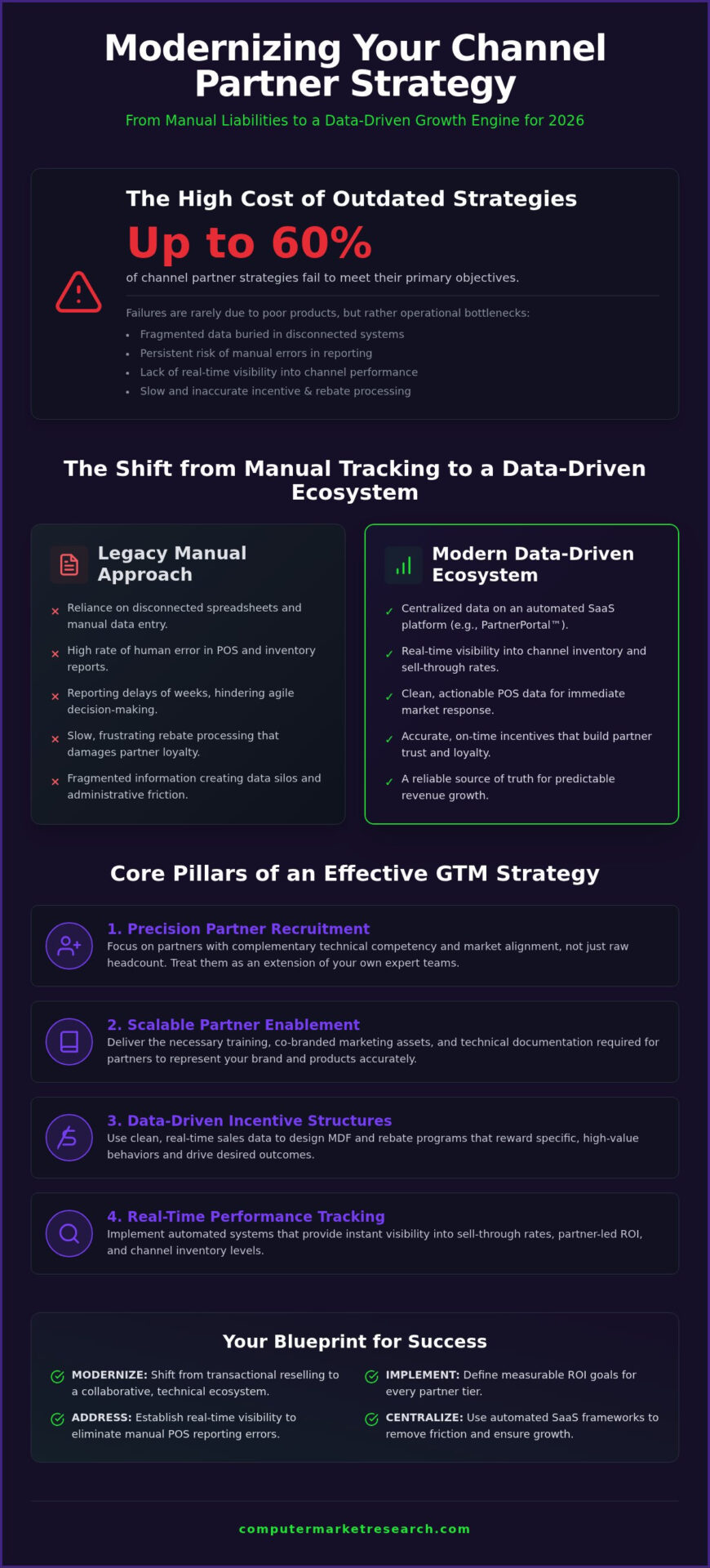
Despite the potential for high returns, industry assessments suggest that up to 60% of these strategies fail to meet their primary objectives. These failures rarely stem from poor product quality or a lack of market demand. Instead, they’re often the result of fragmented data and a reliance on manual tracking methods that can’t keep pace with the speed of global commerce. When information is buried in disconnected systems, leadership loses the visibility required to pivot or scale effectively. This lack of clarity transforms a promising growth engine into a series of expensive administrative hurdles.
To better understand the core requirements of a successful program, watch this helpful video:
The Cost of Legacy Manual Processes
Legacy systems, particularly disconnected spreadsheets, create persistent data silos that hinder executive decision-making. When you rely on manual entry, the time lag between a sale and its reporting can stretch into weeks, making it impossible to respond to market shifts in real time. This delay directly impacts partner loyalty, as slow rebate processing and incentive payouts frustrate the very people driving your revenue. Partners who don’t get paid accurately and on time will eventually move their focus to competitors who offer more reliable systems. The operational bottleneck represents the primary obstacle to growth in modern indirect sales.
Strategic Alignment vs. Operational Execution
There’s a critical distinction between setting Go-To-Market (GTM) goals and having the infrastructure needed to reach them. While a strategy defines the where and why, operational execution handles the how. This is why Fortune 500 companies are increasingly moving toward automated systems to manage their complex networks. Effective channel partner strategy implementation requires a shift from manual oversight to technical precision. Aligning your high-level vision with the digital tools required for success is essential. For more depth on this transition, you can explore our guide on how to partner smarter to scale your indirect sales effectively.
Core Pillars of an Effective Channel GTM Strategy
A successful channel partner strategy relies on four foundational pillars: recruitment, enablement, incentives, and performance tracking. In 2026, recruitment has shifted from a volume-based approach to a precision-based model. You should identify partners with complementary technical expertise who can serve as an extension of your own engineering or service teams. This alignment ensures that the end customer receives a consistent experience, regardless of the sales path. For a specialized manufacturer like RMR Reagents, which supplies high-quality chemicals and laboratory reagents, these structured frameworks ensure that technical standards are maintained across every industrial application. According to Gartner’s definition of channel partners, these entities are essential for scaling market presence, but they require a structured framework to remain productive and loyal.
- Partner Recruitment: Focus on technical competency and market alignment rather than raw headcount.
- Enablement: Deliver the training and co-branded assets required to represent your brand accurately.
- Incentive Structures: Use data to design programs that reward specific, high-value sales behaviors.
- Performance Tracking: Implement systems that provide real-time visibility into sell-through rates and partner-led ROI.
Designing High-Impact Incentive Programs
Effective incentives go beyond simple percentage-based commissions. You must distinguish between the strategic roles of rebates, co-op funds, and Market Development Funds (MDF). While rebates reward volume, MDF and co-op programs provide the necessary capital for partners to execute localized marketing campaigns. Sophisticated strategies also incorporate financial mechanics like ship and debit management to protect partner margins during price fluctuations or competitive bidding. Automated deal registration further secures these relationships by preventing channel conflict and ensuring that the partner who identifies the lead is the one who profits from it.
Partner Enablement through Centralization
Fragmentation is the enemy of enablement. A centralized PartnerPortal™ is essential for global onboarding, providing a single source of truth for training materials and certification status. When partners have real-time access to inventory levels and dynamic pricing data, they can close deals faster and with greater confidence. This transparency reduces the administrative burden on your internal teams and allows your partners to operate autonomously. Through-channel marketing automation also plays a vital role by allowing partners to deploy pre-approved campaigns that maintain your brand’s integrity while reaching diverse markets. To see how these pillars function in a live environment, you can explore our automated management tools.
Data-Driven Strategy vs. Legacy Manual Tracking
Relying on manual spreadsheets is the greatest risk to a modern channel partner strategy. Many organizations operate under the myth of ‘good enough’ data, but manual POS reports are often 20% inaccurate due to human error and inconsistent reporting cycles. These inaccuracies lead to flawed financial projections, misallocated resources, and missed opportunities in competitive markets. In 2026, success requires a shift toward Decision-Grade insights that provide a definitive source of truth for every transaction, ensuring that every strategic move is backed by verified information.
Real-time visibility into channel inventory and sell-through rates allows you to react to market shifts before they impact your bottom line. Without this clarity, your team spends more time reconciling data than executing growth plans. Managed data services solve this by offloading the administrative burden of data collection and validation from your internal staff. It’s a transition that ensures your operations professionals focus on performance rather than spreadsheet maintenance. This approach creates a more agile organization that can scale without adding significant headcount.
Normalizing POS and Inventory Data
Global partners often submit reports in disparate formats, creating a massive data normalization challenge. Processing these files manually is slow and prone to errors that compromise your incentive programs. Automated cleansing and validation ensure that your data is standardized and ready for analysis immediately, regardless of the source or format. This precision is a cornerstone of a data-driven channel partner strategy. For a deeper look at this process, see our Channel Data Management (CDM) guide to decision-grade insights.
Automating Ship & Debit Claims
Manual ship and debit processing is a frequent source of overpayments and partner disputes. When you don’t validate claims against real-time POS data, you invite guesswork that erodes your profitability and damages partner relationships. Automation protects your margins and strengthens partner trust by providing a transparent, audit-ready trail for every transaction. This ensures that credits are only issued for valid, documented sales. Implementing Ship & Debit Management Software is the most effective way to modernize this critical financial workflow and eliminate the risk of manual processing errors.
5 Steps to Implementing Your 2026 Partner Strategy
Implementing a high-performance channel partner strategy requires a transition from manual oversight to technical precision. You don’t just need a plan; you need a sequence of operational improvements that eliminate friction at every stage of the partner lifecycle. Success in 2026 depends on your ability to move from reactive troubleshooting to a proactive, data-led methodology. Follow these five steps to build a scalable infrastructure that supports long-term indirect growth.
- Step 1: Define ROI Goals. Establish specific, measurable channel ROI goals for each partner tier to ensure resources are allocated where they generate the highest returns.
- Step 2: Infrastructure Audit. Conduct a thorough audit of your current data systems to identify manual bottlenecks and areas of information fragmentation.
- Step 3: Centralize Onboarding. Deploy a centralized PRM like PartnerPortal™ to automate the onboarding process and ensure global consistency.
- Step 4: Automate Incentives. Streamline the MDF and rebate lifecycle to eliminate payment delays and drive higher partner engagement.
- Step 5: Optimize with Analytics. Utilize real-time POS analytics to monitor sell-through rates and optimize your channel spend based on actual performance.
Auditing Your Channel Infrastructure
Before you can scale, you must identify where your current system is failing. Look for ‘leakage’ in your incentive and rebate programs, such as overpayments or duplicate claims that erode your margins. You should also assess whether your current communication methods can handle an influx of new partners without increasing administrative headcount. An operational audit serves as the essential prerequisite for strategic growth. This audit should also cover data security and the discovery of sensitive information to maintain compliance; for more on how to automate this process, click here. By documenting these inefficiencies, you create a clear roadmap for modernization and technical integration.
Automation isn’t just a convenience; it’s the only viable way to manage Global 2000 partner volumes effectively. When you rely on manual processes, you’re constantly in a reactive state, fixing errors that have already occurred. Transitioning to a proactive, data-led strategy allows you to anticipate market shifts and support your partners with accurate inventory and pricing data. This transformation is driven by robust Channel Sales Management Software that centralizes all partner activity. To see how these automated systems can transform your operations, you can claim your 90-day free trial and begin your transition today.
PartnerPortal™: The Engine of Modern Channel Success
A channel partner strategy reaches its full maturity when it moves from manual intervention to automated execution. For global enterprises, the complexity of managing thousands of relationships across different regions often leads to operational paralysis. SaaS automation provides a clear path forward by standardizing workflows and ensuring that data flows seamlessly between your organization and your partners. This technical foundation is what allows Global 2000 companies to maintain predictable revenue growth without being overwhelmed by administrative noise. Automated data management isn’t just a feature; it’s the final, essential step in a mature strategy that prioritizes stability and accuracy over legacy guesswork. Just as Future Me, Answered provides students with a strategic way to explore their future careers, implementing these systems provides a stable foundation for your organization’s long-term growth.
Centralizing Operations with PartnerPortal™
Efficiency begins with a single source of truth. By integrating PartnerPortal™ with your existing CRM and ERP systems, you eliminate the data silos that previously hindered your decision-making. This environment provides partners with a self-service workspace where they can handle deal registration and MDF requests without waiting for manual approval. It’s a shift that empowers your partners to work at their own pace while ensuring your internal teams retain full oversight. This centralized approach reduces the risk of duplicate entries and ensures that every partner has access to the same high-quality data. When partners have the tools they need to succeed independently, your indirect channel becomes a more scalable asset.
Achieving Strategic ROI
Moving from manual to automated channel management produces measurable business outcomes that directly impact your bottom line. Many organizations find that offloading the burden of data administration to CMR allows their sales leaders to focus on high-level relationship building rather than technical troubleshooting. This transition doesn’t just save time; it improves the accuracy of every transaction and incentive payout. By relying on a systematic approach, you ensure that your channel partner strategy is supported by modern infrastructure and high-quality information. It’s the most logical step for any organization looking to secure its market position in 2026. To begin modernizing your ecosystem, you can choose to Partner Smarter with Computer Market Research and eliminate the bottlenecks that are currently stalling your growth.
Modernizing Your Indirect Sales Infrastructure
The path to partner-led growth in 2026 requires a definitive shift from manual tracking to technical precision. By prioritizing real-time POS data visibility and automated MDF processing, you eliminate the operational bottlenecks that historically stalled expansion. We’ve explored how a data-driven channel partner strategy serves as the foundation for predictable revenue, replacing fragmented spreadsheets with a single source of truth. This transition allows your team to offload administrative burdens and focus on high-value strategic relationships.
Computer Market Research has been a trusted partner for Fortune 500 companies since 1984, providing the stability and technical competence required for global scale. Our systems ensure your rebate and incentive programs operate with total accuracy, protecting your margins and building partner trust. It’s a proven way to move beyond legacy obstacles and embrace a modernized ecosystem built for performance.
Scale your channel strategy with PartnerPortal™ and experience the clarity of automated management. We’re ready to help you build a more efficient and profitable future.
Frequently Asked Questions
What are the key components of a channel partner strategy?
The key components of a channel partner strategy include partner recruitment, enablement, incentive structures, and performance tracking. You need to focus on identifying partners with complementary technical expertise while providing them with necessary training and co-branded assets. A successful framework also requires robust financial mechanics like Ship & Debit management. By centralizing these elements, you ensure that your indirect sales efforts are scalable and aligned with your broader corporate objectives.
How do you measure the ROI of a channel partner program?
You measure the ROI of a channel partner program by tracking sell-through rates, partner-sourced revenue, and market penetration costs. It’s essential to compare these metrics against your direct sales expenses to determine the efficiency of the indirect channel. Using real-time POS data management ensures your calculations aren’t skewed by manual entry errors or reporting delays. This data-driven approach provides the visibility required to optimize your channel spend and justify ongoing investments.
What is the difference between a reseller and a channel partner?
A reseller typically focuses on transactional sales of finished goods, whereas a channel partner acts as a strategic extension of your brand. Channel partners often provide technical expertise, integration services, or localized support that adds value to the end customer’s experience. While resellers might only focus on volume, a modern channel partner strategy prioritizes collaborative ecosystems where both parties share data and align their go-to-market goals for long-term growth.
How can automation improve my channel partner strategy?
Automation improves your channel partner strategy by eliminating manual spreadsheet errors and accelerating administrative workflows. It streamlines partner onboarding and ensures that incentive payouts, such as rebates and MDF, are processed accurately and on time. By replacing legacy tracking methods with a centralized platform like PartnerPortal™, you gain real-time visibility into inventory and sell-through rates. This shift allows your team to focus on strategic growth rather than troubleshooting fragmented data sets.
Why is deal registration important for channel sales?
Deal registration is critical because it protects partner margins and prevents internal or external channel conflict. When a partner identifies a lead, registering it ensures they receive the appropriate incentives and support for that specific opportunity. This process provides manufacturers with early visibility into the sales pipeline, allowing for better inventory planning. Automated registration systems build trust by ensuring that the partner who does the work is the one who gets the credit.
How do I choose the right partners for my GTM strategy?
Selecting the right partners requires an evaluation of technical synergy, market reach, and operational alignment. You should prioritize partners who possess the specific expertise needed to support your product’s value proposition in local markets. It’s also vital to assess their willingness to adopt your data reporting standards. Choosing partners based on their ability to integrate with your systems ensures that your channel partner strategy remains data-driven and scalable across different regions.
What is the role of MDF in a channel partner strategy?
Market Development Funds (MDF) provide the necessary capital for partners to execute localized marketing and lead generation campaigns. In a mature channel partner strategy, MDF acts as a strategic lever to drive brand awareness in specific territories or vertical markets. By automating the request and claim process, you ensure these funds are used effectively and that partners are reimbursed quickly. This transparency encourages partners to invest more heavily in your brand’s market presence.
How do I prevent channel conflict between partners?
You prevent channel conflict by implementing clear deal registration policies and transparent territory definitions. Automation plays a vital role here by providing a neutral, audit-ready record of who identified an opportunity first. Clear communication regarding incentive structures and lead management also reduces friction between partners. When everyone understands the rules of engagement and has access to the same real-time data, the risk of disputes over accounts or margins decreases significantly.

Article by
Del Heles
Del Heles is the founder and CEO of Computer Market Research (CMR), a channel management software company he launched in 1984. With more than 40 years of experience, he’s known for helping manufacturers and distributors simplify complex partner programs through practical, customer-focused technology solutions.