

What if your channel partner program could scale its revenue by double digits without adding a single administrative head to your operations team? Most channel leaders accept inaccurate POS data, mismatched inventory reports, and weeks of manual rebate processing as the unavoidable cost of doing business. You’ve likely felt the frustration of chasing down distributors for clean information or dealing with the errors that inevitably arise from manual MDF claims. It’s a cycle that drains resources and obscures your true channel performance.
Key Takeaways
- Understand the transition from transactional reselling to strategic ecosystems and why automation is now a requirement for Global 2000 growth.
- Learn how to eliminate manual friction in your channel partner program by automating the lifecycle of POS data and inventory reporting.
- Discover the methodology for designing tiered incentive structures and automated financial processing that motivates partners without increasing headcount.
- Identify the core pillars of partner enablement that move your collaborators toward self-sufficiency and long-term alignment with your business goals.
- Master the shift from fragmented, error-prone spreadsheets to decision-grade insights that provide a clear, real-time view of your channel ROI.
What is a Channel Partner Program in the 2026 Ecosystem?
The definition of a channel partner program has fundamentally transformed. It’s no longer a simple linear path from manufacturer to reseller to end-user. Instead, it has evolved into a multi-directional ecosystem where service partners, alliances, and independent software vendors (ISVs) collaborate to deliver value. In this environment, success depends on your ability to orchestrate these complex relationships without getting buried in administrative debt. Global 2000 organizations often find that manual processes are the single greatest barrier to this orchestration, as fragmented data prevents a clear view of partner contributions.
To better understand how these modern relationships are structured, watch this helpful video:
The Shift from Linear Channels to Strategic Ecosystems
Why Automation is No Longer Optional for Scaling
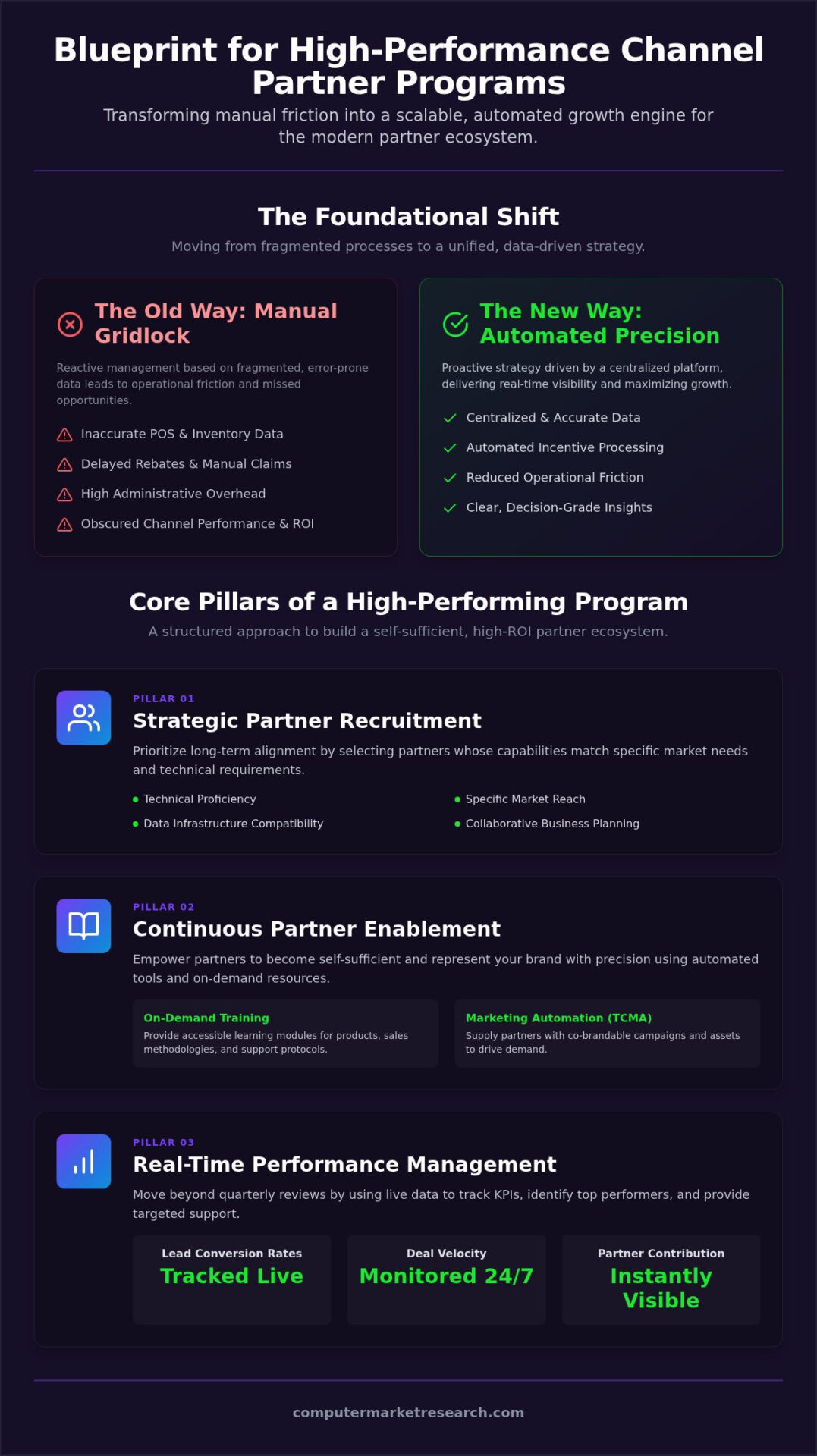
Scaling a channel partner program manually is a recipe for operational gridlock. The hidden costs of spreadsheet-based management include delayed rebate payouts, inaccurate inventory levels, and high partner churn. When onboarding takes weeks instead of days due to manual paperwork, you lose the initial momentum of the partnership. Automation removes these friction points, allowing your team to move from reactive firefighting to proactive strategy. By digitizing the onboarding journey and automating incentive triggers through channel partner management software, you ensure that your program remains the preferred choice for top-tier partners. These partners value efficiency and accuracy, and they’ll gravitate toward brands that provide a frictionless experience. Transitioning away from manual tracking isn’t just about saving time; it’s about securing the high-quality information needed to make informed, decision-grade investments in your channel’s future.
Core Pillars of a High-Performing Channel Partner Program
Building a successful channel partner program requires more than just signing up distributors; it demands a structured approach to recruitment, enablement, and performance tracking. High-performing programs prioritize long-term alignment by selecting partners whose capabilities match specific market needs. This alignment starts during recruitment, where you should evaluate potential partners based on concrete criteria:
- Technical proficiency and existing service capabilities
- Market reach within specific geographic or vertical segments
- Compatibility with your existing CRM and data infrastructure
- Willingness to participate in collaborative business planning
Once onboarded, partners need continuous enablement. Providing tools for self-sufficiency, such as on-demand training and through-channel marketing automation (TCMA), empowers partners to represent your brand with the same precision as your internal sales team. Performance management ties these efforts together by using real-time data to track key performance indicators (KPIs). Instead of waiting for quarterly reviews, modern programs monitor lead conversion rates and deal velocity as they happen. This visibility allows you to identify which partners are excelling and which require additional support, creating a culture of accountability that drives consistent ROI.
Strategic MDF and Co-op Fund Management
One common pitfall in channel administration is failing to distinguish between Market Development Funds (MDF) and Co-op funds. MDF is typically discretionary and forward-looking; it’s designed to stimulate future growth in specific territories or segments. In contrast, Co-op funds are usually earned based on a percentage of past sales volume. Managing both requires a system that can handle complex accrual rules and validation requirements without manual intervention. When you automate your MDF program, you eliminate the delays that often lead to partner frustration. Timely reimbursement is a significant loyalty driver, as it directly impacts your partner’s cash flow and marketing agility.
Deal Registration and Conflict Resolution
Trust is the currency of the channel. Deal registration software is the primary mechanism for maintaining that trust by preventing internal sales teams or other partners from poaching opportunities. By protecting partner margins, you encourage them to invest more heavily in your products. A well-structured registration process ensures that the partner who did the heavy lifting of lead generation is the one who reaps the rewards. Effective conflict resolution isn’t just about rules; it’s about having a single source of truth for every transaction. If you’re looking to modernize these workflows, you can streamline your incentive management to ensure every partner behavior aligns with your strategic goals.
Solving the Data Gap: The Foundation of Channel ROI
The most significant hurdle to a high-performing channel partner program isn’t a lack of strategy; it’s the sheer volume of fragmented data. Manufacturers often struggle with a “Data Burden” where point-of-sale (POS) and inventory reports arrive in dozens of different formats, from raw CSV files to complex EDI transmissions. Without a systematic way to cleanse and normalize this information, your team spends more time fighting with spreadsheets than analyzing performance. This administrative bottleneck prevents you from achieving the decision-grade insights necessary to allocate resources effectively. By utilizing managed data services to standardize these inputs, you can finally optimize your channel data management and move toward a more predictable growth model.
When data remains siloed or unformatted, the entire ecosystem suffers. Partners feel the friction of manual reporting, while manufacturers lose sight of where their products are actually sitting in the channel. Solving this gap is about more than just cleaning up files; it’s about building a reliable infrastructure that supports every subsequent step of the partner lifecycle, from incentive payouts to inventory replenishment.
Real-Time Visibility into POS and Inventory
In the 2026 ecosystem, relying on monthly or quarterly sales reports is a liability. Lagging data means you’re making strategic decisions based on old news, which often leads to costly stockouts or excessive overstocking. Real-time visibility allows you to see exactly which SKUs are moving in specific regions as it happens. This level of transparency helps you identify emerging market trends before your competitors can react. When you have a clear view of channel inventory levels, you can proactively manage production schedules and ensure that partners always have the right products to meet local demand, directly improving the overall health of your channel partner program.
Automating Rebates and Ship & Debit Claims
Financial inaccuracies in ship-and-debit processing represent a major risk to your bottom line and partner trust. Manual verification is notoriously prone to errors, often resulting in overpayments or frustrating disputes that sour partner relationships. Automating these incentive triggers ensures that every claim is validated against actual POS data before any funds are released. This precision reduces administrative overhead and ensures that your financial incentives are actually driving the behaviors you want to reward. If you’re looking for deeper strategies on this topic, consider maximizing channel ROI with incentive programs to see how automated verification transforms your financial operations into a strategic advantage.
Strategic Implementation: Building Your Program for Scale
Implementing a scalable channel partner program requires moving beyond ad-hoc management toward a structured, five-step framework. The first step involves defining shared goals and key performance indicators (KPIs) that align your corporate objectives with your partners’ business models. Without this mutual agreement, you risk misallocating resources on activities that don’t drive revenue. Once goals are set, you must design a tiered incentive structure that rewards growth and technical proficiency. This leads to the selection of a centralized Partner Relationship Management (PRM) system, which serves as the operational hub for all partner activities.
Designing a Competitive Incentive Framework
A successful framework balances direct financial rewards with robust enablement and support. While rebates and commissions are essential, partners also value access to co-op funds and specialized training that enhances their market position. You can create ‘gamified’ tiers to encourage partners to advance from basic reselling to higher-value service roles. For a deeper look at how to manage these financial levers, read The Strategic Guide to MDF. This approach ensures that your incentives are motivating the right behaviors at every stage of the partner journey.
Technical Integration: PRM vs. CRM
A common mistake is assuming a standard CRM can manage a complex indirect sales channel. While CRMs are excellent for internal sales tracking, they lack the specialized modules required for deal registration, MDF claims, and multi-tier distribution data. A dedicated partner portal provides a secure environment for external collaboration, allowing partners to access leads and marketing assets without compromising your internal system of record. Seamless data flow between the portal and your ERP is non-negotiable for accurate financial reporting and inventory management. If you’re ready to eliminate manual errors and see how automated systems can transform your operations, you can start your 90-day free trial today to experience the benefit of a unified platform.
Centralize Your Operations with CMR PartnerPortal™
One of the most significant advantages of working with CMR is our Managed Data Services. We don’t just provide the software; we offload the administrative burden of cleansing and normalizing raw POS and inventory reports. This service ensures that the information entering your system is accurate, standardized, and ready for analysis. It allows your team to focus on strategic growth rather than the tedious task of manual data entry and error correction. Experience matters.
The CMR Advantage: Accuracy and Technical Competence
Precision is required when managing the intricate data relationships inherent in B2B administration. Founded in 1984, CMR brings over 40 years of specialized expertise to every integration. We approach channel management with a sense of quiet confidence, knowing that technical precision is the only way out of operational gridlock. Our focus isn’t on trendy marketing jargon but on building stable, reliable systems that provide a clear path out of manual errors. When you explore the PartnerPortal™ solution, you’re looking at a platform built on decades of understanding complex industry relationships. This technical competence ensures that your data remains a high-quality asset rather than a liability.
Driving Revenue Growth through Data Transparency
Gaining a clear path out of fragmented information is the ultimate goal for any modern channel leader. Data transparency isn’t just about having more numbers; it’s about having the right numbers in real time. This visibility leads to better executive decision-making, as you can see exactly which incentives are driving performance and where your market share is expanding. Modernizing your channel partner program infrastructure is no longer a luxury for those who wish to remain competitive. The first step toward this transformation is acknowledging that legacy methods have become primary obstacles to your growth. By centralizing your operations and adopting an automated approach to data management, you secure a measurable business outcome that benefits both your organization and your partners.
Future-Proof Your Channel Strategy
The evolution of the channel partner program from a manual reselling model to a strategic ecosystem requires a fundamental shift in how you manage information. By prioritizing automation over legacy spreadsheets, you eliminate the friction that has historically hindered Global 2000 growth. You’ve seen how cleansing and normalizing partner POS data, alongside automating financial incentives like co-op/MDF and rebates, can transform your operational efficiency. Centralizing onboarding and deal registration isn’t just about administrative order; it’s about creating a scalable foundation for long-term partner loyalty and technical precision.
Moving toward a modernized infrastructure allows you to gain the decision-grade insights needed to maximize ROI. You can finally stop firefighting manual errors and start focusing on the high-level strategy that drives revenue. If you’re ready to secure this level of accuracy for your organization, take the next step toward operational excellence. Streamline your channel operations with PartnerPortal™ and begin your transition to a data-driven future. Your path to automated growth starts with a single, systematic decision that rewards both you and your partners.
Frequently Asked Questions
What is a channel partner program?
A channel partner program is a strategic business framework where a manufacturer or vendor collaborates with third-party entities, such as resellers, distributors, or service providers, to sell and support its products. These programs are designed to expand market reach and increase sales through external expertise and local presence. Modern versions of these programs prioritize data transparency and automated workflows to maintain alignment between all parties involved in the ecosystem.
How do I build a channel partner program from scratch?
Building a program from scratch requires a structured approach that begins with defining clear business objectives and target partner profiles. You must establish a formal recruitment strategy, develop a tiered incentive structure, and select a centralized platform for operational management. Integrating these systems with your existing CRM and ERP infrastructure is critical to ensure that data flows seamlessly between your internal teams and external partners from day one.
What is the difference between MDF and Co-op funds?
Market Development Funds (MDF) are discretionary funds provided to partners in advance to stimulate future sales through specific marketing activities or market expansion. Co-op funds are earned incentives based on a percentage of a partner’s past sales volume. While MDF is often project-based and strategic, Co-op funds are typically accrual-based and rewarded to partners who consistently meet or exceed their sales targets over a set period.
Why is automation important for partner management?
Automation eliminates the manual friction and errors that typically arise from managing complex partner relationships through spreadsheets. It ensures that critical processes, such as rebate processing and MDF claims, are handled with technical precision and speed. By digitizing the partner lifecycle, organizations can scale their operations without increasing administrative headcount while providing partners with the real-time visibility they need to remain engaged and productive.
How can I improve the ROI of my channel incentives?
Improving ROI requires validating every incentive payout against actual point-of-sale (POS) data to ensure you’re rewarding the right behaviors. By automating the verification process for rebates and ship-and-debit claims, you reduce overpayments and administrative waste. Utilizing decision-grade insights allows you to identify which incentive structures are driving the most significant revenue gains, enabling you to reallocate funds toward high-performing partners and regions.
What are the key features of a partner portal?
A partner portal should feature centralized onboarding, automated deal registration, and a secure environment for accessing marketing and training materials. It must include robust reporting modules that provide both the vendor and the partner with real-time visibility into sales performance and incentive accruals. Effective portals also offer seamless integration with the vendor’s system of record to maintain a single source of truth for all channel activities.
How does deal registration prevent channel conflict?
Deal registration prevents conflict by granting a specific partner exclusive rights to a lead or opportunity for a defined period after they’ve registered it. This protection ensures that internal sales teams or other partners don’t compete for the same transaction, thereby protecting the partner’s margins. By establishing clear rules of engagement through an automated system, you build trust and encourage partners to invest more heavily in lead generation efforts.
What is channel data management (CDM)?
Channel data management (CDM) is the discipline of collecting, cleansing, and normalizing raw data from partners to create a standardized view of channel performance. This process involves aggregating POS and inventory reports from various sources and converting them into a consistent format for analysis. CDM is the foundation of a data-driven channel partner program, as it provides the high-quality information needed for accurate financial reporting and strategic decision-making.

Article by
Del Heles
Del Heles is the founder and CEO of Computer Market Research (CMR), a channel management software company he launched in 1984. With more than 40 years of experience, he’s known for helping manufacturers and distributors simplify complex partner programs through practical, customer-focused technology solutions.