

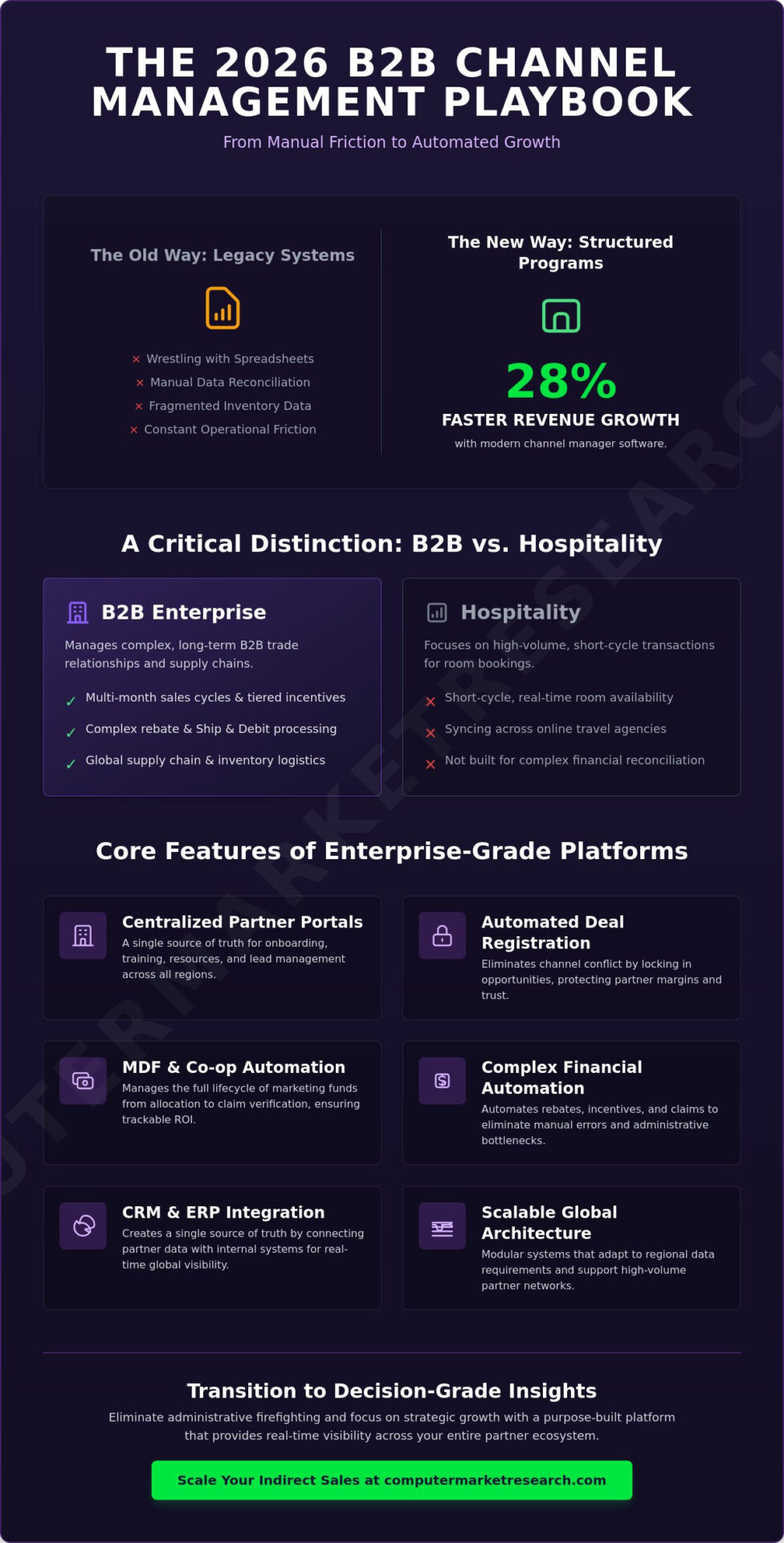
In 2026, enterprise channel management is a data-cleansing discipline, not just a communication portal. If your team is still wrestling with spreadsheets to manage global partner networks, you’re missing out on the 28% faster revenue growth that structured programs now deliver. Selecting the right channel manager software tools is the difference between constant operational friction and a scalable, high-performance ecosystem. You need a system that doesn’t just host documents but actively reconciles the complex financial realities of global B2B trade.
Selecting enterprise-grade channel manager software tools requires a shift in perspective from “what does the software do” to “how does the software handle our data.” For organizations managing thousands of global partners, a tool that looks impressive in a demo but fails to scale under the weight of millions of transaction lines is a liability. Evaluation must prioritize infrastructure stability and the ability to maintain Global 2000 security standards across diverse jurisdictions. You aren’t just buying a portal; you’re investing in a system that must reconcile the financial realities of your indirect business every single day. This is particularly true in specialized sectors like auto finance, where platforms like Verifacto provide the integrated dealer and loan management systems necessary for precise financial oversight.
You’ve likely felt the frustration of manual errors in Ship & Debit processing or the blind spots created by fragmented inventory data across different regions. It’s an exhausting cycle that drains ROI and strains partner trust. This guide shows you how modern channel manager software tools automate these complex relationships and eliminate manual data hurdles for good. We’ll explore the transition to purpose-built platforms that handle everything from POS data management to automated rebate workflows, giving you the decision-grade insights required to lead your market.
Key Takeaways
- Distinguish between B2B-specific platforms and hospitality solutions to ensure your tech stack matches the complexity of enterprise indirect sales.
- Evaluate the core features of modern channel manager software tools, from automated deal registration to centralized partner onboarding portals.
- Master the integration requirements for connecting partner data with existing CRM and ERP systems to achieve real-time visibility across global regions.
- Streamline complex financial workflows by automating Ship & Debit processing and MDF management to eliminate manual administrative bottlenecks.
- Learn how to scale global partner networks effectively using modular systems that adapt to regional data requirements and high partner volumes.
What is B2B Channel Manager Software? Defining the 2026 Landscape
B2B channel manager software tools have evolved significantly from their origins as basic communication portals. In 2026, these systems function as the central operating environment for indirect sales, orchestrating data flows between manufacturers and their global partner networks. For many Fortune 500 organizations, the transition away from manual spreadsheet tracking is no longer optional; it’s a survival mechanism. Relying on fragmented data leads to costly errors in financial reconciliations and missed market opportunities.
The core objective of these platforms is to provide a single source of truth for complex partner relationships. To understand the foundation of these strategies, it helps to look at the broader context of What is Channel Management? within modern distribution. High-performing enterprises use these tools to replace legacy, manual processes with precision-engineered automation.
To better understand the practical application of these systems, watch this helpful overview:
B2B vs. Hospitality: Why the Distinction Matters
Most search results for “channel manager” point toward hotel booking engines. This is a critical distinction for the enterprise leader. Hospitality tools focus on real-time room availability and short-cycle bookings across travel agencies. In contrast, B2B channel manager software tools manage multi-month sales cycles, complex rebate structures, and intricate supply chain logistics. “Syncing inventory” for a manufacturer isn’t about filling a room tonight; it’s about ensuring a distributor in Singapore has the right SKU levels to meet a quarterly forecast. B2B systems must handle tiered incentive models and Ship & Debit claims that hospitality software simply isn’t built to process.
The Evolution of Channel Management in 2026
The current year marks a definitive shift toward decision-grade insights. Raw data is no longer enough to maintain a competitive edge. Modern platforms now utilize AI to provide predictive performance tracking, alerting managers to potential partner churn or inventory shortages before they impact the bottom line. This automation replaces the tedious manual verification of financial claims, allowing operations teams to focus on strategic growth rather than administrative firefighting. By integrating directly with POS data management systems, these tools ensure that every incentive paid is backed by a verified sale.
B2B channel software is the technical backbone that supports and scales every dollar of indirect revenue.
Core Features of Enterprise-Grade Channel Management Tools
Identifying the right channel manager software tools requires looking past surface-level dashboards and evaluating the underlying financial engine. Enterprise organizations require more than a basic interface; they need a system that manages the complex operational realities of indirect sales across global markets. Unlike entry-level platforms that offer generic reporting, sophisticated systems provide a unified infrastructure to handle high-volume data without manual intervention.
Centralized partner portals serve as the digital front door for your ecosystem. These portals ensure that onboarding remains consistent across different regions while providing partners with a single location for training, resource access, and lead management. Within these environments, automated deal registration acts as a critical safeguard. By locking in opportunities early, these systems eliminate internal channel conflict and protect the margins of the partners who invested the effort to secure the lead.
Managing Market Development Funds (MDF) and Co-op programs often becomes an administrative bottleneck for large firms. Enterprise-grade tools automate the entire lifecycle of these funds, from initial allocation to final claim verification. This ensures that every marketing dollar is trackable and directly aligned with corporate strategic objectives, removing the guesswork from channel spend.
Financial Automation: Rebates, Incentives, and Ship & Debit
Manual claim processing is frequently plagued by inaccuracies that drain corporate profitability. Automation shifts the administrative burden from human teams to precise algorithms, ensuring that Rebates and Incentives are calculated based on verified POS data rather than self-reported spreadsheets. This level of precision is vital for Ship & Debit programs, where price protections and inventory credits must be settled quickly to maintain partner liquidity. When partners have real-time visibility into their incentive status, it builds a foundation of trust that encourages higher levels of engagement and long-term loyalty.
Inventory and POS Visibility
For many manufacturers, partner-held stock remains a “black hole” that complicates global demand planning. Transitioning to automated data collection allows for real-time visibility into channel inventory levels. This insight prevents both overstocking and costly stockouts, ensuring the supply chain remains lean and responsive to market shifts. To master this discipline, consult our Guide to Channel Data Management.
By normalizing Point of Sale (POS) data from hundreds of disparate sources, organizations finally gain the decision-grade insights needed to adjust strategies mid-quarter. If you’re ready to move beyond the limitations of manual tracking, consider how automated channel management can stabilize your indirect revenue streams and improve your overall channel ROI.
B2B Channel Manager Software vs. PRM: Understanding the Ecosystem
Understanding the hierarchy of digital tools is essential for maintaining a lean, effective operations stack. While the market often uses terms interchangeably, a clear distinction exists between broad management platforms and specialized channel manager software tools. Most enterprise leaders find themselves at a crossroads: do they adopt an all-encompassing suite or build a modular ecosystem designed to solve specific operational bottlenecks? The answer usually lies in the complexity of your data and the scale of your global partner network.
Avoiding “feature bloat” is a primary concern for modern organizations. Large, monolithic systems often include dozens of modules your team will never use, yet they require extensive training and high maintenance costs. A modular approach allows you to select functional channel manager software tools that address your most pressing challenges, such as reconciling complex rebate structures or managing global inventory visibility. This strategy ensures that your technology serves your business processes rather than forcing your processes to adapt to the software’s limitations. It’s about precision over volume.
The PRM Foundation
Partner Relationship Management (PRM) acts as the broad umbrella for the entire partner lifecycle, from initial recruitment to long-term performance tracking. To gain a deeper understanding of this framework, explore our guide on What is Partner Relationship Management?. While a PRM provides the structural foundation, specialized tools are often necessary to handle the heavy lifting of data normalization and financial automation. For enterprises dealing with high-volume transactions and complex incentive programs, a dedicated tool often provides better precision and transparency than a generic, all-in-one PRM module.
TCMA and Marketing Alignment
Marketing alignment is the next logical step once your operational foundation is secure. Through-Channel Marketing Automation (TCMA) ensures that your partners have the right content and tools to represent your brand effectively in local markets. You can find detailed strategies in our Through Channel Marketing Automation Guide. The synergy between TCMA and sales tracking is where true growth happens. When your lead distribution system is directly linked to your channel sales data, you create a closed-loop environment where every marketing dollar is tied to a specific revenue outcome. This integration eliminates the data silos that typically exist between marketing execution and sales performance, allowing for a more agile response to market shifts.
How to Evaluate Channel Manager Software for Your Organization
Selecting enterprise-grade channel manager software tools requires a shift in perspective from “what does the software do” to “how does the software handle our data.” For organizations managing thousands of global partners, a tool that looks impressive in a demo but fails to scale under the weight of millions of transaction lines is a liability. Evaluation must prioritize infrastructure stability and the ability to maintain Global 2000 security standards across diverse jurisdictions. You aren’t just buying a portal; you’re investing in a system that must reconcile the financial realities of your indirect business every single day.
Data security and compliance are the bedrock of these evaluations. Ensure any prospective platform meets rigorous SOC2 and ISO requirements, particularly if you operate in highly regulated sectors like medical devices or telecommunications. The goal is to build a resilient framework that protects sensitive partner information while providing the transparency needed for accurate audits. If a platform cannot prove its ability to protect data at scale, it cannot be part of your long-term strategy.
The Integration Checklist
Modern channel manager software tools must act as a seamless extension of your existing technology stack. Bi-directional data flow between the channel platform and your primary CRM is non-negotiable for maintaining a single source of truth. Without this, your sales teams remain blind to partner activities, and your partners lack the real-time feedback they need to close deals. Key integration points include:
- API Robustness: Can the system handle high-frequency data pulls from your ERP without lag?
- Legacy Compatibility: Does the tool integrate with older financial systems still used by regional offices?
- Single Sign-On (SSO): Does the partner experience remain frictionless through unified access?
Managed Data Services: The 2026 Differentiator
Software alone cannot solve the “dirty data” problem. In 2026, the most significant differentiator between successful channel programs and those that stagnate is the presence of managed data services. Partners often submit POS reports in inconsistent formats, with missing fields or misspelled product names. Legacy systems simply reject these files, leading to weeks of manual back-and-forth between your admin team and the partner.
Managed services bridge this gap by providing professional data normalization and cleansing before the information ever hits your ledger. This ensures that your Rebates and Incentives are always calculated on clean, verified data. By outsourcing the administrative burden of data reconciliation, your internal operations team can stop acting as data entry clerks and start acting as channel strategists. If you’re tired of chasing down missing spreadsheet rows, it’s time to speak with an expert about managed channel data services and reclaim your team’s bandwidth.
Scaling Your Indirect Sales with PartnerPortal™
Computer Market Research (CMR) provides the technical infrastructure that allows global organizations to reclaim control over their indirect revenue. Our PartnerPortal™ is designed specifically for the high-stakes environment of enterprise B2B sales, where precision is the only path to scalability. By deploying our specialized channel manager software tools, you replace the uncertainty of manual tracking with a disciplined, automated framework. This is why many Fortune 500 companies rely on CMR; we understand that at this scale, even a small percentage of data error can result in millions in lost revenue.
Our platform focuses on the most complex financial hurdles in the channel. For instance, our Ship & Debit module ensures that price protections and inventory credits are settled based on verified transaction data, not partner estimates. Similarly, our MDF management tools provide a clear audit trail for every marketing dollar spent, ensuring compliance and performance across global regions. This transition from fragmented information to decision-grade insights allows your leadership team to make strategic pivots based on reality rather than intuition.
The CMR Modular Advantage
One of the primary benefits of working with CMR is the ability to select only the specific modules that solve your current operational bottlenecks. Whether you need to streamline Lead Management, automate Rebates & Incentives, or refine your POS Data Management, our platform adapts to your needs. This modular approach prevents the technical debt often associated with bloated, all-in-one systems. To see how this fits into a broader strategy, read our guide on Scaling Indirect Sales with Channel Management. By bridging the data gap between manufacturers and partners, PartnerPortal™ creates a transparent environment where both parties can thrive.
Getting Started with CMR
The implementation of CMR’s channel manager software tools is a structured, expert-led process. We work with your team to configure the platform to your specific business rules, ensuring the interface reflects your brand identity. Our support doesn’t end at launch; we offer ongoing managed data services to handle the continuous normalization of partner reports. This partnership ensures that your system remains a source of high-quality information as your channel grows. We invite you to contact our team to schedule a demo and discover a custom solution tailored to your organization’s unique requirements.
Securing a Scalable Path for Indirect Revenue
The transition from manual spreadsheets to automated systems is the defining shift for B2B leaders in 2026. By implementing specialized channel manager software tools, you eliminate the operational bottlenecks that prevent global growth. Precision-engineered modular architectures allow for total control over Ship & Debit and MDF programs without the burden of feature bloat. This disciplined approach ensures your data remains clean, your partners stay engaged, and your financial workflows remain accurate across every region.
Since 1984, Computer Market Research has provided the technical expertise required to support Fortune 500 and Global 2000 companies. Our modular cloud-based SaaS architecture is built to handle the most complex data challenges while maintaining strict security and compliance standards. It’s time to move past legacy methods and embrace a system designed for the future of distribution. Automate your channel operations with CMR’s PartnerPortal™. Building a high-performance ecosystem starts with a foundation of stability and precision.
Frequently Asked Questions
What is the difference between a B2B channel manager and a hotel channel manager?
B2B systems manage complex, long-cycle manufacturing or technology sales rather than short-cycle hotel bookings. While a hotel tool focuses on real-time room availability across travel sites, B2B channel manager software tools handle intricate financial workflows like Ship & Debit and tiered rebates. These platforms are designed for high-volume data reconciliation across diverse distributor networks rather than simple reservation syncing.
How does channel manager software prevent channel conflict?
Automated deal registration is the primary mechanism for preventing conflict within your ecosystem. By allowing partners to register leads early, the system provides a clear, time-stamped record of ownership that protects their margins. This transparency prevents multiple partners from bidding against each other for the same end-user contract, which maintains partner trust and stabilizes market pricing.
Can channel management tools integrate with my existing CRM?
Yes, enterprise-grade tools are designed for seamless bi-directional integration with your primary CRM and ERP systems. This connection ensures that lead distribution and deal registration data flow directly into your central sales records without manual intervention. It eliminates the need for duplicate data entry and provides your internal teams with real-time visibility into all partner-led opportunities through a single source of truth.
What are the most important features to look for in 2026?
In 2026, the focus has shifted toward AI-driven predictive analytics and modular financial automation. You should prioritize channel manager software tools that offer specialized modules for POS data management and Ship & Debit processing. The ability to normalize disparate data sets through managed services is now a critical differentiator for organizations managing complex global partner networks.
How much does enterprise channel management software typically cost?
Pricing for enterprise-grade solutions is typically customized based on the scale of your partner network and the specific modules required. Most providers offer tiered subscription models or custom quotes that reflect the complexity of your data integration and the volume of transactions. This approach ensures you only pay for the infrastructure that supports your specific operational needs and strategic growth goals.
How does automation improve the ROI of Market Development Funds (MDF)?
Automation increases MDF ROI by linking fund allocation directly to partner performance metrics and verified POS data. By replacing manual claim verification with automated workflows, you reduce administrative overhead and eliminate the risk of duplicate or fraudulent payments. This transparency allows you to redirect marketing spend toward the specific partners and programs that deliver the highest measurable returns.
What is managed data service, and why do I need it for my channel?
A managed data service is a professional offering where the provider cleanses and normalizes inconsistent partner reports before they enter your system. You need this to solve the “dirty data” problem caused by varying POS formats and manual reporting errors. It ensures your financial incentives are always calculated on accurate, decision-grade information without taxing your internal administrative resources.
Can these tools handle global partner networks with different currencies?
Yes, enterprise-level tools are built to handle global operations with multi-currency support and regional compliance features. These systems automatically convert local transaction data into your corporate currency for unified reporting and financial reconciliation. This capability is essential for organizations that need to maintain consistent financial oversight across diverse international markets and varying partner tiers.

Article by
Del Heles
Del Heles is the founder and CEO of Computer Market Research (CMR), a channel management software company he launched in 1984. With more than 40 years of experience, he’s known for helping manufacturers and distributors simplify complex partner programs through practical, customer-focused technology solutions.