

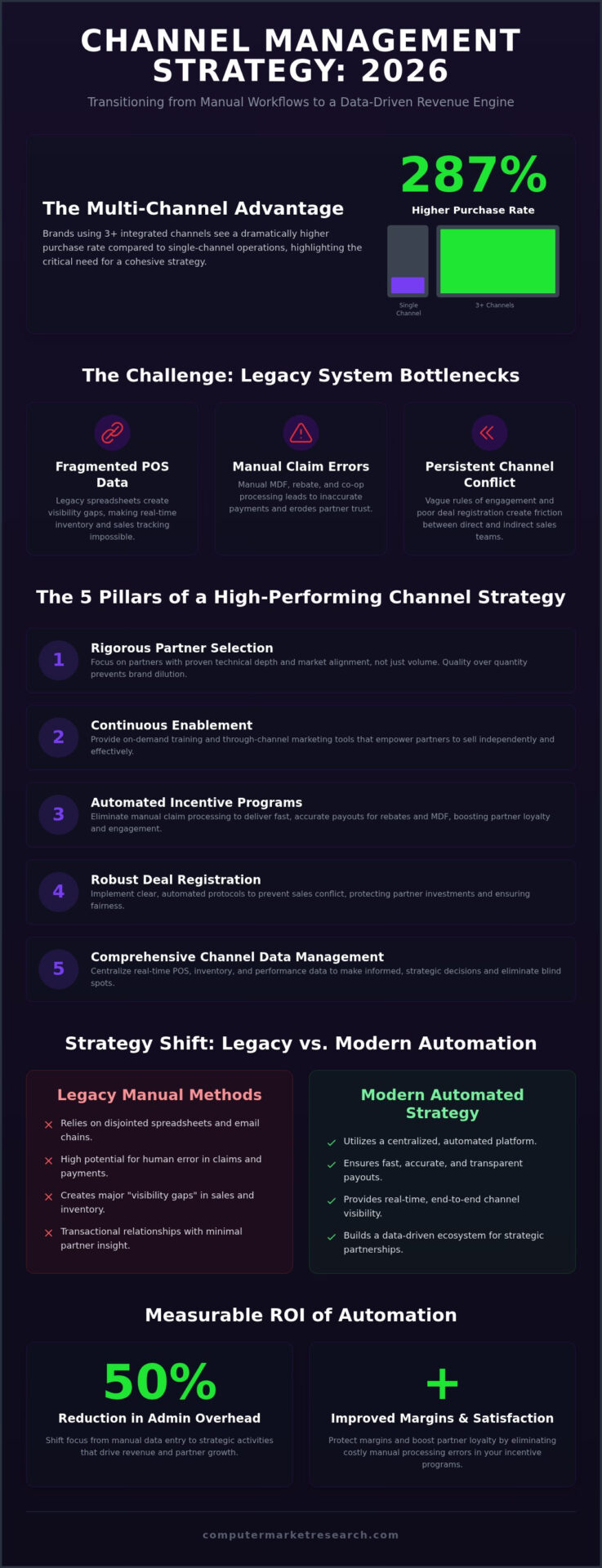
Did you know that brands utilizing three or more integrated channels achieve a 287% higher purchase rate than those relying on a single-channel model? While the opportunity for expansion is clear, executing a high-performance channel management strategy often feels impossible when you’re buried in manual workflows. You’ve likely experienced the frustration of fragmented POS data, manual MDF processing errors, and the persistent friction of channel conflict. Relying on legacy spreadsheets isn’t just inefficient; it’s a primary obstacle to growth in a market where 64% of buyers now prefer digital-first interactions.
Scaling indirect sales requires a transition to automated infrastructure that provides real-time visibility and operational control. In this 2026 guide, you’ll master a framework designed to eliminate administrative bottlenecks and drive measurable partner ROI. We’ll examine the shift toward data-driven enablement, showing you how to automate incentive workflows and streamline deal registration. This approach ensures your channel operations become a predictable engine for revenue rather than a source of technical debt. By the end of this discussion, you’ll have a clear roadmap for partner recruitment and modernized data collection.
Key Takeaways
- Transition from transactional relationships to a data-driven ecosystem by focusing on rigorous partner selection and continuous enablement.
- Eliminate the “visibility gap” in your channel management strategy by replacing legacy manual tracking with real-time POS and inventory data management.
- Protect margins and partner satisfaction by automating co-op/MDF, rebates, and ship & debit claims to prevent manual processing errors.
- Implement a scalable framework by conducting a thorough channel audit and establishing clear partner tiers supported by automated deal registration.
- Reduce administrative overhead by up to 50% through centralized automation, shifting the focus from manual data entry to strategic revenue growth.
What is a Channel Management Strategy in 2026?
A channel management strategy is a structured framework for identifying, recruiting, and managing third-party partners to maximize market reach and revenue. It serves as the blueprint for how a company delivers value to end customers through intermediaries. By 2026, this discipline has shifted from simple transactional relationships to complex, data-driven ecosystems. A comprehensive What is a Channel Partner? definition includes distributors, resellers, and systems integrators who act as extensions of your brand. Success in this field now requires a seamless flow of information that matches the physical flow of goods.
Alignment with corporate goals is the foundation of any successful program. If your indirect sales efforts don’t mirror your broader business objectives, you’ll face high error rates and lost revenue. Legacy manual processes often result in inaccurate rebate payments and mismanaged co-op funds, creating friction that drives partners away. Transitioning to a modernized system isn’t just about efficiency; it’s about reclaiming the revenue lost to operational blind spots.
To better understand how these programs function in a modern environment, watch this helpful video:
The Core Components of Modern Channel Strategy
Modern strategies prioritize precision over volume. Partner profiling has evolved from accepting any interested party to selecting the right partners who possess the technical capability to represent your brand. Operational transparency is equally critical. Real-time data regarding inventory levels and point-of-sale transactions is no longer optional for companies that want to remain competitive. Finally, scalability ensures your processes can handle 10,000 partners as easily as 100. Without automated workflows, your administrative team becomes a bottleneck that prevents the organization from reaching its full market potential.
Strategic Alignment vs. Operational Execution
Ensuring your channel management strategy doesn’t conflict with direct sales targets is a primary responsibility of leadership. Conflict arises when rules of engagement are vague or deal registration is handled through manual spreadsheets. The Channel Manager acts as a strategic orchestrator, balancing these interests to ensure a cohesive market presence. Managing this complexity requires robust channel sales management software that can orchestrate these moving parts without increasing headcount. Identifying legacy manual tracking as your primary bottleneck is the first step toward building a high-performing indirect sales engine.
The 5 Pillars of a High-Performing Channel Strategy
Building a resilient channel management strategy requires more than just a list of active partners. It demands a structured approach built on five foundational pillars that ensure every relationship is productive and measurable. When these pillars are ignored, programs quickly become unmanageable as they scale, leading to the administrative bottlenecks discussed in the previous section. A high-performing channel management strategy integrates the following elements into a single, cohesive workflow:
- Rigorous Partner Selection: You don’t need more partners; you need the right ones. Focus on those with the technical depth and market alignment to represent your brand effectively.
- Continuous Enablement: Move beyond basic training by providing through-channel marketing tools that empower partners to sell independently and consistently.
- Automated Incentive Programs: Remove the friction of manual claim processing to ensure fast, accurate payouts that drive partner loyalty.
- Robust Deal Registration: Implement clear protocols to prevent internal and external sales conflict, protecting the time and effort partners invest in your products.
- Comprehensive Channel Data Management (CDM): Establish Data-Driven Channel Management as the standard for all operational decisions to ensure total visibility.
Legacy programs often fail because they treat these pillars as independent silos. For example, CDM provides the data necessary to justify rigorous partner selection. Without this data, companies often fall into the trap of over-recruiting, which dilutes brand value and increases support costs without a corresponding rise in revenue.
Automating Incentives: MDF and Co-op Funds
Automation is the only way to close the ROI gap in incentive programs. When claims are processed manually, error rates climb and partner trust erodes. Marketing Development Funds are performance-based financial resources provided by vendors to help partners execute local marketing initiatives that drive mutual pipeline growth. Moving to real-time tracking through MDF management ensures that every dollar spent is tied to a specific sales outcome. This transition from manual spreadsheets to a centralized system provides the transparency needed to optimize global marketing spend and reward high-performing partners instantly.
Deal Registration: Eliminating Channel Conflict
Protecting partner margins is essential for encouraging proactive selling. A cloud-based deal registration system eliminates ambiguity by time-stamping entries and providing instant approval or rejection based on pre-defined rules. This creates a single source of truth when integrated with your CRM, ensuring that your direct sales team and partners aren’t competing for the same business. By automating this process, you reduce the time spent on dispute resolution and allow your channel managers to focus on strategic growth. If you’re ready to see how automation can transform your partner relationships, you can start with a 90-day trial to evaluate the impact on your operational efficiency.
Data-Driven Strategy vs. Legacy Manual Methods
Many enterprises operate in a persistent fog because they lack real-time visibility into their partners’ warehouses and sales activities. This “Visibility Gap” is a direct byproduct of relying on legacy manual methods, such as monthly spreadsheet submissions that are often outdated before they’re even opened. When your channel management strategy relies on stale information, you’re forced into a reactive stance, solving yesterday’s problems instead of anticipating tomorrow’s demand. Inaccurate ship & debit claims and overpaid rebates are common risks that drain profitability in manual environments. A foundational channel management strategy must prioritize data integrity to protect company margins from these avoidable leakages.
Centralized channel data management systems provide the necessary infrastructure to bridge this gap. By moving away from fragmented tracking, organizations can achieve a single source of truth that spans the entire partner ecosystem. This transition allows channel managers to shift their focus from verifying data accuracy to proactive channel optimization. High-quality information ensures that incentive programs are actually driving the desired behaviors rather than simply rewarding transactions that would have happened anyway.
The Critical Role of POS and Inventory Data
Normalizing disparate data formats from global distributors is a significant technical hurdle for growing companies. One partner might provide data via a modern API, while another still relies on legacy EDI or manual CSV uploads. Automated systems ingest these varied formats and standardize the information, providing clear inventory visibility across the network. This level of detail helps prevent costly stockouts that lead to lost sales and overstocking situations that tie up valuable capital. For a deeper technical look at how to master these insights, refer to our Channel Data Management Guide.
Ship & Debit: Automating Complex Financial Claims
The operational burden of manual ship & debit processing frequently leads to high dispute rates and partner dissatisfaction. When a distributor sells a product at a lower price to win a competitive bid, they expect a timely and accurate credit. If your validation process is manual, it’s prone to human error and significant delays. Implementing Ship and Debit Management Software reduces these disputes through automated validation against point-of-sale (POS) data. This ensures that credits are only issued for verified sales, protecting your bottom line from fraudulent or duplicate claim requests while accelerating the payout process for legitimate partners.
5 Steps to Implementing a Scalable Channel Strategy
A scalable channel management strategy requires a shift from reactive problem-solving to proactive ecosystem orchestration. For Fortune 500 and Global 2000 companies, this means replacing manual intervention with automated governance across five distinct stages. Without a structured roadmap, increasing your partner count simply increases your administrative burden. By following a disciplined implementation process, you can ensure that growth leads to higher revenue rather than higher overhead.
- Step 1: Conduct a comprehensive channel audit to identify high-potential partners vs. those who are underperforming.
- Step 2: Define clear partner tiers and incentive structures that reward growth and loyalty.
- Step 3: Deploy a centralized PartnerPortal™ to serve as the hub for all partner interactions.
- Step 4: Automate the collection of POS, inventory, and financial claims data.
- Step 5: Use real-time insights to measure, refine, and optimize your total channel ROI.
Step 1 & 2: Building the Foundation
You can’t fix what you can’t see. Successful implementation begins with a rigorous partner gap analysis to differentiate between partners who are driving volume and those who are merely occupying a slot in your directory. Once you’ve identified your top performers, create a recruitment package that specifically attracts Tier 1 partners by highlighting your ease of doing business. This foundation ensures that your channel management strategy is built on high-quality relationships rather than just high quantity. For a deeper look at these foundational concepts, our What is Channel Management? guide provides a detailed breakdown of the 2026 landscape.
Step 3 & 4: Technology and Automation
To support the intensive research and documentation needed for these partner analyses, Clarami offers an intelligent workspace designed to help professionals and researchers organize their findings and streamline the writing of high-level strategic reports.
Many organizations attempt to manage partners using a generic CRM, but these systems are built for direct sales and lack the nuance required for indirect ecosystems. A dedicated partner relationship management system is necessary to handle the complexities of multi-tier distribution. This technology allows you to automate the cleansing of partner POS data, which is often submitted in disparate, “un-automatable” formats. Modern channel operations can’t survive on legacy spreadsheets; a cloud-based portal is the mandatory central nervous system for any organization seeking to scale. By centralizing these operations, you eliminate the manual bottlenecks that typically stall expansion efforts.
Ready to modernize your partner infrastructure? Claim your 90-day free trial of our PartnerPortal™ platform today and start automating your channel workflows.
Maximizing ROI with Automated Channel Management
Implementing a modern channel management strategy is a transition from viewing channel operations as a cost center to treating it as a high-yield revenue engine. Automation plays the central role in this shift. Industry benchmarks suggest that automating manual workflows can reduce administrative overhead by up to 50%. This efficiency gain allows your operations team to redirect their focus from data entry and claim verification to strategic partner enablement. Real-time visibility into global marketing spend ensures that resources are allocated based on current performance rather than historical assumptions.
Partner satisfaction is a critical, often overlooked component of ROI. When rebate payouts and incentive claims are processed within days instead of weeks, partner loyalty increases. Computer Market Research’s PartnerPortal™ provides the specialized infrastructure Global 2000 companies need to maintain this speed at scale. By centralizing these workflows, you eliminate the friction that typically causes top-tier partners to prioritize other vendors. Reliable systems build trust, and in the indirect sales world, trust is a primary driver of long-term profitability.
Measuring What Matters: Channel KPIs
To determine the effectiveness of your channel management strategy, you must track metrics that reflect both operational health and market impact. Lead conversion rates through the partner pipeline provide the most direct evidence of enablement success. Additionally, calculating the ROI of Market Development Funds (MDF) allows you to identify which marketing initiatives actually drive pipeline growth. Inventory turnover rates serve as a final measure of channel health, signaling whether your product is moving through the ecosystem or stagnating in a warehouse.
The Future of Channel Management: AI and Beyond
The next evolution of channel operations involves shifting from reactive data collection to predictive orchestration. Predictive analytics now allow for sophisticated channel inventory forecasting, helping vendors anticipate demand surges before they occur. AI-driven partner matching and recruitment also enable brands to identify potential partners whose capabilities perfectly align with specific product lines or geographic targets. These advancements ensure your infrastructure remains resilient in an increasingly complex B2B environment. To ensure your organization is equipped for these changes, you should Partner Smarter with Computer Market Research to modernize your indirect sales operations.
Modernizing Your Path to Market Expansion
Integrating a robust channel management strategy is no longer a matter of preference; it’s a requirement for organizations aiming to scale without proportional increases in administrative debt. By prioritizing data transparency and replacing legacy manual tracking with automated workflows, you secure a single source of truth that spans your entire global ecosystem. This shift ensures that your incentive programs, from co-op funds to complex rebates, actually drive the partner behaviors necessary for sustained growth. Precision in data collection isn’t just a technical goal; it’s the foundation of a trust-based relationship with your distributors and resellers.
Since 1984, Computer Market Research has empowered Fortune 500 and Global 2000 companies to navigate these complexities with quiet confidence. Our cloud-based SaaS platform provides a comprehensive suite for managing MDF, rebates, and POS data, ensuring global scalability and technical precision. It’s time to move beyond the limitations of fragmented spreadsheets and reclaim your operational focus. You don’t have to manage these relationships in the dark. Streamline your channel operations with PartnerPortal™ and start driving measurable partner ROI today. Your roadmap to a more efficient, data-driven future is ready when you are.
Frequently Asked Questions
What is the difference between channel management and sales management?
Sales management focuses on the performance and activities of an internal team selling directly to customers. In contrast, channel management involves coordinating third-party intermediaries to reach the market. It requires managing complex external relationships where you don’t have direct authority over the sales reps. A successful channel management strategy prioritizes partner enablement and standardized data exchange to ensure these external entities represent your brand with technical precision.
How do I prevent channel conflict between partners and my direct sales team?
Preventing conflict requires transparent rules of engagement and automated deal registration. By providing partners with a way to register opportunities early, you protect their time and margins from internal competition. This system creates a single source of truth that alerts both teams to potential overlaps. Clear geographical or account-based boundaries also help maintain order. Automation ensures these rules are applied consistently, reducing the friction that often erodes partner trust.
What are the key features to look for in channel management software?
Look for a comprehensive suite that centralizes co-op/MDF management, automated rebates, and deal registration. The software must handle POS data management by cleansing and normalizing disparate formats from global partners. Scalability is essential for Global 2000 companies, so a cloud-based SaaS platform like PartnerPortal™ is ideal. Ensure the system provides real-time visibility into inventory levels and claims processing to eliminate the administrative bottlenecks associated with legacy manual methods.
How can a channel management strategy improve partner engagement?
A robust channel management strategy improves engagement by reducing the administrative burden on your partners. When you provide streamlined tools for deal registration and lead management, you become easier to do business with than your competitors. Fast, accurate incentive payouts and transparent co-op fund tracking also build long-term loyalty. Partners prioritize vendors who provide clear visibility into their performance and reward their contributions without the frustration of manual processing errors or delays.
What is the best way to track Market Development Funds (MDF)?
The most effective way to track MDF is through an automated management platform that ties fund allocation directly to specific sales outcomes. Manual spreadsheets often lead to unspent funds or untracked ROI. By centralizing claim submissions and approvals, you can monitor fund utilization in real time. This allows you to identify which marketing initiatives drive the most pipeline growth. Automation ensures that co-op funds are utilized strategically rather than being treated as generic discounts.
How does automated POS data management improve channel ROI?
Automated POS data management improves ROI by eliminating the visibility gap in your supply chain. When you receive cleansed, normalized sales data, you can prevent costly stockouts and overstocking. This transparency also ensures that rebates and ship & debit credits are only issued for verified transactions. By reducing overpayments and administrative overhead, you protect your margins. Real-time data allows for more accurate demand forecasting, which optimizes production and marketing spend across the network.
Can I integrate a channel management system with my existing CRM?
Yes, integrating your channel management system with your CRM is a best practice for maintaining a unified view of your sales pipeline. While your CRM manages direct relationships, a specialized partner portal handles the unique complexities of indirect sales. Integration ensures that registered deals and lead assignments flow seamlessly between systems. This prevents data silos and gives leadership a holistic view of total market performance. It also streamlines the hand-off between direct and indirect teams.
What are the risks of using spreadsheets for channel management?
Spreadsheets introduce significant risks, including high human error rates and a lack of real-time visibility. Data in a spreadsheet is often stale by the time it’s reviewed, leading to reactive decision-making. You also face a higher risk of incentive fraud and duplicate rebate claims without automated validation. For growing organizations, the administrative cost of manually cleansing partner data becomes a primary obstacle to growth. Spreadsheets simply can’t scale to meet modern requirements.

Article by
Del Heles
Del Heles is the founder and CEO of Computer Market Research (CMR), a channel management software company he launched in 1984. With more than 40 years of experience, he’s known for helping manufacturers and distributors simplify complex partner programs through practical, customer-focused technology solutions.