

What turns a compliance review from a document chase into a clear decision process? A channel compliance audit checklist brings the work into a consistent sequence: define the scope and criteria, assign responsibilities, gather and assess evidence, record findings, and track corrective actions. Tailor the checklist to the requirements and risks relevant to the organization and its channel relationships.
A checklist can make reviews more consistent, but only when each item has clear ownership and supporting documentation. Organize policies, transaction records, partner information, and control evidence so reviewers can see what was assessed and where follow-up is needed.
This guide explains what to include, how to assign responsibilities, and how to review documentation without losing sight of the audit’s purpose. It also covers how to record findings and communicate their impact and next steps to leadership, so the review supports decisions rather than becoming a disconnected list of issues.
Key Takeaways
- Set a documentation review cadence that responds to changes in systems, vendors, and applicable requirements.
- Define the audit’s scope around relevant obligations, channel processes, and risk areas before gathering evidence.
- Assign clear ownership for evidence collection, control review, and incident response across teams.
- Translate findings into prioritized actions so leadership can see exposure, accountability, and progress.
- Use structured channel data management to support more consistent reviews of partner activity, deals, and incentives.
How often should compliance documentation be reviewed?
Review compliance documentation on a regular schedule, often annually, and whenever systems, vendors, or applicable requirements change. A new partner-data workflow, platform integration, or revised policy can make existing evidence incomplete. Assign an owner to each review trigger, record the date, and update the audit calendar so changes are addressed before the next scheduled cycle.
Use risk to set the depth and timing of each review. For example, a process involving sensitive information may need closer monitoring than a stable administrative procedure. Compare current policies with actual practices, then document gaps, owners, and remediation steps. The NIST Cybersecurity Framework 2.0 includes a Govern function covering cybersecurity risk strategy, expectations, and policy, according to the National Institute of Standards and Technology.
Administrative safeguards need evidence, not just policy titles. Keep approved policies, access procedures, role assignments, training records, and incident-response procedures together. The Fair Labor Standards Act (FLSA) of 1938 establishes U.S. standards for minimum wage, overtime compensation, hours worked, and recordkeeping, according to the U.S. Department of Labor. Where those records apply, include the relevant timekeeping and recordkeeping procedures in the review scope.
Prepare documents in a repeatable sequence. First, identify the regulation, contractual obligation, or internal control under review. Then gather the current policy, supporting records, prior findings, and evidence that controls operate as described. According to the U.S. Department of Health and Human Services, HIPAA audits assess whether healthcare providers, health plans, and other entities comply with privacy and security rules protecting patient information.
Control document versions by recording an owner, approval status, effective date, and revision history. Remove obsolete copies from active workspaces while preserving records under the organization’s retention schedule. Clearly distinguish draft policies from approved policies so reviewers can identify which procedures are formally in force.
Schedule reviews of training records, too. Match completion evidence to the policy or procedure taught, and record follow-up when staff need additional instruction. When a process changes, update its materials and assign training to affected roles. These steps help show whether employees received relevant guidance and whether documentation reflects current operations.
For a channel compliance audit checklist, connect each review item to its evidence, owner, and next review trigger. GDPR non-compliance can result in fines of up to 4% of annual global turnover, according to the European Union. That makes requirement tracking and documented updates important parts of a disciplined review process.
What Is a Compliance Audit Checklist?
A channel compliance audit checklist is a structured set of questions and evidence requests for assessing whether an organization follows applicable requirements. It turns obligations into reviewable items, such as whether a partner agreement is current, sales records support reported transactions, or a required approval is documented. Each item should identify the control being tested and the evidence that can demonstrate how it works.
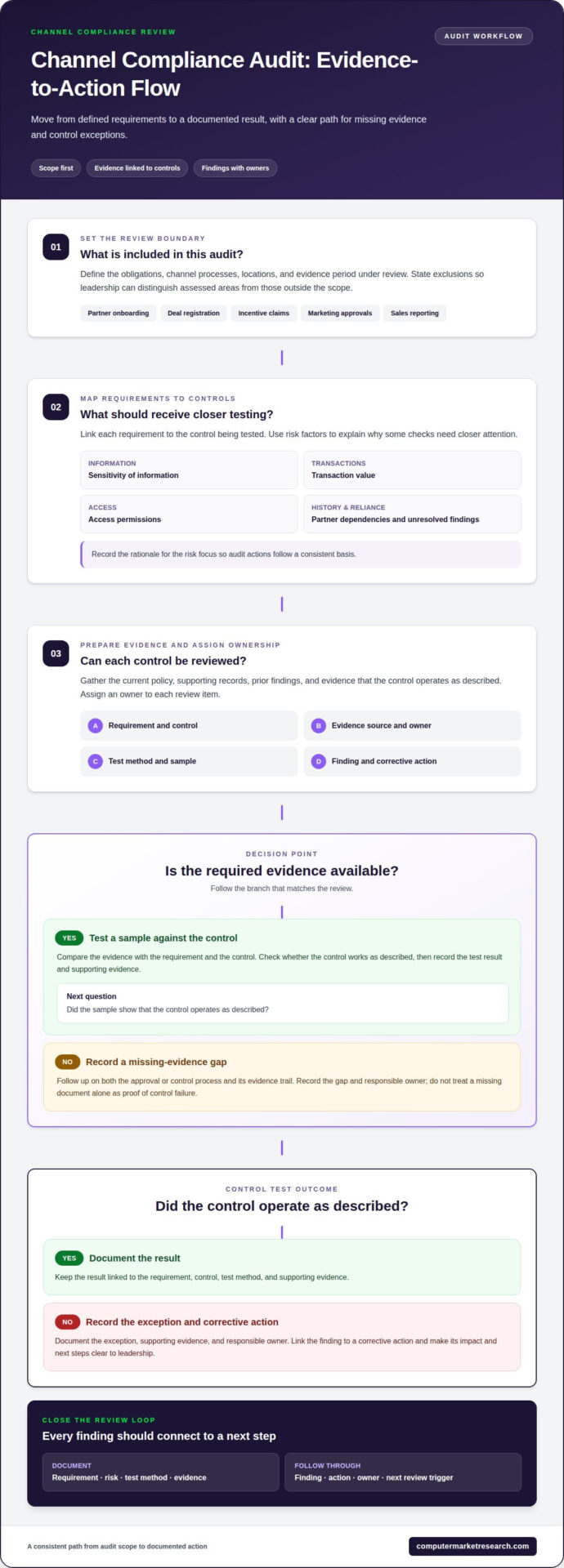
Define what the audit covers, which locations or business processes are included, and the period represented by the evidence. For a channel review, the scope might include partner onboarding, deal registration, incentive claims, marketing approvals, and sales reporting. State exclusions as well, so leadership can distinguish reviewed areas from processes outside the assessment.
Applicable requirements depend on the organization’s activities, contracts, markets, and data practices. A review might map internal procedures to contractual terms, privacy obligations, or financial controls, and record the source for each requirement. For example, an organization handling personal data connected to EU residents may assess relevant GDPR controls, while a financial reporting review may consider SOX requirements.
Use risk factors to determine which controls deserve closer testing. Assess information sensitivity, transaction value, access permissions, partner dependencies, and the history of unresolved findings. A partner with access to confidential customer information may warrant different evidence checks from a partner using approved public marketing materials. Record the rationale so audit actions follow a consistent risk basis.
To audit partner sales practices, marketing claims, and brand use, compare partner agreements and approved materials with sampled sales records, campaign assets, and public claims. Document exceptions, supporting evidence, and the responsible owner. Examples include an unapproved product claim or outdated brand artwork.
During the audit, reviewers can follow a defined sequence: confirm objectives, map each requirement to a control, identify evidence sources, test a sample, and record results. Procedures should distinguish a missing document from a control failure. For instance, a missing approval record calls for follow-up on both the approval process and its evidence trail.
A useful checklist links every requirement to its risk, test method, evidence, finding, and corrective action. That structure helps organizations see why an issue matters and what action addresses it. For channel workflows, explore structured partner workflow management as a way to bring related information into a more consistent process.
Auditor roles and responsibilities
Assign audit responsibilities before evidence collection begins. Internal audit teams can coordinate the review, define test procedures, and document results. External auditors or specialized compliance professionals may conduct the assessment, while regulatory teams provide records and process context. Clear ownership helps prevent unanswered requests and duplicate testing.
Separate the work into defined roles. The audit lead sets objectives, scope, and timelines; control owners explain how procedures operate; evidence coordinators collect records; and reviewers test whether evidence supports each control. For example, a channel operations owner can explain deal registration approvals, while finance supplies transaction records. The auditor records the conclusion and supporting evidence.
A shared responsibility matrix makes handoffs visible. List each control or process, the accountable owner, supporting teams, evidence location, and escalation contact. For partner onboarding, the matrix might assign operations to maintain approval records, IT to manage system access, and legal to interpret contract terms. Assignments vary by program, so document the actual workflow rather than assuming every department has the same duties.
Include service providers in the matrix when they handle systems, transactions, or sensitive information. PCI DSS guidance says organizations remain responsible for overseeing service providers and monitoring each provider’s PCI DSS compliance status. Assign an internal owner to track provider evidence, review status changes, and record unresolved gaps. A contract alone does not demonstrate ongoing oversight.
Assign clear owners for incident and breach response. Identify who receives reports, preserves relevant records, assesses operational impact, coordinates response steps, and informs leadership. For a suspected exposure involving partner data, the response path should identify the system owner, security contact, channel operations lead, and decision-maker. Record incident timelines and actions in a consistent case file.
Auditors should assess whether these responsibilities work in practice. Trace a sample incident from its initial report through investigation, decisions, and closure, and compare timestamps and records across teams. If an alert has no assigned owner, document the accountability gap and its effect on response coordination. This test connects governance documents to operational behavior.
Frontline staff can identify process gaps that policy owners may miss. Interview relevant employees about partner approvals, marketing reviews, or data handoffs. Distinguish staff observations from verified evidence, then validate material findings against system records or approved procedures. This keeps conclusions grounded and helps leadership assign corrective actions to the right owners.
Communicating audit findings to leadership
Channel compliance violations can lead to financial penalties, legal action, reputational damage, or loss of business licenses. Consequences depend on the requirement breached and the circumstances. Remediation should identify the cause, assign an accountable owner, set a corrective action, and track evidence that the fix works.
Begin the leadership report with the audit scope, review period, and overall conclusion. Then summarize significant findings, affected processes, supporting evidence, and decisions needed. For example, if partner claims lack approval records, state which process was sampled, what documentation was missing, and who must address the control gap.
Assess each finding by its potential impact, likelihood of recurrence, and reach across channel operations. A missing record in one transaction differs from a repeated approval failure across partner claims. Explain the distinction with evidence, such as sampled files, system logs, or documented procedures, rather than relying on labels like “high risk” without context.
Common findings include incomplete partner files, outdated procedures, inconsistent approval trails, and overdue corrective actions. Prevent recurrence by identifying why each issue occurred. If staff use an obsolete form, update the controlled template and remove superseded copies. If approvals are routinely absent, clarify the workflow and monitor completed records.
Track corrective actions in a table listing the finding, root cause, owner, due date, status, and closure evidence. This format helps leadership distinguish immediate containment from longer-term process changes. For example, restrict an incorrect claim while the responsible team corrects the underlying review procedure and documents its approval.
Include unresolved issues and external dependencies in the report. If a service provider controls relevant data, state which evidence remains outstanding, who owns follow-up, and what decision leadership must make. PCI DSS oversight responsibilities, for example, make provider status relevant to organizations monitoring service-provider compliance.
Close with a concise decision summary: actions completed, resources or approvals needed, and the next monitoring point. Keep supporting evidence available for audit follow-up, including records showing that corrective actions were completed effectively. Documenting even minor issues can reveal recurring patterns and help leadership plan prevention across teams.
Compliance audit checklist
Use this checklist to conduct a channel review from documented requirements through corrective actions. For every test, record the requirement, evidence examined, result, owner, and follow-up date. This structure creates accountability and makes ongoing monitoring easier to maintain.
To check partner pricing, discount, and promotion compliance, compare approved price lists and campaign terms with sampled quotes, invoices, and claims. Record each variance, its approval status, and the policy that governs it.
Audit reseller and distributor compliance through a repeatable sequence: define the scope, select partners and transactions, gather records, test controls, document exceptions, and assign remediation. For example, trace a registered deal from submission through approval to its final sales record.
Assess channel partner data privacy and cybersecurity by reviewing access permissions, data-handling procedures, security policies, incident plans, and relevant testing reports. Compare documented controls with observed system access, and record gaps for accountable owners.
- Confirm scope and requirements. Identify covered partners, processes, agreements, and applicable obligations before testing begins.
- Map each requirement to a control. Link a contract term or internal policy to the procedure and evidence that demonstrate compliance.
- Test partner authorization. Compare active reseller records with current agreements and approved territories to identify mismatches.
- Trace financial activity. Match selected transactions to approved discounts, promotions, deal records, and supporting documentation.
- Review marketing and brand controls. Compare partner campaign materials with approved claims and current brand assets, then record exceptions.
- Examine data access. Compare partner roles with system permissions and documented approval records to identify excessive or outdated access.
- Validate provider oversight. Record service-provider status, evidence reviewed, and the internal owner responsible for follow-up.
- Document each finding. Capture evidence, impact, root cause, action owner, due date, and closure criteria in a controlled record.
- Track remediation and monitoring. Re-test completed actions and preserve evidence showing whether the corrective control operates as intended.
Software can centralize partner records, approvals, and review evidence, reducing dependence on scattered files. A structured workflow also helps teams connect a failed test to its owner and follow-up. Explore a structured partner-management workflow to support clearer audit trails.
Computer Market Research
Computer Market Research can help when channel reviews expose fragmented partner records, deal activity, or incentive data. Its channel management software centralizes information connected to partner workflows, helping organizations maintain visibility across processes that support indirect sales and marketing. This is useful when manual tracking makes it difficult to locate consistent records or connect activity with supporting documentation.
PartnerPortal™ centralizes partner onboarding, deal registration, and performance tracking. These workflows give teams an organized view of partner information and activity. When an audit examines whether a deal was registered and tracked through the appropriate process, centralized records help teams locate relevant information and understand how the workflow operates.
Computer Market Research offers Co-op/MDF Management and Rebates & Incentives for administering channel program funds, claims, and incentive records. When a review identifies disconnected records across program administration, sales, and finance, structured management of these workflows can support clearer operational visibility.
Deal Registration supports reviews of how partner-submitted opportunities are recorded and tracked. A consistent process helps teams follow deal information through its workflow and connect records to the relevant partner activity. It does not replace an organization’s audit criteria, but supports the channel operations and data processes those criteria examine.
Consider Computer Market Research when recurring review work depends on spreadsheets, scattered files, or manual handoffs across channel teams. Its cloud-based SaaS solutions are designed to automate and streamline channel management for global enterprises. The fit depends on the workflows being administered, such as partner onboarding, registered deals, co-op or MDF funds, and incentive programs.
Use audit findings to identify where channel information needs more consistent administration. Repeated gaps in partner records may point to a workflow issue, while disconnected deal information may make activity harder to trace. A platform built for channel management can help teams organize these records and improve data visibility.
If your review points to a need for more structured channel data and workflows, contact Computer Market Research to discuss your requirements.
Put Your Review Process Into Motion
A useful channel compliance audit checklist should be part of ongoing channel operations, not a document opened only before a review. Assign a clear owner to each follow-up, connect findings to operational decisions, and use recurring reviews to keep responsibilities visible as partner workflows evolve. This makes audit work an ongoing management practice rather than a disconnected exercise.
Start by identifying where fragmented records or manual handoffs make partner activity harder to track. A structured channel management approach can help organize the data and workflows behind those reviews. Computer Market Research supports channel management through solutions designed for partner and incentive processes.
Move forward by aligning your review priorities with the channel workflows that need clearer oversight. Explore the next step with Computer Market Research, and keep building a review process that supports informed decisions and stronger accountability.
Frequently Asked Questions
What is a channel compliance audit?
A channel compliance audit evaluates whether partner-related activities follow the organization’s applicable requirements and documented controls. It can examine how a reseller is approved, how sales transactions are recorded, or how marketing materials are authorized. The review should distinguish between a control that exists on paper and one that is consistently followed. Its scope depends on the organization’s channel model, relevant obligations, and risk areas.
What should a channel compliance audit checklist include?
Include the requirement being tested, the channel process it affects, the evidence needed, the test method, and a place to record the result. For example, a discount review can compare an approved promotion with selected quotes and invoices. Add an owner and follow-up status for exceptions. This structure helps reviewers distinguish a missing record from a process that failed to operate as intended.
What records and documents should be reviewed in a channel audit?
Review partner agreements, onboarding records, approval histories, sales transactions, promotion terms, and marketing materials relevant to the audit scope. For data or security reviews, include access records, privacy and security procedures, incident response plans, and applicable third-party agreements. The evidence needed depends on the control being tested. Match each document to its owner and the partner activity it supports.
What U.S. laws and regulations apply to channel partners and resellers?
Applicable requirements depend on the organization’s activities, information, and contractual relationships. Examples include the Fair Labor Standards Act for relevant wage, overtime, hours-worked, and recordkeeping practices; HIPAA for covered healthcare entities handling protected patient information; and SOX for applicable financial controls. Workplace health and safety requirements may also matter. A partner review should identify which obligations apply to the specific process, rather than assume every rule covers every reseller.
What are common channel compliance risks and red flags?
Watch for unexplained pricing differences, promotions without clear approval, incomplete partner files, inconsistent sales records, and marketing claims that differ from approved materials. For example, a reseller’s invoice may show a discount that doesn’t match the promotion terms. Repeated manual corrections or unresolved exceptions can signal weak process controls. Assess each issue against its evidence, potential impact, and recurrence before assigning corrective action.
How often should channel compliance audits be conducted?
Set a predictable audit schedule, then add reviews when material changes affect channel operations. Examples include introducing a new partner workflow, changing a data system, revising an agreement, or responding to a control failure. Organizations commonly conduct compliance audits annually or bi-annually, while higher-risk environments may need more frequent reviews. Align timing with applicable requirements and the pace of operational change.

Article by
Del Heles
Del Heles is the founder and CEO of Computer Market Research (CMR), a channel management software company he launched in 1984. With more than 40 years of experience, he’s known for helping manufacturers and distributors simplify complex partner programs through practical, customer-focused technology solutions.