

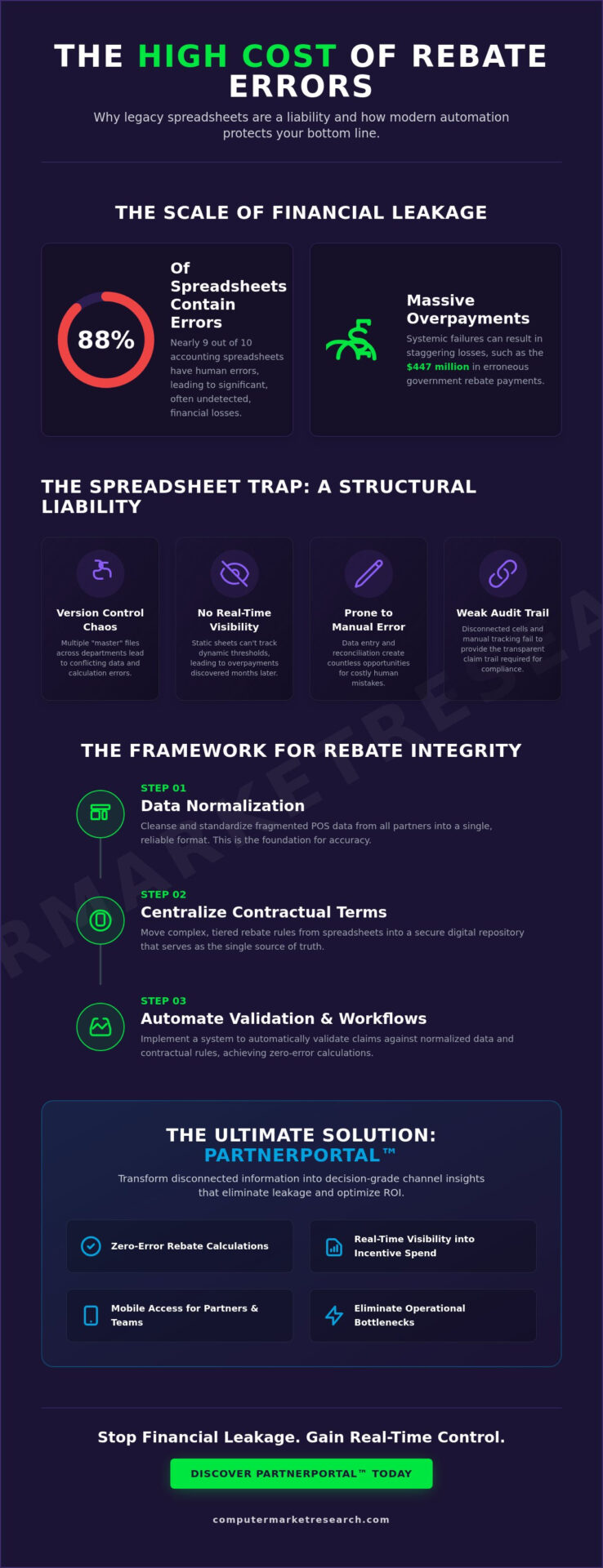
Nearly 88% of accounting spreadsheets contain human errors, a statistic that explains why so many organizations face massive financial leakage every year. In early 2025, even the federal government saw over $447 million in erroneous rebate payments issued due to eligibility verification failures. For channel leaders, avoiding overpayments in rebate programs is no longer a matter of simple math. It is a challenge of infrastructure. You likely struggle with fragmented POS data from multiple partners and the persistent anxiety of a manual audit trail that lacks transparency.
We understand that legacy processes and manual tracking are the primary obstacles to your operational growth. This strategic guide provides a clear path out of these bottlenecks by introducing data-driven validation and automated workflows. You will learn how to identify and eliminate leakage, achieve zero-error rebate calculations, and gain real-time visibility into your incentive spend. We will explore how modernizing your POS data management and utilizing tools like PartnerPortal™ can transform disconnected information into decision-grade channel insights that protect your bottom line.
Key Takeaways
- Define the financial impact of “invisible” margin erosion and learn how to quantify incentive payouts that exceed your contractual agreements.
- Identify the structural limitations of legacy spreadsheets that lead to version control failures and calculation errors in complex, tiered rebate programs.
- Implement a strategic framework for avoiding overpayments in rebate programs by utilizing data normalization as a prerequisite for financial accuracy.
- Follow a structured roadmap to conduct a leakage audit and centralize your contractual terms within a secure digital repository.
- Discover how the modular infrastructure of PartnerPortal™ provides the visibility needed to eliminate operational bottlenecks and optimize channel ROI.
The Financial Impact of Rebate Overpayments in 2026
A rebate overpayment is any incentive payout that exceeds the specific terms of a contractual agreement. While the definition is straightforward, the operational reality is a complex web of miscalculations that drain corporate resources. Understanding what is a rebate in a modern B2B context requires looking beyond the discount to the data infrastructure supporting it. For many global enterprises, “invisible” margin erosion occurs through cumulative 1-2% calculation errors. These small discrepancies might seem negligible in isolation, but across a high-volume channel, they represent millions in lost capital.
This risk is especially acute in Ship & Debit programs. When distributors claim credits based on outdated price lists or inaccurate inventory levels, the financial leakage accelerates. Avoiding overpayments in rebate programs requires a level of precision that manual systems cannot sustain. When payouts are inflated, your channel partner performance metrics become distorted. You aren’t seeing true market growth; you’re seeing the results of accounting failures. This lack of accuracy also introduces significant risks regarding non-compliance with financial regulations like the Sarbanes-Oxley (SOX) Act, where transparent claim trails are a legal necessity.
To better understand how systemic overpayments can impact large-scale financial systems, watch this helpful video:
The Hidden Costs of Manual Claims Processing
The drain on your organization isn’t limited to the overpaid dollars. Manual reconciliation requires hundreds of labor hours from skilled analysts who should be focused on strategic growth. Instead, they’re trapped in a cycle of data entry and dispute management. When an error is finally identified, the resulting “clawback” process creates significant awkwardness with valued partners. It’s difficult to maintain a position of authority when you’re constantly requesting funds back due to internal processing bottlenecks.
Fraud vs. Error: Identifying the Source of Leakage
Distinguishing between unintentional errors and deliberate claim inflation is critical for long-term program health. Unintentional errors often stem from fragmented POS data or complex tiered structures that manual spreadsheets can’t track. However, deliberate fraud can consume up to 13% of program budgets in some industry segments. A lack of transparency often encourages “gray market” behavior, where products are diverted to unauthorized regions to trigger higher incentives. While legitimate platforms like CommercePal provide a structured environment for sales, unauthorized diversion remains a major risk. Avoiding overpayments in rebate programs means closing these visibility gaps before they become systemic liabilities.
Structural Failures: Why Spreadsheets Fail Global Enterprises
Static spreadsheets are fundamentally incapable of managing the multi-layered logic of 2026 incentive programs. While a manual sheet might suffice for a simple flat-rate rebate, it collapses under the weight of dynamic, tiered structures that depend on real-time volume thresholds and complex eligibility windows. Version control becomes a recurring nightmare when Finance, Sales, and Operations each maintain their own “master” file. This fragmentation is a primary driver of budget overruns, as the lack of real-time visibility means overpayments are often discovered months after the capital has left the building. Navigating Rebate Compliance in this environment is nearly impossible without a centralized data structure that can withstand a rigorous audit.
The reliance on manual tracking isn’t just an efficiency issue; it’s a structural liability. When data is trapped in disconnected cells, it can’t be cross-referenced against actual POS data or inventory levels. This creates a vacuum where errors thrive. Avoiding overpayments in rebate programs requires a system that moves at the speed of your transactions, not the speed of a manual data entry clerk. For global enterprises, the “spreadsheet trap” represents a significant barrier to scaling incentive programs effectively without sacrificing margin integrity.
The ERP Gap: Why Your Current System Isn’t Enough
ERP systems are the backbone of corporate accounting, yet they frequently fail to ingest and normalize diverse partner POS data. Most standard ERPs struggle with the “many-to-one” data relationship inherent in channel sales, where a single SKU might be sold through hundreds of different partners with unique pricing agreements. Without specialized Ship & Debit modules, organizations often resort to custom ERP coding. This creates technical debt and a rigid infrastructure that cannot adapt to changing market conditions or new partner incentives. This rigidity makes the goal of avoiding overpayments in rebate programs increasingly difficult to achieve as your partner network expands.
Data Silos and Cross-Functional Misalignment
Friction between departments is an inevitable byproduct of disconnected data. Sales teams prioritize rapid payouts to maintain partner loyalty, while Finance teams prioritize accuracy to protect margins. When these departments operate in silos, there is no “single version of truth” for channel ROI. This misalignment leads to delayed data that compromises end-of-quarter financial reporting and forces leadership to make decisions based on outdated information. Transitioning to a unified platform is the only way to ensure that incentive spend translates into actual performance. For organizations seeking to modernize their infrastructure, exploring automated channel management solutions is a logical first step toward regaining financial control.
A Framework for Eliminating Financial Leakage
Eliminating leakage requires more than just better oversight; it demands a fundamental shift in how data is processed. Accuracy is impossible without data normalization, the process of cleansing and standardizing fragmented reports from diverse partners. When you move beyond manual review, you create a system capable of validating every claim against current contractual price lists and actual inventory levels in real time. This level of precision is the only reliable method for avoiding overpayments in rebate programs while maintaining the speed required by modern business. By transforming raw data into decision-grade insights, organizations can stop reacting to errors and start proactively managing their incentive budgets.
Real-time inventory tracking is a critical component of this framework. It prevents “double-dipping,” where a partner might claim multiple incentives for the same unit of sale across different programs. By cross-referencing sales reports with inventory movement, automated systems flag discrepancies before they become financial losses. When a claim is rejected, automated dispute workflows provide a transparent trail of evidence, significantly reducing the friction often associated with manual rejections. This systematic approach ensures that your financial integrity is protected without damaging the critical relationships you have built with your channel partners.
POS Data Normalization: The Foundation of Accuracy
POS data normalization involves cleansing, deduplicating, and standardizing partner reports into a single, usable format. This technical discipline is the core of effective channel data management. It allows you to identify duplicate claims submitted by different partners for the same end-customer sale, a common occurrence in multi-tier distribution networks. Automated cleansing also filters out invalid sales, such as internal transfers, test transactions, or returns, which are primary sources of financial leakage in manual systems. Without this foundation, any validation process is built on flawed information that inevitably leads to overpayment.
Automated Ship & Debit Validation
Ship & Debit claims are notoriously complex in high-velocity industries where pricing and eligibility change daily. Automation handles this complexity by validating every claim against specific deal registrations, pre-approved price protections, and verified inventory positions. Instead of the traditional 30-day reconciliation cycle that leaves capital in limbo, automated systems allow for immediate claim approval or rejection. This speed builds trust with partners while ensuring that every dollar paid out is backed by verified data. Avoiding overpayments in rebate programs becomes a byproduct of a well-engineered system rather than a constant administrative burden for your finance team.
Roadmap to Rebate Integrity: Implementation Steps
Transitioning from the “spreadsheet trap” to a modernized infrastructure requires a structured, sequential approach. It begins with a rigorous leakage audit to identify where existing overpayments are occurring. By comparing historical claims against actual sell-through records, you can pinpoint the specific patterns, such as duplicate claims or incorrect pricing tiers, that lead to financial loss. This process quantifies your “error rate,” providing the evidence needed to build a business case for automation. Centralizing your contractual terms in a digital repository is the next logical step. By eliminating the ambiguity of physical documents or fragmented emails, you ensure that every incentive payout is anchored to a definitive, searchable agreement.
Standardizing the POS reporting format for all channel partners is critical for long-term success. When data arrives in a uniform structure, the need for manual cleansing is removed, allowing your team to focus on strategic analysis. Integrating this data flow with your existing CRM and ERP systems creates a unified ecosystem where financial tracking is automated and accurate. This connectivity is a fundamental requirement for avoiding overpayments in rebate programs, as it ensures that every transaction is validated against the latest pricing and inventory data without human intervention. To see how these modules work together, you can schedule a demonstration of our Rebates & Incentives solutions.
Step 1: The Incentive Audit and Baseline
Before implementing new systems, you must understand the depth of your existing financial leakage. This audit involves comparing historical claims to actual sell-through data to pinpoint exactly where overpayments occurred. By quantifying this error rate, you create a baseline to measure the performance of your future automated workflows. Maximizing channel ROI requires this clear understanding of your current financial position to ensure that every marketing dollar contributes to genuine growth rather than covering for operational errors.
Step 2: Partner Onboarding and Portal Deployment
Deploying a partner portal is a transformative step that shifts the data entry burden from your internal team to the partners themselves. This transition requires thorough training to ensure that partners understand how to submit data according to your new standardized formats. When partners have a dedicated space for self-service claim submission and tracking, the volume of status-related inquiries drops significantly. This transparency builds trust, as partners can see the real-time status of their incentives while you maintain total control over the validation process. Avoiding overpayments in rebate programs becomes a natural outcome of a system that prevents the submission of non-compliant claims at the source.
Optimizing Channel ROI with CMR’s PartnerPortal™
CMR’s PartnerPortal™ serves as the definitive infrastructure for global enterprise channel management. It replaces the fragmented, error-prone manual methods described earlier with a unified, cloud-based platform. By adopting a modular approach, your organization can select specific tools to address your unique leakage points. For example, our Ship & Debit module specifically targets the high-risk area of price protection claims, where outdated inventory data often leads to significant overpayment. This modularity ensures you aren’t paying for features your current program doesn’t require while providing a clear path for future expansion. For companies with limited internal data resources, CMR’s Managed Data Services provide the specialized support needed to maintain high-quality information without increasing internal headcount.
With over 40 years of expertise in the field, we understand the nuances of complex industry relationships and the technical requirements for avoiding overpayments in rebate programs. Our approach is that of a pragmatic, data-focused partner who values performance and order above all else. We recognize that legacy processes are the primary obstacles to your growth, and our systems are engineered to remove those bottlenecks through technical competence and reliable data administration. Transitioning to an automated environment is the only logical step for a growing organization that values financial integrity and operational efficiency.
The CMR Difference: Decision-Grade Insights
The CMR difference lies in our ability to transform raw numbers into decision-grade insights. We don’t just aggregate data; we cleanse and normalize it to ensure every payout is based on verified transactions. This level of precision provides real-time visibility into MDF and co-op funds spend, allowing you to optimize your marketing investments based on actual performance. An automated audit trail is built into every workflow, making financial compliance effortless and alleviating the anxiety typically associated with manual claim trails. This transparency ensures that both you and your partners have a single, accurate version of the truth.
Scalability for Global Enterprise Operations
Global enterprise operations require systems that can scale across borders and currencies. PartnerPortal™ supports multi-region rebate programs, ensuring that local nuances in pricing and eligibility are respected regardless of the transaction’s origin. Our infrastructure is designed to handle massive POS data volumes without performance lag, providing the stability your organization needs to maintain a competitive edge. Achieving total control and avoiding overpayments in rebate programs is the logical result of modernizing your data administration. This transition ensures that your incentive spend translates into measurable performance rather than operational waste. To see how our platform can protect your margins, request a demo of CMR’s Rebate & Incentive module today.
Securing Your Channel Margins for the Future
The transition from manual spreadsheet tracking to a modernized, automated infrastructure is no longer optional for global enterprises. Relying on legacy processes creates a vacuum where “invisible” margin erosion and calculation errors thrive. By prioritizing POS data normalization and establishing a single version of truth, your organization can move from reactive dispute management to proactive financial control. This strategic shift is the only reliable method for avoiding overpayments in rebate programs while maintaining the speed and transparency your channel partners expect. Supporting this shift requires a robust technological foundation; IT and cybersecurity providers like Novutec Group help organizations secure and optimize the infrastructure necessary for such data-intensive operations.
CMR has been trusted by Fortune 500 companies since 1984 to solve these complex data challenges. Our cloud-based platform provides real-time validation and dedicated managed data services designed to scale alongside your business. It’s time to replace operational bottlenecks with high-quality information and decision-grade insights. Automate your rebate validation and stop margin leakage with CMR. You have the tools to reclaim your margins and build a more resilient, profitable channel ecosystem.
Frequently Asked Questions
What are the most common causes of overpayments in rebate programs?
Most overpayments result from fragmented POS data and manual spreadsheet errors. When multiple departments maintain different versions of incentive data, calculation mistakes become inevitable. Tiered rebate structures are particularly susceptible to errors because static systems cannot track real-time volume thresholds accurately. These structural failures lead to payouts that exceed contractual agreements, often going undetected until a formal audit is performed. Establishing a centralized digital repository is the first step toward correcting these systemic issues.
How does data normalization prevent inaccurate rebate claims?
Data normalization cleanses and standardizes diverse partner reports into a single, usable format. This process identifies duplicate claims across different tiers and filters out invalid sales, such as internal transfers or test transactions. By establishing a clean data foundation, organizations can ensure that every claim is validated against a single version of truth. This technical discipline is essential for avoiding overpayments in rebate programs and ensuring financial integrity across the entire channel ecosystem.
Can my existing ERP system effectively manage tiered rebate programs?
Standard ERP systems often struggle with the complex many-to-one data relationships inherent in channel sales. While they handle general accounting well, they lack specialized modules for dynamic tiered logic and Ship & Debit validation. Customizing an ERP for these needs often creates technical debt and rigid infrastructure. For most global enterprises, a dedicated rebate management platform is required to handle the high volume and complexity of modern incentive structures without performance lag or administrative bottlenecks.
What is the difference between an error and fraud in channel incentives?
The primary difference lies in intent. Errors are unintentional mistakes caused by fragmented data, manual entry, or version control failures. Fraud involves deliberate claim inflation, such as submitting the same invoice multiple times or diverting products to unauthorized regions to trigger higher incentives. While both contribute to financial leakage, identifying the source is critical. Automated validation systems help distinguish between systemic process failures and bad actors by creating a transparent audit trail for every transaction.
How much money do companies typically lose to rebate overpayments?
What is a Ship & Debit program, and why is it prone to leakage?
A Ship & Debit program allows distributors to claim credits when the market price drops below their original acquisition cost. It is prone to leakage because claims rely on accurate, real-time inventory and pricing data that manual systems often lack. Without automated validation against specific deal registrations and verified inventory levels, distributors may claim credits on units already sold or at incorrect price points. This complexity makes Ship & Debit a primary source of overpayment in many distribution networks.
How does a partner portal improve the accuracy of rebate claims?
A partner portal shifts the responsibility for data entry and claim submission to the partners themselves within a standardized framework. By requiring specific data formats at the point of entry, the portal prevents non-compliant claims from being submitted in the first place. This self-service model provides real-time visibility for both parties, reducing status inquiries and ensuring that every claim is backed by a transparent digital trail. It is a fundamental tool for avoiding overpayments in rebate programs.
What are the benefits of outsourcing channel data management?
Outsourcing to a specialist provider gives companies access to expert-led data administration and advanced technical infrastructure without increasing internal headcount. Managed data services ensure that POS reports are cleansed, normalized, and validated with a level of precision that internal teams often lack the resources to maintain. This approach allows your skilled analysts to focus on strategic growth and decision-grade insights while a pragmatic partner handles the nuances of financial tracking and incentive accuracy.

Article by
Del Heles
Del Heles is the founder and CEO of Computer Market Research (CMR), a channel management software company he launched in 1984. With more than 40 years of experience, he’s known for helping manufacturers and distributors simplify complex partner programs through practical, customer-focused technology solutions.