

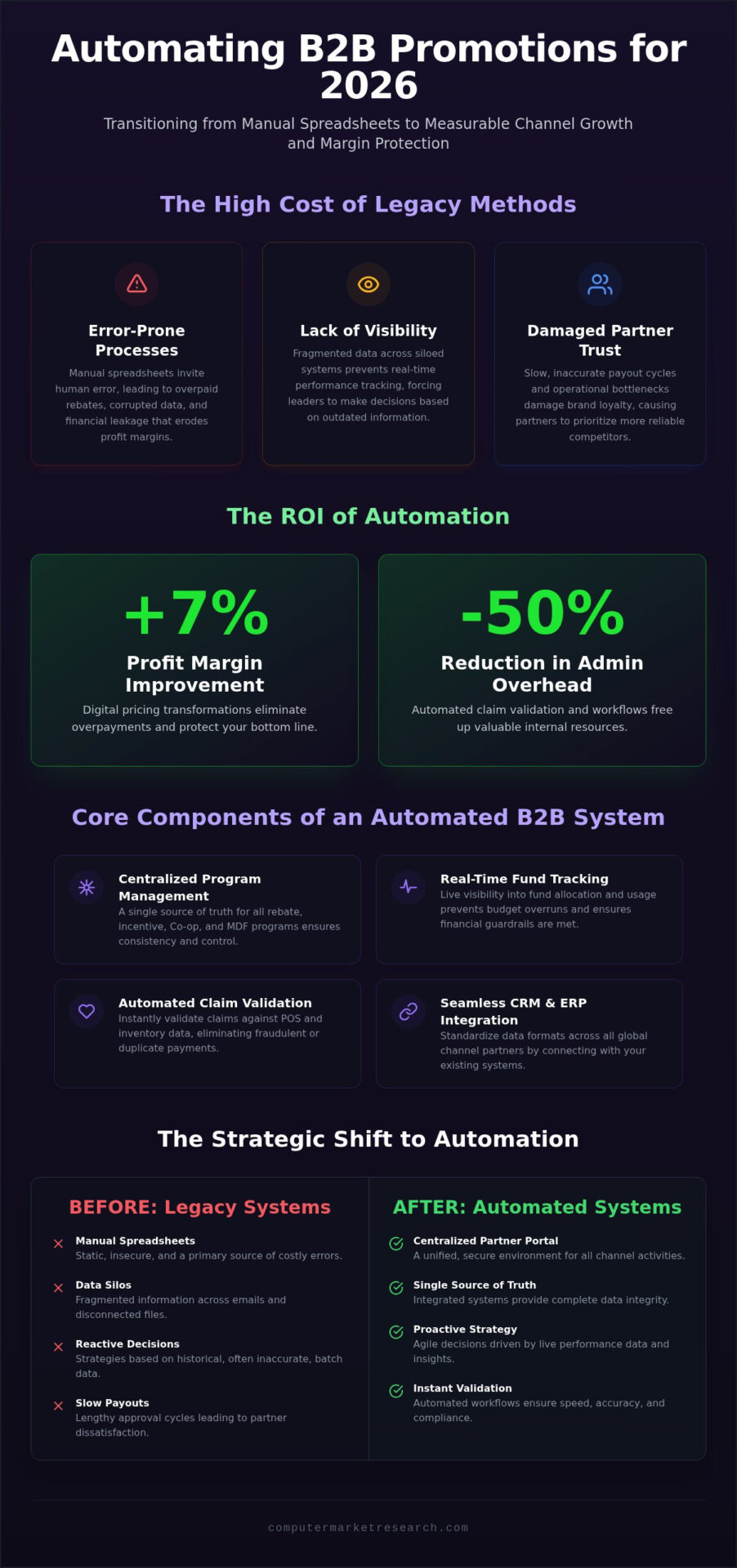
Recent industry data indicates that digital pricing transformations can lead to a 7 percentage point improvement in profit margins, yet many B2B leaders remain tethered to spreadsheets that invite human error. If you’re still managing MDF and rebates through manual entry, you’re likely overpaying on claims while losing visibility into your actual channel spend. Transitioning to automated promo management isn’t just a technical upgrade. It’s a strategic necessity to protect your bottom line and maintain operational control in 2026.
We understand that the administrative burden of tracking fragmented information often feels like an unavoidable cost of doing business. It’s frustrating to watch margins erode because of overpaid rebates or slow payout cycles that damage partner trust. This guide will show you how to eliminate those manual bottlenecks and maximize your channel ROI using the latest B2B technology. You’ll learn how to implement automated claim validation and real-time performance tracking to ensure every dollar spent drives measurable growth. We will examine the shift from legacy tracking to integrated systems that provide the transparency your organization requires to scale efficiently.
Key Takeaways
- Understand why manual tracking is obsolete and how automated promo management provides the real-time visibility required for 2026 channel strategies.
- Identify the essential components of a modern B2B system, including centralized rebate management and automated Ship & Debit workflows for high-volume distributors.
- Discover how to protect your margins by eliminating fraudulent or duplicate claims while reducing administrative overhead by up to 50 percent.
- Learn how to integrate your partner portal with existing CRM and ERP systems to standardize data formats across all global channel partners.
- Explore how specialized B2B technology can transform fragmented information into a clear, results-driven path for improved channel ROI.
The Evolution of Automated Promo Management in 2026
By 2026, automated promo management has redefined how B2B organizations handle complex incentive structures. It’s no longer sufficient to treat rebates and marketing funds as isolated line items. Instead, this systematic approach integrates every incentive into a unified data environment. While foundational concepts of Trade Promotion Management (TPM) remain relevant, the execution has shifted from reactive record-keeping to proactive, real-time strategy. Organizations that rely on fragmented information often find themselves reacting to margin loss rather than preventing it.
The primary driver of this evolution is the transition to cloud-based SaaS solutions. These platforms serve as a single source of truth, centralizing partner data that was previously siloed across various departments. By implementing a dedicated partner portal, enterprises can replace the chaos of email chains and disconnected files with a disciplined, automated workflow that ensures data integrity at every touchpoint.
From Manual Spreadsheets to Real-Time Execution
Spreadsheets don’t scale. They’re static, prone to corruption, and invite human error that can lead to overpaid rebates. In a global channel program, the hidden costs of manual entry quickly compound. Automated promo management eliminates these risks by enabling real-time data flow. Instead of waiting for month-end batch processing, systems now offer instant claim validation. This immediate feedback loop prevents budget overruns before they occur. It ensures that promotion cycles remain within financial guardrails while providing the agility to adjust tactics based on live performance data.
Why Legacy Promotion Methods Fail Global Enterprises
Managing multi-tier distribution networks without a centralized system is a recipe for operational bottlenecks. Legacy methods often result in slow payout cycles, which directly damage partner trust and brand loyalty. Partners expect accuracy and speed; delays in incentive fulfillment can lead them to prioritize competitors who offer more reliable financial tracking. Traditional manual workflows also lack decision-grade insights. Without real-time visibility, leaders are forced to make strategic choices based on outdated information. Transitioning to modern infrastructure is the only logical path for enterprises that value order, performance, and long-term channel stability.
Core Components of a B2B Automated Promotion System
A high-performance B2B system requires more than just a digital ledger; it demands a sophisticated architecture capable of handling multi-layered financial interactions. While many general marketing tools focus on simple coupons or referral codes, true automated promo management addresses the specific complexities of the manufacturer-distributor relationship. This includes managing high-volume transactions where margins are thin and precision is paramount. By centralizing the management of rebates, incentives, and marketing funds, organizations can eliminate the fragmented information that typically leads to financial leakage.
The core components of a modern system go beyond simple tracking. They provide a proactive framework for growth through several key features:
- Centralized oversight of all rebate and incentive programs to ensure a single source of truth.
- Automated submission and approval engines that reduce partner friction.
- Real-time fund tracking to prevent the over-allocation of resources and budget exhaustion.
- Seamless integration with existing POS and inventory data for instant validation.
Managing Rebates, Incentives, and Ship & Debit
For high-volume distributors, ship and debit management is a critical function that often suffers from manual friction. When price fluctuations occur between the time of purchase and the time of sale, distributors require immediate compensation to protect their margins. Automation ensures these claims are processed against real-time data, reducing the window for error. Tiered incentive structures can also be programmed to reward high-performing partners automatically, encouraging growth without increasing administrative headcount. This systematic approach ensures global financial compliance by maintaining a clear, auditable trail for every transaction, regardless of the region or currency involved.
Automating Co-op and MDF Program Workflows
Marketing funds are often underutilized or mismanaged due to cumbersome request and reimbursement cycles. An automated system simplifies this by allowing partners to submit requests through a self-service portal. By linking fund usage directly to proof-of-performance documentation, organizations can ensure that every dollar spent aligns with strategic objectives. This eliminates the administrative burden of chasing down receipts or verifying campaign details manually. For a deeper look at maximizing these investments in 2026, refer to our Market Development Funds (MDF) guide. Transitioning to these modernized workflows allows your team to focus on channel strategy rather than data entry. If you’re ready to see how these components function in a live environment, you can start with a risk-free evaluation of our portal features.
The ROI of Automation: Data Accuracy and Margin Protection
Investing in automated promo management yields returns that extend far beyond simple efficiency gains. It’s a strategic shield for your gross margins. In a manual environment, financial leakage is often an accepted, albeit painful, cost of doing business. Automation transforms this by ensuring that every dollar of incentive spend is tied to a verified, earned transaction. By shifting to self-service portals, organizations can reduce administrative overhead by up to 50 percent, allowing operations teams to pivot from tedious data entry to high-level strategic analysis.
The value of clean data cannot be overstated. When your promotion information is normalized and accurate, you can calculate the true effectiveness of your programs without the noise of human error. This precision allows for a disciplined approach to channel spend where capital is allocated based on performance rather than guesswork.
Eliminating Overpayments and Fraudulent Claims
Manual processes are inherently vulnerable to duplicate claims and calculation errors. These discrepancies often lead to significant margin leakage, particularly when dealing with complex volume tiers or regional pricing variances. Automated validation rules solve this by cross-referencing every claim against actual sales data in real time. If a claim doesn’t meet the pre-defined criteria, the system flags it for review or rejects it automatically. This rigorous filtering ensures that overpayments are stopped before they hit the ledger. For a deeper look at how accuracy impacts your bottom line, our guide on Channel Data Management provides a framework for achieving decision-grade insights through data normalization.
Gaining Granular Visibility into Channel Performance
True ROI isn’t just about stopping loss; it’s about optimizing gain. Automation provides the granular visibility required to track promotion performance by region, partner type, or specific product line. You can finally identify which incentives drive the highest incremental revenue and which are simply subsidizing sales that would have happened anyway. This level of transparency allows you to refine your 2026 strategy with surgical precision. Instead of wading through fragmented spreadsheets, you can turn raw data into actionable, boardroom-ready reports that clearly demonstrate the impact of your channel investments. This systematic reporting builds trust with stakeholders by proving that your promotion strategy is a measurable driver of corporate growth.
Strategic Implementation: Integrating Promos with Your CRM
Successful automated promo management depends on the seamless flow of information between your partner ecosystem and your internal systems of record. While many organizations rely on an ERP as their primary source of truth, these systems often lack the specialized functionality required to manage the nuances of B2B incentives. By connecting a dedicated portal to your CRM and ERP, you create a unified environment where promotion data and financial records exist in harmony. This integration ensures that every stakeholder, from finance to channel sales, operates with the same set of validated facts. It’s about creating a data loop that informs every strategic decision and eliminates the friction of siloed information.
Bridging the Gap Between POS Data and Incentives
A common failure in legacy systems is the disconnect between end-user sales and incentive payouts. Many competitors focus on ERP integration for accounts payable but fail to address the POS data gap in the channel. Implementing robust POS data management allows you to verify that a sale actually occurred before a rebate is issued. Automation cleanses and normalizes disparate data formats from various global partners, ensuring that “ship-to” and “sold-to” addresses match your specific promotion criteria. This level of technical discipline prevents the errors that occur when sales teams manually interpret raw distributor reports. By closing this gap, you ensure that your incentives are driving the desired market behavior rather than simply subsidizing inventory movement. You’re effectively turning raw transaction data into decision-grade intelligence that protects your bottom line.
Scalability: Managing Global Partner Networks Effortlessly
As your partner network expands, the complexity of managing global currencies, languages, and regional regulations increases. A centralized PartnerPortal™ provides the infrastructure needed to support thousands of independent partners while maintaining strict brand consistency. This system reduces the operational bottleneck typically associated with onboarding new incentive programs or entering new markets. Instead of building custom workflows for every region, you can deploy standardized templates that scale with your growth. This modular approach allows you to focus on strategic expansion in 2026 without being restricted by the technical limitations of your tracking methods. It ensures that your brand voice remains professional and consistent across all partner interactions, regardless of geographic location. Maintaining this level of order is essential for building long-term trust within your distribution network.
Building a scalable infrastructure is the only way to move beyond the constraints of manual oversight and fragmented information. If you’re ready to modernize your integration strategy and eliminate the data gaps in your channel, start your 90-day free trial of PartnerPortal™ today. This risk-free entry point allows you to experience the value of automated integration firsthand while positioning your organization for sustainable growth.
Optimising Your Channel with CMR PartnerPortal™
CMR has defined the landscape of channel automation since its founding in 1984. With over 40 years of specialized expertise, the company understands the specific operational bottlenecks that prevent Global 2000 and Fortune 500 organizations from achieving full channel transparency. Implementing automated promo management through PartnerPortal™ allows businesses to move beyond the limitations of legacy tracking systems. This platform provides the stability and accuracy required to manage high-stakes incentive programs without the risk of manual error.
A significant advantage of the CMR approach is the combination of cloud-based SaaS with Managed Data Services. Many software providers offer a platform but leave the burden of data cleansing to the client. CMR provides POS and inventory normalization; this ensures that the information flowing through your system is high-quality and decision-grade. This synergy between technical infrastructure and data precision is what allows for the seamless transition from fragmented, manual workflows to a modernized, systematic environment.
Why PartnerPortal™ is the Industry Standard for 2026
The platform offers a holistic approach to Partner Relationship Management (PRM) by centralizing every aspect of the partner lifecycle. Organizations can deploy customizable modules for Co-op/MDF Management, Rebates and Incentives, and Lead Management based on their specific needs. This modularity ensures that the system grows alongside your partner network rather than becoming an obstacle. PartnerPortal™ has a proven track record in complex global environments, providing the reliability that enterprise leaders demand when managing multi-tier distribution channels. It’s a voice of authority in a field often cluttered with generalist providers.
Start Your Journey with a 90-Day Free Trial
Transitioning to a modernized system shouldn’t feel like a leap into the unknown. CMR offers a 90-day free trial to allow organizations to prove the ROI of automated promo management before making a long-term commitment. During the implementation and setup phase, our team assists with the integration to ensure your data sources are correctly mapped and validated. This risk-free entry point provides a clear path out of operational bottlenecks, allowing you to experience the efficiency gains of automated claim validation and real-time visibility firsthand. It’s time to replace obsolete tracking methods with a system built for the performance demands of 2026. Claim your 90-day free trial today and begin the journey toward total channel control.
Transforming Your Channel Strategy for 2026
The transition from manual spreadsheets to a modernized infrastructure is the only logical step for organizations looking to scale. By implementing automated promo management, you eliminate the margin leakage associated with overpaid rebates and administrative errors. You’ve seen how integrating POS data and centralized portals provides the transparency required to turn fragmented information into decision-grade intelligence. This shift ensures your channel spend is always tied to measurable performance and strategic growth.
CMR brings over 40 years of channel experience to your operations, a legacy of competence that has made us a trusted partner for Global 2000 and Fortune 500 companies. Our cloud-based systems offer high-level security alongside real-time data cleansing to ensure your financial records remain accurate and auditable. It’s time to leave obsolete tracking methods behind and adopt a solution that prioritizes order and ROI. You can begin this transformation with total confidence and clear visibility.
Claim your 90-day free trial and automate your promos today.
Frequently Asked Questions
What is automated promo management for B2B channels?
Automated promo management is a systematic approach to coordinating B2B incentives through centralized software rather than manual spreadsheets. It streamlines the lifecycle of rebates, co-op funds, and ship and debit claims by integrating partner data into a single source of truth. This discipline ensures that manufacturers can execute complex promotion strategies with precision. By replacing legacy tracking methods, organizations gain the real-time visibility necessary to protect margins and drive channel growth in 2026.
How does automation reduce rebate overpayments?
Automation reduces overpayments by implementing rigorous validation rules that cross-reference every claim against verified POS and inventory data. Unlike manual audits that occur weeks after a sale, automated systems flag duplicate or fraudulent claims instantly. This prevents financial leakage caused by incorrect volume tiers or regional pricing discrepancies. By ensuring every dollar of incentive spend is earned through a validated transaction, organizations maintain strict control over their gross margins and eliminate administrative errors.
Can automated promo systems integrate with my existing CRM?
Yes, technical integration with standard enterprise CRM and ERP systems is a core component of a modernized channel infrastructure. PartnerPortal™ is designed to bridge the gap between sales activity and financial fulfillment by synchronizing data across your existing software stack. This connection ensures that partner onboarding, lead management, and incentive tracking occur in a unified environment. By centralizing these records, businesses eliminate the friction of siloed information and ensure all departments operate with the same validated facts.
What is the difference between MDF and co-op fund automation?
MDF are typically discretionary, strategic investments provided to partners for future activities; while co-op funds are earned based on a percentage of prior sales. Automation handles the distinct workflows for each by simplifying the request and reimbursement cycles. It links fund usage directly to proof-of-performance documentation, ensuring that both earned and discretionary funds align with corporate objectives. This systematic oversight prevents budget over-allocation and reduces the administrative burden of verifying campaign outcomes across your network.
How does POS data improve promotion accuracy?
POS data acts as the ultimate verification layer for end-user sales. By utilizing Managed Data Services to cleanse and normalize disparate reports from global distributors, manufacturers can ensure that “ship-to” and “sold-to” data matches specific promotion criteria. This level of technical discipline eliminates the guesswork associated with raw sales reports. It allows for accurate claim validation, ensuring that rebates and incentives are only paid for verified market movement rather than simply subsidizing stagnant inventory.
Is automated promo management suitable for global enterprises?
Automated promo management is specifically engineered for the complexities of Global 2000 and Fortune 500 enterprises. These organizations often manage multi-tier distribution networks across different currencies, languages, and regional regulations. A centralized platform provides the scalable infrastructure needed to maintain brand consistency while supporting thousands of independent partners. This systematic approach reduces the operational bottlenecks that occur when legacy tracking methods fail to keep pace with global expansion and complex international financial compliance requirements.
How long does it take to implement a partner portal for promotions?
The implementation timeline depends on the complexity of your current data environment and the depth of technical integration required with your CRM or ERP. The process includes the initial configuration, branding of the self-service portal, and mapping of global data sources. Computer Market Research provides professional services to streamline this transition, ensuring that your system is configured to meet the performance demands of 2026. A 90-day free trial is available to prove the ROI before a long-term commitment.
What are the security standards for automated B2B incentive platforms?
Modern B2B incentive platforms utilize cloud-based security protocols to protect sensitive channel data and financial records. These standards ensure that partner information is centralized in a secure environment, accessible only to authorized stakeholders. Systems like PartnerPortal™ provide an auditable trail for every transaction, from initial claim to final payout. This level of technical oversight alleviates the risks associated with fragmented information and manual entry, providing the stability and accuracy required by specialized operations professionals in 2026.

Article by
Del Heles
Del Heles is the founder and CEO of Computer Market Research (CMR), a channel management software company he launched in 1984. With more than 40 years of experience, he’s known for helping manufacturers and distributors simplify complex partner programs through practical, customer-focused technology solutions.