

A partner program can generate activity across regions while leaving ownership unclear. Managing VAR and MSP partners starts with recognizing that a reseller’s project-based role differs from an MSP’s ongoing service relationship. A VAR typically sources, configures, and deploys a solution, then hands it over. An MSP typically manages and maintains IT over time. When a program includes both, unclear boundaries can complicate accountability and marketing support.
That distinction matters, but it is only the starting point. A strong program also needs practical ways to coordinate partner roles, regional marketing, distributor networks, and performance expectations without fragmented manual tracking.
This guide explains how reseller and MSP programs differ, how to assign responsibilities across partner types and regions, and how to structure funded marketing and downstream distributor relationships. It also covers ways to clarify accountability and connect program activity to partner performance.
Key Takeaways
- Define partner responsibilities around the work delivered: project-based resale, ongoing managed services, or a blend of both.
- Adapt regional marketing support to partner needs while keeping program goals and performance measures aligned.
- Clarify how distributors support downstream partners so engagement and results are easier to track.
- Connect accountability to agreed responsibilities and service commitments across integrated IT partners.
- Recruit and onboard partners by assessing their processes, tools, staffing, client experience, and definition of success.
Differences between VARs, VARs with Service, MSPs, and MSP Partners
Partner models differ in delivery, customer responsibility, and revenue structure. Clarify each role before setting program expectations.
Transactional VAR Relationships
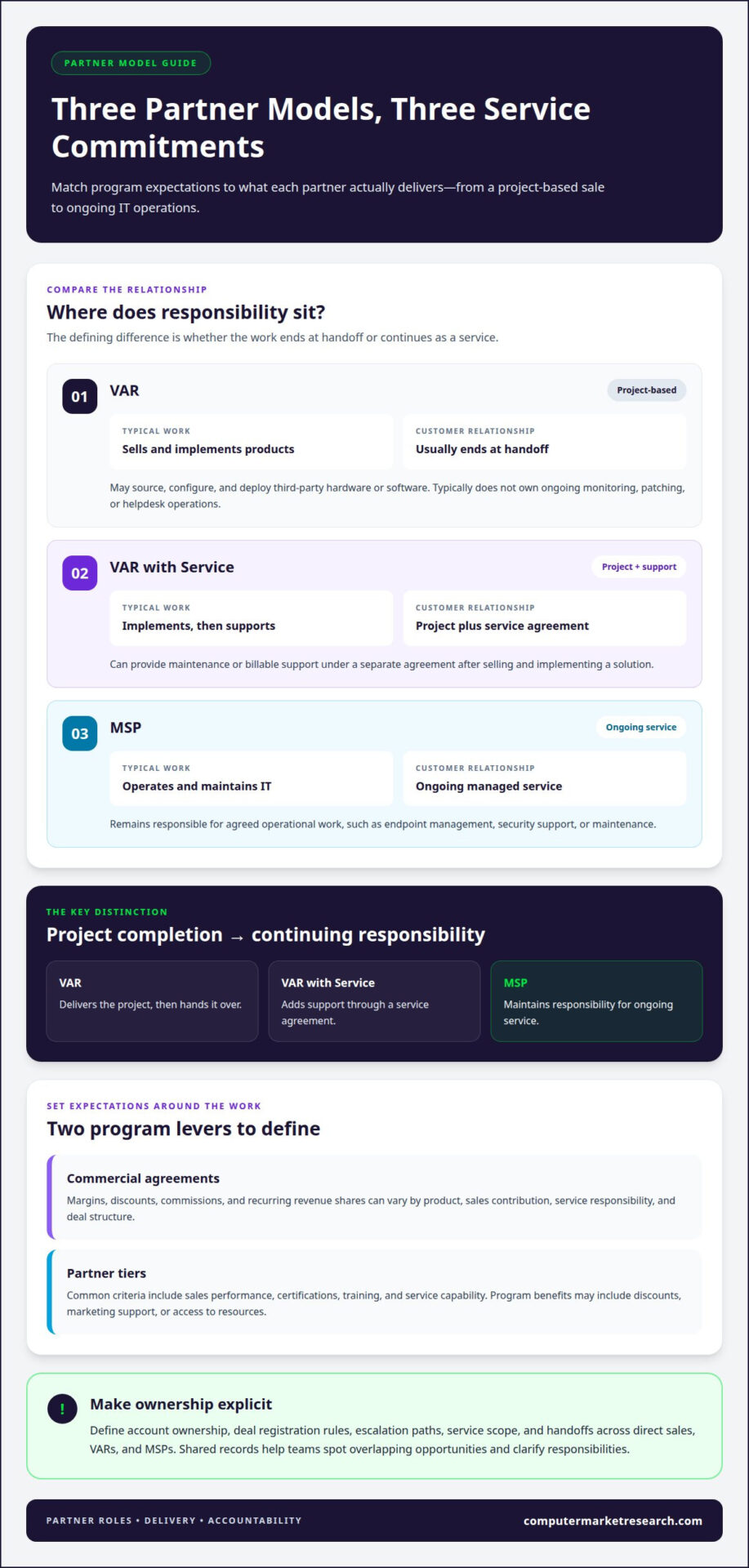
A value-added reseller sources and sells third-party hardware or software, then may configure and implement it for a customer. The engagement is usually project-based, with responsibility often ending at handoff. For example, a VAR might bundle networking equipment with licenses and deployment support. Unlike an MSP, it typically does not take ongoing responsibility for monitoring, patching, or helpdesk operations.
MSP Partner Relationships
An MSP provides an ongoing managed service, such as endpoint management, security support, or maintenance. Customers commonly pay a recurring monthly fee, while the provider remains responsible for agreed operational work. An MSP partner may also contribute specialist resources to a project. The defining distinction is continuity: the relationship centers on ongoing service, not just a completed sale or implementation.
A VAR with service sits between these models. It may sell and implement a solution, then provide maintenance or billable support under a separate agreement. Moving toward managed services calls for assessing recurring-revenue potential, staffing, training, and the ability to meet ongoing commitments. The shift affects both operations and customer relationships.
Partner programs set margins, discounts, commissions, and recurring revenue shares through commercial agreements. Terms can vary by product, sales contribution, service responsibility, and deal structure.
VAR and MSP tiers commonly use factors such as sales performance, certifications, training, or service capability. Benefits may include discounts, marketing support, or access to resources, with requirements defined by the program.
To prevent channel conflict, define account ownership, deal registration rules, and escalation paths for direct sales, VARs, and MSPs. Shared records help teams spot overlapping opportunities before they become disputes.
Common risks include unclear service scope, poor handoffs, security gaps, and inaccurate partner data. Document responsibilities, customer access, data handling, and service commitments, and align compliance processes with applicable obligations.
Regional field service can add local implementation capacity. For example, a model serving mid-market organizations in Salt Lake City and Phoenix uses its own engineers rather than subcontractors.
| Partner type | Typical work | Customer relationship |
|---|---|---|
| VAR | Sell and implement products | Project-based |
| VAR with Service | Implement, then support | Project plus service agreement |
| MSP | Operate and maintain IT | Ongoing service |
Choose the model that matches the work, ownership, and service duration required.
Partner Management Across Regions and Funded Marketing
Managing VAR and MSP partners across regions requires shared program rules and locally relevant execution. Funded marketing works best when vendors connect campaign activity to partner goals.
Regional Partner Management
Across the United States, VAR and MSP management should use common program rules while adapting field execution to local coverage. VAR support often centers on product launches and implementation projects; MSP support must also enable ongoing service delivery. A vendor can set shared campaign objectives while helping regional partners tailor messaging to their customers.
In practice, regional differences often reflect partner roles and local delivery needs, rather than a single formula. For example, field teams serving Salt Lake City and Phoenix can coordinate local activities while following the same opportunity and reporting structure.
Partner Relationships and Communications
Vendors should assign a relationship owner, agree on communication routines, and share updates relevant to each partner’s work. A VAR may need product and implementation information; an MSP may also need operational updates to support ongoing customer services. Clear ownership and documented agreements help prevent missed handoffs across a distributed network.
For funded marketing, vendors can provide co-op and market development funds alongside reusable campaign materials. For example, a vendor might help an MSP promote its managed service while aligning the campaign with related product opportunities. Define eligible activities, approval steps, and outcome measures before using funds.
Lead and Deal Management Tools
Lead and deal processes should give partners a consistent way to submit opportunities, record ownership, and track progress. A shared system can capture lead source, region, partner role, next action, and deal status. Deal registration distinguishes partner-sourced opportunities from direct sales activity and provides a defined process for resolving overlap.
Enablement also benefits from centralized records. For example, a vendor can connect campaign responses with lead assignments, then review follow-up status and outcomes. Regular updates help operations identify stalled leads, route them to the right partner, and recover opportunities that might otherwise be lost in email or spreadsheets.
Managing VAR and MSP partners effectively means using a consistent workflow while tailoring communications and marketing to regional coverage. This keeps reporting comparable without treating every partner as if it performs the same work.
That approach preserves a shared framework while allowing partners to present their own capabilities. Brands have historically supported channel partners with market development funds and promotional assistance. They can help partners market and sell their own services, which may lead to sales of related products. Campaign planning can keep a partner’s service offer visible while connecting it with related product opportunities, in line with the partner’s role and regional coverage.
Brands can support SI and MSP partners by investing in reusable engagement models and helping promote the partners’ brands. Reusable materials provide a common starting point, while partner-specific messaging reflects the services being promoted. Funded activity can retain the program’s eligibility, approval, and outcome measures. Teams can review campaign responses and follow-up against partner goals, keeping regional execution aligned without treating every partner’s offer as identical.
Distributor Downstream Partner Management
Distributors connect vendors with downstream VARs and MSPs, extending reach across software, hardware, and infrastructure markets. Their role goes beyond order fulfillment: they can coordinate partner enrollment, product access, sales data, and program communication. For example, a distributor supporting resellers and managed service providers can distinguish product transactions from ongoing subscription activity.
Start with a clear partner structure. Record each downstream partner’s role, territory, customer segment, and program status in a shared system. Then connect those records to sales, inventory, and point-of-sale data. This view helps distributors identify active partners, spot coverage gaps, and route product or enablement information to the right organizations.
Performance measures should reflect the partner’s business model. For a VAR, track measures tied to product sales and implementation activity. For an MSP, include managed seats, renewals, and recurring service growth. It also targets 2,000 managed seats under contract, with 1,240 achieved.
Those figures show why distributors need baselines, not just targets. New MSPs should establish current KPI levels, then review changes as their service model matures. If managed-seat growth slows, the distributor can examine partner engagement, customer retention, and sales pipeline data before adjusting enablement or marketing support. This makes reporting a practical management tool.
Relationships also need defined ownership. Assign a distributor contact for partner enrollment, another for sales operations, and a clear route for resolving data or fulfillment issues. For example, when a reseller reports a shipment mismatch, the distributor can trace the transaction through order and inventory records. Consistent processes prevent fragmented updates across email, spreadsheets, and separate systems.
Funded marketing can strengthen downstream engagement when it supports a specific partner strategy. A distributor might coordinate a software adoption campaign, then track partner participation and resulting leads. Define eligible activities, approval steps, and reporting expectations before allocating funds. Review results with the partner, then refine the next campaign based on actual activity.
Effective downstream management connects partner roles, performance data, and support in one operating model. Distributors can use this structure to strengthen relationships, identify execution gaps, and align vendor strategy with partner success.
Integrated IT Partner Accountability
Integrated delivery needs named owners, clear handoffs, and shared performance measures. A platform that records responsibilities helps teams see who delivers each part. Managing VAR and MSP partners effectively means connecting those records to specific operational commitments.
Partner Accountability
Set accountability by task, not by partner label alone. For example, a VAR may install hardware while an MSP manages its ongoing operation. Record the owner for configuration, cybersecurity monitoring, incident response, and customer updates. When responsibilities overlap, document which partner leads and how the other supports the work.
Service level agreements should define measurable commitments and reporting routines. MSPs should meet their service level agreement commitments. If a customer reports an outage, the agreement should clarify who responds, communicates status, and coordinates recovery. The vendor can review service records with partners and address missed handoffs through a defined escalation process.
Accountability also changes as a reseller adopts the MSP model. A project-focused team may need training, operational procedures, and assigned staff before it can deliver recurring services. For example, a reseller adding managed cybersecurity should define monitoring ownership, customer communications, and escalation responsibilities before taking on the work. Clear roles help protect customer relationships as new operations develop.
Performance Measurement KPIs
Vendors should track KPIs that reflect commercial results and delivery quality. For VARs, useful measures include registered opportunities, product revenue, implementation completion, and customer adoption. For MSPs, include recurring service revenue, managed seats under contract, renewals, and service level performance. A shared baseline makes changes easier to interpret as the partner’s business model matures.
Pair outcome measures with operational indicators. For example, review open incidents alongside response ownership, or compare registered deals with closed sales. If training completion supports a cybersecurity service, track it alongside delivery readiness. These measures show whether a partner can fulfill commitments, not just generate pipeline.
Review KPIs regularly and assign an owner to each follow-up. If renewals decline, examine service delivery and customer engagement before changing the growth strategy. If deal activity rises but implementation stalls, review staffing and handoffs. Managing VAR and MSP partners this way turns performance data into specific actions and connects revenue goals to reliable service.
If service quality falls, review whether ownership, readiness, or customer communication is weakening delivery before drawing conclusions. Managed service providers report that managed services account for their largest share of revenue, although this varies by geography. Recurring-service commitments can therefore be reviewed alongside delivery responsibilities, without assuming every partner has the same revenue mix. Value-added resellers typically bundle software with hardware and deliver the combination as an integrated solution. Accountability reviews can consider whether ownership covers the complete offering and its operation where applicable.
MSSPs can use object storage immutability and hardened repositories to prevent backups from being altered or deleted, including by compromised accounts. Backup protection can be included in reviews of service ownership and performance evidence. Businesses transitioning from a VAR model to an MSP model should account for upfront investments and develop their teams’ relationship-building and recurring-service skills. Assigning responsibility for those investments and skills development makes the transition part of operational planning, rather than treating it as a change in label alone.
What Are Best Practices for Recruiting and Onboarding VAR and MSP Partners?
Recruitment should assess delivery fit, not just sales interest. A structured process helps identify partners who can support the intended customer experience.
Begin with the role the program needs to fill. For a VAR, assess product knowledge, implementation processes, typical clients, staffing, and sales coverage. For an MSP, also examine service operations, toolsets, client and employee tenure, and how the provider defines success. These criteria show whether a candidate’s capabilities match the program’s expectations.
Use consistent questions when evaluating candidates. Ask how the partner qualifies opportunities, handles customer handoffs, and reports performance. For an MSP, explore how it manages service issues and assigns responsibilities across its team. For a VAR, clarify who handles configuration and implementation after a sale. Compare answers with the actual partner role, not a generic profile.
Recruitment should also consider customer fit. A VAR serving organizations that need deployment expertise may complement a vendor’s direct sales team. An MSP with established recurring services may suit customers seeking ongoing IT operations support. Define the target customer, region, and expected contribution before approval. This helps avoid recruiting partners whose delivery model conflicts with the program’s goals.
After selection, onboard partners through a defined sequence. First, document the partner’s responsibilities, territory, customer profile, and escalation contacts. Next, provide access to relevant product information, sales materials, and program processes. Then train the teams that will register opportunities, manage customer handoffs, and report activity. A launch checklist can record each completed enablement task and its owner.
Make onboarding role-specific. A VAR may need product configuration guidance and implementation steps. An MSP may need service workflows, operational contacts, and clear expectations for ongoing delivery. In both cases, explain how to submit leads, register deals, and receive updates. Keep the process in a shared record rather than relying on email threads or individual memory.
Set an initial review around observable activity, such as training completion, opportunity submissions, and first customer engagements. Use it to identify gaps in tools, staffing, or process knowledge. If a partner has sales capability but lacks delivery readiness, define the next enablement actions before expanding responsibilities.
Recruitment establishes fit; onboarding turns it into repeatable execution. Clear role expectations, practical training, and recorded ownership give each VAR or MSP a defined path into the program.
Computer Market Research
Computer Market Research helps organizations structure partner program operations through channel management software and related services. Turn to the company when partner roles are defined, but onboarding, deal activity, funded marketing, or performance data remain scattered across manual workflows.
This support is useful when a program spans VARs, MSPs, and distributors, but teams lack a consistent operational view. PartnerPortal™ centralizes partner onboarding, deal registration, and performance tracking. It gives program teams a shared place to manage key partner activities and review channel performance, rather than piecing together updates from separate files.
For example, a vendor can use a centralized process to record partner details during onboarding, then track registered opportunities through the sales process. Clear records help program managers see which partner owns an opportunity and what activity comes next. The platform supports visibility into channel data, helping organizations refine workflows as partner networks grow.
Funded marketing also benefits from organized administration. Co-op/MDF Management supports partner marketing fund management, while Rebates & Incentives supports incentive program administration. These capabilities help teams connect program activity with partner participation and performance instead of relying on disconnected records to understand fund usage and results.
Deal Registration supports a defined process for recording partner opportunities. When direct sales and channel teams need visibility into opportunity ownership, a consistent record helps clarify how a deal is being handled. Together, these capabilities address practical parts of partner program administration without treating every relationship as identical.
Organizations may turn to Computer Market Research when manual tracking makes partner activity difficult to coordinate, distributor and reseller records are fragmented, or program leaders need better visibility into performance. The right operational focus depends on the bottleneck: onboarding, opportunity ownership, funded marketing, or incentives. Aligning processes with supporting data can make program decisions easier to manage.
For support with channel partner program operations, contact Computer Market Research.
Frequently Asked Questions
How does an MSP program differ from a reseller program?
An MSP program supports partners delivering ongoing services, while a reseller program focuses on selling vendor products through third parties. This difference shapes enablement: an MSP may need service-process guidance and operational updates, while a reseller needs product information and sales materials. For example, when software changes, a vendor can provide MSPs with service-impact details and resellers with updated product positioning. Program measures should reflect each partner’s role.
What Is the Difference Between a VAR and an MSP?
A VAR sells third-party products and may add configuration or implementation; an MSP manages agreed IT operations over time. A business that wants to retain control of its IT environment may use a VAR to design and deploy a solution. An organization seeking ongoing operational support may engage an MSP. Some VARs add support agreements, so the practical distinction depends on the work and responsibility defined in each customer arrangement.
What are VAR and MSP partners, and how do their business models differ?
VAR and MSP partners are third-party businesses that help vendors sell products or deliver related services to customers. VAR revenue can come from product resale and project work, while an MSP commonly earns recurring revenue for ongoing services. For example, a vendor may plan product launch materials for a VAR and service enablement for an MSP. Distinguishing the models helps align partner incentives, sales resources, and reporting with the work each partner performs.

Article by
Del Heles
Del Heles is the founder and CEO of Computer Market Research (CMR), a channel management software company he launched in 1984. With more than 40 years of experience, he’s known for helping manufacturers and distributors simplify complex partner programs through practical, customer-focused technology solutions.