

Administrative work shouldn’t obscure how your channel program is performing. To understand how to simplify your channel program, align it with current business goals, automate repeatable tasks, clarify account ownership, and bring partner and sales information into a shared system. These steps reduce fragmented workflows and make it easier to see where action is needed.
Channel programs often become more complex as partner relationships and incentive approaches expand. The answer isn’t simply to add processes, but to make essential ones clearer and easier to manage. This guide explains how to review program structure, streamline administration, prevent overlapping sales efforts, and centralize channel information. You’ll also learn how to assess whether partner relationships still support your goals, so you can focus resources where they contribute most.
Key Takeaways
- Set partner goals around each participant’s results and your program’s current priorities to keep incentives relevant.
- Automate repeatable administration, including partner communications and the flow of market development fund requests and reimbursements.
- Make deal and account ownership visible across direct and indirect sales to reduce the risk of duplicate outreach.
- Use a shared source of channel information so internal teams and partners can work from consistent, appropriate data.
- Review overlapping partner roles and tier requirements to focus program resources and reduce unnecessary complexity.
Automating program administration
Streamline partner onboarding, training, and certification with one repeatable workflow. Set clear milestones for account setup, learning, and completion records, then automate reminders and status updates.
- Map each recurring task before automating it. List the actions required for onboarding, training, certification, claims, and reimbursements. Assign an owner and define what starts each task, what information it needs, and what completes it. For example, an approved partner application can trigger account setup and an onboarding checklist. A clear sequence helps prevent manual handoffs from becoming hidden delays.
- Give participants a personalized progress view. Incentive dashboards can show partners their progress, earnings, and next steps in real time. Make requirements and outstanding actions visible instead of relying on separate email updates. Tailor the information to each participant’s program and goals. Partners can then see what to do next, while administrators focus on exceptions.
- Automate market development fund administration. Create a consistent process for requests, approvals, documentation, and reimbursement. Automated communications can support each step, from the initial request through reimbursement. For example, a request can prompt a status update, while an approval can trigger the next instruction. Clear steps reduce repetitive follow-up and organize records of fund activity.
- Set partner goals from individual performance. Use each participant’s previous-year results as a baseline, then define incremental goals suited to that partner. This makes targets more relevant than applying the same threshold to every relationship. As partner types, personalization, incentive options, objectives, and budget constraints expand, simple rules become harder to administer. Document each goal and its calculation to give administrators and participants a consistent reference.
- Repeat incentive instructions across the program. Important messages may need to be repeated at least 10 times before participants act. Schedule reminders around program milestones, such as enrollment, a funding request, or an approaching deadline. Keep each message focused on a clear action and the information needed to complete it. Repeating the same requirement across useful touchpoints can reduce confusion without creating a new manual process.
- Connect incentive eligibility to incremental business. Pay incentives only after participants generate more business than before. Define the performance baseline and evidence used to assess progress, then make the criteria visible in program instructions. This gives administrators a consistent basis for reviewing claims and helps participants understand how their activity relates to earning an incentive, rather than treating payment as automatic.
- Use feedback and performance data to refine workflows. Review partner feedback alongside program results to identify confusing requirements, stalled requests, or incentives that aren’t supporting intended outcomes. Unused market development funds can point to limited engagement with the vendor’s products. Use that signal to improve communication and program design, and revisit workflows as objectives and partner needs change.
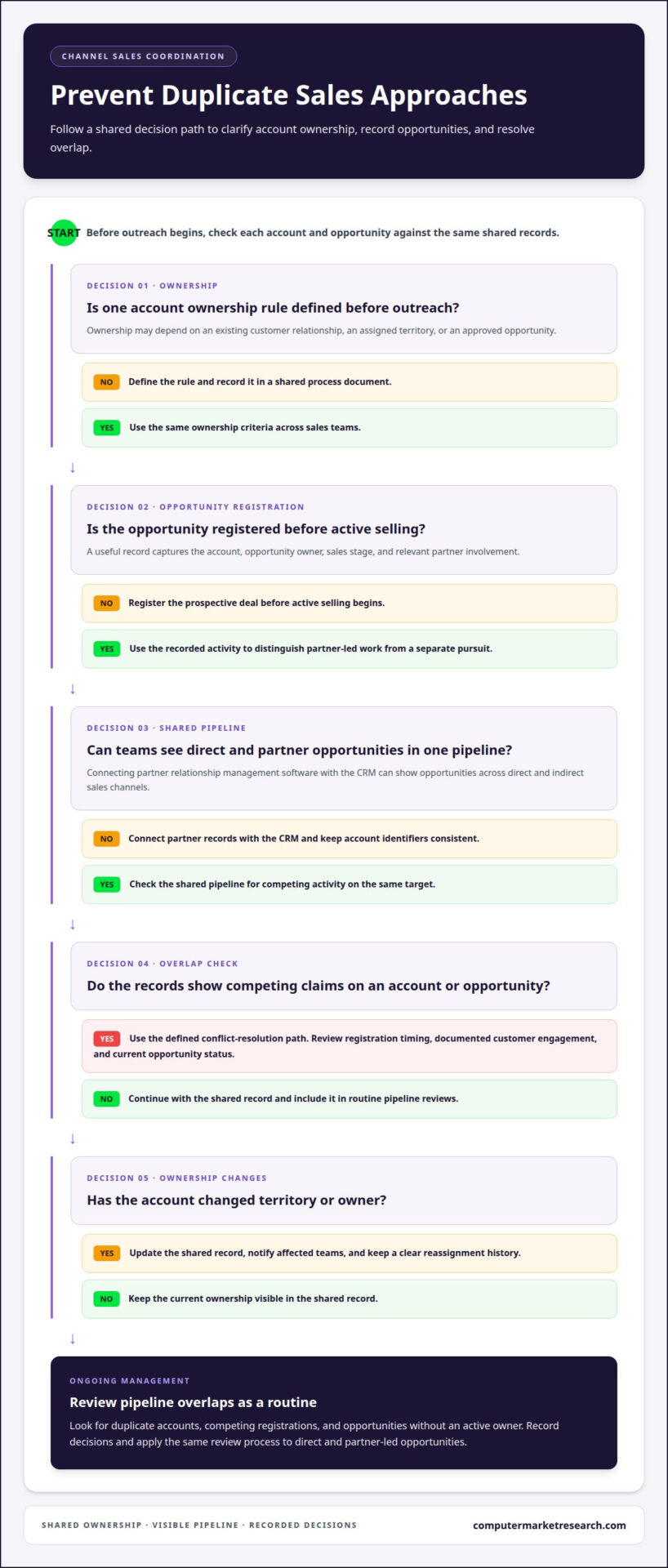
Avoiding duplicate sales approaches
- Set one account ownership rule. Define how the company assigns each target account before outreach begins. Ownership might depend on an existing customer relationship, an assigned territory, or an approved opportunity. Record the rule in a shared process document. When sales teams apply the same criteria, account assignments are easier to explain and less dependent on informal conversations.
- Register opportunities before active selling. Give direct salespeople and partners a consistent way to record prospective deals. Capture the account, opportunity owner, sales stage, and relevant partner involvement. This helps distinguish a partner developing a deal from a salesperson independently pursuing the same account. Clear registration criteria also help managers resolve conflicts using recorded activity rather than conflicting recollections.
- Connect partner records with the CRM pipeline. Integrating partner relationship management software with a CRM can show opportunities across direct and indirect sales channels. This shared pipeline helps teams spot when two salespeople may approach the same target. For example, a direct seller can see a registered partner opportunity before contacting that account. Keep account identifiers consistent so matching records remain useful.
- Define a practical conflict-resolution path. Specify who reviews competing claims, what information informs the decision, and how the outcome is recorded. Relevant details can include registration timing, documented customer engagement, and the opportunity’s current status. Apply the same review process to direct and partner-led opportunities. A recorded decision gives sales teams a clear next step and reduces repeated escalation.
- Make territory and account changes visible. When an account changes territory or ownership, update the shared record and notify affected teams. For example, a departing account owner should not remain the only person visible in the CRM. Keep a clear reassignment history so salespeople can understand current ownership and avoid acting on outdated records.
- Review pipeline overlaps as a management routine. Use recurring pipeline reviews to identify duplicate accounts, competing registrations, and opportunities without an active owner. Focus each review on resolving specific record conflicts, not rebuilding the pipeline manually. A consistent process helps leaders spot patterns, such as repeated overlap around particular accounts or territories, and refine assignment rules. Teams assessing a shared sales workflow can explore the 90-day trial.
Look for partner-led and direct opportunities that overlap, or accounts that repeatedly lack a clear owner. Use these findings to refine registration guidance and improve handoffs. Preserve the decision record so teams can apply the same approach later.
Channel sales and channel managers should work from the same information in a centralized system. A centralized channel system can give partners access to the same information as internal teams, as appropriate to their relationship with the company. That shared view can support coordinated outreach, with access reflecting partner roles and need. Keep updates to ownership, registration status, and resolution outcomes current so everyone relying on the system acts on the latest agreed record. A communication plan should allow time for review, approvals, revisions, and clearance by all partners, as the Centers for Disease Control and Prevention (CDC) advises. Build that time into announcements about process changes, territory adjustments, or new registration expectations, and confirm that affected partners and internal teams receive consistent guidance before changes take effect.
Centralized channel information
Use one governed system as the source for channel records, program rules, and performance data. For incentives and rebates, keep eligibility, approval status, and payment records connected so teams and partners can follow the same process.
- Define the records every team needs. Start with core channel details, such as partner profiles, account assignments, program participation, and performance activity. Add incentive and rebate status where relevant. For example, connect each partner record to its approved program terms and related submissions. A consistent data model makes records easier to interpret across sales and channel operations.
- Assign one authoritative location for each data type. Decide which system owns partner profiles, opportunity details, and financial program records. If teams maintain separate spreadsheets, duplicate updates can produce conflicting versions. Document the source of truth and connect related systems where practical. Channel data management systems can support a consistent foundation for channel information.
- Set access according to each relationship. Internal sales, channel operations, finance, and partners need different views. Give each audience the information needed for its role. A partner may need its submission status and program requirements, while finance needs supporting records for review. Appropriate access protects sensitive information without forcing teams to rely on manual updates.
- Standardize names and required fields. Use consistent partner names, account identifiers, program labels, and status values. Otherwise, one account might appear under different spellings in sales and finance records. Define required fields for submissions and use the same terms across systems. Standardized information improves search, reporting, and handoffs between channel managers and sales teams.
- Make program rules visible beside activity. Keep eligibility criteria, documentation requirements, approval status, and next steps connected to the relevant incentive or rebate record. An administrator reviewing a submission should be able to see its program terms without searching separate files. Clear context helps participants understand decisions and staff apply rules consistently.
- Establish ownership for updates and corrections. Assign responsibility for maintaining each record type, including partner details, program terms, and status changes. Define how teams report outdated or incorrect information. If a partner’s business details change, a clear update path helps prevent old data from carrying into later transactions. Record changes so teams can identify the current information.
- Review data quality through real workflows. Use common tasks to find gaps, such as locating a partner’s current program, checking a rebate submission, or reviewing channel performance. Note where users need duplicate entry or cannot find a status. Prioritize corrections that interrupt decisions or create repeated follow-up. A shared system is useful only when its records support daily work.
Which channel partners should a company keep, consolidate, or remove?
- Assess each partner against current business goals. Identify the markets, customer types, and capabilities the program needs, then review each partner’s contribution to those priorities. A partner may provide regional coverage, technical expertise, or access to a customer segment. Keep relationships that fill a clear need, rather than treating enrollment alone as evidence of value.
- Compare partner activity with outcomes. Review available performance data alongside the work partners perform. Consider sales contribution, customer engagement, service coverage, and participation in program activities. A partner with modest sales may still provide important specialist support, while repeated inactivity may signal a poor fit. Apply consistent criteria across the program, and distinguish missing data from evidence of low performance.
- Identify overlapping customer and service coverage. Map which partners target the same customers and offer similar services. According to the U.S. Government Accountability Office, programs targeting the same clients with similar services can add administrative costs and complicate service delivery. For example, overlapping coverage may create unclear ownership or duplicate coordination. Record where overlap occurs before deciding whether it serves a deliberate business purpose.
- Consolidate relationships when overlap creates avoidable work. If two partners serve the same segment with similar capabilities, compare their coverage, performance, and operational demands. Consolidation may make sense when one relationship can maintain the required customer access with clearer accountability. Preserve distinct roles when partners bring different expertise or reach, and document the rationale so teams understand the change.
- Keep partners that fill a distinct, useful role. Assess more than immediate revenue. A partner may support customer needs that direct teams cannot serve efficiently or provide specialized knowledge for a defined market. A technically capable partner could remain valuable even if another partner leads sales in the same region. Tie each retained relationship to a specific contribution and review it using relevant evidence.
- Address underperformance before removing a partner. Identify the gap, explain the expected contribution, and agree on a practical improvement path. A partner with incomplete product training may need enablement; one with unclear account ownership may need a defined territory. Track progress using the same criteria applied during assessment. This separates correctable process problems from a persistent mismatch with program needs.
- Plan removals around customer and operational continuity. Before ending a relationship, identify affected accounts, open opportunities, service responsibilities, and outstanding program activity. Assign ownership for each transition and communicate changes to relevant internal teams. A reassigned account needs a clear new contact and current records. A documented transition reduces confusion as the partner roster changes.
How can you reduce complexity in channel tiers and partner requirements?
- Define what each tier is meant to achieve. Give every tier a distinct business purpose, such as market coverage, technical capability, or customer support. If two tiers expect the same work and provide similar benefits, the distinction may add administration without guiding partner behavior. Define the purpose first, then use it to test whether each requirement belongs in that tier.
- Keep only requirements tied to a clear outcome. Review each target, training expectation, certification, and reporting task. Ask what decision or partner capability it supports. Product training may be essential for a partner delivering technical support, but less relevant to a referral-focused role. Remove requirements that don’t affect performance, customer service, or program decisions.
- Use shared baseline requirements across tiers. Set a common foundation for partner registration, conduct, and essential program knowledge. Add tier-specific criteria only where responsibilities genuinely differ. A shared baseline makes the program easier to explain, while focused additions preserve meaningful distinctions. Partners can see which rules apply to everyone and which reflect their specific role.
- Make advancement criteria observable. Define how a partner qualifies for a tier using evidence teams can review, such as completed training, demonstrated capability, or documented performance. Avoid vague labels like “strategic partner” without a clear meaning. Specify what activity demonstrates readiness for expanded responsibilities. Visible criteria help partners understand expectations and administrators apply decisions consistently.
- Align benefits with partner responsibilities. Each tier should connect its requirements to relevant support, resources, or program access. If a higher tier requires additional reporting, explain what the partner gains from that effort. Remove benefits that no longer support program goals. This makes tier differences practical rather than a collection of labels and exceptions that administrators must explain separately.
- Reduce exceptions and duplicated rules. Compare requirements across tiers and identify repeated forms, separate approval paths, or conflicting deadlines. Consolidate rules that serve the same purpose. For example, one common process can collect required partner information, with tier-specific fields added only when needed. Fewer exceptions make training clearer and reduce the risk of inconsistent administration.
- Review the structure with partner feedback and program results. Look for requirements partners find confusing, steps that delay participation, and tier distinctions that don’t change outcomes. Use that evidence to revise the structure, then communicate changes in direct language. A controlled trial can help assess a simpler workflow; start a 90-day free trial to explore the process.
Computer Market Research
Computer Market Research helps organizations streamline channel administration when manual workflows and disconnected records make programs difficult to manage. PartnerPortal™ centralizes partner onboarding, deal registration, and performance tracking to support clearer processes across indirect sales operations. Its Rebates & Incentives and Co-op/MDF Management capabilities help manage related program activity. Together, these tools can reduce administrative friction and improve visibility into partner workflows.
If you’re ready to simplify your channel program, contact Computer Market Research to discuss your needs.
Put your next channel improvement into motion
Start with one process where administrative friction limits visibility or slows decisions. Define what a better workflow should make easier for your team and partners, then use that outcome to guide implementation. This keeps the question of how to simplify your channel program connected to operational priorities, rather than adding technology without a clear purpose.
Computer Market Research offers PartnerPortal™, Co-op/MDF Management, and Rebates & Incentives to support channel operations. Consider how these offerings fit the process you want to improve, whether that means organizing partner activity or managing program administration. Start with the workflow creating the clearest operational need.
Contact Computer Market Research to discuss your channel program and identify a practical next step. With a focused objective and a clear implementation path, your program can become easier to manage as partner needs evolve.
Frequently Asked Questions
What does simplifying a channel program mean?
Simplifying a channel program means reducing unnecessary work and making its operating rules easier to apply. The goal isn’t to remove useful partner distinctions, but to make participation, administration, and decision-making clearer. For example, a manufacturer might retain specialized partner requirements while eliminating repeated data entry across separate program forms. A simpler structure helps teams focus on partner activity and customer needs instead of avoidable process overhead.
How do you audit and simplify a channel partner program?
To decide how to simplify your channel program, map requirements, workflows, and partner roles, then compare them with intended outcomes. Trace an activity, such as a partner claim, to identify unclear instructions or unnecessary handoffs. Ask channel operations staff and participating partners where the process creates friction. Prioritize changes that remove redundant work while preserving controls needed for sound decisions. Record the reason for each change so teams can apply it consistently.
What tools can automate channel program management and partner communication?
For teams assessing how to simplify your channel program, a partner relationship management platform can bring partner activities into a coordinated workflow. PartnerPortal™ centralizes onboarding, deal registration, and performance tracking, while supporting self-service tasks such as submitting claims and accessing resources. CRM and ERP integrations can connect relevant business records, and dashboards help teams review activity. Match tools to specific workflow needs, then assign clear ownership for the information they manage.
How do you measure the success of a simplified channel program?
Compare each partner’s results with their previous-year baseline and incremental goals, and assess whether incentives generate more business. Review program performance, return on investment, partner feedback, stalled requests, and unused market development funds to identify where workflows or incentives need improvement.

Article by
Del Heles
Del Heles is the founder and CEO of Computer Market Research (CMR), a channel management software company he launched in 1984. With more than 40 years of experience, he’s known for helping manufacturers and distributors simplify complex partner programs through practical, customer-focused technology solutions.