

A channel dashboard can show what happened without revealing what may happen next. Predictive analytics for channel performance uses historical data and statistical models to estimate future outcomes, helping teams move beyond reviewing results and make better-informed decisions about partner activity, campaigns, and incentives.
That shift is useful only when the underlying information is connected and reliable. Campaign engagement, incentive activity, sales submissions, and partner records need to relate to the same partner. Otherwise, forecasts may reflect gaps in the data rather than meaningful changes in performance.
This article explains how predictive analytics works, where it can improve channel planning, and what its estimates can and can’t tell you. It compares solution approaches and outlines a practical workflow, from defining a business objective and preparing data to validating forecasts and using them to guide action.
Key Takeaways
- Use predictive models to anticipate partner and campaign outcomes, then treat forecasts as decision support rather than certainty.
- Connect partner identities across engagement, incentive, sales, and profile data to build a more useful foundation for analysis.
- Define a business objective, prepare historical data, and validate model outputs before using them to guide channel decisions.
- Measure channel activity alongside outcomes such as lead conversion, revenue, retention, and campaign return to understand performance more fully.
- Explore how partner management and incentive tools can centralize channel information and support clearer performance tracking.
What are the benefits of predictive modeling?
Predictive modeling helps channel teams estimate which campaigns, partners, and actions may produce stronger outcomes. A model can combine engagement, sales submissions, and incentive activity to prioritize follow-up or guide budget allocation. Unlike a report of past results, a forecast provides a forward-looking basis for decisions. It is still an estimate, so teams should compare predictions with actual outcomes.
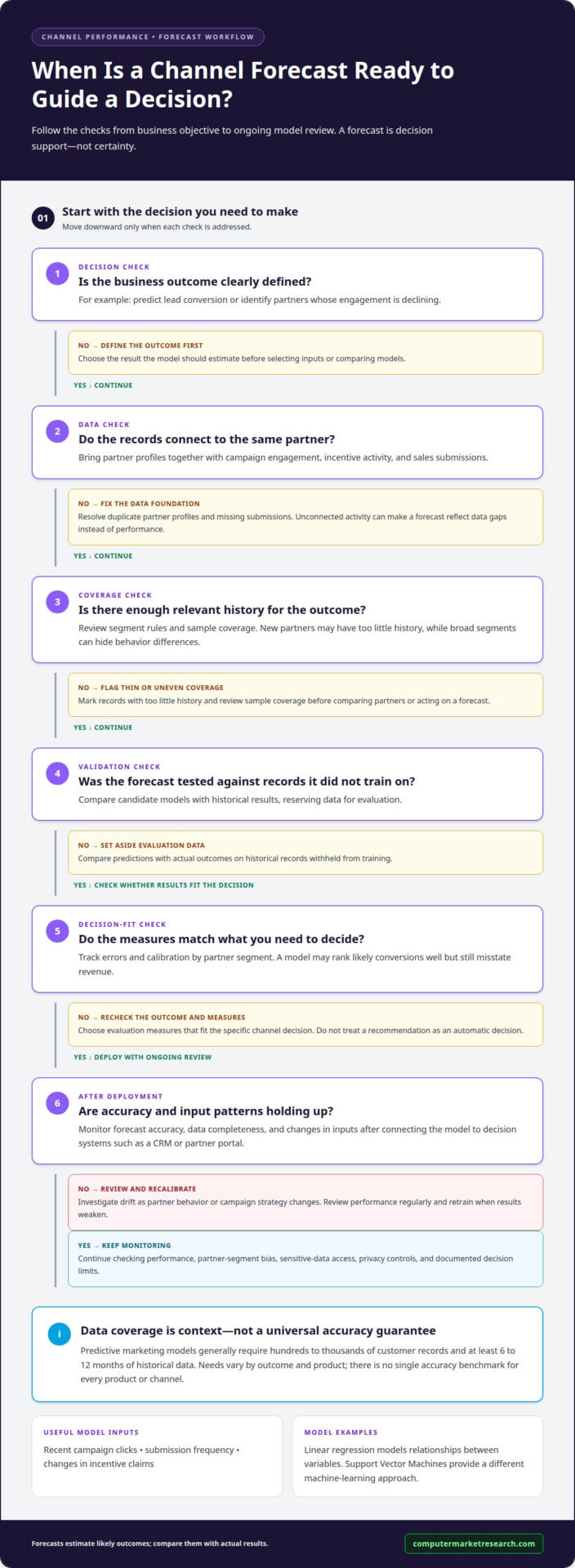
Model failure often starts with inconsistent inputs. Duplicate partner records, for example, can split one partner’s activity across profiles, while missing sales submissions can make performance appear weaker than it is. Segmentation creates its own edge cases: a new partner may have too little history to compare, and a broad segment can conceal differences in behavior. Define segment rules, review sample coverage, and flag records with too little history before acting on a forecast.
Training starts with a defined outcome, such as predicting lead conversion or identifying partners whose engagement is declining. Feature engineering turns source data into useful inputs, such as recent campaign clicks, submission frequency, or changes in incentive claims. Linear regression can model relationships between variables, while Support Vector Machines offer a different machine-learning approach. Compare candidate models with historical results and reserve data they have not trained on for evaluation.
Deployment should connect the model to the systems where teams make decisions, such as a CRM or partner portal. After launch, track forecast accuracy, data completeness, and changes in input patterns. A model can drift as partner behavior or campaign strategy changes, so review performance regularly and retrain when results weaken. Check for bias across partner segments, restrict access to sensitive data, and apply privacy controls consistent with applicable requirements, including GDPR and CCPA. AI governance should document the model’s purpose, ownership, decision limits, and review procedures.
Marketing mix modeling can estimate how different channels relate to outcomes and inform budget allocation. A team might compare campaign activity, partner engagement, and sales submissions before shifting investment. Use consistent outcome definitions and account for the time between exposure and revenue. Then test proposed allocations against observed results instead of treating a model’s recommendation as an automatic decision.
What is predictive analytics?
Predictive analytics applies statistical methods and machine learning to historical data to estimate likely future outcomes. Descriptive analytics summarizes past activity; diagnostic analysis explores causes; predictive analysis projects what may happen next. For example, a channel team can combine partner engagement and sales submissions to estimate which accounts may need attention. The forecast supports strategy, but it does not replace operational judgment.
Tools differ in the decisions they support. A CRM may provide lead scoring, while a business intelligence platform focuses on reporting and visualization. Specialized analytics tools can combine partner, campaign, and sales information for channel forecasts, while workplace platforms such as heartsy.ai turn organizational data and scattered learning into predictive analytics. Compare products by their data connectors, identity matching, model controls, deployment options, and reporting needs. Pricing may depend on licensing, data volume, integrations, and implementation requirements, so assess those factors rather than headline features alone.
Useful predictions depend on a coherent data foundation. First-party data is collected directly, such as partner submissions or campaign engagement. Second-party data is another organization’s first-party information, shared through an arrangement; third-party data comes from external sources and may add market-intent signals. Identity resolution connects records that refer to the same partner, even when systems use different identifiers. Consistent event definitions also help teams compare behavior across sources.
GDPR and CCPA affect how organizations collect and use behavioral data. Privacy requirements for behavioral cookies can vary, so teams should check applicable rules and manage consent accordingly. CCPA requires opt-out mechanisms for cookie-related data practices. Consent status and permitted purposes should travel with relevant records so a model does not use data beyond its authorized scope. Privacy controls belong in both data collection and downstream operations.
Data needs depend on the outcome being predicted. Reliable predictive marketing models generally require hundreds to thousands of customer records, while historical coverage should capture meaningful patterns. Predictive marketing models generally require at least 6 to 12 months of historical data. Product type also matters: lead scoring uses prospect attributes and engagement, while reorder forecasting relies on purchase timing and order history. There is no single accuracy benchmark that applies to every product or channel.
How accurate are channel performance forecasts, and how can accuracy be measured? Accuracy depends on data quality, forecast horizon, and the outcome being modeled. Compare predictions with actual results on historical records withheld from training, then track errors and calibration by partner segment. A forecast that ranks likely conversions well may still misstate revenue, so choose measures that match the decision. Reassess performance as behavior and strategies change.
What are Channel Performance Analytics Solutions?
Channel performance analytics solutions organize partner, sales, and campaign signals to explain results and anticipate changes. Forecasting may use linear regression, multiple regression, or binary logistic regression. The outcome determines which model fits.
Predictive Analytics and Forecasting
Predictive analytics uses historical channel patterns to estimate future partner contributions, demand, or campaign outcomes. A forecast helps organizations plan for likely changes rather than rely only on past totals. For example, comparing a partner’s sales submissions and engagement over time can reveal a shift before revenue changes. Teams can then investigate whether the pattern reflects readiness, demand, or incomplete reporting.
Forecasting for Prioritization
Predictive forecasting ranks potential actions by their expected relevance to a business target. A team might prioritize partners showing falling training engagement, or focus outreach on accounts whose sales submissions are narrowing. Repeat-purchase timing can also guide follow-up: if customer orders commonly recur around a 90-day interval, a forecast can help identify accounts approaching that point. These signals inform attention and timing, rather than dictating decisions.
Marketing Channel Performance Metrics
Channel metrics measure activity and outcomes, helping teams distinguish attention from contribution. Opens, clicks, and downloads show campaign engagement; lead conversions, partner sales, revenue, and retention show downstream results. Comparing both groups helps explain whether a campaign reached its audience and moved prospects toward an outcome. Demand forecasts offer another perspective by estimating future product needs from order patterns, helping teams plan channel priorities and inventory discussions.
Models for Channel Performance Forecasting
Regression models estimate relationships between channel inputs and a measurable outcome. Linear regression uses one independent variable, while multiple regression uses two or more to predict the outcome. Binary logistic regression predicts a response with two values, such as 0 or 1, making it suitable for outcomes like conversion or no conversion. For maintenance forecasting, organizations can analyze available equipment usage and service records to anticipate demand for support. Model selection should match the decision and the quality of available data.
Building a predictive analytics workflow
Start with a business objective, such as forecasting partner revenue or spotting declining engagement. Define the audience, decision, and outcome before selecting a machine-learning method. A clear target keeps the workflow focused. For example, a channel team might predict which partners need enablement support rather than trying to forecast every possible result.
Next, assess the historical data that supports the target. Predictive marketing models generally require at least 6 to 12 months of historical data. Check channel tracking, remove duplicate records, and correct incomplete fields before modeling. If sales submissions are missing for a partner, its apparent performance may not reflect actual activity. Clean inputs help separate real trends from recording gaps.
Next, collect and organize relevant sources around the same business outcome. A revenue forecast might combine past sales submissions, campaign engagement, and incentive activity. Choose features that could plausibly signal the outcome, such as changing submission volume or declining training engagement. Keep the measurement period consistent so the model learns from comparable observations, not mismatched time windows.
Train candidate models on historical examples, then evaluate them against records withheld from training. Compare predicted outcomes with actual results, such as whether a partner’s activity declined as forecast. Review errors by audience segment, since a model may perform differently for established partners and newly recruited ones. Before deployment, document the model’s purpose, input fields, and decision limits.
Deployment connects the validated forecast to the team’s operating process. For example, a partner manager could receive a prioritized list of accounts for follow-up. After launch, monitor forecast errors, missing data, and shifts in input trends. When business conditions or partner behavior change, reassess performance and retrain as needed. Teams should understand what a forecast represents, rather than treating it as a guaranteed result.
A five-phase predictive-segmentation implementation can be planned across 12 weeks. In one example, a pilot campaign uses 20% of the budget during weeks 9-10. That staged rollout gives teams a defined window to assess the model’s recommendations against campaign outcomes. Use the pilot findings to refine segment definitions, adjust features, and decide whether broader deployment supports the original objective.
Which metrics best measure marketing channel performance
Choose metrics that connect campaign activity to business outcomes. Marketing automation platforms can report opens, clicks, and downloads, but those signals do not show whether activity created pipeline or revenue. Pair engagement measures with lead conversions, partner sales submissions, and campaign results. For example, rising email clicks alongside flat conversions may indicate a gap between audience interest and the offer or follow-up.
Conversion metrics show how effectively channel activity advances prospects. Track leads generated, lead-to-opportunity conversion, and closed sales by campaign or partner. Define each stage consistently across reporting systems, then compare the same period and audience. A partner with fewer leads but more closed deals may contribute more value than one with high lead volume and weak conversion.
Revenue, retention, and marketing ROI help assess business impact. Compare revenue associated with channel activity against campaign investment, and examine customer retention alongside acquisition. Co-marketing analysis should also include audience reach and engagement, because exposure alone does not establish return. Consistent attribution rules help teams interpret results across campaigns without crediting several sources for the same outcome.
Partner-level measures help explain where performance changes. Track sales submissions, lead conversions, revenue generation, and customer retention by partner. Compare current activity with each partner’s own baseline; a drop in submissions may warrant attention even when total channel revenue remains steady. Segmenting by partner type or product focus can reveal whether a shift is broad or concentrated in a specific group.
Use a balanced view, not a single headline metric. A real-time dashboard can bring partner sales, lead conversions, campaign results, and co-marketing engagement together. Review definitions and data coverage before comparing segments. If campaign clicks rise but sales submissions do not, investigate timing, partner participation, and the path from engagement to sales. This helps distinguish a tracking issue from a genuine performance change.
For a practical way to explore channel performance measurement, claim a 90-day free trial.
Channel performance analytics solutions can evaluate revenue generation, customer retention, and marketing ROI to identify high-performing partners and address underperformance. Channel performance analytics tools can also assess co-marketing campaign ROI, engagement levels, and audience reach.
Computer Market Research
Predictive analysis is more useful when partner and program information is organized around clear channel processes. Computer Market Research provides cloud-based SaaS solutions for channel management, including PartnerPortal™, Co-op/MDF Management, Rebates & Incentives, and Deal Registration. These offerings support operational processes that generate useful information about partner activity. They are a natural next step when disconnected records and manual tracking make channel performance difficult to understand.
PartnerPortal™ centralizes partner onboarding, deal registration, and performance tracking. When partner information and registration activity are managed in one system, teams gain a clearer operational view of those processes. That context can support analysis of partner contributions alongside other business information. Predictive forecasts still depend on suitable, accurate data and a defined business objective, but structured tracking provides a more consistent starting point.
Co-op/MDF Management and Rebates & Incentives support partner funding and incentive processes. These programs generate activity records that can help teams understand participation and payouts. A change in claims activity, for example, may prompt a closer review of partner engagement. Connecting program activity with sales submissions and campaign results gives decision-makers broader context instead of treating incentive records as isolated totals.
Consider these solutions when manual administration, fragmented partner records, or limited performance visibility complicate channel operations. A team building a predictive workflow can first clarify which processes generate the information it needs. It can then assess how partner onboarding, deal registration, and incentive activity fit into its analysis. This creates a more orderly foundation for reviewing channel activity, identifying information gaps, and deciding which operational questions deserve attention.
Computer Market Research’s channel management solutions focus on organizing key partner processes, not promising a particular forecast or business result. Predictive models remain dependent on the data and outcomes an organization defines; well-managed program records can make those inputs easier to interpret. The right next step depends on the operational challenge: PartnerPortal™ for centralized partner processes, Deal Registration for tracking registered opportunities, or the relevant funding and incentive management offering for program administration. Contact Computer Market Research to discuss your channel management needs.
Turn channel forecasts into a stronger operating rhythm
Make forecasting part of how your team reviews channel decisions, not a separate analytics exercise. Start with one business question leaders need to answer, then connect the forecast to a clear action and review what happened. As actual results accumulate, they can inform future planning and help teams refine how they allocate attention across partners and programs.
When fragmented processes make this difficult, Computer Market Research offers channel management tools that support more structured operations. PartnerPortal™ centralizes partner onboarding, deal registration, and performance tracking. Co-op/MDF Management and Rebates & Incentives support funding and incentive processes that contribute to channel activity records. These offerings can help create a more organized operational context for evaluating performance.
Predictive analytics for channel performance becomes more actionable when forecasts connect to the work teams already manage. Choose the operational priority that matters most, and build from there. Explore a free trial of PartnerPortal to see how structured channel management can support your next steps. A focused start can give your team a clearer path forward.
Frequently Asked Questions
What is predictive analytics for channel performance?
It uses channel data to estimate future outcomes, such as which partners may contribute more pipeline or need support. For example, a manufacturer could compare partner activity with historical opportunity results to prioritize account reviews. The key distinction is between forecasting an outcome and deciding what to do: predictive analytics for channel performance informs that decision, while channel leaders still weigh commercial priorities and partner context.
What data is needed to predict channel performance accurately?
Useful inputs depend on the outcome, but often include partner identifiers, campaign interactions, deal registrations, sales submissions, and incentive activity. For example, a model predicting registered-deal conversion needs registration dates and eventual deal outcomes, not just partner profiles. Consistent timestamps and outcome definitions help align records. If different systems use different partner IDs, identity matching is also needed to avoid splitting one partner’s activity.
How can businesses attribute conversions across marketing channels?
Businesses can assign conversion credit using a consistent attribution model and shared campaign, account, and partner identifiers. A first-touch model credits the initial recorded interaction, while a last-touch model credits the final one before conversion. A multi-touch approach distributes credit across recorded interactions. Compare the resulting view with CRM opportunity and sales data, and document the chosen rules so campaign comparisons use the same basis.
How do predictive analytics tools compare for channel performance?
Compare tools by the work they support, their connectors, data handling, forecasting options, and how easily teams can use their outputs. A reporting platform may explain historical results, while a predictive tool estimates future outcomes. A channel-focused solution may connect partner activity with sales processes. For instance, a team tracking deal registrations should assess whether its chosen tool can relate registration records to later opportunity outcomes.
What are the costs of predictive analytics platforms for marketing channels?
Costs vary with platform scope, data volume, user or partner needs, and required integrations. For channel management software, subscription fees may scale with active partners or processed data; setup and integration work can also affect total costs. Managed data services are another potential cost category when data collection and normalization are included. Compare the components and deployment requirements rather than assuming every platform uses the same pricing model.
How to implement predictive analytics for channel performance step by step?
Begin with one decision, such as prioritizing partners for a campaign, and define the outcome that will guide it. Map the relevant records, resolve partner identities, and prepare historical inputs. Train a model, test its predictions against withheld outcomes, then connect the results to an existing review process. For example, assign a manager to review priority accounts and compare subsequent activity with the original forecast.

Article by
Del Heles
Del Heles is the founder and CEO of Computer Market Research (CMR), a channel management software company he launched in 1984. With more than 40 years of experience, he’s known for helping manufacturers and distributors simplify complex partner programs through practical, customer-focused technology solutions.