

One tier structure can serve ISVs, resellers, and service partners, but qualification criteria should reflect how each type creates value. The benefits of a tiered partner program are clearest when partners advance through meaningful outcomes and capabilities, rather than a one-size-fits-all checklist. Many programs can start with three levels: entry, middle, and elite.
That does not mean every partner needs a separate ladder. ISVs may demonstrate solution depth through a validated integration or packaged service, while resellers and service partners can be assessed on contributions relevant to their roles. The key is to make each tier’s expectations clear, achievable, and connected to useful support or incentives.
This article explains how tiering can motivate partner growth, balance revenue with capability and commitment, and adapt criteria for different partner types. It also covers how to keep the structure manageable, review performance consistently, and avoid tiers that add administrative work without making the program clearer.
Key Takeaways
- Align tier requirements with how ISVs, resellers, and service partners create value rather than applying one checklist to every partner type.
- Use clear progression criteria so partners can see which capabilities and outcomes support advancement.
- Balance revenue measures with evidence of capability and commitment to build a more complete view of partner performance.
- Keep the structure simple: a small number of meaningful tiers can make benefits and expectations easier to understand.
- Connect tier administration with partner operations such as deal registration, incentives, and co-op/MDF management to improve program visibility.
Adapting tier criteria for ISV, reseller, and service partners
A flat partner program gives ISVs, resellers, and service partners the same requirements and benefits. A tiered program can recognize different contributions within shared levels. For example, an ISV might qualify through integration depth, while a reseller demonstrates sales contribution. Both can reach the same tier using evidence relevant to their roles.
Keep tier names and advancement processes consistent, but tailor how partners demonstrate capability. This avoids treating unlike activities as equivalent. An ISV may create value through a validated integration or packaged service. A reseller may show market reach through partner-sourced revenue. A service partner may demonstrate delivery capability with a defined implementation offer.
Consider role-relevant evidence for each partner type:
- ISVs: Recognize one validated integration or one packaged service as evidence of solution depth. Consider whether the offer complements the program’s customer and sales needs.
- Resellers: Assess partner-sourced revenue, deal registration activity, and sales engagement. These measures help distinguish active selling from a signed agreement alone.
- Service partners: Evaluate packaged services, delivery readiness, and customer implementation support. A clearly described service can show how the partner extends the solution.
These are role-specific proofs, not necessarily separate tier systems. For example, an entry tier could accept an ISV’s integration evidence or a reseller’s first qualified sales contribution. The program can then set shared advancement expectations, such as consistent engagement or stronger customer outcomes. Partners get a visible path without having to provide identical evidence.
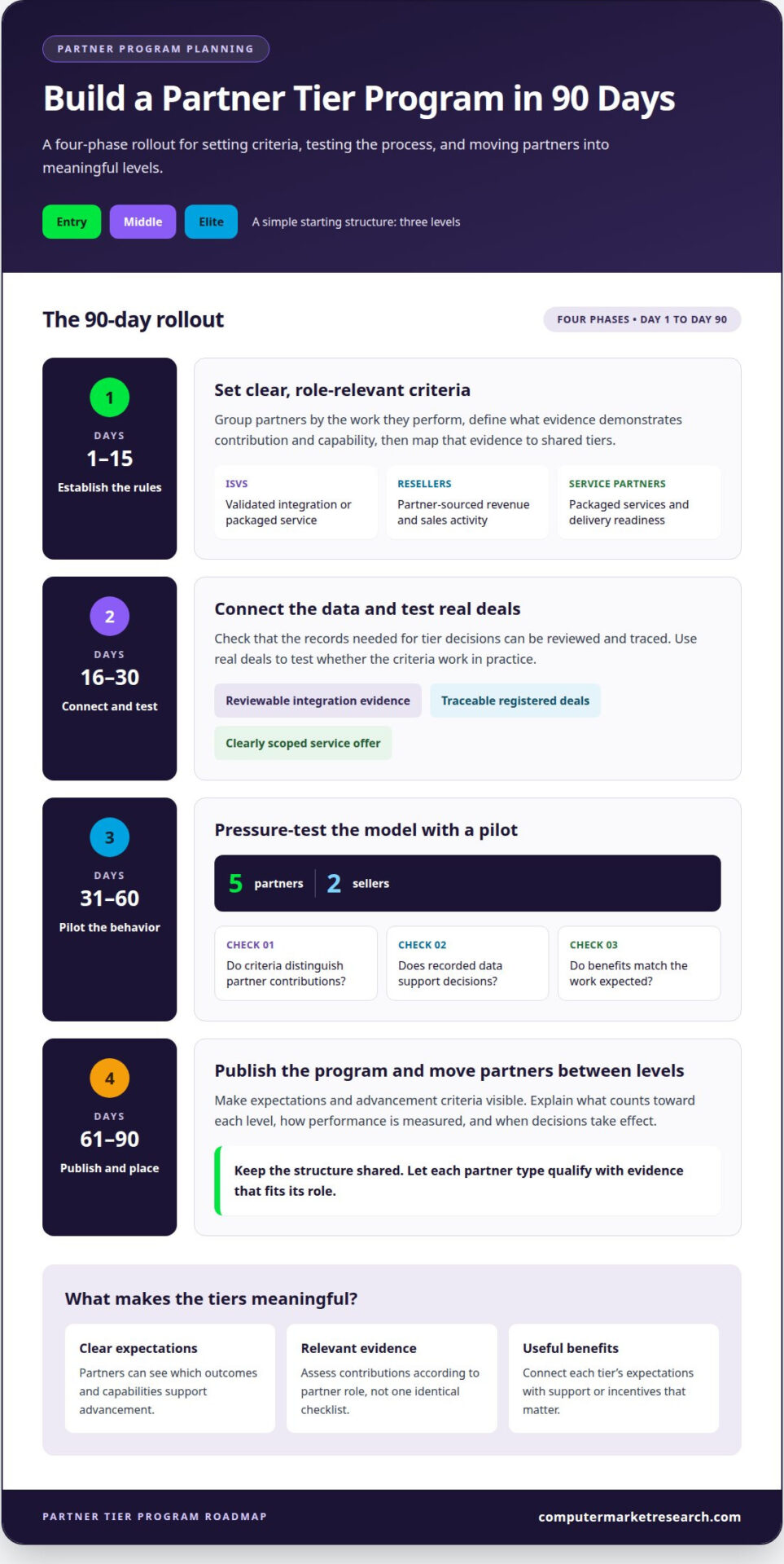
Set the criteria before assigning partners. First, group partners by the work they perform, not just by company labels. Next, define what evidence demonstrates capability and contribution for each group. Then map that evidence to shared tiers. If an organization acts as both an ISV and a reseller, let it qualify through the relevant role criteria rather than duplicating its record.
Keep evidence practical to collect. An ISV’s validated integration should be reviewable, a reseller’s registered deals traceable, and a service partner’s packaged offer clearly scoped. Consistent records make tier decisions easier to explain and reduce disputes caused by informal judgments. The same framework can still recognize different kinds of contribution.
Check that each requirement measures the intended behavior. If an ISV’s tier depends only on reseller revenue, the criteria may overlook solution depth. If a service partner is judged only on integrations, delivery capability may go unrecognized. Role-specific evidence makes advancement more relevant while keeping the overall structure coherent.
That balance is central to the benefits of a tiered partner program: partners can see how their strengths count, while program managers retain a consistent framework for evaluating progress.
How tiering structures partner growth
A tiered partner program groups partners by defined performance levels and connects each level to expectations and rewards. This gives partners a visible progression path and helps program managers distinguish current performance from growth potential.
The Structure of a Tiered Program
A tiered program sets levels, then links each level to clear criteria and benefits. For example, an entry-level partner might receive a standard commission, while a top-tier partner earns more after meeting stronger requirements. A sample commission schedule uses 15 percent for entry, 20 percent for mid-tier, and 25 percent for top-tier partners. These figures illustrate a model, not a required rate card.
Progression matters because partners can connect specific actions to advancement. Define what counts toward each level, how performance is measured, and when decisions take effect. When partners can see the next tier’s criteria, managers can focus reviews on concrete gaps, such as sales activity or capability development, rather than subjective status.
Growth Through Engagement and Retention
Tiering can support engagement by pairing advancement criteria with relevant recognition and support. For example, a reseller working toward middle-tier status can focus on improving qualified deal activity if that measure drives progression. Clear milestones give partner conversations a practical agenda and show what continued participation can unlock.
Retention partly depends on whether partners see a credible path forward. If the top tier feels unreachable, the program may discourage developing partners; if advancement is automatic, the distinction loses meaning. Set expectations that reward meaningful progress and review them in partner check-ins. The benefits of a tiered partner program depend on making advancement understandable and attainable.
A rollout can be planned across 90 days. The first 15 days can establish rules; days 16-30 can connect data and test real deals; days 31-60 can pilot desired behavior; and days 61-90 can publish the program and move partners between levels. This sequence gives managers time to uncover unclear criteria before broad launch.
For a pilot, pressure-test the model with five partners and two sellers. Ask whether the criteria distinguish partner contributions, whether the recorded data supports decisions, and whether the offered benefits match the work expected. A reseller may respond to commission progression, while an ISV may value recognition tied to solution development. The pilot should reveal where one structure needs role-specific measures.
Use those findings to adjust partner plans, not just tier labels. A partner just below a target may need a focused development plan; a partner advancing quickly may need clearer expectations for sustaining performance. Review the criteria against actual deals and partner activity before publishing changes. This makes tier progression a framework for growth, rather than a badge detached from daily channel work.
Partner enablement and sales support
Tier-linked support should help partners perform the work that qualifies them for advancement. A reseller building its pipeline may need sales training and deal guidance, while an ISV preparing a joint solution may need technical enablement. Match each benefit to a partner task, then make the eligibility rules visible.
Common tier incentives include commission or rebate opportunities, co-marketing funds, training, sales resources, and support access. Entry-level partners might receive foundational product materials; higher tiers could receive tailored campaign planning or broader incentive eligibility. These are program design options, not universal entitlements. Tie each to clear criteria and an operating purpose.
Use enablement to remove practical barriers. A partner with strong product knowledge but few qualified opportunities, for example, may benefit more from sales playbooks than another training course. A partner that generates demand but struggles to close deals may need help with positioning, proposals, or subject-matter expertise. Support should address the gap behind the performance measure.
Tier benefits can be organized around specific partner needs:
- Sales readiness: Provide product training, approved messaging, and a clear route for deal questions.
- Demand generation: Offer co-marketing resources or market development funds for eligible campaigns.
- Performance incentives: Connect rebate or commission opportunities to defined partner activity and program rules.
- Technical readiness: Give ISVs and service partners relevant documentation, solution guidance, or implementation resources.
Set boundaries before announcing benefits. A co-marketing fund needs eligible activities and an approval process; a rebate needs measurable terms and reliable transaction records. If partners cannot tell which actions qualify, incentives create administration rather than motivation. Written criteria also help internal sales teams explain the program consistently.
Enablement should remain useful at every tier. An entry-level reseller still needs accurate product information, while an established partner may need more advanced sales support. The difference can be in depth, access, or customization, rather than withholding basic resources. This keeps the program useful for developing partners and gives experienced partners a reason to pursue additional support.
Check whether each benefit changes a behavior the program values. If training is intended to improve product readiness, connect it to a defined capability measure. If campaign funds are intended to generate qualified demand, assess relevant campaign outcomes. Avoid rewarding activity partners can complete without contributing to program goals.
Finally, document who qualifies, how benefits are administered, and which records support decisions. Clear rebate and incentive rules help partner teams explain eligibility and reduce manual disputes. A tier should signal not only recognition, but also the support and responsibilities attached to that status.
Revenue, capability, and commitment criteria
Design a tier program around five to seven measures covering outcomes and capabilities. Then define the evidence, review schedule, and advancement rules before launch. This makes tier decisions easier to explain and connects partner status to trackable performance.
Use a balanced scorecard rather than revenue alone. Revenue shows commercial contribution, capability indicates what partners can deliver, and commitment captures ongoing participation. A partner may generate sales but lack the readiness to support customers. A separate capability measure can surface that gap without erasing the revenue contribution.
Revenue thresholds should fit the program’s economics and partner model. One example uses annual partner-sourced ACV of $50K to $100K for entry, $200K to $500K for mid-tier, and $750K or above for top-tier status. Treat these as example thresholds, not universal benchmarks. A company should align its own thresholds with deal size, sales cycle, and partner role.
Measure partner-sourced revenue over a rolling four-quarter window. That view smooths short-term fluctuations while keeping recent performance relevant. Pair it with measures such as deal progression, product or service capability, and participation in agreed plans. Each measure should have a defined data source, so teams assess partners consistently rather than relying on memory or informal reports.
To launch, publish the criteria and explain how each measure affects tier placement. Set tier decisions on an annual cycle, while using quarterly check-ins to discuss progress against partner plans. Assess performance quarterly with a rolling four-quarter window, but avoid changing tier status every quarter. If a partner narrowly misses a requirement, allow one quarter to recover under a written plan.
Measure program results through partner-sourced revenue, capability progression, and engagement with agreed plans. To assess ROI, compare the program’s attributable contribution with the resources invested in incentives and enablement. Use consistent periods and attribution rules; otherwise, a revenue increase may reflect unrelated sales activity rather than the tier program.
- Revenue: Track partner-sourced ACV and deal progression using consistent attribution.
- Capability: Record evidence that partners can deliver the agreed solution or service.
- Commitment: Review participation in plans and scheduled quarterly check-ins.
Keep the scorecard focused. If a measure doesn’t inform advancement, support, or program evaluation, remove it. A concise set of criteria helps partners understand what matters and gives managers a workable basis for annual decisions.
Avoiding excessive tiers
Many partner programs can operate with three levels: entry, middle, and elite. Add levels only when each creates a clear distinction partners can understand.
Risks of Tiered Programs
Tiered programs can create administrative burden when each level has separate rules, benefits, and review requirements. Five or six tiers may fragment benefits and complicate administration. Partners may also struggle to understand why one level differs from the next, especially when criteria overlap or advancement depends on inconsistent judgments.
More levels can weaken the signal of recognition. If adjacent tiers offer nearly identical support, for example, the additional status may not motivate different behavior. Managers then spend time maintaining distinctions that do not clarify partner performance. Each tier should mark a meaningful change in contribution, capability, or program support.
Keeping Tier Structures Manageable
Three levels often provide a practical progression: entry for initial participation, middle for established contribution, and elite for sustained performance. More than four levels can add complexity without improving clarity. Before adding a level, identify the partner need it addresses and the distinct criteria and benefits it requires.
A middle tier, for example, should mark a real step beyond entry, not simply split one broad group in two. Compare the requirements, benefits, and partner actions attached to both levels. If they remain largely the same, keep one tier and make its advancement path clearer.
Use a simple test for every proposed tier: can a partner explain how to qualify, what changes after advancement, and why the distinction matters? If the answer requires a complex explanation, simplify the structure. A consistent review process also helps prevent tier placement from becoming an informal judgment that varies by manager.
Count the operational work, not only the labels. Each added level can require separate eligibility rules, benefit administration, reporting, communications, and review decisions. With more tiers, teams must maintain more distinctions and keep partner records aligned. If an added layer does not improve decisions or support, the work of maintaining it can outweigh its value.
Keep the framework stable while reviewing whether its tiers remain useful. If partners cluster in one level because the next threshold does not fit their work, revisit the criteria before creating another tier. A new level will not fix a gap caused by unclear requirements or benefits that do not reflect partner needs.
Document the purpose of each level in a concise program guide. Include qualification criteria, available benefits, and the review cycle. Use the same terms in partner communications and internal records. This reduces differences in interpretation and helps partners understand their status and next steps.
For a clearer view of partner activity across program levels, explore the partner program platform.
Computer Market Research: PartnerPortal™
Computer Market Research offers PartnerPortal™ for organizations managing channel partners, deal registration, and performance data. When tier decisions rely on scattered records or manual tracking, a centralized view can help teams work with more consistent partner information. Co-op/MDF Management and Rebates & Incentives support the administration of partner funds and incentive programs, while Deal Registration helps organize registered opportunities.
These offerings are relevant when a tier structure is established but partner activity, eligibility, or incentives are difficult to track across workflows. Clear records give program managers a stronger operational basis for reviewing participation and administering program rules. To discuss how PartnerPortal™ can support your partner program, contact Computer Market Research.
Build a Program That Can Adapt
Once a tier structure is in place, treat its ongoing governance as part of channel operations. Assign clear ownership for partner records, tier decisions, and communications. This keeps administration connected to how teams work, rather than leaving criteria in a document that becomes outdated.
As partner strategies evolve, revisit whether the program still rewards the contributions your business needs. A shift toward new solution types, sales motions, or service models may call for changes to evidence or support, even if the tier framework remains intact. Make changes deliberately, explain them clearly, and give partners a consistent view of expectations.
The benefits of a tiered partner program grow when partners and internal teams can act on its rules with confidence. Choose a next step that helps turn your program design into a manageable operating process. Explore a practical next step for your partner program and keep building a channel structure that supports lasting progress.
Frequently Asked Questions
Do ISV, resell, and service partners need different tiers?
They usually need role-specific qualification measures, not entirely separate tier systems. An ISV might qualify through an integration, while a reseller could provide evidence through registered opportunities. A service partner may demonstrate readiness through delivery capabilities. For a partner with multiple roles, define which role each contribution supports. This helps managers assess relevant work and avoid counting the same activity twice toward advancement.
How often should levels change?
Set tier decisions annually, with quarterly check-ins to discuss progress and support needs. This gives partners a stable status while allowing regular conversations about performance. A partner who narrowly misses a requirement, for example, can have a quarter to recover under a written plan. Keep the decision cycle separate from check-ins, so short-term fluctuations do not trigger abrupt status changes.
What are the main benefits of a tiered partner program for businesses?
The main benefits of a tiered partner program include clearer expectations, differentiated support, and a structured way to recognize partner contributions. For a business, the framework can also make administration more consistent: teams can connect eligibility to recorded activity rather than informal judgments. Clear rules, for example, help sales and channel teams explain why a partner qualifies for a specific benefit.
How do partner tiers increase sales, referrals, and revenue?
Partner tiers can encourage sales activity by connecting defined achievements with relevant incentives and support. A partner pursuing a higher level may prioritize qualified opportunities or customer referrals if those actions count toward program goals. Track referrals, registered deals, and resulting sales consistently to understand contribution. Tier status alone does not create revenue; the program needs useful incentives and clear attribution for partner activity.
What criteria are used to qualify partners for each tier?
Programs commonly combine revenue, capability, and commitment measures. Choose criteria that reflect commercial contribution and a partner’s ability to support the relevant sales or service motion. A record of qualified opportunities can show activity, while demonstrated delivery readiness can indicate capability. Define how each measure is evidenced and reviewed, so partners understand the basis for their status and managers apply criteria consistently.

Article by
Del Heles
Del Heles is the founder and CEO of Computer Market Research (CMR), a channel management software company he launched in 1984. With more than 40 years of experience, he’s known for helping manufacturers and distributors simplify complex partner programs through practical, customer-focused technology solutions.