

A new PRM platform won’t fix a partner program problem by itself. The clearest sign of when to switch PRM providers is a persistent gap between what your program needs and what the platform can support, even after you’ve addressed process or configuration issues. Declining partner engagement, limited deal visibility, and integration constraints can all point to a provider mismatch.
If the system becomes harder to use or manage as your partner ecosystem grows, take a closer look. First separate platform limitations from incentive, workflow, and data problems before committing to a transition. Assess performance, partner activity, integrations, incentives, and operational processes to determine whether a switch is the right next step.
Key Takeaways
- Look for persistent patterns in partner engagement and referral activity, not isolated performance dips, when assessing whether your PRM still supports the program.
- Define integration goals and success metrics before judging whether system connections are helping or adding workflow friction.
- Separate platform limitations from incentive and process issues by auditing the partner program before committing to a replacement.
- Compare providers against the workflows, data visibility, and integrations your teams and partners actually need.
- PartnerPortal™ and related channel-management offerings can support organizations refining deal registration, incentives, and co-op/MDF processes.
Provider performance, referral patterns, and engagement
Assess performance through referral completion, response delays, repeat activity, and partner participation. For example, a referral dashboard that shows submissions but not outcomes leaves teams unable to identify stalled handoffs. PRM teams can track completion, surface delays, follow up on lapsed referrals, and report status to referring providers. If staff rely on manual updates to answer basic questions, the workflow may be limiting engagement rather than supporting it.
Look beyond referral volume. Compare patterns across provider groups and strategic growth areas, then check whether outreach reflects those differences. A CRM can manage relationship workflows and activity tracking, while a customer data platform can reveal behavior, referral trends, and patient impact. Together, these views can help teams prioritize provider outreach and identify relationships at risk. A consistent decline in participation across a group deserves investigation, especially when the process is difficult to use.
Patient experience also affects retention. Patients who report poor-quality relationships with physicians are three times more likely to switch practices than patients reporting high-quality relationships. In a clinical setting, convenient access to health information, timely responses, and clear treatment updates can strengthen communication. EHRs commonly handle appointment reminders, lab results, and billing alerts, but those basic messages may not meet more complex engagement needs. EHR records primarily support clinical work; PRM tools can support personalized communication across the care journey.
Partner retention matters in channel programs, too. If partners avoid deal registration, ignore program updates, or repeatedly ask for status, examine usability and communication before blaming motivation. Deciding when to switch PRM providers means identifying whether low engagement stems from platform limits, unclear incentives, or inconsistent internal processes. Partner-facing workflows should make participation and progress clear.
PRM software costs, including migration and implementation, vary with modules, customizations, integrations, data volume, and project scope. The price depends on the case and is provided after a quote request, with those requirements shaping the estimate.
Migration typically involves transferring records, moving resource-library content, revising training and certification programs, and reconnecting CRM and marketing automation tools. A PRM replacement process can consume six months in sourcing and procurement, so sequence these workstreams around program needs.
To limit disruption, map partner access, active registrations, records, and key workflows before cutover. Plan a controlled transition, communicate access changes to partners, and reconcile transferred records against the source system. For example, test deal registration, approval status, and reporting before moving all users.
These signals help separate isolated problems from a persistent provider mismatch. If the platform supports core workflows but engagement remains weak, review incentives and process design. If essential referral visibility or partner access remains difficult after workflow adjustments, a provider change may be warranted.
Integration goals and performance metrics
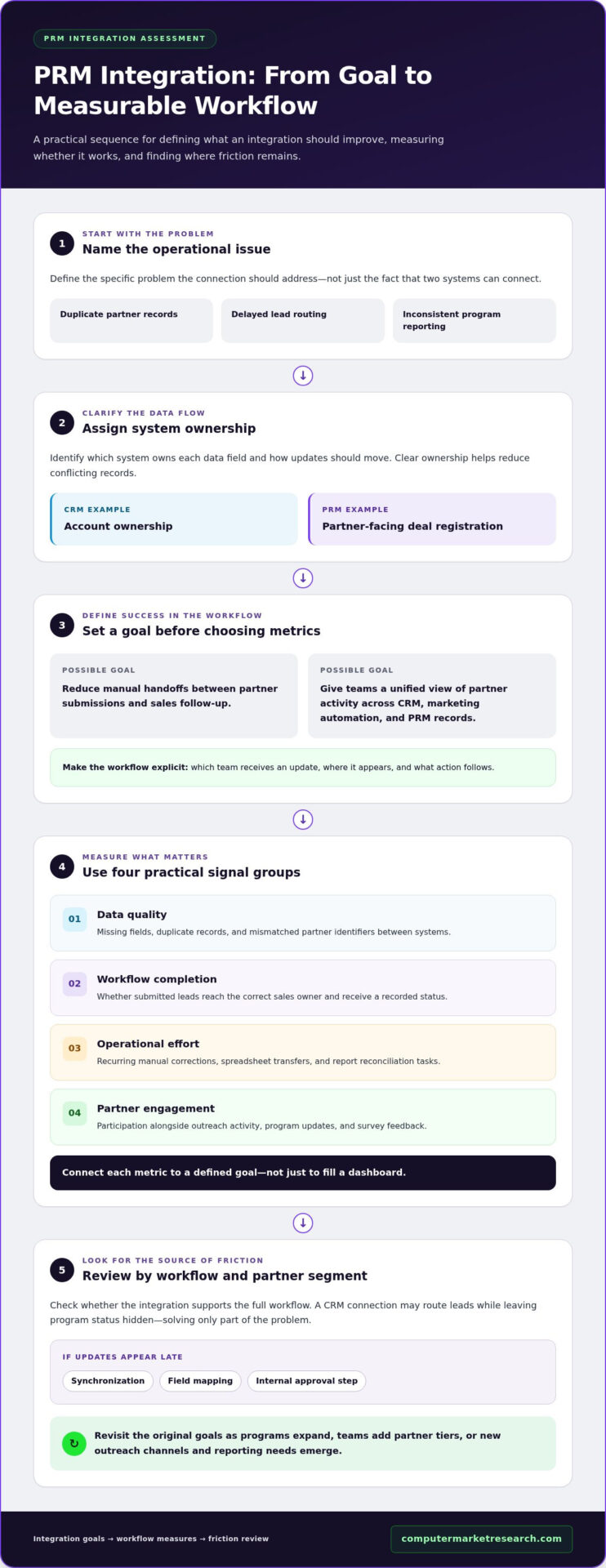
Integration is valuable when it improves a defined partner workflow, not simply because two systems connect. Start by naming the operational problem, such as duplicate partner records, delayed lead routing, or inconsistent program reporting. Then identify which system owns each data field and how updates should move. For example, a CRM may hold account ownership while a PRM manages partner-facing deal registration. Clear ownership reduces conflicting records and makes system performance easier to assess.
Set goals before evaluating integrations. A goal might be reducing manual handoffs between partner submissions and sales follow-up. Another might be giving teams a unified view of partner activity across CRM, marketing automation, and PRM records. Define the expected workflow in practical terms: which team receives an update, where it appears, and what action follows. That gives operations teams a specific basis for improving process design.
Choose metrics that reveal whether the workflow works. Track record completeness, duplicate entries, routing delays, and the time staff spend reconciling reports. For partner outreach, review whether intended audiences receive relevant communications through the right channels. Partner feedback can show whether people understand program steps or find deal registration difficult. Metrics should connect directly to a goal, not merely fill a dashboard.
For each integration, establish a small measurement set:
- Data quality: Monitor missing fields, duplicate records, and mismatched partner identifiers between systems.
- Workflow completion: Track whether submitted leads reach the correct sales owner and receive a recorded status.
- Operational effort: Record recurring manual corrections, spreadsheet transfers, and report reconciliation tasks.
- Engagement: Compare partner participation with outreach activity, program updates, and survey feedback.
Review these measures by workflow and partner segment. If a CRM integration supports lead routing but leaves program status hidden, the connection may solve only part of the problem. If updates appear late, identify whether the delay comes from synchronization, field mapping, or an internal approval step. A PRM connected to a customer data platform can also help surface patterns across behavioral and operational information.
Integration needs may change as programs expand. Revisit the original goals when teams add partner tiers, new outreach channels, or reporting requirements. If performance remains poor after correcting mappings and workflows, the platform’s integration model may no longer fit. That distinction helps leaders decide whether improving configuration is sufficient or a provider change is necessary.
Reasons organizations consider switching PRM providers
A PRM can become a constraint when partner-program complexity outpaces its structure. An acquisition may add partner tiers, regional rules, and approval paths that the existing system cannot handle cleanly. An initial public offering can also create more elaborate customization requirements. In either case, the issue is not growth alone; it’s whether the platform can support new workflows without creating fragmented records or manual workarounds.
Usability is another clear signal. Widespread partner complaints that a PRM is difficult to use suggest the problem reaches beyond individual training needs. Look for concrete examples: partners abandon deal registration, staff maintain parallel spreadsheets, or routine program changes require repeated workarounds. Compare those patterns with the intended workflow. If the platform repeatedly blocks ordinary participation, it may be limiting program performance.
Switching is not automatically the answer. First separate product limits from configuration gaps, unclear ownership, and process design. For example, if your organization is choosing between an integrated PRM and a more closely connected setup, the right fit depends on how staff need to work. Map the workflow and data handoffs to determine which arrangement is practical.
How long does switching PRM providers typically take? Sourcing and procurement alone can consume six months, and implementation adds work such as record transfer, workflow redesign, and system connections. The overall timeline depends on program complexity, approvals, and migration scope.
Risks include interrupted partner access, incomplete records, broken integrations, and confusion over active registrations or approvals. Reduce them by assigning owners to each workstream, preserving a source-of-truth record, testing critical workflows, and communicating access changes before cutover. For example, validate a partner’s ability to submit and track a registration before moving the full program.
Contract timing also affects continuity. A transition may require overlapping contracts with the current provider, while implementation can call for additional consultants or internal hires. Map those dependencies alongside the technical plan. This makes operational capacity visible and helps prevent a migration schedule from relying on staff who are already supporting daily partner activity.
Use a decision review to determine whether switching addresses the root cause:
- Document the failure: Record the partner complaint, blocked workflow, or recurring workaround.
- Test a remedy: Assess whether reconfiguration, training, or a process change resolves the issue.
- Assess the fit: Compare current capabilities with the organization’s partner-program and integration needs.
- Plan continuity: Assign owners for records, access, contracts, communications, and acceptance testing.
A switch is more defensible when the same limitations persist after targeted fixes, especially if they affect partner participation or essential workflows. A documented gap between program needs and platform capabilities gives leaders a clearer basis for evaluating replacement options.
Reviewing partner program incentives and processes
Before replacing a PRM, audit the partner program to locate the source of friction. Review incentive rules, eligibility criteria, submission steps, approval ownership, and payment or reimbursement status. For example, if partners delay co-op requests because required evidence is unclear, the problem may lie in program instructions rather than software. A short process map can show where partners pause, repeat information, or contact staff for clarification.
Assess whether incentives support the behaviors the program aims to encourage. Compare the written terms with the actual workflow: can partners see which activities qualify, what documentation is needed, and where a request stands? If a rebate process requires manual spreadsheet reconciliation, record each handoff and correction. That evidence helps determine whether the platform causes friction or reflects a process that needs redesign.
Partner feedback adds context to system data. Gather examples from deal registration questions, support requests, program reviews, and recurring complaints. Then group them by process stage. If feedback clusters around eligibility, clarify the rules; if it clusters around status visibility, examine the tracking workflow. A partner journey map can connect each friction point to an owner, system step, or incentive policy.
Review internal processes with the same care. Identify who approves funding, updates program terms, resolves exceptions, and communicates changes. For example, if sales and finance use different eligibility records, partners may receive inconsistent answers. A single source of truth and clear approval ownership can resolve that issue without a provider change.
Patient relationship management has a different meaning in healthcare, but the process lesson is relevant: communication should support the full journey. A clinic might coordinate an appointment reminder and follow-up information. In a channel program, the equivalent is clear guidance from incentive enrollment through claim review. Keep these contexts distinct while assessing whether the PRM supports the interactions your program requires.
Before switching, discuss specific remedies with the current provider. Ask whether a different subscription configuration, system reconfiguration, or revised workflow could address the documented issue. Compare the proposed remedy with the audit findings. A different configuration may help when unused functionality adds complexity, while reconfiguration may help when an existing workflow does not align with program rules.
Use the review to create a decision record:
- Issue: Describe the affected incentive or process, such as unclear co-op eligibility.
- Evidence: Capture partner feedback, repeated corrections, and approval bottlenecks.
- Root cause: Separate policy, ownership, training, and platform configuration problems.
- Remedy: Record the proposed process change or vendor adjustment and its expected effect.
This audit makes the next decision more precise. If process changes or provider adjustments address the root cause, switching may add unnecessary disruption. If documented program requirements remain unsupported, the evidence can guide a focused provider evaluation.
What features should you compare when choosing a new PRM provider?
Compare platforms against the workflows your organization needs, not a generic feature checklist. Start with the use cases driving the evaluation, such as provider enrollment, referral coordination, patient communication, and performance reporting. A feature matters when it supports a specific task. For example, a referral status view should help staff identify incomplete handoffs and communicate progress to the referring provider.
Integration design deserves close attention. Check how the PRM connects with your EHR, access center, and engagement tools, and identify which system owns each record. Two-way data flow can update appointment changes made through the PRM in the EHR. During evaluation, trace a sample appointment update from entry through synchronization, then confirm that staff can see the current information without repeating the update manually.
Review data quality and reporting capabilities alongside integrations. Useful measures include provider satisfaction, credentialing and enrollment turnaround, provider record accuracy, and referral completion. Ask whether reports can separate activity by provider group or workflow, so teams can act on patterns rather than relying on broad totals. A practical scenario is checking whether a delayed enrollment appears clearly enough for staff to follow up.
Interface design also shapes adoption. An embedded PRM places relationship functions inside the EHR, allowing clinicians to work through one interface and view communication history alongside clinical data. A separate PRM may better fit workflows requiring distinct outreach or coordination tools. Compare both approaches using the tasks clinicians and operations staff perform each day, including reviewing messages and updating records.
Assess partner-facing functions against the actual program journey. Relevant capabilities may include onboarding, training, content sharing, deal registration, incentive management, and performance tracking. These features should fit existing workflows and program rules. Avoid selecting modules simply because they appear on a checklist.
Use a consistent evaluation matrix to compare each platform:
- Workflow fit: Test enrollment, referral tracking, communication, and follow-up using representative scenarios.
- Integration behavior: Trace how appointment changes and other updates move between the PRM and EHR.
- Data visibility: Confirm reports surface record accuracy, turnaround, and provider satisfaction measures.
- Usability: Have clinicians and operational staff complete routine tasks, then note friction and duplicated work.
- Governance: Review how access, consent, and data-sharing policies are managed across connected systems.
Weight each capability by its importance to your defined goals. A platform that handles core workflows clearly may be a better fit than one with more features but weaker integration. To assess partner-management workflows in practice, explore the available trial.
Also compare whether the program can track provider satisfaction, credentialing and enrollment turnaround times, provider data accuracy, and regulatory compliance. Verify that the PRM and EHR integration supports two-way data flow, including appointment changes entered through the PRM appearing in the EHR. Assess whether confidential communication can cover medical information, test results, and treatment plans.
Computer Market Research: PartnerPortal™
Computer Market Research offers PartnerPortal™ for organizations managing channel partner relationships and programs. If your evaluation points to fragmented deal registration, incentive administration, or limited visibility across partner activity, its channel-focused tools may align with those needs. Co-op/MDF Management and Rebates & Incentives support program administration, while Deal Registration helps manage partner-submitted opportunities. These offerings are designed for channel operations, so they are relevant when your PRM decision concerns partner workflows rather than patient relationship management.
Use your requirements list to assess whether these capabilities fit your program’s processes and priorities. To discuss your channel partner management needs, contact Computer Market Research or visit computermarketresearch.com.
Turn your PRM decision into a practical next step
A sound PRM decision should create a clear direction for the program, not just replace one system with another. Knowing when to switch PRM providers means connecting the decision to the work ahead: which processes need to change, who will own them, and how teams will know the new setup supports their objectives.
Before moving forward, give internal stakeholders a shared reference point. Document the outcomes your organization expects, the workflows that matter most, and the responsibilities required to maintain them. This helps keep the decision grounded as implementation planning begins and gives teams a consistent basis for prioritizing improvements.
When you’re ready to explore a channel management option, take the next step with Computer Market Research. Use the evaluation to connect your program priorities with a practical path forward.
With clear ownership and focused goals, your next PRM decision can support a more manageable, responsive partner program.
Frequently Asked Questions
When Is It Time To Switch Your PRM?
Consider a change when recurring platform limitations continue to block important partner-program outcomes after configuration and process improvements. The decision about when to switch PRM providers should reflect documented operational impact, not a single complaint or temporary dip. For example, if teams cannot reliably connect program activity to business results, define the missing capability and assess whether the current system can support it. A replacement makes sense when that gap remains material.
Why Might Someone Consider a PRM Switch?
Organizations may consider switching when their PRM no longer fits how they manage partner relationships. A shift toward new sales channels, different partner roles, or more complex approval paths can change system requirements. For example, a team that once needed basic deal submissions may now need clearer coordination between partner activity and sales operations. The key is identifying which new requirement the current platform cannot support effectively.
What signs indicate it’s time to switch PRM providers?
Look for recurring evidence across teams, not just one isolated issue. Examples include partners repeatedly seeking help with routine tasks, staff maintaining separate records to complete core work, or managers lacking reliable answers about program activity. Compare those signals with the documented workflow and identify where the breakdown occurs. If the same failure persists across partner groups and internal owners, it can indicate a provider-fit problem.
How do you compare PRM providers for integrations, customization, and scalability?
Compare providers using real partner-program scenarios rather than feature names alone. Demonstrate how a partner submits a deal, how an approval rule routes it, and how the resulting activity appears in reporting. Then examine how administrators can adjust workflows and how connected systems exchange data. Ask each provider to show the same scenarios, including a more complex program structure, so differences in fit and operational effort become clear.

Article by
Del Heles
Del Heles is the founder and CEO of Computer Market Research (CMR), a channel management software company he launched in 1984. With more than 40 years of experience, he’s known for helping manufacturers and distributors simplify complex partner programs through practical, customer-focused technology solutions.