

A product sale is only the starting point of a value-added reseller’s work. To understand what is a value-added reseller VAR, look beyond the transaction to how a partner adapts products to customer needs through services such as integration, configuration, training, or support. That expertise can help turn a standalone product into a solution suited to a customer’s business.
It’s easy to confuse a VAR with a conventional reseller or another channel partner, especially when their roles overlap. This article explains how the VAR business model works, what VARs do beyond reselling, and how they differ from distributors, system integrators, and OEMs. It also covers practical ways manufacturers can support VAR relationships through clear deal registration, transparent incentives, training, and consistent communication. Finally, it shows how centralized partner workflows and performance visibility can help manufacturers manage channel activity, including through CMR’s channel-management solutions.
Key Takeaways
- To understand what is a value-added reseller var, look at the services that adapt or integrate a product to meet customer needs.
- Trace how a VAR supports customers, from understanding requirements through implementation and ongoing use.
- Distinguish VARs from resellers, distributors, OEMs, and system integrators by their primary roles and customer relationships.
- Build stronger VAR partnerships with clear onboarding, current product resources, and defined workflows.
- Use centralized partner information and channel workflows to improve visibility into program activity and performance.
What Is a Value-Added Reseller (VAR)?
A value-added reseller (VAR) sells a third-party product with additional services or capabilities. Those services can adapt, configure, or integrate the product to address a customer’s requirements, rather than simply passing the product along.
To understand what is a value-added reseller var, focus on the work that connects a product to a usable solution. A VAR may help a customer select components, make them work together, and prepare employees to use them. The exact role depends on the agreement, product, customer, and market. As outlined in What is a Value-Added Reseller (VAR)?, the model commonly combines products with services to create an integrated offering.
For a concise overview of the VAR model, watch this video:
What does a value-added reseller do?
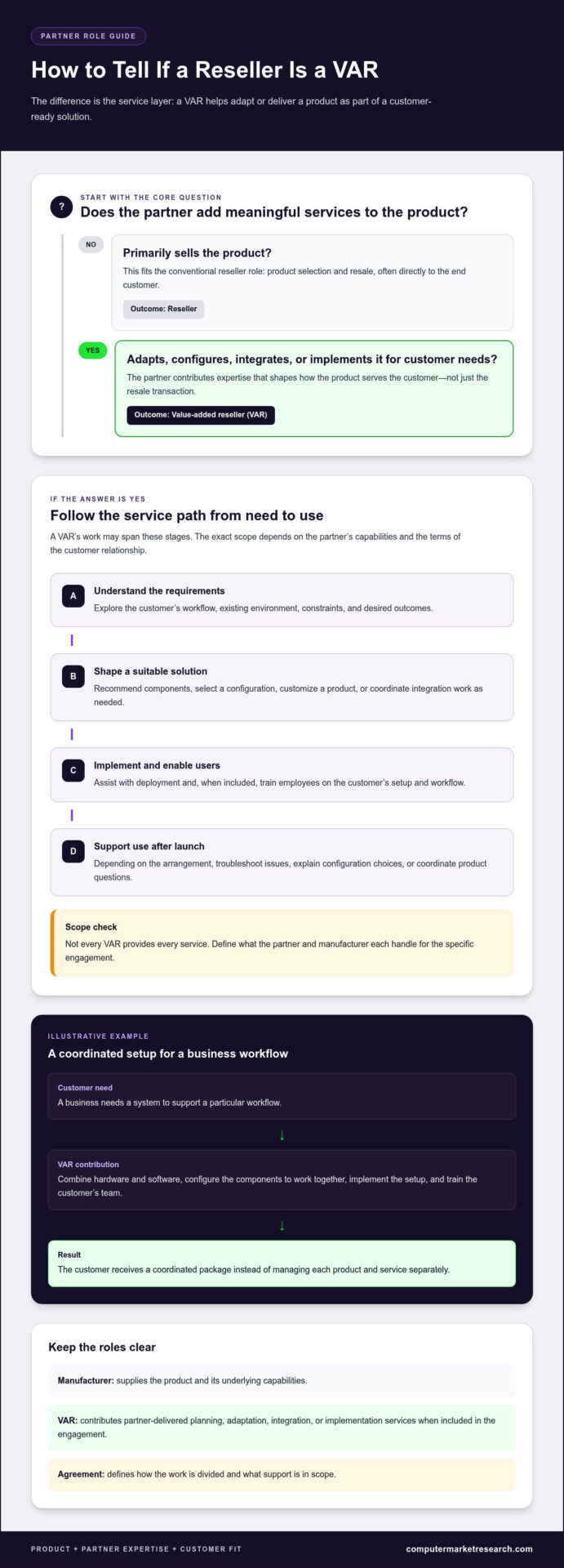
A VAR may assess requirements, recommend a solution design, configure or customize products, integrate components, and manage implementation. Depending on the engagement, it may also provide training, troubleshooting, or post-purchase support. By coordinating these services, the VAR can give the customer a more direct path from product selection to effective use.
Example: A business needs a system to support a particular workflow. A VAR might combine hardware and software, configure the components to work together, implement the setup, and train the customer’s team. The customer receives a coordinated package instead of managing each product and service separately.
What makes a reseller a VAR?
The distinction is the service layer. A conventional reseller primarily sells a product, while a VAR contributes meaningful customization, integration, implementation, or other expertise that shapes how the product serves the customer. The term describes a business model, not a fixed package of services, so the value-add can differ from one relationship to another.
A reseller sells the product; a VAR helps adapt and deliver it as part of a solution. The difference is practical: the VAR’s contribution connects the offering to the customer’s requirements. Define the responsibilities for each engagement rather than assuming them from the VAR label alone.
How Does a VAR Create Value Across the Customer Journey?
A VAR’s contribution can begin with a conversation about a business need and continue through deployment and post-launch support. The work often follows a practical sequence: understand the requirements, assemble or adapt a suitable solution, implement it, and support its use. Not every VAR provides every service. The scope depends on the partner’s capabilities and the terms of the customer relationship.
A VAR bridges product capabilities and customer-specific requirements by shaping how products are configured, connected, and put into use. That can reduce the customer’s coordination burden while clarifying the difference between the product itself and the services a partner provides around it.
From customer requirements to an integrated solution
Discovery starts with the customer’s workflow, existing environment, constraints, and desired outcomes. The VAR uses that context to consider which product configuration or complementary services may fit. Depending on the engagement, its role might include recommending components, configuring a product, or coordinating integration work. No single technical task applies to every VAR relationship.
Illustrative IT example: A company wants to connect new business software with its existing systems. A VAR might clarify the required data flow, configure the software, and coordinate integration with other components. The manufacturer supplies the product and its underlying capabilities; the VAR contributes partner-delivered planning or implementation services. The agreement defines how the work is divided.
Implementation, training, and ongoing support
After solution design, a VAR may assist with deployment, explain the new workflow to users, and provide training tailored to the customer’s setup. These steps help employees understand how to use the solution in their day-to-day work. They don’t change what the original product includes; they are services delivered by the VAR when included in the engagement.
Support may continue after launch. Depending on the arrangement, the VAR might troubleshoot issues, explain configuration choices, or coordinate product questions. This can give customers a practical point of contact during adoption. Define support scope and responsibilities for each relationship.
Across the customer journey, the VAR translates requirements into decisions about configuration, complementary services, deployment, and user enablement. Mapping each stage helps customers understand where the partner’s contribution begins and ends, and which responsibilities remain with the product manufacturer.
For manufacturers, mapping these touchpoints can also clarify where partner workflows and activity data need coordination. CMR’s 90-day free trial lets teams explore channel management workflows.
VAR vs. Reseller, Distributor, OEM, and System Integrator
Channel roles can overlap, but each has a different primary contribution. To understand what is a value-added reseller VAR, compare its work with that of a conventional reseller, distributor, original equipment manufacturer (OEM), and system integrator. These distinctions help map responsibilities across a sale, from creating a product to preparing it for a customer’s environment.
| Role | Primary contribution | Customer relationship | Typical activities |
|---|---|---|---|
| Reseller | Sells products to customers | Often transacts directly with the end customer | Product selection and resale |
| VAR | Adds services or capabilities to products before resale | May advise and work directly with the end customer | Configuration, customization, implementation, or integration |
| Distributor | Supports product movement through the channel | Typically serves resellers or VARs | Supplying products to channel partners |
| OEM | Creates the original product | May sell through channel partners or directly | Designing and manufacturing its offering |
| System integrator | Connects technologies or systems so they work together | Works with customers on integration needs | Coordinating systems, applications, and components |
VAR vs. reseller and distributor
A reseller’s main contribution is making a product available to a buyer, though its responsibilities can vary. A VAR adds a service or integration layer that adapts the offering to customer requirements. A distributor generally occupies a different position in the channel, helping move products from manufacturers to resellers or VARs rather than focusing primarily on delivering a solution to an end customer.
These roles aren’t always separated by company. An organization might distribute products and also provide configuration or implementation services. To distinguish the roles in a specific transaction, look at the work being performed: product supply, resale, or customer-focused value-added delivery.
VAR vs. OEM and system integrator
An OEM originates the product; a VAR resells products made by another company and may adapt or integrate them for a customer. A system integrator focuses on connecting technologies or systems so they operate together. Integration can also be part of a VAR’s service, so the labels aren’t mutually exclusive.
For example, a VAR could resell a manufacturer’s software and coordinate its connection to a customer’s existing tools. The OEM remains the source of the software, while the VAR handles resale and customer-facing services. A system integrator may focus more narrowly on cross-system design and implementation. In practice, examine the responsibilities in the engagement, not just the partner’s title.
How Manufacturers Can Build Effective VAR Partnerships
Recruiting VARs is only the start of building a channel. Partners need clear processes, useful product information, and visibility into the workflows that shape their work with a manufacturer. Without these foundations, even capable partners can encounter friction during onboarding, product positioning, opportunity registration, and program administration.
Understanding what is a value-added reseller var helps manufacturers focus on the relationship as well as the role. A VAR contributes customer-facing expertise, so manufacturers can support that contribution with timely resources and predictable processes. Make it clear how partners get enabled, submit opportunities, access program information, and review activity.
Enable VARs with clear processes and resources
Structured onboarding can introduce partners to product positioning, program requirements, and resources for customer conversations. Keep training materials and product content current, organized, and accessible so partners can use consistent information as products or programs change. Broader partner relationship management connects these activities across the partner lifecycle, from onboarding through ongoing engagement.
Deal registration also benefits from a clearly defined process. Specify what information a submission requires, how it moves through review, and how partners can see its status. Clear steps reduce uncertainty for partners and the internal teams managing the program. Explain how registration connects to other partner processes, including incentives, and keep requirements easy to find rather than scattering them across documents and communication channels.
Reliable channel data gives manufacturers a stronger basis for partner program decisions. It helps teams review activity, spot information gaps, and refine program processes.
Use channel data to understand partner activity
Sales and point-of-sale (POS) information can help manufacturers understand activity across indirect channels. Consistent reporting makes it easier to interpret submissions and partner-reported sales within a shared view instead of relying on disconnected files or inconsistent definitions. Channel data management supports data quality and visibility, both important when reviewing partner activity across a channel.
Performance visibility should support useful program oversight, not just produce reports. Manufacturers can use shared information to identify workflows that need attention, determine where partners may need updated resources, and review whether program processes are being used as intended. Data doesn’t replace partner communication; it gives both sides a more consistent basis for it.
Centralized workflows can bring onboarding, deal registration, program activity, and channel information into a more coordinated operating model. Manufacturers evaluating how to organize partner processes can explore CMR’s 90-day free trial.
How CMR Supports Manufacturers Managing VAR Channels
Managing a VAR channel involves more than recruiting partners. Manufacturers also need workable processes for onboarding, deal registration, program activity, and channel information. When these workflows are fragmented, teams can struggle to maintain a shared view of partner activity and program status.
Understanding what is a value-added reseller VAR clarifies why these relationships need coordination: partners contribute customer-facing work, while manufacturers manage the programs and information that support the channel. Computer Market Research provides channel management software for manufacturers and other organizations that rely on indirect sales. CMR supports channel programs; it is not a VAR.
Centralize partner activity and channel workflows
PartnerPortal is CMR’s platform for centralized channel program management. Its capabilities include partner onboarding and deal registration, while channel information helps manufacturers review partner activity and performance. Coordinating these processes can give program teams a clearer view of partner participation and the status of key workflows.
For example, a manufacturer can use defined onboarding steps to organize how partners enter a program, then use a consistent deal registration process to record and review opportunities. Performance visibility and channel data can inform program oversight alongside those workflows. CMR’s channel partner management software centralizes channel program management, helping manufacturers coordinate partner-related processes instead of relying solely on disconnected records.
Centralization also gives manufacturers a practical foundation for managing program information over time. Teams can use clear processes for partner participation, deal activity, and channel data, then apply that information to program administration. The software supports operational coordination; it doesn’t replace the manufacturer’s decisions about partner strategy, program rules, or how to act on performance insights.
Evaluate the approach with a 90-day free trial
A channel platform should be assessed against the workflows a manufacturer needs to manage. During CMR’s 90-day free trial, teams can evaluate how the platform fits their partner onboarding, deal registration, performance visibility, and channel data processes. This gives them a defined period to assess operational fit without assuming a particular outcome or implying that access remains free after the trial.
As you assess the platform, consider whether its information and workflows support the way your organization manages its channel program. Reviewing current processes can help identify where partner activity is coordinated effectively and where teams may need greater consistency.
Start your 90-day free trial to evaluate CMR’s channel management software against your VAR program workflows.
Put Your VAR Channel Strategy Into Practice
Understanding what is a value-added reseller var is a starting point. The next step is building a channel approach that works across your partner network. Consider where partner information is maintained, how opportunities move through review, and whether teams can see the activity they need to manage the program. These questions help identify practical areas to assess without assuming every partner needs the same process.
A coordinated view of workflows and channel data gives your team a clearer basis for reviewing how it supports partners. Use that view to assess whether a channel management platform fits the way your organization operates. CMR’s trial provides an opportunity to evaluate the platform against your own workflows.
To assess that fit, start your 90-day free trial and evaluate centralized channel management for your VAR program.
Frequently Asked Questions
What is a value-added reseller in simple terms?
A value-added reseller (VAR) sells another company’s product with additional expertise or services that help address a customer’s needs. For example, a VAR might configure business software to fit a team’s workflow or help coordinate deployment. To understand what a value-added reseller is, look at the partner’s contribution around the product, not just the transaction. The exact services depend on the partner’s capabilities and agreement with the customer.
How does a VAR make money?
A VAR may earn revenue from product resale and from fees for services it provides. Those services might include consulting, configuration, implementation, training, or support, depending on the engagement. How a VAR packages and charges for products and services varies by business and agreement. Customers should understand which work is included in a proposed solution and which services may be priced separately.
Is a VAR the same as a distributor?
No. A distributor generally supplies products to resellers or other channel partners, while a VAR typically sells to or works with end customers and adds services to the offering. The roles can overlap: a company may distribute products and also provide customer-facing services. To distinguish them in a specific transaction, consider who the buyer is and whether the organization is primarily supplying products through the channel or delivering a tailored solution.
What is the difference between a VAR and a system integrator?
A VAR’s role centers on reselling products with additional value, while a system integrator focuses on connecting technologies so they function together in a customer’s environment. A VAR may also perform integration, so the terms aren’t mutually exclusive. For instance, an organization could resell software and configure its connection to other systems, while another engagement might focus mainly on designing and coordinating a multi-system integration.
Can a VAR customize software or hardware?
Yes. A VAR may customize or configure software or hardware when the product’s technical limits and the partner’s capabilities allow it. Software work could involve settings or workflows; hardware work might involve assembling components into a customer-specific setup. Customization isn’t automatically part of every VAR engagement. Define the requested changes, responsibilities, and product support boundaries in the project scope.
Why do manufacturers work with value-added resellers?
Manufacturers work with VARs to reach customers through partners that bring product knowledge, market expertise, or customer-facing services to the relationship. A VAR may explain how an offering fits a particular business context and support its adoption. This channel model can extend a manufacturer’s route to market. Partner enablement and clear program processes help align the manufacturer’s resources with the VAR’s customer work.
What industries commonly use VARs?
VARs are common in technology markets, where customers may need products configured, connected, or supported as part of a broader solution. They also operate in areas such as telecommunications, healthcare technology, and business equipment. The value-add varies by industry: one partner might focus on software deployment, while another supports specialized equipment. In each case, the model connects a third-party product with services relevant to its intended use.

Article by
Del Heles
Del Heles is the founder and CEO of Computer Market Research (CMR), a channel management software company he launched in 1984. With more than 40 years of experience, he’s known for helping manufacturers and distributors simplify complex partner programs through practical, customer-focused technology solutions.