

What if the lowest per-partner rate leads to the wrong budget? Enterprise prm software pricing models can use different billing units, so a subscription that looks straightforward may not reflect implementation, integration, or data-service needs. The right comparison starts with the work your partner program must support, not a single headline figure.
It’s difficult to compare proposals when one vendor scales fees by active partners and another by processed data volume. Growth can also change the equation: more partners may increase platform value, while adding integrations or data administration can affect the overall scope. A consistent view of recurring subscriptions, one-time implementation and integration fees, and ongoing managed data services helps bring those differences into focus.
This guide explains common enterprise PRM pricing structures and their trade-offs, identifies the cost drivers to include in a total-cost comparison, and offers a framework for assessing fit as your channel evolves. You’ll also see how to define an evaluation before making a purchase decision, including using Computer Market Research’s 90-day free trial to assess PartnerPortal against your program requirements.
Key Takeaways
- Compare enterprise prm software pricing models by the billing unit each uses, then consider how that unit may fit your partner ecosystem as it grows.
- Look beyond the subscription: implementation, integrations, and ongoing data services can all shape the full cost picture.
- Use a like-for-like proposal framework to document scope, assumptions, service boundaries, and renewal terms.
- Start with your workflows and data requirements to identify which pricing structure best aligns with how your organization operates.
- Use a defined evaluation period to assess platform fit against real program needs before making a purchase decision.
Enterprise PRM software pricing models: why the structure matters
A vendor quote is only useful when you know what it measures. Enterprise prm software pricing models are the structures vendors use to charge for partner-management software and related services. They may define subscription fees around active partners or processed data volume, while implementation, integrations, and managed data services may be scoped separately. There is no single structure that fits every program, so this section compares evaluation approaches rather than universal market prices.
What does enterprise PRM pricing usually account for?
Start by mapping the work the platform needs to support. Partner-program scope can include the size and activity of the partner network, the volume and type of data being processed, and the workflows teams rely on to manage onboarding, sales, marketing, or channel operations. A proposal built around one billing unit may not capture the effort or services required elsewhere.
PRM pricing models are the methods vendors use to calculate charges for partner-management software and associated services, based on defined billing units, scope, and service inclusions. Use that definition to separate the recurring software subscription from one-time implementation or integration work and ongoing managed data services. Then map your requirements before comparing proposals. A clear scope makes it easier to identify what a quote covers, what is priced separately, and which assumptions could change the overall investment.
Why enterprise channel complexity changes the comparison
Partner ecosystems rarely follow one uniform process. Different partner groups may need distinct onboarding steps, sales workflows, marketing programs, or data-handling processes. Those differences affect how a PRM must be configured and which capabilities teams will actually use. A platform comparison should therefore connect each proposed charge to a workflow or operating requirement, rather than treating partner count as the whole picture.
Integration planning adds another layer. Connecting PRM processes with CRM or ERP systems may involve aligning data fields, defining which system supplies or receives information, and coordinating implementation work across teams. These requirements can influence the scope of implementation and integration services, even when the software subscription is quoted separately. Document the systems involved and the data that needs to move between them before reviewing vendor proposals.
For context on how PRM supports channel relationships and partner-facing processes, see this Partner Relationship Management (PRM) software reference. Organizations assessing how channel operations fit together can also review channel sales management software as part of defining their program scope. With those workflows mapped, enterprise prm software pricing models become easier to compare on consistent terms: billing unit, subscription coverage, implementation needs, integration scope, and ongoing services.
Four enterprise PRM pricing structures and what each measures
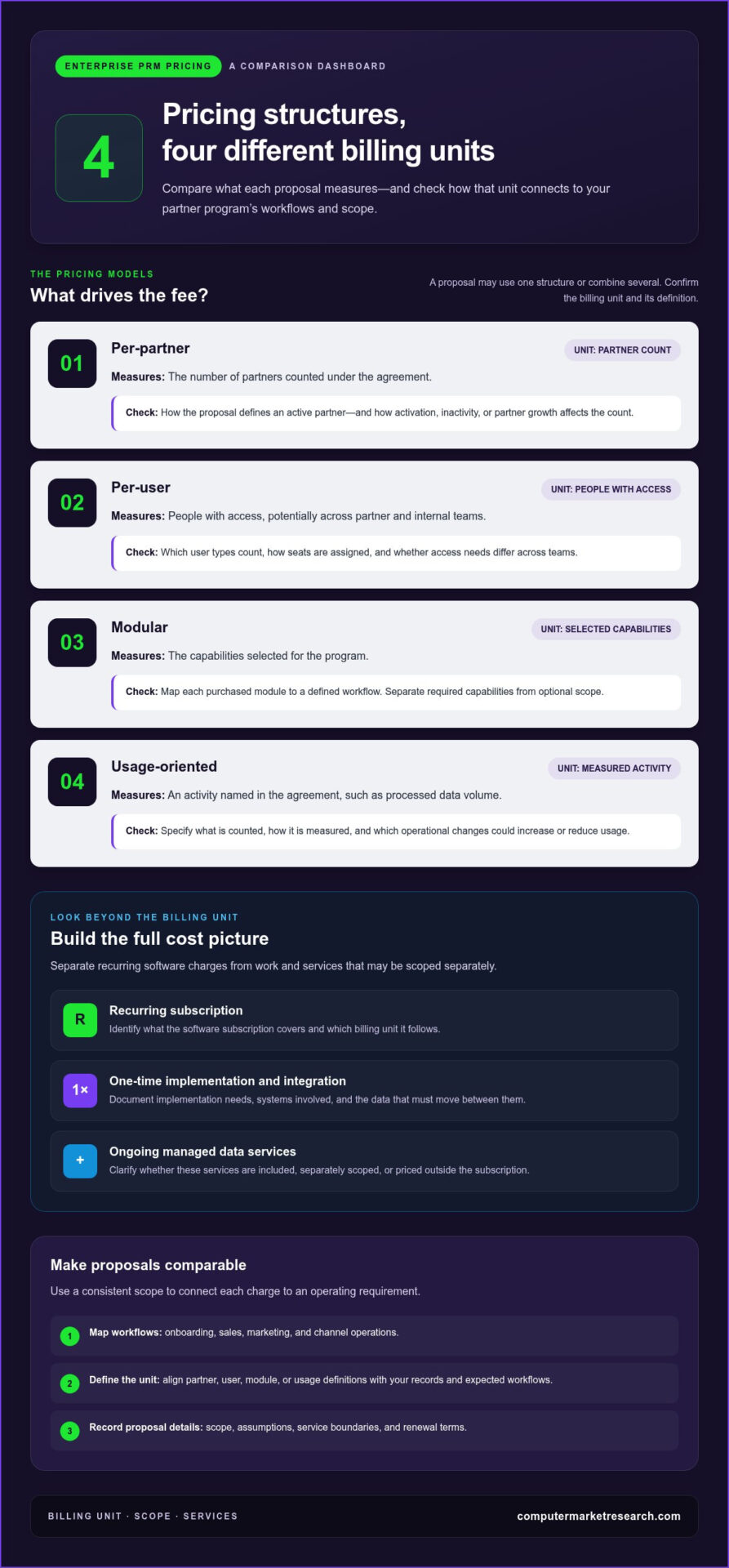
Pricing labels are useful only when they reveal what drives the fee. The four structures below are comparison categories, not universal market rules or a statement of plans offered by Computer Market Research (CMR). A proposal may use one approach or combine several, so identify the billing unit and its effect on your program before comparing totals. For broader context, common pricing models for enterprise software include different ways of linking charges to access, features, or usage.
Structure | What it measures | What to examine
Per-partner | The number of partners counted under the agreement | Define an active partner and clarify how activation, inactivity, or partner growth affects the count.
Per-user | The people with access, potentially across partner and internal teams | Establish which user types count, how seats are assigned, and whether access needs change across teams.
Modular | The capabilities selected for the program | Map each purchased module to a defined workflow and distinguish required capabilities from optional scope.
Usage-oriented | A measured activity, such as processed data volume | Specify what activity is counted, how it is measured, and which operational changes could increase or reduce usage.
Partner-, user-, and usage-oriented pricing
Each billing unit responds to a different change in operations. A per-partner structure is sensitive to the partner population included in its definition. A per-user approach reflects the people who need system access, which may include internal administrators as well as partner users. Usage-oriented pricing follows the activity named in the agreement; for CMR, subscription fees are typically scaled by active partners or processed data volume.
Definitions matter. Your partner directory may include inactive records, while a user count may distinguish between people who log in regularly and those with occasional access. Before comparing proposals, align each vendor’s definitions with your own records and expected workflows. The relevant question is not simply how many partners or users you have, but whether the proposal’s unit tracks the operational activity you intend to manage.
Modular subscriptions and service-based fees
A modular structure can help buyers connect selected capabilities to specific program requirements. List the workflows you need to support, then map each capability in the proposal to those workflows. This makes it easier to identify mismatches, avoid comparing different scopes as if they were equivalent, and understand how a change in program needs may affect the subscription.
Subscription charges cover recurring software access; professional services and managed data services are separate fee categories. Implementation and integration charges may be one-time, while managed data services are ongoing. Keep those items distinct in the comparison, and record what work each covers. CMR describes these as separate fee categories rather than publishing a single universal price. Teams assessing centralized partner-program management can explore PartnerPortal partner management, then use the 90-day free trial to evaluate platform fit against defined workflows.
How to compare enterprise PRM proposals beyond the subscription
A subscription figure can’t show the full scope of a PRM purchase. To compare enterprise PRM software pricing models consistently, align proposals around the same workflows, partner population, users, data requirements, and program scope. Computer Market Research does not publish specific price figures, so this comparison focuses on how to assess proposal structure without estimating or implying a quote.
Create a consistent enterprise PRM cost comparison
Build a comparison sheet with a column for each proposal and shared rows for the elements being evaluated. Record recurring subscription charges separately from one-time implementation and integration fees, as well as any ongoing managed data services. Don’t assume two similar labels cover the same work. Note what each fee includes and where the service boundary falls.
Document each proposal’s billing unit and assumptions. For example, capture how it defines an active partner, which users are counted, and how processed data is measured if that is relevant to the subscription. Record the scope used for each estimate, the workflows covered, and the renewal terms that apply. This creates a consistent basis for evaluating differences instead of comparing quotes built on different assumptions.
For every proposal, record the scope, billing unit, assumptions, included services, one-time and recurring fees, service boundaries, and renewal terms.
Account for integrations and managed data requirements
Include systems and data flows in the comparison, not just portal functions. List the ERP and CRM integrations required to support your workflows, the information that needs to move between systems, and any implementation work associated with those connections. This gives your team a clearer view of whether proposals address the same integration scope.
Then assess whether POS or inventory data administration is part of your operating requirements. If it is, include the relevant data processes and ongoing responsibilities in the scope you compare. CMR’s channel data management guide provides context for evaluating channel data management capabilities alongside PRM requirements.
Separate what the software subscription covers from any one-time implementation or integration work and ongoing managed data services. The Partner Relationship Management Market Report offers broader context on the PRM market, while your proposal review should stay anchored to your organization’s defined scope. Consistent categories make differences visible without treating any one fee structure as a market standard.
Once the requirements are documented, use them to assess platform fit against real workflows. A 90-day free trial can provide a defined period to evaluate PartnerPortal before a purchase decision.
Choose an enterprise PRM pricing model for your operating needs
The best-fit billing structure is the one that reflects how your partner program operates, not simply the one with the clearest headline. Use a consistent decision process to connect pricing assumptions to real workflows, data requirements, and expected changes. This makes it easier to compare enterprise prm software pricing models on operational fit rather than unsupported savings claims.
- Define scope. Document your current partner ecosystem, internal teams, program goals, and the business processes the platform needs to support. Separate existing requirements from expected changes in partner volume or program scope.
- Map workflows. Identify essential activities such as partner onboarding, deal registration, MDF administration, rebates, and reporting. Mark each as required or optional so that proposals are compared against the same operating needs.
- Assess data. Record the information each workflow uses, where it originates, and how it needs to be managed. Include POS or inventory data if those processes are relevant to your organization.
- Compare fee categories. Match the proposed billing unit to your partner ecosystem and intended usage. Review subscription scope alongside implementation, integration, and managed data service fees, keeping one-time and ongoing categories distinct.
- Evaluate fit. Test whether the proposed platform and billing assumptions support current priorities and anticipated changes. Compare expected outcomes with your own baseline measures, not generalized ROI promises.
Match pricing assumptions to partner-program requirements
Current needs and future possibilities should be visible, but not blended together. For example, distinguish the partners and workflows in scope today from planned expansion or new program activity. Then check whether the billing unit responds to a change you expect, such as more active partners or increased data processing. Mapping essential workflows first also helps prevent optional capabilities from obscuring the needs the platform must meet.
For centralized partner operations, channel partner management software can bring program workflows into a shared evaluation. Use your requirements map to assess which capabilities are relevant, rather than assuming every available function belongs in the initial scope.
Evaluate value without relying on unsupported ROI promises
Set organization-specific baselines before evaluating potential value. You might track time spent on manual partner administration, the completeness and timeliness of reporting, or how clearly your team can review MDF and rebate fund utilization. Compare those measures during evaluation, and document any process changes alongside the results. This creates a practical basis for judging fit without relying on invented savings figures or industry benchmarks.
Deal and opportunity workflows should also be assessed against how your channel team currently records, reviews, and reports partner activity. Once you’ve defined those workflows and comparison criteria, evaluate PartnerPortal with a 90-day free trial to see how it aligns with your operating requirements before making a purchase decision.
Evaluate CMR’s enterprise PRM approach with a 90-day trial
PartnerPortal is Computer Market Research’s flagship PRM platform for centralized partner-program management. To understand its fit, assess the platform against the workflows, data needs, and integration context your team has documented, then consider its fee categories alongside the operating scope. CMR describes recurring SaaS subscriptions that are typically scaled by active partners or processed data volume, one-time implementation and integration fees, and ongoing managed data services fees. Pricing figures aren’t published, so this guide doesn’t estimate a quote.
A 90-day free trial gives organizations a defined period to evaluate the platform before making a purchase decision. Use your requirements as the test plan. The aim is to determine whether the platform aligns with the work your partner program needs to manage, not to assume particular trial features or outcomes.
What to evaluate during the 90-day trial
Test relevant partner workflows using representative scenarios from your program. If onboarding, deal registration, MDF or rebate administration, and reporting are priorities, assess how each fits your documented processes. Review whether the information your teams need is visible and organized in a way that supports their work.
Include integration context in the assessment. Note the ERP or CRM systems involved, the data your workflows depend on, and the connections that matter to your operations. Compare what you observe during the trial with your requirements and proposal assumptions. This keeps the evaluation grounded in your environment without presuming which integrations, services, or results are included.
Why channel expertise matters in the buying decision
PRM selection involves more than software access. Partner processes, channel data, integrations, and program administration all shape the operational context. Computer Market Research was founded in 1984 and brings over 40 years of channel program experience to this specialized area. That history can inform a considered evaluation, while your own requirements remain the measure of fit.
Customer outcomes should also be read with clear attribution. Jabra reported a sales pipeline increase and a sales spike of over $10 million. This is a reported customer result, not a guaranteed outcome for every organization. Use your own baselines and program priorities to assess potential value, including administrative effort, reporting clarity, and visibility into channel activity.
The right choice among enterprise prm software pricing models depends on how well the billing assumptions and service scope align with your partner operations. Evaluate PartnerPortal against your documented needs during the 90-day trial, then use that assessment to inform your decision. Start your 90-day free trial.
Make your next PRM decision with confidence
A useful buying decision doesn’t end when a proposal is selected. Establish who will monitor partner activity, review data quality, and revisit whether the platform’s scope still matches program priorities. As partner relationships and workflows evolve, these ownership practices help keep technology decisions connected to day-to-day operations.
Use your evaluation to set a practical starting point: document the processes your team wants to improve and the information it needs to manage them. That baseline can support future reviews of platform fit and keep decisions grounded in actual channel requirements. The same discipline makes enterprise prm software pricing models easier to assess as your organization’s needs change.
Take the next step by evaluating PartnerPortal against your program’s requirements. Start your platform evaluation and give your team a clear basis for deciding what supports its partner operations. A structured assessment can turn a complex software decision into a more confident path forward.
Frequently Asked Questions
Is enterprise PRM software priced per partner or per user?
Enterprise PRM may be priced per partner or per user, depending on the vendor’s agreement. Per-partner billing counts partner organizations or defined active partners; per-user billing counts people with access; usage-oriented structures track an activity such as processed data. These are comparison categories, not a promise that one vendor offers all three. CMR describes subscriptions as typically scaled by active partners or data volume, so compare definitions before modeling enterprise prm software pricing models.
What costs can be separate from an enterprise PRM subscription?
Costs beyond recurring software access can include implementation, integration, and ongoing data services, depending on the agreed scope. Treat these as distinct categories in your budget: CMR describes implementation and integration as one-time fees, while managed data services fees are ongoing. For example, separate the work to connect a CRM or ERP from recurring platform access, then note the data services required for your program. Don’t assume additional charges or inclusions beyond the proposal.
Does CMR publish PartnerPortal pricing?
CMR does not provide specific PartnerPortal price figures in the available information. Rather than rely on an estimated figure, define the workflows, partner activity, and data requirements you want to assess, then use the 90-day free trial to evaluate platform fit. The trial is an evaluation period, not a statement that use remains free afterward. Keep any purchasing decision separate from assumptions about undisclosed fees or contract terms.
How long does enterprise PRM implementation take?
Enterprise PRM implementation timelines vary, and CMR structures implementation around business requirements and integrations. Build your project plan around the work your organization needs, including portal configuration and connections to ERP or CRM systems. Identify the systems involved, the data they exchange, and the internal teams needed to define requirements. This creates a grounded planning basis without relying on a generic duration or assuming a fixed delivery schedule.
Can enterprise PRM software pricing change as a partner program grows?
The effect depends on the vendor’s pricing basis and agreement. CMR describes subscriptions as typically scaled by active partner volume or processed data volume; this does not establish automatic adjustments or a specific threshold. For a proposal comparison, record current partner and data baselines, then document anticipated changes. That makes it easier to assess how each structure aligns with planned usage without presuming how a vendor will adjust fees.
What should an enterprise test during a PRM software trial?
Use a trial to test the workflows your team actually runs, not just a general platform walkthrough. Select representative partner processes, assess reporting requirements, and review ERP or CRM integration context against documented needs. CMR offers a 90-day free trial for platform evaluation. Keep observations tied to your requirements, and avoid assuming that a particular feature, integration, assistance, or business result is included.

Article by
Del Heles
Del Heles is the founder and CEO of Computer Market Research (CMR), a channel management software company he launched in 1984. With more than 40 years of experience, he’s known for helping manufacturers and distributors simplify complex partner programs through practical, customer-focused technology solutions.