

Automating partner tier progression starts with clear rules and reliable data, not simply a faster way to assign tiers. When reviews depend on spreadsheets and performance details sit across disconnected systems, teams spend time reconciling records while partners wait for answers. A well-designed process makes the criteria visible, the inputs dependable, and each decision easier to explain.
If your team is balancing manual reviews with late or inconsistent data, define the rules before automating the workflow. Tie each criterion to a program objective, specify what evidence counts, and make each partner’s status and next steps clear. This guide explains how to build that foundation and automate progression without making decisions opaque.
You’ll learn how to set measurable tier criteria, connect them to trustworthy performance data, and establish review and communication workflows. PartnerPortal™ centralizes partner onboarding, deal registration, and performance tracking, helping teams bring key channel information together. The result is a more organized approach to tier reviews, with better visibility for program teams and partners.
Key Takeaways
- Link tier criteria to program outcomes, then define thresholds, measurement windows, and how incomplete records are handled.
- Choose an evaluation workflow that balances timely decisions with traceability and appropriate human oversight.
- Test progression rules against historical partner records before applying them to live statuses.
- Make automating partner tier progression easier to govern by assigning clear ownership for exceptions and ongoing rule reviews.
- Use centralized partner information to support a consistent view of eligibility, decisions, and next steps.
Why Automate Partner Tier Progression Instead of Rebuilding It by Hand?
Partner tier progression is the rule-based movement of a partner from one program level to another after meeting measurable requirements. Criteria might include revenue, registered deals, completed training, or another program-defined measure. Progression differs from segmentation: segmentation groups partners by attributes such as market, product focus, or business model, while tier rules determine whether a partner qualifies to advance or needs a review.
The goal of automating partner tier progression isn’t to remove judgment from the program. It’s to reduce repetitive calculations, apply agreed rules consistently, and give reviewers a dependable record of how a status was reached. Partner Relationship Management (PRM) systems support the broader work of managing channel relationships, including onboarding and deal registration, as described in this overview of Partner Relationship Management (PRM) systems.
What does automating partner tier progression mean?
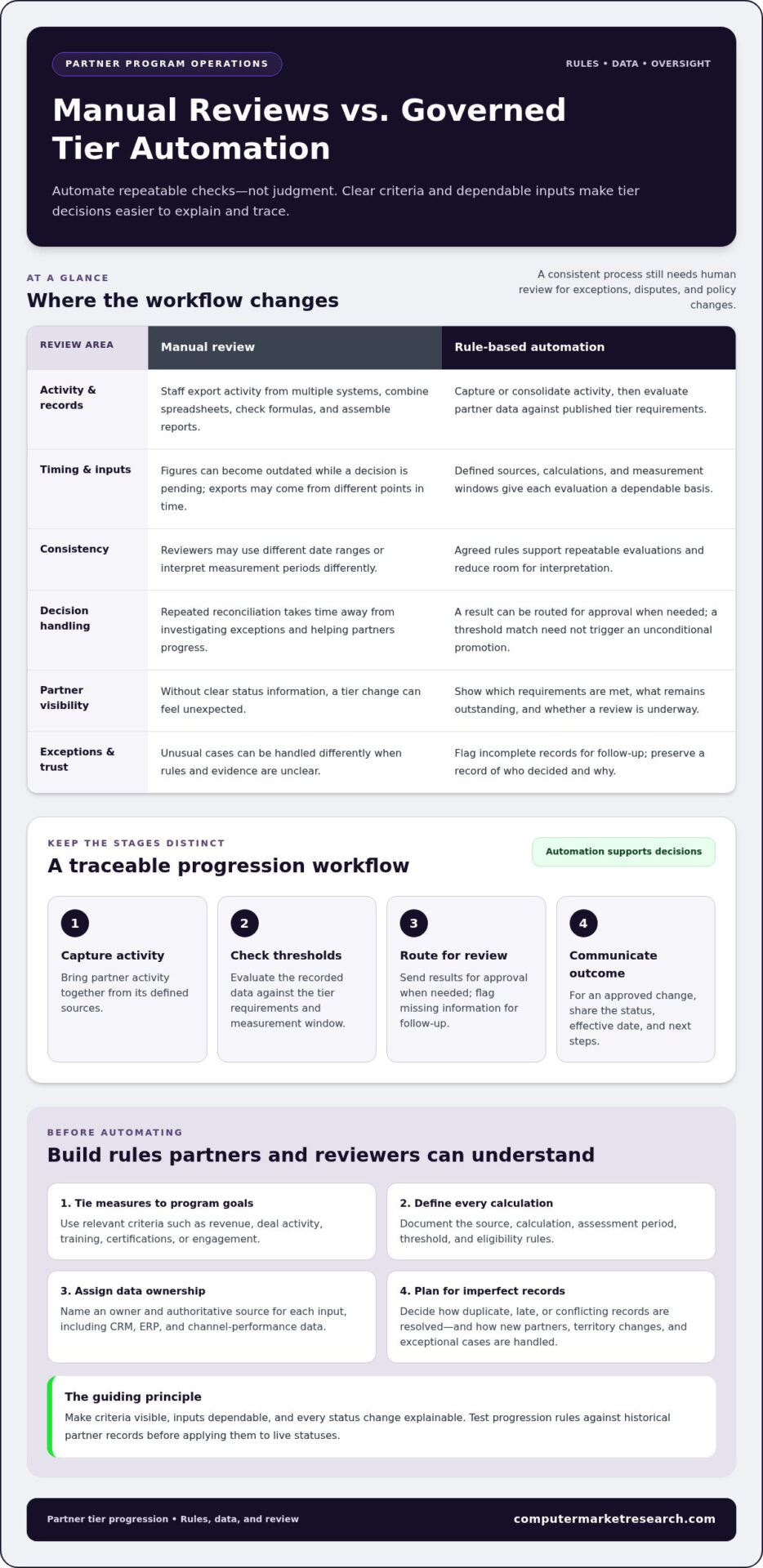
Automation evaluates partner data against published tier requirements. The process has distinct stages: capturing or consolidating activity, checking whether thresholds are met, routing results for approval when needed, and communicating an approved status change with its effective date and next steps. Keeping these stages separate makes decisions easier to trace and troubleshoot.
For example, a rule might flag a partner whose recorded performance meets a stated threshold during the program’s measurement window. That result can prompt a review instead of triggering an unconditional promotion. If records are incomplete, the workflow can flag the gap for follow-up rather than treating missing information as proof that the partner did not qualify.
Which manual tiering problems should automation address?
Manual reviews often require staff to export activity from multiple systems, combine it in spreadsheets, check formulas, and assemble a report for each review cycle. Each handoff takes time, and figures can become outdated while a decision is pending. Repeated reconciliation also leaves program staff with less time to investigate exceptions or help partners understand how to progress.
Spreadsheets make consistency harder to maintain. Reviewers may calculate a measurement window differently, use different date ranges, or rely on exports from different points in time. Those variations can produce different outcomes for partners with similar performance, even when reviewers are trying to follow the same policy. Documented rules and repeatable evaluations reduce room for interpretation while preserving a way to investigate unusual cases.
Visibility matters as much as calculation. If partners can’t see which requirements they’ve met, what remains outstanding, or whether a review is underway, a tier change can feel unexpected. Clear status information connects a decision to the criteria behind it. Human oversight remains important for exceptions, data disputes, and policy changes. Automation should make those decisions easier to review, not hide who made them or why.
How to Design Partner Tier Rules Around Goals and Reliable Data
Start with the result the partner program is meant to support. If the objective is stronger revenue contribution, a revenue threshold may be relevant. If the priority is developing sales capability, completed training or certifications may provide a better signal. A criterion should reflect how a partner contributes to the program, not simply reward activity that is easy to count.
Before automating partner tier progression, define how each measure will be interpreted and who owns its source data. A dependable rule needs clear inputs, calculations, timing, and exception handling that reviewers and partners can understand.
Choose criteria that reflect program objectives
Use a focused set of measures tied to the outcomes you want to encourage. Revenue, deal activity, training, certifications, and engagement can all be useful when they connect to a program goal. For example, counting deal registrations without defining what qualifies could reward volume rather than meaningful contribution. Document why each metric belongs in the tier model and what partner behavior it is intended to recognize.
Define how every measure is calculated
Document the source, calculation, and assessment period for each criterion. Specify whether revenue means booked sales or another recorded value, which date determines inclusion, and how the measurement window is applied. Then set the threshold and eligibility rules for each tier. For example, define how a transaction close to the period boundary is treated. These details help prevent reviewers from reaching different results because they interpreted a metric or reporting period differently.
Govern inputs and handle incomplete records
Assign an owner and authoritative source for each input, including CRM, ERP, and channel-performance data. Decide how duplicate, late, or conflicting records are resolved before they affect eligibility. Channel data management can help teams collect, cleanse, and normalize channel information for consistent partner records and performance reporting. Define how new partners, territory changes, and exceptional circumstances are handled rather than leaving decisions to ad hoc judgment.
Make requirements and benefits easy to understand
Write tier requirements in language partners can act on, and keep internal guidance consistent with the partner-facing explanation. Clarify what qualifies, how progress is measured, and which benefits are associated with each level. If a partner falls short because a record is incomplete, explain what information needs review. Clear criteria help partners plan their effort and give internal reviewers a shared basis for consistent decisions.
Review the rules before configuring them
Walk through sample partner scenarios with program, sales, and data owners. Check whether each rule produces the intended outcome, whether the required information is available, and whether exceptions have a defined path. This review can expose ambiguous language or unreliable inputs before they affect progression decisions. Finalize the policy first, then configure calculations around the approved definitions rather than assumptions embedded in a spreadsheet.
Compare Automated Partner Tiering Workflows, Controls, and Trade-Offs
The right workflow depends on how often performance data changes, how dependable the inputs are, and what a tier change affects. Spreadsheet-led reviews preserve direct human control but require repeated data preparation and manual checks. Scheduled evaluations assess eligible partners at defined intervals, creating a predictable review cycle. Event-triggered evaluations run when a relevant update arrives, which can shorten the gap between a qualifying event and review but depends on timely, accurate inputs.
Each approach handles calculation, approval, and communication differently. Keep these steps distinct: a system can calculate whether a threshold appears to be met without approving a status change or notifying a partner automatically.
| Workflow | Calculation | Approval | Partner notification |
|---|---|---|---|
| Spreadsheet-led review | Staff compile and calculate results manually. | Reviewer checks records and confirms the outcome. | Staff communicate the decision and next steps. |
| Scheduled evaluation | Rules evaluate eligible records at set intervals. | Approval can be required for all changes or exceptions. | Send an update after approval, or after the rule result if policy allows. |
| Event-triggered evaluation | A relevant data update prompts a rule check. | Clear cases may proceed under policy; exceptions go to a reviewer. | Notify only when the approved status change is recorded. |
Automating partner tier progression doesn’t require every result to change a partner’s status immediately. Automatic updates make sense only when criteria are unambiguous, source data is sufficiently reliable, and the consequences of a change are understood. Route borderline results, disputed records, and material exceptions to an accountable reviewer. This hybrid model can reduce routine work while retaining human judgment where context matters.
Controls make outcomes explainable. Record the evaluated inputs, the rule version used, the result, and the responsible approver. Define promotion and demotion rules with equal clarity, including whether they use the same measurement window, whether review is required, and how the effective date is determined. Tell partners what triggered a change and what they can do next. Without these controls, rapid status changes can feel arbitrary even when the calculation is correct.
Connect each tier to benefits the program can deliver and administer consistently, such as relevant enablement, incentives, or program access. Explain how a change affects those benefits so partners can anticipate the practical outcome. If tiers influence funding or rewards, align the rules with the program’s co-op/MDF incentive programs and document related eligibility conditions. A visible path from input through approval to communication gives reviewers a dependable control framework and partners fewer surprises.
How to Implement Automated Tier Progression Step by Step
A controlled rollout turns tier policy into a dependable operating process. Before automating partner tier progression, align the people who own program rules, source data, approvals, exceptions, and partner communications. Clear ownership helps resolve discrepancies quickly and prevents workflow configuration from becoming a substitute for policy decisions.
- 1. Review the current program. Document each tier, eligibility requirement, benefit difference, measurement period, and decision owner. Note how promotion and demotion are handled today, including exceptions. This gives the team a baseline for identifying manual work and clarifying rules before configuration.
- 2. Assign owners and confirm inputs. Identify who maintains partner records, resolves data issues, approves policy changes, and communicates decisions. Make sure the teams responsible for CRM, ERP, and channel-performance information agree on the source used for each calculation. Coordination across these responsibilities is central to channel partner management.
- 3. Configure and test the rules. Before changing live partner statuses, run the logic against historical records. Include examples that should qualify, fall short, have incomplete information, or require exception review. Compare results with reviewed historical decisions, investigate every mismatch, and revise unclear definitions or input handling before moving forward.
- 4. Pilot with a limited group. Apply the workflow to a defined set of partners or a controlled review cycle. Keep appropriate approval controls in place while the team checks calculations, exception routing, and partner-facing explanations. A pilot can reveal edge cases, unclear criteria, and questions partners may raise before the process expands.
- 5. Launch, monitor, and refine. Broaden use only after owners are comfortable with the pilot results and know how to manage exceptions. Track processing delays, exception volumes, disputed outcomes, and completeness of source data. Review these measures with channel teams, then use partner feedback to improve explanations and address recurring confusion.
Keep a record of what was tested, which issues were resolved, and who approved broader use. After launch, revisit the workflow when program goals or tier rules change; otherwise, it can continue applying outdated assumptions consistently. Centralized partner onboarding, deal registration, and performance tracking can support visibility into information used for program administration, while policy owners remain accountable for the rules and decisions.
PartnerPortal™ brings together partner onboarding, deal registration, and performance tracking to support channel-program administration. Find out more through the PartnerPortal™ trial page.
Make Partner Tier Progression Operational with Clear Visibility
A sustainable tier process depends on more than configured rules. Partners need to understand the requirements and their current status, while internal teams need dependable data, review controls, and clear decision ownership. Together, these elements make automating partner tier progression easier to govern and explain as program priorities change.
Evaluate platform fit for your tiering process
Assess whether your team can access partner records and performance information in a consistent workflow. Map the information used for reviews, including relevant CRM, ERP, and financial-system inputs, then identify where each source is maintained and how updates reach the review process. Document the systems and data flows your program needs so the evaluation reflects actual operating requirements.
PartnerPortal™ centralizes partner onboarding, deal registration, and performance tracking, providing infrastructure for channel-program visibility. Explore how its channel partner management software fits your operational needs, including how your team organizes partner and performance information. Evaluate the process end to end: what reviewers need, where partners see program guidance, and how teams retain oversight of tier decisions. A centralized view can support informed reviews, while calculations, approvals, and status changes remain tied to the rules and workflow your organization has defined.
Turn tier status into clear partner next steps
A tier label is useful only if a partner understands what it means. Communicate the requirements for each level, the partner’s current standing, and the specific actions that could support progress. If an outcome is awaiting review or depends on incomplete information, make that status clear rather than presenting it as a final decision. Give channel teams a consistent explanation for partner questions about how a result was reached.
Performance tracking gives reviewers information to consider against program criteria and supports informed decisions. It should not be described as automatic tier progression unless the workflow has been deliberately configured and governed to perform that action. Distinguish between recorded performance, calculated eligibility, approved status, and partner communication. This makes it easier to see where a decision stands and who owns the next step.
Evaluate whether your operating model lets teams work from useful, centralized partner information, maintain clear review ownership, and provide understandable guidance. PartnerPortal™ supports partner-program administration through centralized onboarding, deal registration, and performance tracking.
Make Your Tiering Process Ready to Scale
Treat tier progression as an operating process that can evolve with your partner program. As goals shift, review whether the rules still reward meaningful contributions, whether the supporting information remains dependable, and whether partners can understand what progress looks like. This ongoing discipline helps automation remain useful without turning policy into a set-and-forget calculation.
For teams evaluating the infrastructure behind that process, PartnerPortal™ brings together partner-program information through onboarding, deal registration, and performance tracking. Computer Market Research specializes in cloud-based channel management solutions that help automate and streamline channel operations.
Put your criteria and partner workflows into practice with PartnerPortal™. Start your 90-day free trial to take a practical next step toward automating partner tier progression with greater clarity and control. A transparent process gives your team a stronger foundation for partner decisions as the program grows.
Frequently Asked Questions
Can partner tier progression be automated without a PRM platform?
Yes. A small program can start by documenting its criteria and recording decisions in a controlled process, though collecting data and maintaining spreadsheets may become harder as the partner base grows. Before automating partner tier progression, map where each input lives and who validates it. That inventory helps identify which steps can be standardized now and whether a channel-management platform would provide useful centralization as the program expands.
How often should a company review its partner tier thresholds?
Review thresholds when program objectives, partner economics, or the reliability of the underlying data materially change. A governance review can also identify criteria that no longer distinguish meaningful contribution. For example, if a program shifts focus to a different product line, a measure tied to the former priority may need revision. Record the reason and effective date, and avoid changing rules mid-assessment without a clearly communicated policy.
What should a partner tier change notification include?
A useful notification explains the new tier, when the change takes effect, and the basis for the decision in language the partner can understand. If benefits or access change with the tier, clarify what the partner should expect and when. Distinguish an approved change from a pending review so the partner doesn’t act on a status that isn’t final. Include a clear channel for raising a possible data error.
Can one tiering framework work for resellers and distributors?
Yes, a shared framework can establish common program principles while role-specific criteria account for how each partner contributes. A distributor’s value may be reflected in different activities than a reseller’s, so identical measures could misrepresent performance. Define which requirements apply to every partner and which depend on role. Document the rationale so reviewers apply distinctions consistently and partners understand how their category affects evaluation.
How can a company account for seasonal partner performance?
Choose measurement periods that reflect the program’s sales cycle, then compare partners across periods that represent similar conditions. For example, a seasonal product line may produce uneven activity across the year, making a short snapshot misleading. Consider whether reporting delays could shift results into another period, and state how those records will be treated. Document the measurement approach before evaluation begins so temporary fluctuations don’t create unexpected status changes.
What should teams do when partner performance data is incomplete?
First determine whether information is missing, delayed, or recorded under a duplicate or mismatched partner account. Don’t treat an absent value as zero or confirmed underperformance without an established policy. Assign an owner to investigate the gap and record whether the affected decision is pending or can proceed under program rules. Tracking recurring gaps by source can help teams prioritize data correction and prevent the same issue from affecting future reviews.

Article by
Del Heles
Del Heles is the founder and CEO of Computer Market Research (CMR), a channel management software company he launched in 1984. With more than 40 years of experience, he’s known for helping manufacturers and distributors simplify complex partner programs through practical, customer-focused technology solutions.