

What if a reward designed to drive partner sales also creates month-end reconciliation delays? Backend incentives can motivate partners, but unclear eligibility rules, incomplete sales data, or inconsistent proof requirements can make it difficult to confirm what’s earned and payable. In channel sales, these are rewards calculated after a transaction or defined performance period, not discounts applied at checkout.
The distinction matters. Partners need to know how to qualify, and your team needs reliable records to verify results and reconcile claims with financial data. If either side is working from different terms or information, even a well-intentioned program can create confusion and extra administrative work.
This guide explains how backend incentives work, how they differ from frontend rewards, and how to choose structures that fit your partner strategy. You’ll learn how to define eligibility, measurement, and evidence requirements, then improve the processes and systems used to track results and manage administration. The goal is a program partners can understand and your team can review consistently.
Key Takeaways
- Understand how backend incentives reward partner performance after a defined measurement period, rather than reducing the price during a transaction.
- Map the program lifecycle, from setting objectives and eligibility rules to validating results and reviewing performance.
- Compare incentive structures by when rewards are earned and how they’re settled to choose an approach that fits your channel goals.
- Use a practical rules checklist to make requirements clearer for partners and easier for internal teams to apply consistently.
- Assess whether connected channel data and partner-facing visibility can reduce reconciliation friction as your program grows.
What Are Backend Incentives, and Why Do Channel Programs Use Them?
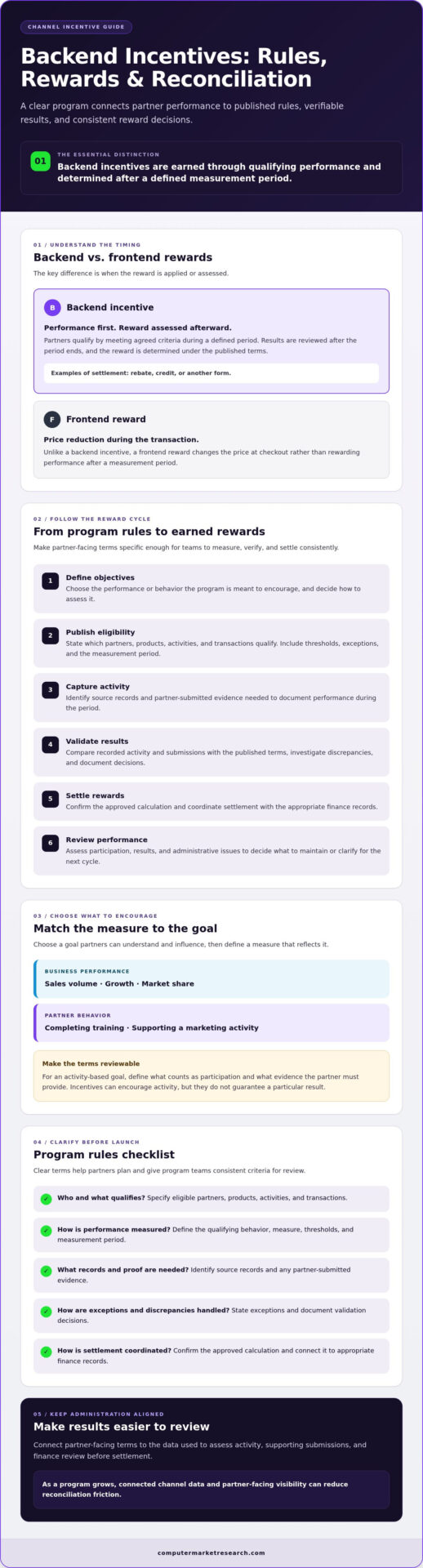
Backend incentives are rewards partners earn by meeting agreed performance criteria. The results are assessed after a defined measurement period. Rather than changing the price during a sale, these incentives recognize qualifying performance once the results can be reviewed.
Backend incentives are retrospective rewards: partners earn them through qualifying performance, and the reward is determined after the measurement period ends. This structure can encourage consistent effort over time instead of focusing only on a single transaction. For a wider overview of how businesses use rewards to shape behavior, see Incentive program.
To see how this works in practice, watch Backend Incentives’ Real Value from Channelnomics:
What makes an incentive a backend incentive?
The sequence is straightforward: define the terms, measure eligible activity, verify the results, then determine the reward. Before the program begins, specify the qualifying behavior, any thresholds, and the measurement period. Partners can then plan against published requirements, while program teams have consistent criteria to apply when reviewing results.
For example, a program might reward a partner for reaching a quarterly eligible-sales threshold. The threshold, reward rate, and timing in this example are illustrative only. After the quarter, the team would assess the partner’s activity and calculate the reward under the published terms. Whether the reward is recorded as a rebate, credit, or another form of settlement is separate from how it was earned.
Which business goals can backend incentives support?
A program can focus on goals such as sales volume, growth, or market share, or on specific partner behaviors, such as completing training or supporting a marketing activity. Choose a goal partners can understand and influence, then define a measure that reflects it. For example, if the goal is to encourage a marketing activity, make clear what counts as participation and what evidence the partner must provide. Incentives can encourage activity, but they don’t guarantee a particular result.
For guidance on connecting incentive design to broader channel performance, see Maximizing Channel ROI: The Definitive Guide to Channel Incentive Programs in 2026.
How Backend Incentives Move from Program Rules to Earned Rewards
A reliable reward cycle starts before partners begin qualifying activity. The terms should be clear enough for partners to act on and specific enough for internal teams to measure, verify, and settle consistently. Vague rules can lead to disputes after the performance period, when it may be difficult to correct expectations or fill gaps in the records.
Published rules and verifiable performance records support consistent reward decisions. Connect the partner-facing terms to the data used to assess activity, any supporting submissions, and the finance review that takes place before settlement.
- Define objectives. Choose the performance or behavior the program is meant to encourage, then decide how to assess it.
- Publish eligibility. State which partners, products, activities, and transactions qualify. Include thresholds, exceptions, and the measurement period.
- Capture activity. Identify the source records and partner-submitted evidence needed to document performance during the period.
- Validate results. Compare recorded activity and submissions with the published terms, investigate discrepancies, and document decisions.
- Settle rewards. Confirm the approved calculation and coordinate settlement with the appropriate finance records.
- Review performance. Assess participation, results, and administrative issues to decide what to maintain or clarify for the next cycle.
Set eligibility, targets, and measurement periods
Before launch, specify eligible partners, products or activities, the start and end of the measurement period, and the conditions that determine a reward. Explain how thresholds are calculated and document exceptions in accessible language. Then test the rules against realistic cases: can the team identify the qualifying activity, locate its source record, and calculate the result without relying on unwritten judgment? If not, clarify the terms or the evidence required.
Government guidance on Incentive Contracts offers a separate example of structuring incentives around defined performance factors. It applies to federal contracts, not channel partner programs, but reinforces the value of specifying measurable criteria in advance.
Validate results and close the reward cycle
At period close, compare partner submissions with the data sources named in the rules, such as sales records or other program-approved evidence. If records differ, establish who investigates, which source takes precedence, what additional documentation is acceptable, and who makes the final decision. A consistent discrepancy process makes decisions easier to explain and gives partners a defined way to raise questions.
Source-data quality matters: incomplete or inconsistent channel records can make even clear rules difficult to apply. Reviewing channel data management systems may help teams assess data visibility and alignment. If you’re evaluating how a channel platform fits your incentive administration workflow, you can explore PartnerPortal™ with its 90-day free trial.
Backend Incentives vs. Frontend Incentives, Rebates, and Credits
These terms describe different parts of a partner program. Frontend and backend refer to when a reward is earned or applied. Rebate and credit describe possible ways an earned reward may be settled. Keeping the distinctions clear helps partners understand the offer and helps finance teams apply the documented terms.
| Mechanism | Timing | Earning basis | Operational purpose | Example |
|---|---|---|---|---|
| Frontend incentive | Applied during or in connection with a transaction | Often tied to a qualifying purchase or sale | Influence a specific transaction | A partner receives an eligible discount on a qualifying order. |
| Backend incentive | Determined after a defined measurement period | Performance against program terms | Recognize results across a period | A partner earns a reward after meeting a published sales target. |
| Rebate | As specified in the program’s settlement terms | A qualifying transaction or measured performance | Settle an earned reward under the agreement | A program calculates a rebate after confirming eligible purchases. |
| Credit | As specified in the program’s settlement terms | A qualifying transaction or measured performance | Provide the reward in the form defined by the arrangement | A partner receives an approved credit under the program terms. |
Backend vs. frontend incentives: when is each used?
A frontend offer can support a goal tied to a particular transaction. Backend incentives can recognize performance assessed across a defined period. A business might use a transaction-level offer to encourage eligible purchases and a separate period-based reward to recognize broader partner performance. Neither mechanism is automatically the right choice. The goal, eligibility, qualifying activity, and published terms determine how each program works.
Backend rebates vs. backend credits: what is the difference?
A rebate and a credit aren’t interchangeable by definition. The program agreement should explain what each term means, when settlement occurs, how the reward is documented, and what the partner can use it for. Finance teams should review applicable company policy and records before deciding how to record or settle a reward. Accounting treatment can vary, so don’t assume one method applies across organizations.
For either settlement method, retain the program terms, performance evidence, calculation, and approval record needed for review. This separates the question “What did the partner earn?” from “How will the company settle it?” For a broader view of how these mechanisms fit within channel incentive programs, see Maximizing Channel ROI: The Definitive Guide to Channel Incentive Programs in 2026.
How to Design Backend Incentive Rules Partners Can Understand
Clear rules explain how a reward is earned and give partners a consistent basis for planning activity. They also give internal teams a workable standard for reviewing eligibility. As backend incentives grow, administration becomes harder when terms sit in one place, sales data in another, and partner submissions in disconnected files. Define the process and the evidence requirements together to make reviews more consistent.
Incentive terms should be measurable before partners begin earning rewards. Use this checklist to test whether the program is clear to participants and practical to administer:
- Goal: State the partner outcome or behavior the program is designed to encourage.
- Eligibility: Identify qualifying partners, products, transactions, and activities.
- Measurement: Set the measurement dates, calculation method, thresholds, and any exclusions or exceptions.
- Evidence: Name the source records and partner submissions used to verify results.
- Approvals: Assign responsibility for checking eligibility, resolving discrepancies, and confirming rewards.
- Review: Define when the program will be assessed and who can approve changes for a future period.
What should backend incentive terms specify?
Write each condition so partners can understand it without informal guidance. Make the current rules easy to find, identify the period they apply to, and communicate changes before they affect eligibility. Before launch, test every requirement against available records. If the team can’t consistently identify an eligible transaction or verify a threshold, revise the rule or state what evidence is needed.
How can teams reduce disputes and manual reconciliation?
Standardize partner submission fields so claims arrive with comparable information. Record the evidence reviewed, the decision, and the reason for any adjustment. Establish a discrepancy process that states who investigates, which records take precedence, and who communicates the outcome. Accurate, accessible channel data supports dependable eligibility reviews. Channel data management systems are one area teams can evaluate to improve visibility into source data.
For broader measurement considerations, see Maximizing Channel ROI: The Definitive Guide to Channel Incentive Programs in 2026. To explore a channel platform that includes partner performance tracking and rebates and incentives, start a 90-day free trial of PartnerPortal™.
Managing Backend Incentives at Scale with Connected Channel Data
Backend incentives become harder to manage when partner records, sales activity, claim evidence, and finance data are spread across separate systems and files. Teams may reconcile the same information repeatedly, struggle to explain differences between records, or lack a clear view of performance until the measurement period closes. These are signs to review how data is coordinated, rather than simply adding more manual checks.
Connected channel data can help teams assess performance against program terms with greater visibility. The platform still needs to fit the workflow, and its specific capabilities should be verified before it’s relied on for incentive administration.
What should teams evaluate in incentive management software?
Assess a solution against the full information path, from partner activity to internal review. Ask how it handles:
- Partner-facing access: Can partners find relevant program information and submit or review the information the process requires?
- Performance visibility: Can teams view partner activity and results in a way that supports eligibility review?
- Data alignment: Can relevant channel and partner records be compared consistently, with clear sources for resolving mismatches?
- Workflow fit: How would the solution work with existing CRM, ERP, and finance processes? Verify specific integrations and data flows rather than assuming compatibility.
- Incentive capabilities: Confirm whether the system supports the rule configuration, validation, approvals, or payout steps your program needs. Don’t assume these functions are included without verification.
A practical evaluation follows one partner’s activity through the process. Identify the source record, check how results are reviewed, and determine how an approved reward is reflected in finance workflows. This makes gaps visible before adopting a new system.
How can PartnerPortal™ fit into channel operations?
PartnerPortal™ is a cloud-based channel management platform that centralizes partner onboarding, deal registration, and performance tracking. Computer Market Research also provides rebates and incentives. These capabilities may be relevant for organizations reviewing how partner information and incentive activity fit into channel operations. For specific rule configuration, claim validation, approval routing, payout automation, or integrations, confirm requirements and capabilities directly before relying on them.
Consider whether PartnerPortal™ aligns with your data sources and review workflow. Explore a 90-day PartnerPortal™ free trial to assess its fit for your channel operations.
Build a Program Partners Can Rely On
Effective backend incentives depend on more than the reward structure. Partners need clear terms, and your team needs performance records it can verify and reconcile. Define eligibility and measurement before the program begins, distinguish how rewards are earned from how they’re settled, and check that the available data supports consistent decisions.
Connected channel information can help teams review partner activity with greater clarity. Computer Market Research, founded in 1984, offers rebates and incentives and channel data services. Its cloud-based platform, PartnerPortal™, centralizes partner onboarding, deal registration, and performance tracking. When evaluating a platform, confirm that its capabilities fit your workflows and the specific incentive processes you need.
Ready to explore whether PartnerPortal™ fits your channel operations? Explore a 90-day PartnerPortal™ free trial. With transparent rules and accessible data as your foundation, you can build a program that’s easier for partners to understand and your team to manage.
Frequently Asked Questions
What are backend incentives?
Backend incentives are rewards partners earn by meeting agreed performance criteria, with results assessed after a defined measurement period. Program terms determine which partners and activities qualify, what targets apply, and when rewards are calculated. Unlike an immediate transaction discount, the reward is based on verified performance under those terms. The program may settle an earned reward in different ways, so don’t assume every incentive uses the same reward type or payment method.
How do backend incentives differ from frontend incentives?
Frontend incentives generally apply during or near a transaction, while backend incentives are assessed retrospectively against program rules. A frontend offer may influence a specific purchase; a backend reward may recognize performance over a defined period. Organizations can use both mechanisms for different goals, but neither is required by default. The published terms determine qualifying activity, timing, eligibility, and how each incentive is applied or settled.
What are common types of backend incentives?
Possible structures include rewards for sales volume, growth, market share, or specified partner behaviors, such as completing training or supporting a marketing activity. These are examples, not a universal taxonomy or a promise that every program offers each type. Start with the business objective, then define the qualifying metric and acceptable evidence. Partners should be able to understand what activity counts and how their performance will be reviewed.
Are backend rebates and backend credits the same?
Not necessarily. A rebate and a credit may both be used to settle a post-sale incentive, but their intended use and handling can differ by program and company process. Check the written agreement for how the reward is earned, documented, and delivered. Finance teams should also consult applicable internal procedures before recording or settling it. Don’t treat the terms as interchangeable unless the program documentation explicitly defines them that way.
How do you measure backend incentive performance?
Start with the program objective, then define eligible activity, the measurement period, any threshold, and the data source used to verify results. Compare performance with the rules communicated to partners and document how discrepancies are reviewed. There’s no universal formula: the metric should reflect the stated goal. For example, a growth-focused program needs a clearly defined growth measure and a consistent basis for evaluating it.
Can software help manage backend incentives?
Channel software may help centralize partner information, provide performance visibility, and support related workflows, depending on the solution’s confirmed capabilities. Computer Market Research’s PartnerPortal™ centralizes partner onboarding, deal registration, and performance tracking, and the company offers rebates and incentives. Before selecting a platform, verify its incentive-specific features, integrations, validation processes, and approval functions. Don’t assume a system automates claims or payouts unless those capabilities have been confirmed.

Article by
Del Heles
Del Heles is the founder and CEO of Computer Market Research (CMR), a channel management software company he launched in 1984. With more than 40 years of experience, he’s known for helping manufacturers and distributors simplify complex partner programs through practical, customer-focused technology solutions.