

What if the strongest argument for PRM funding isn’t a projected return, but the work your current process already makes difficult to see? If partner onboarding, deal registration, incentive tracking, and reporting depend on email or disconnected systems, the effort and errors can be hard to quantify. That’s the challenge of building a business case for prm software when no budget has been set aside.
It’s reasonable for leadership to ask for evidence before funding another platform. A credible case doesn’t need inflated savings estimates or guaranteed ROI. It needs a clear account of where channel work gets stuck, how much time teams spend managing it, and what the friction means for partner and business outcomes.
This article explains how to build that case using evidence you can gather internally: map manual workflows, establish a baseline for effort and errors, and connect PRM capabilities to measurable goals. You’ll also learn how to present a staged, low-risk path to evaluation and funding, so PRM is considered as operational infrastructure for partner management, not just another software request.
Key Takeaways
- Map a specific partner workflow from start to finish to pinpoint where handoffs, delays, and data gaps occur.
- Use internal records and team input to establish a baseline, then label estimates clearly rather than relying on generic benchmarks.
- When building a business case for prm software, connect each proposed capability to an operational measure leadership can review.
- If funding is unavailable, narrow the proposal to one priority workflow and define a bounded evaluation scope.
- Set success measures before evaluating a platform, then compare the results with the documented baseline.
Why a Business Case for PRM Software Starts With Channel Friction
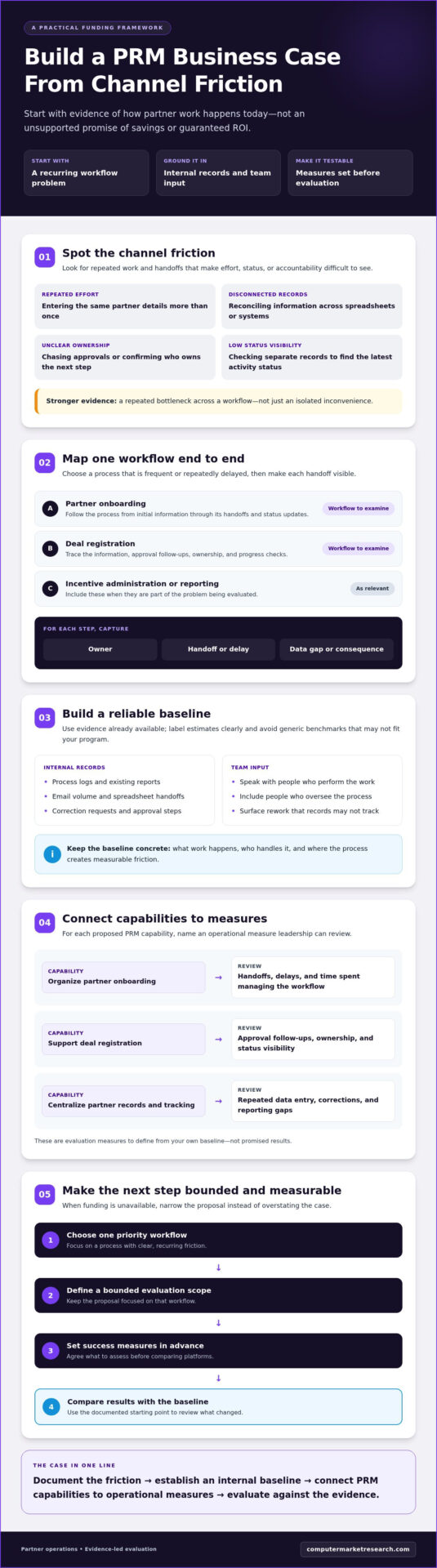
A missing software budget can make a PRM proposal difficult to advance, especially when leadership sees partner management as a set of tasks rather than a connected operation. Start with the friction your team can document: repeated data entry, unclear ownership, approval follow-ups, and difficulty confirming the status of partner activity. Building a business case for prm software begins with evidence of how work gets done today, not a promise of unsupported returns.
Partner relationship management (PRM) software organizes and supports workflows between a business and its channel partners. A neutral overview of Partner relationship management (PRM) provides foundational context. In practice, disconnected spreadsheets, email threads, and business systems can leave effort, status, and accountability scattered, making it harder to assess channel performance consistently.
For a broader view of how to frame a technology investment, watch this video:
What does PRM software help a channel team manage?
Common workflows include partner onboarding, deal registration, and performance tracking. When partner information and workflow status are organized in a central system, teams have a clearer view of records and next steps. That can support operational visibility, though results depend on how the system is configured and used. For a foundational explanation, see the guide What Is Partner Relationship Management (PRM)? Organizations assessing channel workflows can also review channel sales management software as one relevant category.
PRM is not a collection of spreadsheets and email workflows; it is a way to organize partner processes, records, and accountability in one operational system.
How to recognize a business problem before proposing software
Look for recurring work: Where do employees enter the same partner details more than once? Which records must be reconciled across systems? Where do staff chase approvals or ask colleagues to confirm the latest status? An isolated inconvenience may not justify a platform. A repeated bottleneck across onboarding, deal registration, or reporting is stronger evidence of a process issue.
Example, not client evidence: A channel manager updates a partner record in a spreadsheet, emails another team for deal approval, then manually checks a separate report for status. If similar handoffs recur across workflows, document their frequency, owners, and consequences. This gives leadership a concrete problem to evaluate before considering software.
Build the PRM Business Case From a Reliable Operational Baseline
Once you’ve identified recurring channel friction, document how the work actually moves before estimating what a PRM system might change. A reliable baseline gives finance and operations a shared reference point, and helps distinguish a persistent process issue from a one-off complaint. In building a business case for prm software, internal evidence is more useful than an industry benchmark that may not reflect your partner program.
A credible PRM case begins with a documented baseline: what work happens, who handles it, and where the process creates measurable friction.
Which partner workflows should you measure first?
Start with processes that are either frequent or repeatedly delayed, such as partner onboarding and deal registration. Add incentive administration or channel data tasks only if those workflows are part of the problem you’re evaluating. For broader context on the types of processes PRM can support, consult the existing guide, What Is Partner Relationship Management (PRM)?
What evidence can you collect without a new system?
Use records your teams already maintain: process logs, email volume, spreadsheet handoffs, correction requests, approval steps, and existing reports. Then speak with the people who perform or oversee the work. Records can show visible activity, while interviews often uncover rework that isn’t formally tracked.
Build the baseline in a clear sequence:
- 1. Select workflows. Choose a high-volume or high-friction process with a clear start and finish.
- 2. Map the steps. Note each handoff, system, owner, approval, and point where information is entered or transferred.
- 3. Gather evidence. Collect available records and ask process owners to describe tasks that leave no system trace.
- 4. Identify friction. Record repeated entry, record reconciliation, waiting, corrections, and unclear ownership. Separate observed problems from their possible effects.
- 5. Validate findings. Review the map with the people involved and resolve differences before presenting it to decision-makers.
Keep facts distinct from estimates, assumptions, and stakeholder opinions. For example, a logged approval delay is an observation; the time employees spend following up may be an estimate if it isn’t tracked. Label each item, state the measurement period, and note gaps such as incomplete records or reliance on interview recall. That transparency makes findings easier to assess, not less useful.
With a validated baseline in place, you can later compare today’s workflow with a proposed one without treating assumptions as proven savings. If you’re ready to assess fit against documented partner processes, you can evaluate PRM through a 90-day free trial.
Quantify PRM Software Value Without Overstating ROI
A funding request is more credible when it compares the current workflow with specific outcomes to monitor in a proposed one. Use the baseline you documented to examine effort, handoffs, visibility, and data quality. Don’t treat a possible improvement as a guaranteed saving. The goal of building a business case for prm software is to show what your organization can measure and what remains an estimate.
Which measures can support a PRM funding request?
Choose measures teams can capture consistently before and during an evaluation. Examples include staff time spent on repetitive administration, incomplete partner or deal records, correction requests, and the time or effort required to establish workflow status. Pair each measure with an owner and a business question, such as whether the team can identify deal status without reconciling multiple records.
A simple comparison table helps reviewers see the evidence behind each claim:
| Baseline | Proposed measure | Data source | Owner | Assumption |
|---|---|---|---|---|
| Time spent reviewing deal-registration records | Time required to review the same workflow during evaluation | Time log or workflow sample | Channel operations | Comparable cases and steps are included |
| Records missing required information | Completeness of records reviewed during evaluation | Record audit | Data or program owner | Completeness criteria remain consistent |
These are measurement examples, not promised results. Define the scope and counting method in advance so a change in process or case mix doesn’t distort the comparison.
How should you handle uncertain benefits and assumptions?
Separate direct operational measures from broader strategic benefits. Time spent on administration or the share of records requiring correction may be measurable. Better partner experience or stronger channel performance may matter, but should be framed as potential benefits unless your organization has a reliable way to attribute and track them.
Use conservative, expected, and upside scenarios only when internal data supports the assumptions behind each one. If the evidence isn’t strong enough, state the uncertainty rather than manufacturing a range. Keep software, implementation, integration, and ongoing administration considerations distinct, and have the relevant owners validate them before presenting a total investment estimate.
Data quality can affect both the baseline and the evaluation. If partner information is scattered across systems, clarify which records and fields you’ll assess; the guide to channel data management systems offers related context. A disciplined comparison gives decision-makers a clear view of observed changes, assumptions, and benefits that still need validation.
What to Do When There Is No Budget for PRM Software
No allocated budget is a funding constraint, not evidence that channel friction is immaterial. It means the next step is to make the issue easier to assess, not to assume approval. Building a business case for prm software can start with one workflow, a clear operational problem, and a bounded request for evaluation rather than a proposal for a full rollout.
An evidence-backed phased request gives leadership a defined problem and decision point; a premature full rollout asks them to fund a broad change before its fit is established.
How can you make progress before funding is approved?
Document the workflow, its owners, recurring friction, and the evidence needed to judge whether a change would help. If records are incomplete, teams can agree on a consistent tracking method using existing tools, such as a shared log or standard fields in current records. These steps improve the quality of the decision; they don’t replace a system or prove that new software is required.
Then narrow the potential evaluation to one process, such as onboarding or deal registration. Define what’s in scope, who will participate, what information is needed, and which measures will determine whether to proceed. Depending on how your organization manages adjacent channel workflows, channel sales management software may offer useful context for assessing process needs.
If current planning is closed, identify whether the request could be considered through an internal reallocation or submitted for the next planning cycle. Present each as an option for review, not an assured funding path. Keep the request specific enough that leadership can weigh it against other priorities.
How should you answer concerns about implementation and adoption?
Address practical risks in the scope rather than treating them as reasons to delay all evaluation. Ask how a potential platform would fit with existing CRM, ERP, and financial systems, including which records need to move between them and who should validate that information. Also identify the internal process owner, partner users affected, data-quality needs, and change-management work the organization would need to plan.
Set decision checkpoints before beginning: confirm the workflow and baseline, assess whether the proposed process fits, review partner and staff feedback, and compare available measures with the starting point. State what evidence would support proceeding, revising the scope, or stopping. That makes the evaluation bounded and accountable without suggesting a guaranteed result or implementation timeline.
Once the workflow, measures, and review criteria are defined, you can evaluate PRM through a 90-day free trial as a way to assess fit against the documented need.
Turn the PRM Business Case Into a Measurable Next Step
A decision-ready PRM case moves from evidence to a controlled evaluation, then to a review against agreed measures. The sequence is straightforward: establish the baseline, define a focused scope, evaluate how a platform fits the documented workflow, and assess what the evidence supports. Set success measures before testing so the team isn’t choosing criteria after seeing the results.
What should a focused PRM evaluation test?
Choose representative users, partner workflows, and data requirements that reflect the problem you documented. For example, assess whether partner onboarding, deal registration, and performance tracking align with actual team needs. Identify the information each workflow depends on, and clarify what should be checked across connected CRM, ERP, or financial systems.
Assign an owner to each evaluation area and give participants a consistent way to record feedback. Compare the proposed workflow with the baseline using measures your team can capture, such as time spent on defined tasks, record completeness, or visibility into workflow status. These measures help reveal fit; they don’t guarantee a particular operational or financial result.
How do you present a decision-ready recommendation?
Summarize the operational problem, baseline evidence, proposed scope, assumptions, risks, and success measures. State exactly what approval you’re requesting, whether that’s permission to evaluate a defined workflow or to consider funding in a future planning cycle. Explain what evidence will guide the next decision and who will review it.
PartnerPortal™ is one example to assess against documented needs. It centralizes partner onboarding, deal registration, and performance tracking, with channel workflows that also include co-op/MDF funds and rebates and incentives. Review the PartnerPortal™ channel partner management platform in the context of your requirements, rather than assuming a platform will address every process gap.
Building a business case for prm software is ultimately about making the decision traceable: leadership should be able to see the current problem, the proposed test, and the evidence that would support a next step. If you’d like to assess whether PartnerPortal™ fits your documented workflow, evaluate PartnerPortal™ with a 90-day free trial.
Make Your Next PRM Decision Evidence-Led
A missing budget doesn’t have to stop a well-supported PRM discussion. Start with one recurring channel workflow, document its effort and friction, then define measures that can show whether a proposed change addresses the problem. Keep observed facts separate from estimates, and present a focused evaluation as a decision point, not a promise of guaranteed savings.
That disciplined approach is the foundation of building a business case for prm software. It gives leadership a clear view of the operational need, the assumptions behind the request, and the evidence that will guide the next step.
PartnerPortal™ centralizes partner onboarding, deal registration, and performance tracking. Computer Market Research has specialized in channel management solutions since 1984, bringing relevant experience to the processes you’re assessing. Explore whether the platform fits your documented needs with a 90-day free trial of PartnerPortal™.
A clear baseline turns a software request into a practical decision. Take the next step with confidence, one measurable workflow at a time.
Frequently Asked Questions
What is a business case for PRM software?
A business case for PRM software explains the operational problem, why a partner-management platform may address it, and what evidence will guide a funding decision. It typically connects current workflows, such as onboarding or deal registration, to measurable concerns like administrative effort, rework, incomplete records, or limited status visibility. A credible case distinguishes documented facts from estimates and describes expected benefits without presenting them as guaranteed outcomes.
How do you build a business case for PRM software?
Build the case by documenting a partner workflow before proposing a platform. Select a process with recurring volume or friction, map its steps and owners, then review available records and interview the people involved. Establish measures you can track consistently, identify gaps and assumptions, and define a focused evaluation scope. Building a business case for prm software this way gives decision-makers an organization-specific baseline rather than relying on generic savings claims.
What should a PRM software business case include?
Include the problem statement, current workflow, baseline evidence, proposed scope, and measures for assessing fit. Identify data sources, process owners, assumptions, risks, and any integration questions involving systems such as CRM, ERP, or financial platforms. Clarify the decision you’re requesting, whether it’s approval to evaluate a defined workflow or consideration in a future budget cycle. Keep measurable operational outcomes distinct from broader benefits that are harder to attribute.
How can I justify PRM software when there is no budget?
A missing budget means funding hasn’t been allocated, not that the operational problem lacks importance. Document the recurring friction and focus the request on one partner workflow, with clear boundaries and decision criteria. You can ask whether internal reallocation or a future planning cycle is appropriate, but don’t assume approval. A well-scoped evaluation request helps leadership understand the problem, what evidence you’ll collect, and what would inform the next decision.
How do you calculate the ROI of PRM software?
Estimate ROI only when your organization has defensible inputs for both benefits and costs. A common calculation is (estimated benefits minus total costs) divided by total costs, but each input needs a clear source and timeframe. Consider measurable changes such as administrative effort or rework, and account separately for software, implementation, integration, and ongoing administration. Label estimates and assumptions, and avoid presenting possible productivity gains as guaranteed financial returns.
Can spreadsheets be enough for managing channel partners?
Spreadsheets may be sufficient when partner workflows are limited, records are easy to maintain, and the team can reliably track ownership and status. They become harder to manage when information is duplicated, handoffs span email and separate files, or teams struggle to confirm which record is current. Document how often those issues occur and what work they create. That evidence helps determine whether process changes or a dedicated PRM system merits evaluation.
What should I measure during a PRM software evaluation?
Measure the same workflow conditions you documented in your baseline. Depending on the process, that could include time spent on repetitive tasks, record completeness, correction requests, handoffs, or how readily users can identify workflow status. Include representative users and data requirements, and assign an owner to collect feedback. Compare results using consistent definitions, then review whether the platform fits the documented need, including relevant integration requirements.

Article by
Del Heles
Del Heles is the founder and CEO of Computer Market Research (CMR), a channel management software company he launched in 1984. With more than 40 years of experience, he’s known for helping manufacturers and distributors simplify complex partner programs through practical, customer-focused technology solutions.