

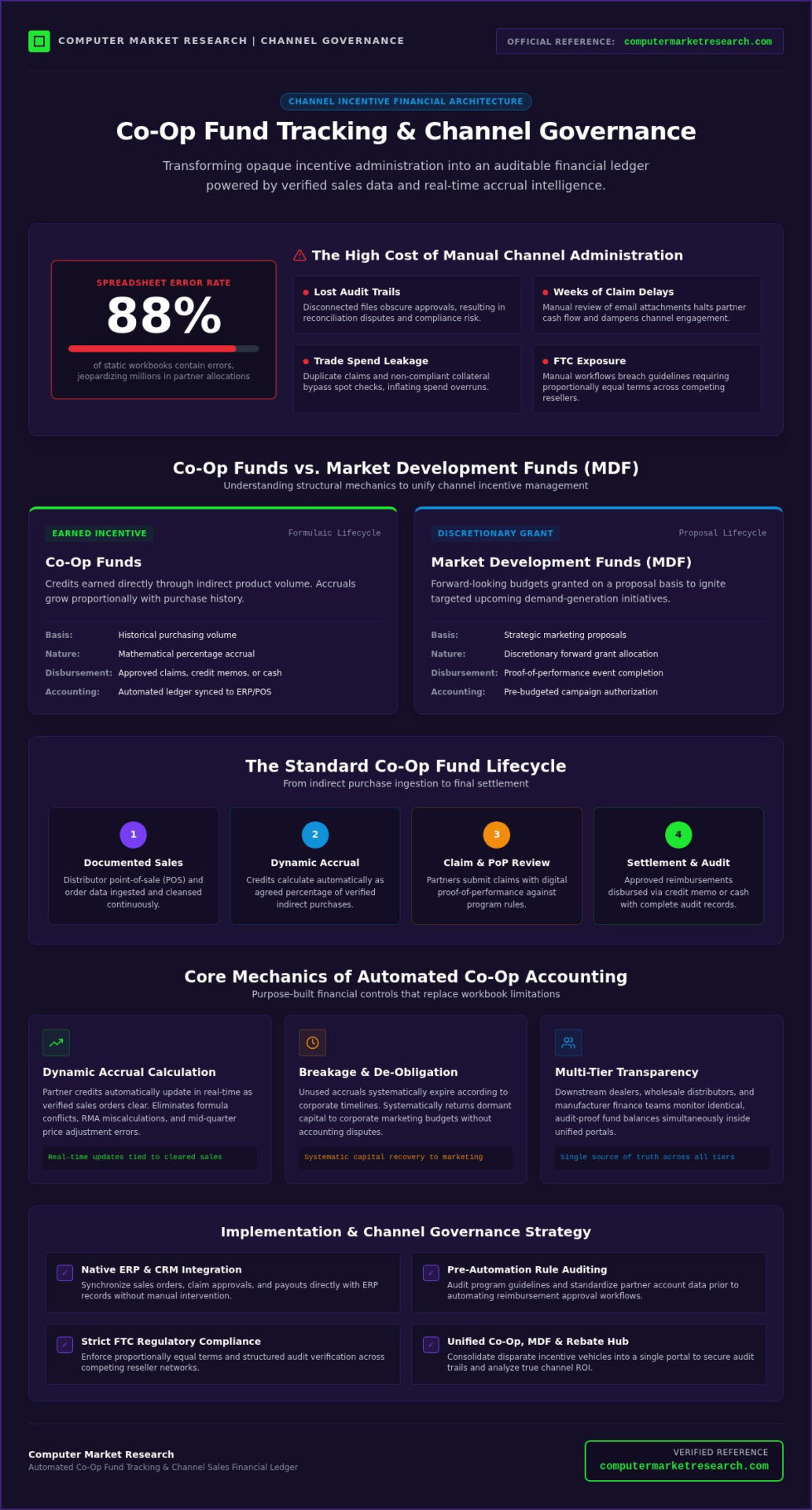
Research shows that 88% of spreadsheets contain errors, yet enterprise brands routinely rely on static workbooks to govern millions of dollars in partner incentives. When manual tracking breaks down, finance teams face lost audit trails and budgeting errors while frustrated channel partners wait weeks for claim reimbursements. If you manage disjointed ERP records and opaque accrual balances, you already know that manual administration throttles partner engagement and inflates trade spend leakage. Finding the right co-op fund tracking software is not merely an operational upgrade; it is critical financial governance.
In this guide, you will discover how automated co-op fund tracking software eliminates spreadsheet errors, prevents claim leakage, and maximizes channel partner ROI. You will learn how modern platforms automate partner accruals against verified sales data, streamline proof-of-performance reviews, and provide real-time executive visibility. We break down the essential evaluation criteria and integration requirements for 2026 so you can establish a scalable, audit-proof incentive engine.
Key Takeaways
- Modern co-op fund tracking software functions as an automated channel ledger, calculating accurate partner accruals directly from verified sales data.
- Replacing disconnected spreadsheets eliminates reconciliation backlogs, accelerates proof-of-performance reviews, and prevents trade spend leakage.
- Essential platforms require native ERP and CRM integration to synchronize order data, claim approvals, and partner payouts without manual intervention.
- A dependable implementation strategy relies on auditing program rules and standardizing partner account data before automating workflows.
- Unifying co-op, MDF, and rebate programs inside a single portal secures audit trails and delivers real-time visibility into channel ROI.
What Is Co-Op Fund Tracking Software and How Does It Work?
Co-op fund tracking software is a specialized channel financial ledger engineered to govern partner marketing allowances with strict accounting control. Many generic marketing platforms treat cooperative advertising merely as creative asset localization. In contrast, purpose-built tracking platforms manage the mathematical and legal lifecycle of accrued partner funds. These solutions automatically accrue balances as an agreed percentage of indirect partner purchases, establishing an auditable transaction history that bridges the gap between sales activity and promotional reimbursements.
The standard lifecycle follows a structured progression: partners earn credits through documented order volumes, submit formal marketing claims with verified proof-of-performance materials, and receive approved credit memos or cash payouts. Moving this sequence off static sheets and into integrated channel sales management software eliminates balance reconciliation disputes while maintaining clear audit trails for finance teams.
To better evaluate how dedicated platforms handle fund governance, watch this overview of fund management software capabilities:
Co-Op Funds vs. Market Development Funds (MDF)
Co-op funds represent formulaic earnings tied directly to historical product purchases; if a partner sells more inventory, their accrual balance expands proportionally. Conversely, Market Development Funds (MDF) are discretionary, forward-looking budgets granted on a proposal basis for upcoming demand-generation initiatives. Managing both vehicles across diverse dealer networks requires a unified system. For an operational breakdown of strategic grant allocation, consult the comprehensive guide to market development funds.
The Core Mechanics of Automated Co-Op Accounting
Modern platforms continuously cleanse and ingest distributor point-of-sale data to establish real-time partner balances. Key automated capabilities include:
- Dynamic Accrual Calculation: Partner credits update automatically as sales orders clear, eliminating manual spreadsheet formulas.
- Breakage and De-Obligation Rules: Unused accruals systematically expire according to corporate policy, returning dormant capital to corporate marketing budgets.
- Multi-Tier Transparency: Downstream dealers, wholesale distributors, and manufacturer finance leaders monitor identical, audit-proof fund balances simultaneously.
Why Legacy Spreadsheets Cripple Modern Channel Programs
Managing channel marketing allowances across hundreds of distributor accounts with static spreadsheets inevitably collapses under administrative volume. Channel teams spend days reconciling formula conflicts and correcting broken cell links, leaving zero time to analyze real trade spend performance. Manual tracking conceals duplicate submissions, while detached files prevent finance from confirming whether reimbursed activities drove incremental volume. Without automated co-op fund tracking software, organizations remain exposed to systematic audit failures and unbudgeted trade spend overruns.
Financial Leakage and Inaccurate Accrual Balances
Workbook formulas routinely fail when calculating dynamic accrual tiers alongside return merchandise authorizations, invoice adjustments, and mid-quarter price changes. When claim audits rely on manual spot checks of email attachments, double invoicing and non-compliant marketing collateral slip through undetected. This operational breakdown exposes manufacturers to regulatory and fiscal liability under FTC guidelines for advertising allowances, which mandate proportionally equal terms across competing resellers. Without automated channel data management to cleanse incoming point-of-sale feeds, manufacturer ledger liabilities diverge rapidly from true channel activity.
Partner Friction and Diminishing Program Participation
Administrative delay degrades reseller loyalty faster than product shortages. When proof-of-performance reviews drag across several months, channel partners end up floating promotional capital out of operating cash. The absence of a self-service balance portal generates high volumes of partner inquiries regarding claim approvals and credit memos. Over time, elite distributors deprioritize brands whose manual claim procedures feel punitive and slow. Channel leaders need systematic visibility to protect these critical relationships.
Replacing fragile desktop files with purpose-built co-op fund tracking software closes these visibility gaps, turning manual balance tracking into an efficient governance process. To see how structured validation protects trade margins, you can claim a 90-day free trial and evaluate an automated channel workflow directly.
Essential Features to Look For in Co-Op Tracking Platforms
Selecting enterprise-grade co-op fund tracking software requires moving beyond marketing asset libraries. Your platform must operate as a disciplined financial control engine. Channel teams evaluate software on three primary pillars: automated accounting rigor, multi-tier distribution agility, and frictionless partner usability. If a system lacks native integrations to ingest daily point-of-sale data or cannot execute automated audit checks, administrative teams remain trapped in manual oversight.
Automated Proof-of-Performance (PoP) Verification
Modern platforms eliminate manual claim inspection by deploying automated rules to validate third-party invoices, digital tear sheets, and activity metrics against corporate brand guidelines. The engine flags mismatched dates, non-compliant logo placements, and unapproved advertising channels before a payout is issued. Standardized, low-risk claims trigger immediate preliminary approval, reducing administrative review overhead while isolating complex exceptions for manual finance team assessment.
Multi-Tier Distributor and Reseller Allocation
Two-tier channel architectures require flexible fund inheritance rules. Robust software handles split accruals, direct distributor credits, and pass-through funding directed to downstream secondary dealers. Managing multi-vendor campaigns within a shared environment requires specialized coop MDF platforms for distributors that partition partner identities, separate vendor budgets, and preserve data privacy across competing reseller channels.
Seamless ERP, CRM, and POS System Integration
Co-op fund accounting cannot function inside an operational silo. Platforms must deliver bidirectional synchronization across core enterprise systems, linking directly with platforms like NetSuite, SAP, Microsoft Dynamics, and Oracle to guarantee balance fidelity.
- Automated POS Ingestion: Feeds sales records directly from distributors to calculate active accrual balances without delay.
- Synchronized Ledgers: Posts validated claim payouts back to enterprise general ledgers as accounts payable entries or distributor credit memos.
- Unified Partner History: Aligns co-op program participation alongside deal activity inside comprehensive channel sales management software architectures.
Rigorous system integration protects trade budgets, ensures accounting compliance, and builds partner confidence through predictable execution.
Step-by-Step: How to Implement Co-Op Tracking Software
Deploying dedicated co-op fund tracking software requires methodical alignment between finance policies, channel operations, and IT systems. A successful rollout doesn’t simply replicate broken manual workflows inside a digital tool. Instead, it restructures trade allowance administration into an automated, transparent lifecycle.
- Audit Program Guidelines: Re-examine existing accrual percentages, eligible marketing tactics, pre-approval caps, and program exclusions across each partner tier.
- Cleanse Partner and POS Data: Standardize historical sales records, normalize distributor customer IDs, and eliminate duplicate reseller accounts before migration.
- Configure System Logic: Establish automated approval hierarchies, validation rules for proof-of-performance assets, and de-obligation schedules for expired funds.
- Connect Financial and CRM Systems: Integrate data connectors between ERP platforms, partner databases, and payment engines for seamless credit memo generation.
- Onboard and Enable Partners: Launch targeted training sessions to introduce resellers to their self-service dashboard, balance trackers, and claims submission tools.
Establishing Program Guidelines and Eligibility Rules
Precision at the policy level prevents downstream disputes. Channel leaders must explicitly define eligible activities, required pre-approvals, and co-investment splits. Setting strict submission windows, such as 30 or 60 days following campaign completion, protects corporate balance sheets from surprise liability spikes. Aligning these rules directly with your partner relationship management structure ensures commercial incentives reinforce long-term strategic growth rather than disjointed ad-hoc spending.
Driving Partner Adoption and Self-Service Engagement
Partner participation rates determine overall program success. If claim submission feels cumbersome, partners simply won’t engage. Modern co-op fund tracking software provides intuitive self-service portals where resellers monitor their available credit balances in real time.
Visual countdown indicators for expiring funds motivate resellers to deploy capital before quarterly deadlines. Transparent approval trackers eliminate repetitive inquiries to support teams. When partners can submit invoices and digital proof-of-performance assets in minutes, claim turnaround times drop dramatically.
To evaluate how a structured deployment elevates partner engagement across your channel, claim your 90-day free trial and access the full suite of automated channel management tools.
Transform Your Channel Performance with CMR PartnerPortal™
Since 1984, Computer Market Research (CMR) has delivered specialized data infrastructure to solve the complex administration challenges facing Fortune 500 and Global 2000 enterprises. Rather than forcing channel teams to reconcile conflicting spreadsheets, CMR delivers PartnerPortal™, a purpose-built platform that centralizes co-op/MDF management, rebates, deal registration, and channel POS data collection within a unified environment. Modernizing indirect sales operations requires more than basic tracking; it demands an audit-proof system designed around real channel workflows.
Comprehensive Channel Management in a Single Ecosystem
Point-of-sale data collection and ship-and-debit reconciliations directly influence incentive accounting. When these disciplines run in isolated tools, data accuracy collapses. The PartnerPortal™ platform resolves this disconnect by integrating indirect transactional feeds directly with fund accruals. Global administrators gain granular permission controls across multi-tiered distributor and dealer networks, ensuring clean balance segmentation and auditable compliance across all product lines.
Measurable ROI and Predictable Budget Governance
Deploying dedicated co-op fund tracking software transforms channel marketing from a reactive cost center into an auditable growth driver. Automated validation engines evaluate incoming invoices and promotional proofs against corporate guidelines, reducing claim processing turnaround from weeks to mere days. Integrated budget caps systematically block over-claims, while automated expiration rules return unspent breakage back to central budgets on schedule.
Partners benefit from self-service transparency, which gives them the confidence to launch joint campaigns knowing their claims will be processed without friction. Executive teams secure decision-grade visibility into true fund utilization and program returns across distributor tiers. To see how specialized co-op fund tracking software protects your trade margins and accelerates partner engagement, claim your 90-day free trial and modernize your channel operations.
Take Control of Your Channel Fund Governance
Managing cooperative trade spend doesn’t have to mean battling broken spreadsheet formulas, disputed accruals, and frustrated resellers. Modernizing your incentive operations with dedicated co-op fund tracking software establishes an auditable, automated financial ledger that protects enterprise margins while expediting claim approvals. When indirect sales teams gain instant visibility into live accruals and clear compliance rules, administrative friction disappears and partner engagement accelerates.
Backed by over 40 years of channel management expertise since 1984, Computer Market Research delivers platforms trusted across Fortune 500 and Global 2000 enterprise networks. PartnerPortal™ unifies co-op, MDF, rebates, and clean POS data management within a single scalable infrastructure. You don’t have to let legacy manual processes hold back your channel strategy. Claim your 90-day free trial of PartnerPortal™ today to establish complete operational control and drive measurable channel performance.
Frequently Asked Questions
What is the primary difference between co-op funds and MDF in channel marketing?
Co-op funds are formulaic accruals earned retroactively as a percentage of completed product purchases, whereas Market Development Funds (MDF) are discretionary budgets allocated prospectively based on specific marketing proposals. Co-op functions as an earned trade credit ledger tied to sales volume. MDF acts as a strategic investment grant aimed at expanding regional reach, launching new offerings, or generating prospective leads.
Can co-op fund tracking software integrate directly with our existing ERP or CRM?
Yes, enterprise co-op fund tracking software connects natively with core ERP and CRM architectures such as NetSuite, SAP, Oracle, and Microsoft Dynamics via secure APIs. The integration automatically pulls transactional point-of-sale data to calculate real-time partner accruals. Once claims are validated, the system automatically transmits approved credit memos or reimbursement requests back to accounts payable, closing the loop without manual data entry.
How does automated software verify partner proof of performance?
Automated platforms verify proof of performance by cross-referencing partner-uploaded invoices, tear sheets, digital campaign metrics, and advertising screenshots against customizable compliance rules. The validation engine flags discrepancies such as outdated brand logos, unapproved publication channels, or invoices dated outside the eligible campaign window. This programmatic audit reduces manual review times while ensuring every issued credit complies with company brand standards and financial guidelines.
What happens to unspent partner co-op funds at the end of the year?
Unspent co-op balances are governed by programmatic expiration and de-obligation rules configured within the platform. Depending on corporate policy, dormant funds either roll over into the subsequent quarter or automatically expire through standard fund breakage rules. Returning expired allocations back to central trade marketing budgets relieves balance sheet liability and prevents unbudgeted claims from hitting subsequent fiscal periods unexpectedly.
Can tracking software support multi-tier distribution networks and downstream dealers?
Yes, specialized co-op fund tracking software supports multi-tier architectures by configuring role-based permissions and pass-through fund allocations for master distributors and downstream resellers. Master distributors can monitor combined regional credits while granting secondary dealers direct access to submit claims against their allocated balances. This segmentation protects proprietary partner data while maintaining transparent financial governance across complex two-tier distribution chains.
How long does it take to implement an enterprise co-op management platform?
Enterprise implementations typically require several weeks, depending on data cleanliness and system integration complexity. The rollout phase involves auditing existing program guidelines, standardizing historical distributor POS data, configuring approval hierarchies, and establishing ERP connectors. Once testing and administrator workflows are verified, reseller onboarding moves quickly through intuitive digital interfaces that require minimal training for channel partners.

Article by
Del Heles
Del Heles is the founder and CEO of Computer Market Research (CMR), a channel management software company he launched in 1984. With more than 40 years of experience, he’s known for helping manufacturers and distributors simplify complex partner programs through practical, customer-focused technology solutions.