

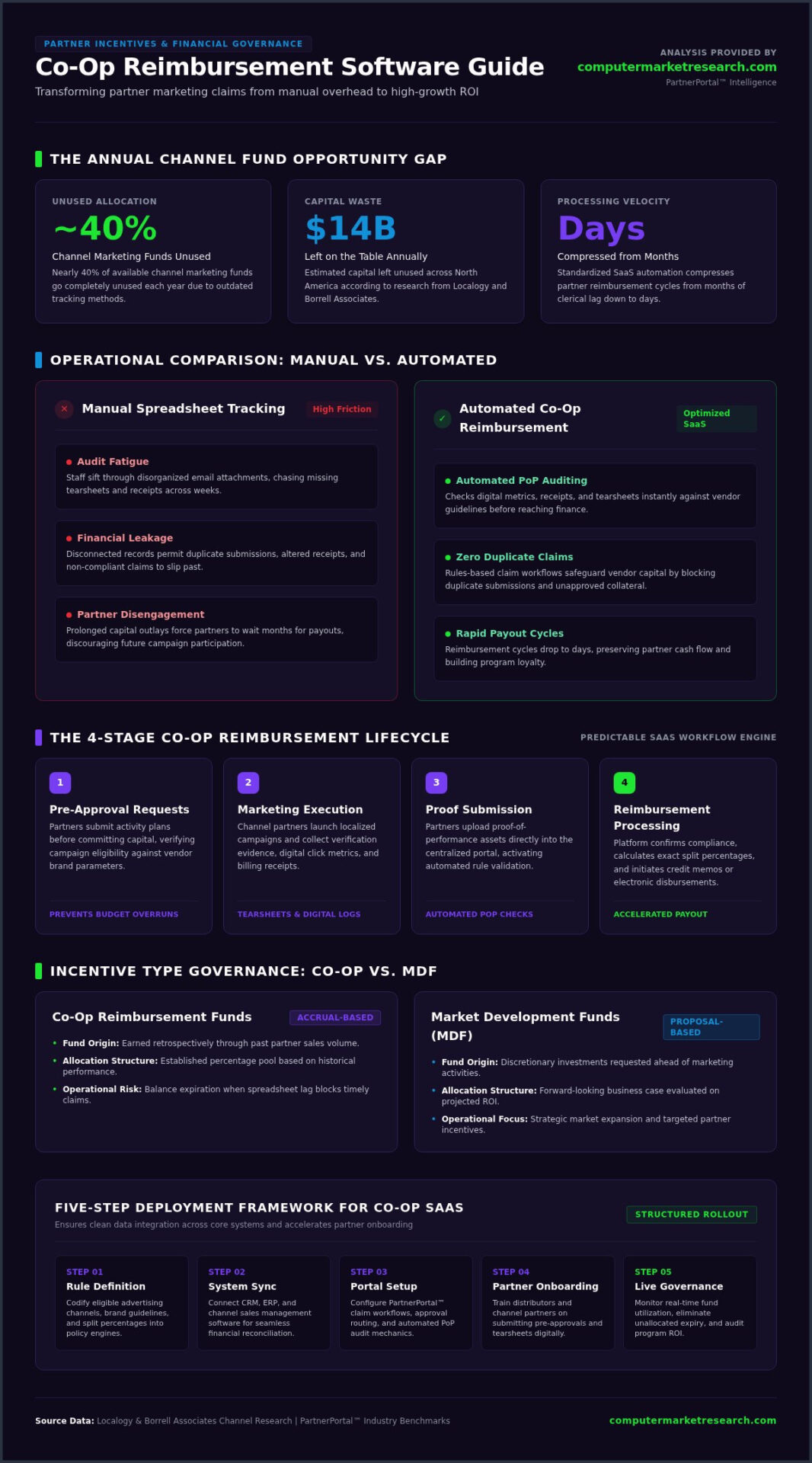
Nearly 40% of available channel marketing funds go completely unused each year, leaving an estimated $14 billion on the table across North America, according to research from Localogy and Borrell Associates. Most of that waste stems from outdated tracking methods. Manual invoice reviews drag on for weeks, non-compliant submissions slip through undetected, and frustrated partners watch their earned balances expire. Dedicated co-op reimbursement software changes this dynamic by replacing fragile spreadsheets with automated, rules-based claim workflows.
You already know that managing partner incentives shouldn’t devolve into weeks of clerical firefighting or strained relationships over delayed payouts. In this guide, you’ll discover how modern channel automation eliminates administrative bottlenecks, audits proof of performance with granular precision, and accelerates partner revenue. We’ll explore essential compliance workflows, auditing mechanics, and practical strategies to turn your co-op program from a sluggish cost center into a predictable growth engine.
Key Takeaways
- Transitioning from manual spreadsheets to purpose-built co-op reimbursement software eliminates costly claim bottlenecks and prevents unallocated partner funds from expiring.
- Automated proof-of-performance auditing checks digital campaign metrics, receipts, and tearsheets directly against vendor guidelines before submissions reach finance.
- Standardized SaaS workflows compress partner reimbursement cycles from months to days while drastically reducing non-compliant and duplicate claims.
- A structured five-step deployment framework ensures clean data integration across core business systems and accelerates partner onboarding.
- Centralizing program governance inside PartnerPortal™ provides real-time visibility into fund allocation, transforming channel incentives into measurable revenue drivers.
Co-Op Reimbursement Software & Why Legacy Tracking Fails
At its core, co-op reimbursement software is an automated platform engineered to validate partner marketing expenses against strict vendor brand and financial guidelines. Rooted in the principles of marketing co-operation, these programs allow vendors and distributors to share the expense of local advertising. Yet managing these shared investments through inbox threads and disconnected spreadsheets introduces severe operational friction. Manual tracking hides budget allocations, leaves finance teams guessing, and exposes organizations to unverified claims.
When claims sit unreviewed for months, partner trust erodes rapidly. Centralized SaaS infrastructure replaces fragmented email chains with clear operational visibility, linking distributed sales teams to finance through dedicated channel sales management software.
Defining the Modern Co-Op Reimbursement Lifecycle
A structured co-op workflow follows a predictable four-stage cycle that balances operational speed with financial control:
- Pre-Approval Requests: Partners submit activity plans before spending capital, confirming campaign eligibility against established vendor parameters.
- Marketing Execution: Channel partners deploy localized campaigns, gathering tearsheets, invoices, and performance metrics.
- Proof Submission: Partners upload collateral directly into a centralized portal, triggering automated rule validation.
- Reimbursement Processing: The platform audits compliance, calculates exact split percentages, and initiates credit memos or electronic disbursements.
Understanding the distinction between incentive types is critical. Co-op funds are accrual-based allocations earned through past sales volumes. In contrast, proposal-based allocations operate as discretionary investments designed for forward-looking strategic initiatives, making the governance of market development funds distinct from retrospective co-op claims.
The High Cost of Legacy Spreadsheet Management
Spreadsheet-driven administration exacts a heavy toll on enterprise efficiency. Processing individual expense documents manually consumes excessive labor hours, while rectifying clerical errors inflates administrative overhead. When operations teams manually verify print invoices and digital click logs, several severe breakdowns routinely occur:
- Audit Fatigue: Staff sift through disorganized attachments, chasing missing proof-of-performance assets across fragmented email chains.
- Financial Leakage: Disconnected records permit duplicate submissions, altered receipts, and unapproved collateral payouts to slip past reviewers.
- Partner Disengagement: Unpredictable reimbursement cycles force channel partners to absorb prolonged capital outlays, discouraging future campaign participation.
Eliminating these manual vulnerabilities requires systematic automation. Replacing ad-hoc documents with standardized validation safeguards vendor capital while rebuilding partner enthusiasm.
Core Features to Demand in Co-Op Fund Reimbursement Systems
Selecting enterprise-grade co-op reimbursement software requires evaluating administrative capabilities far beyond basic document storage. While creative asset distribution matters, program profitability hinges on the platform’s capacity for automated financial reconciliation. Understanding operational mechanics, as detailed in this overview of Co-Op Advertising Explained, helps finance and operations teams establish precise controls that safeguard corporate budgets while keeping claim turnarounds fast.
A resilient system balances strict brand governance with frictionless claim submission. Without integrated audit controls, vendor teams spend endless hours cross-checking paperwork rather than analyzing program performance.
Automated Proof-of-Performance (PoP) Auditing
Automated verification converts subjective reviews into standardized checkpoints. Modern platforms validate assets instantly across print, event, and digital channels, evaluating submissions against set parameters:
- Asset Compliance: Optical character recognition checks uploaded files for approved logo usage, proper trademark attributions, and mandatory disclaimers.
- Execution Timelines: Ingestion rules confirm that media flight dates align strictly with pre-approved project windows, blocking expired claims automatically.
- Digital Spend Validation: Direct integrations ingest performance reports from ad networks, verifying actual cost-per-click charges and impressions against partner invoices.
Deploying structured validation within a dedicated co-op/mdf platform for distributors prevents fraudulent submissions before funds leave your accounts.
Multi-Tier Approvals and Financial System Integration
Enterprise indirect programs involve complex hierarchies that simple tools cannot handle. Dynamic approval engines route submissions based on predetermined governance criteria:
- Conditional Routing: Low-risk claims under preset thresholds approve automatically once PoP checks pass, while multi-thousand-dollar initiatives route straight to regional directors.
- Accrual Visibility: Real-time balances update instantly across tiers, preventing accidental overdraws against historical sales earnings.
- ERP Synchronization: Approved reimbursement batches sync directly into general ledger systems like SAP or NetSuite, triggering credit memos without manual re-entry.
Maintaining clean data pipelines through disciplined channel data management ensures marketing investments mirror audited accounting records. If your operations team struggles with disjointed validation rules or delayed partner payments, exploring an automated framework through a 90-day free trial can demonstrate how rules-based validation streamlines claim processing across your indirect network.
Manual Spreadsheets vs. Automated Co-Op Reimbursement Software
Relying on static spreadsheets to govern indirect channel marketing introduces severe operational drag. While manual workbooks seem low-cost on the surface, they conceal heavy labor overhead, human data entry errors, and significant compliance vulnerabilities. Dedicated co-op reimbursement software replaces these disjointed workflows with programmatic controls that systematically process claims, enforce guidelines, and protect working capital.
The operational difference between these two operating models shows up across every critical financial metric:
| Operational Dimension | Manual Spreadsheets | Automated SaaS Platform |
|---|---|---|
| Reimbursement Turnaround | 4 to 8 weeks per batch | 3 to 5 business days |
| Validation Overhead | 20 to 40 minutes per claim | Instant algorithmic checks |
| Compliance Integrity | Subjective; missed infractions | Systematic rules enforcement |
| Audit Trail Continuity | Fragmented in email threads | Centralized, immutable logs |
Operational Comparison: Efficiency and Error Reduction
Manual review forces channel teams to spend valuable hours cross-referencing invoice line items against static program formulas. Data entry errors frequently cause duplicate claim disbursements, overlooked expiration deadlines, and accidental budget overruns. In contrast, purpose-built platforms automate calculation logic instantly upon submission.
Integrating these claim workflows alongside broader enterprise systems, such as specialized channel sales management software, establishes a clean data pipeline from initial purchase orders to final credit issuance. This speed eliminates friction, allowing channel partners to reinvest capital back into local territory growth without prolonged balance-sheet exposure.
Financial Governance and Audit Readiness
Spreadsheet administration collapses under regulatory scrutiny. Loose file folders and unvetted inbox attachments fail to meet strict corporate financial standards. If internal or external auditors review program expenditures, manual systems offer no reliable way to verify who approved an exception or whether proof-of-performance assets were altered after submission.
Cloud-based co-op reimbursement software maintains tamper-evident audit logs with detailed timestamps for every administrative action. By linking validated marketing receipts directly to authorized general ledger entries, enterprises secure comprehensive visibility across their entire partner network, closing loopholes that drain indirect budgets.
How to Implement Co-Op Reimbursement Software in 5 Steps
Transitioning to modern co-op reimbursement software requires structured data hygiene and disciplined partner enablement. Organizations shouldn’t simply digitize flawed manual processes; they must standardize claim mechanics from the ground up. A predictable five-step rollout establishes strong financial governance while driving partner participation:
- Audit Program Guidelines: Clarify eligible marketing activities, split percentages, pre-approval requirements, and proof-of-performance standards to eliminate ambiguity.
- Cleanse Historical Account Data: Reconcile past partner balances and resolve orphaned records before importing data into the production environment.
- Configure Approval Matrices: Establish tiered approval permissions based on claim amounts, partner classifications, and regional operational hierarchies.
- Connect Enterprise Systems: Integrate bi-directional data feeds across CRM, ERP, and point-of-sale data streams to unify finance and sales.
- Enable the Partner Network: Launch self-service training, localized documentation, and automated alerts to accelerate user adoption.
Rule Definition and System Configuration
Translating policy handbooks into programmatic rules eliminates administrative guesswork. The validation engine checks incoming submissions against predefined criteria, confirming asset flight dates, brand logo placement, and allowable expenses automatically. Automated platform triggers keep partners informed ahead of critical milestones. System alerts notify distributors about expiring fund balances, pending document requests, and approved disbursements. Structuring these checkpoints ensures indirect channels align tightly with the broader goals of your channel incentive programs.
System Integration and Partner Rollout
Long-term software success depends on connecting marketing claim validation directly to general ledger accounting. Bi-directional synchronization ensures approved reimbursement batches flow straight into corporate ERPs, issuing credit memos without manual re-keying through unified PartnerPortal™ workflows.
Partner adoption thrives when the submission experience is frictionless. Provide brief instructional walkthroughs and transparent submission checklists directly inside the interface so distributors can file claims in minutes. To see how automated claim workflows eliminate manual friction across your channel network, claim your 90-day free trial and modernize your reimbursement infrastructure.
Scaling Channel ROI with PartnerPortal™ Co-Op Management
Founded in 1984, Computer Market Research delivers specialized channel automation refined over more than four decades of industry expertise. Modern indirect sales models require infrastructure that links channel marketing directly to partner productivity. Purpose-built co-op reimbursement software must do more than store files; it needs to protect operating margins and drive measurable demand. Through PartnerPortal™, organizations replace fragmented tracking methods with a unified, cloud-based platform that centralizes multi-tier indirect sales management.
End-to-End Control Over Marketing Funds
Disjointed records create blind spots that prevent finance and marketing teams from assessing their true channel liabilities. PartnerPortal™ resolves this by providing complete visibility across global distribution networks from a single, intuitive interface:
- Balance Sheet Precision: Track real-time fund accruals, committed reserves, and pending reimbursements to eliminate unexpected fiscal year-end budget surprises.
- Proactive Fund Utilization: Automated notifications alert distributors before balances expire, prompting timely local marketing execution and preventing unused budget waste.
- Granular Performance Tracking: Evaluate historical claim patterns against regional sell-through figures to determine which marketing activities produce measurable returns.
Connecting reimbursement workflows with broader partner relationship management infrastructure ensures program rules remain consistent across every tier of your indirect sales ecosystem.
Modernize Your Reimbursement Architecture
Relying on ad-hoc spreadsheets forces operations professionals into continuous administrative firefighting. PartnerPortal™ automates routine clerical verification, applying consistent rule validation to proof-of-performance assets while routing exceptions to designated financial managers. This systematic approach reduces claim cycle times from months to days, reinforcing partner trust and encouraging sustained program participation.
The platform natively bridges disparate operational data streams, synchronizing marketing claims with core ERP accounting records, Rebates & Incentives, and point-of-sale data streams. The result is an audit-ready, tamper-evident record of all channel expenditures. If your enterprise is ready to eliminate administrative bottlenecks and elevate channel performance with modern co-op reimbursement software, take the next step and claim your 90-day free trial today.
Modernize Your Channel Incentive Operations for Predictable Growth
Manual spreadsheets and disconnected inboxes don’t just delay partner disbursements; they erode partner confidence and tie up valuable administrative resources. Deploying dedicated co-op reimbursement software standardizes proof-of-performance auditing, eliminates costly duplicate payouts, and compresses cycle times from weeks to days. Channel leaders gain real-time transparency over accruals and liabilities, turning incentive programs into measurable revenue engines.
Founded in 1984 with over four decades of channel operations leadership, Computer Market Research provides the specialized infrastructure modern enterprises need. Trusted across Fortune 500 and Global 2000 indirect sales networks, our platform delivers seamless integration with enterprise ERP, CRM, and financial accounting suites to keep your compliance airtight. Ready to eliminate administrative bottlenecks and accelerate indirect sales? Start your 90-day trial with PartnerPortal™ to elevate your channel operations today.
Frequently Asked Questions
How does co-op reimbursement software differ from market development fund (MDF) software?
Co-op reimbursement software manages retroactive, accrual-based allocations earned through past sales performance, whereas MDF platforms handle forward-looking, proposal-based discretionary budgets. Co-op programs reward historical product volume with formulaic cost sharing on qualified local marketing. MDF initiatives allocate upfront capital toward prospective growth activities like partner certifications or trade shows. Modern channel platforms often unify both functions to maintain consistent oversight across all indirect incentives.
What proof of performance documentation does the software automatically validate?
The platform automatically inspects digital advertising invoices, tear sheets, event sponsorship agreements, and multimedia creative collateral. Optical character recognition and rules-based ingestion scan files for required vendor logo placements, mandatory legal disclaimers, and pre-approved messaging. It also reconciles digital campaign logs against vendor flight dates to verify click counts, impressions, and actual vendor co-share calculations before submissions reach finance teams.
Can co-op reimbursement software integrate with existing enterprise ERP and CRM systems?
Yes, enterprise-grade co-op reimbursement software connects directly with core ERP, CRM, and accounting suites like SAP, Oracle, and NetSuite. Bi-directional API connectors synchronize partner tier statuses, accrual balance adjustments, and verified point-of-sale data in real time. Once an administrator approves a claim batch, the system automatically posts credit memos or disbursement instructions to your general ledger without requiring manual data re-entry.
How does automated claim validation reduce channel marketing fraud?
Automated validation stops fraud by comparing submitted receipts and performance metrics against strict algorithmic controls rather than relying on manual spot-checks. The system detects duplicate invoice submissions across multiple accounts, catches altered digital files, and cross-checks media publication dates against pre-approval windows. By flagging out-of-policy claims before funds leave corporate accounts, vendors prevent accidental overpayments and secure complete financial compliance.
Will implementing a co-op management platform disrupt our active marketing cycle?
A structured implementation avoids disruption by running parallel to your current submission cycle until historical balances reconcile. Legacy claim records and active partner accrual balances get cleansed and migrated during the initial configuration phase. Operations teams can set a definitive cut-over date, allowing partners to transition into the intuitive portal seamlessly while pending invoices clear through standard review pipelines.
How does automated reimbursement improve overall partner program participation?
Faster reimbursement cycles build partner trust and preserve working capital for local channel businesses. When vendors shorten claim turnaround times from months to days, distributors feel confident investing their own capital into regional campaigns. Transparent self-service portals also let partners view real-time accrual balances and upcoming expiration dates, driving active fund utilization and eliminating administrative friction that often leads to abandoned marketing budgets.

Article by
Del Heles
Del Heles is the founder and CEO of Computer Market Research (CMR), a channel management software company he launched in 1984. With more than 40 years of experience, he’s known for helping manufacturers and distributors simplify complex partner programs through practical, customer-focused technology solutions.