

A channel strategy that relies on manual spreadsheets isn’t just slow; it’s a structural barrier to global scale. Most leaders recognize that the strength of their indirect sales isn’t measured by the number of partners, but by the integrity of the data connecting them. If you’re struggling with fragmented information and operational delays, you aren’t alone. Orchestrating a modern channel management ecosystem requires moving beyond legacy processes that stifle growth and obscure performance.
You understand that manual tracking for MDF and rebate processing is no longer sustainable for a growing organization. We’ll show you how to replace these bottlenecks with automated financial workflows and real-time visibility into POS and inventory data. This guide provides a clear framework to centralize all partner activities using tools like PartnerPortal™. This transition ensures your infrastructure is as scalable as your ambitions, providing a stable path to improved returns and global expansion. By modernizing your data layer, you can finally eliminate the manual errors that hinder your competitive edge.
Key Takeaways
- Understand how the modern channel management ecosystem has evolved from linear distribution into a multi-directional network focused on data integrity.
- Learn to eliminate operational bottlenecks by automating complex financial workflows for MDF, co-op, and rebate programs.
- Discover the hidden costs of the spreadsheet trap and why manual tracking methods are now obsolete for growing global enterprises.
- Identify a practical framework for auditing your data maturity and deploying a centralized system to achieve real-time visibility.
- Explore how PartnerPortal™ and managed data services cleanse and normalize information to support scalable, indirect sales growth.
Defining the Channel Management Ecosystem in 2026
In the context of the Global 2000, a channel management ecosystem is no longer a simple pipeline for moving products. It’s a sophisticated, multi-directional network where vendors, distributors, resellers, and influencers collaborate through a unified digital infrastructure. Unlike the rigid structures of the past, today’s ecosystem prioritizes the flow of information as much as the flow of goods. This shift ensures that every participant has the visibility required to execute complex sales strategies across diverse geographic regions.
Orchestration at this level requires a departure from traditional management styles. When you treat your partners as a synchronized community rather than a series of isolated accounts, you unlock new avenues for revenue growth. Trust is the primary currency in these relationships. It’s maintained through data transparency and the reliable execution of financial incentives. Without a centralized layer to manage these interactions, the ecosystem becomes a collection of silos that hinder rather than help your global objectives.
Linear Channels vs. Interconnected Ecosystems
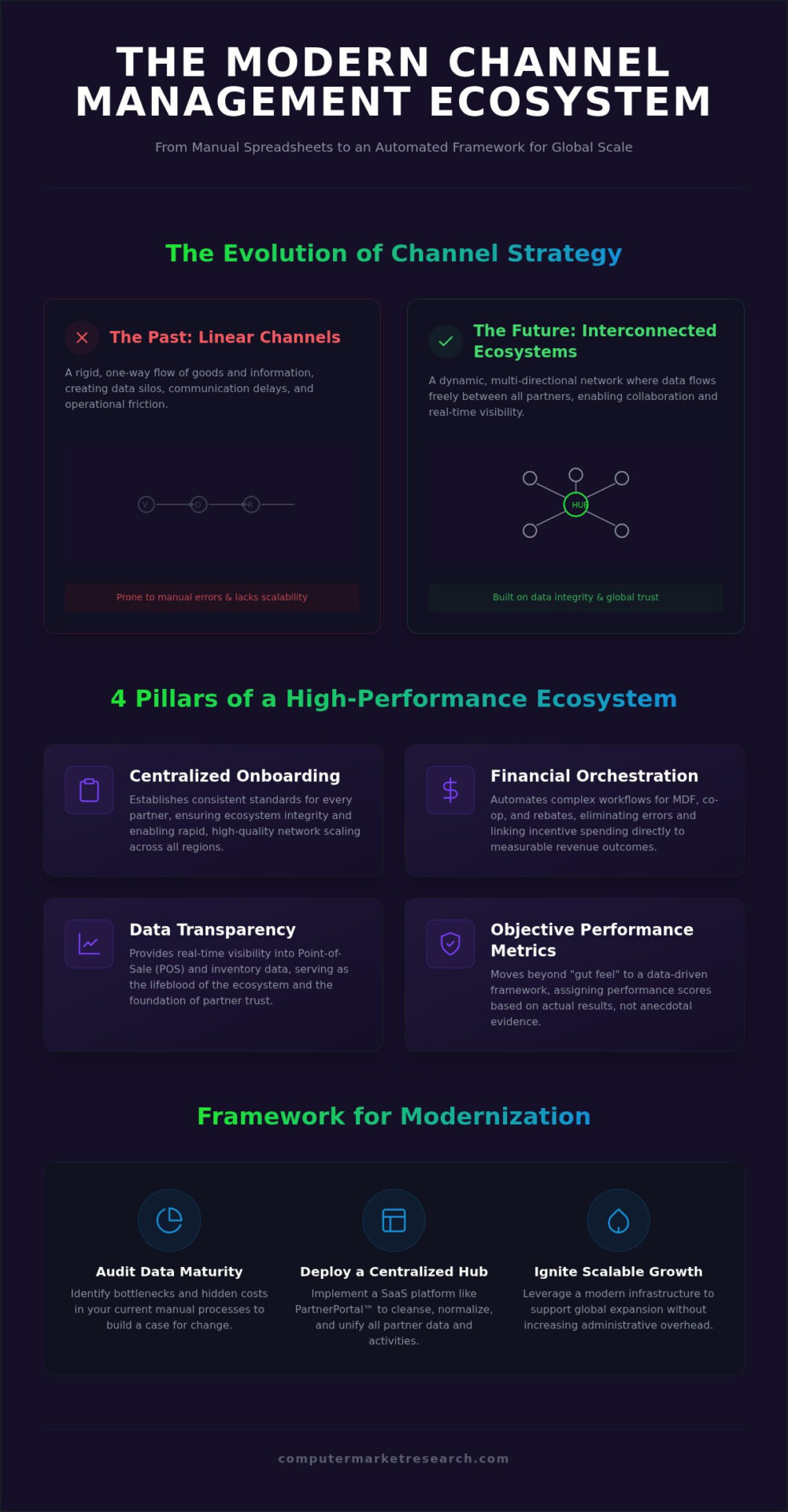
Traditional models often relied on a one-to-many approach that treated the marketing channel as a linear sequence. This model is inherently limited. It creates data silos and significant delays in communication. Modern ecosystems integrate a wider variety of partners, including consultants and service providers, who may never touch the physical product but are essential to the final sale. Implementing professional partner relationship management acts as the connective tissue for these complex networks. It transforms fragmented interactions into a cohesive strategy that benefits all stakeholders.
Strategic Drivers for Ecosystem Adoption
The drive toward these interconnected models is fueled by the sheer complexity of global market expansion. Large enterprises can’t manage thousands of international partners using disconnected spreadsheets and manual emails. This operational friction leads to lost revenue and missed market opportunities. By adopting a centralized SaaS hub, organizations gain the ability to orchestrate activities with precision across multiple time zones and currencies.
Manual processes represent the most significant threat to scaling a channel management ecosystem. When data is trapped in disparate systems, the trust between the vendor and the partner erodes. Transparency in POS data and incentive tracking isn’t just a technical requirement; it’s a strategic necessity. A high-performance ecosystem relies on this transparency to ensure that financial workflows, such as MDF and rebate processing, remain accurate. This level of control allows businesses to scale their indirect sales without a corresponding increase in administrative overhead.
The Core Pillars of a High-Performance Ecosystem
A high-performance channel management ecosystem rests on four foundational pillars: centralized onboarding, financial orchestration, data transparency, and objective performance metrics. If any of these pillars are weak, the entire structure risks collapse under the weight of global operational complexity. Centralized partner onboarding ensures that every new relationship begins with consistent standards, which is vital for maintaining ecosystem integrity across multiple regions. This systematic approach allows for rapid scaling without sacrificing the quality of your partner network.
Modern enterprises must move beyond the “gut feel” that historically governed partner relationships. By establishing a data-driven framework, you can assign performance scores based on actual results rather than anecdotal evidence. This transition from subjective management to objective orchestration is what separates market leaders from those struggling with stagnant growth. Every interaction within the ecosystem should generate actionable data that informs your broader channel strategy.
Automating Financial Workflows and Incentives
The administrative burden of managing market development funds (MDF) and co-op programs often leads to significant delays and friction. Manual processing is prone to human error, which can result in overpayments or, conversely, frustrated partners who don’t receive their incentives on time. By automating these financial workflows, enterprises can ensure absolute accuracy in rebate processing. This precision allows you to link incentive spend directly to measurable revenue outcomes, transforming these programs from a cost center into a strategic growth lever. It’s about ensuring every dollar spent is an investment in verified performance.
The Data Layer: POS and Inventory Visibility
Real-time inventory and point-of-sale (POS) data serve as the lifeblood of a modern channel management ecosystem. Many organizations struggle with an information black hole where they lose sight of products once they leave the warehouse. This lack of visibility makes it impossible to optimize supply chain efficiency or respond to market shifts. Implementing robust channel data management solves this problem by providing a single source of truth for all indirect sales reporting.
Data cleansing is a critical step that competitors often overlook. Raw data from partners is frequently inconsistent, containing variations in product names, dates, and currency formats. Utilizing professional channel data management systems ensures that this information is normalized and decision-grade. This level of technical competence allows business leaders to make informed decisions about inventory allocation and market demand. If you’re ready to eliminate the manual errors currently slowing your progress, you can explore our automation tools with a trial to see the impact of real-time data accuracy.
Overcoming Fragmentation in Channel Operations
Fragmentation is the silent killer of growth in a global channel management ecosystem. Many organizations remain ensnared in the spreadsheet trap, where critical partner data is scattered across disconnected files and local drives. This reliance on legacy methods creates a fragile environment where manual errors in incentive and rebate claims become inevitable. These inaccuracies don’t just drain financial resources; they erode the trust that is fundamental to partner relationships. To achieve a single source of truth, enterprises must integrate their partner data with existing CRM and ERP systems, ensuring that every transaction is verified and visible. This integration transforms the ecosystem from a series of disjointed tasks into a streamlined business process that fuels global expansion.
Replacing Manual Tracking with Automated Systems
Managing a Global 2000 network through Excel is a high-risk strategy that invites operational bottlenecks and data corruption. When data lives in silos, leaders lack the real-time insights needed to pivot in a fast-moving market. Using PartnerPortal™ allows companies to centralize these fragmented operations into a unified cloud-based suite. This transition replaces chaotic manual tracking with a structured environment that supports global scale. The ROI of automation in 2026 is defined by the total elimination of administrative friction and the recovery of revenue lost to incentive overpayments.
Resolving Conflict with Deal Registration
Channel conflict often arises when multiple partners pursue the same opportunity without a clear protocol. Automated deal registration standardizes this process, providing a transparent mechanism to protect partner margins and manufacturer interests. By automating the approval workflow, you ensure that the first partner to register a qualified lead is protected, which encourages proactive selling. Best practices for lead distribution within the ecosystem include clear eligibility criteria and automated routing based on partner expertise or geographic proximity. This level of transparency prevents internal competition and ensures that the most capable partner handles each lead. It’s a pragmatic approach that values order and performance above all else, ensuring that the ecosystem remains a collaborative rather than a competitive environment.
Optimizing the Ecosystem for Maximum ROI
Achieving a high return on investment within a channel management ecosystem requires a transition from reactive administration to proactive orchestration. Many enterprises struggle because they lack a technical framework to measure the efficacy of their channel spend. Optimization begins with a comprehensive audit of your current data maturity to identify where process bottlenecks, such as delayed rebate approvals or opaque inventory reports, are draining resources. Once you identify these gaps, deploying a centralized channel management system provides the infrastructure necessary to automate these workflows and capture decision-grade information.
Aligning incentive programs with strategic business goals is the next critical step. Rather than offering generic rebates, organizations should design incentives that reward specific partner behaviors, such as entering new geographic markets or selling high-margin product lines. This shift allows for the implementation of real-time POS data collection and normalization. Without normalized data, calculating the exact ROI of an incentive program is impossible. Finally, continuous refinement of partner engagement based on performance data ensures that your resources are always allocated to the highest-performing segments of your network. It’s a disciplined approach. Every dollar must be tracked.
Aligning Incentives with Ecosystem Growth
Strategic channel incentive programs act as a catalyst for growth when they move beyond simple transaction-based rewards. Modern systems allow you to transition from reactive cost management to strategic investment by utilizing predictive data. By analyzing historical performance, you can identify which partners are likely to drive future growth and tailor your support accordingly. This level of precision ensures that your financial orchestration isn’t just accurate; it’s impactful. It allows you to prove the value of every dollar spent on co-op and MDF programs.
Leveraging Through-Channel Marketing Automation
Scaling reach across a global network requires more than just a large partner count. It requires the ability to maintain brand consistency while empowering partners with localized marketing assets. Through channel marketing automation (TCMA) plays a vital role here by providing partners with ready-to-use leads and co-branded content. This reduces the time partners spend on administration and increases the time they spend selling. When your partners have the right tools to represent your brand accurately, the entire ecosystem benefits from increased market penetration. If you’re ready to see how automated data can transform your ROI, you can start your 90-day free trial to experience these efficiencies firsthand.
Future-Proofing with CMR PartnerPortal™ Automation
PartnerPortal™ isn’t just a tool; it’s the operating system for a high-performance channel management ecosystem. For Global 2000 enterprises, the ability to scale depends on a foundation that can handle complex, multi-layered data without breaking. This platform provides the stability and accuracy required to manage thousands of global partners while maintaining absolute control over financial workflows. By automating the entire channel lifecycle, from onboarding to incentive payouts, organizations can drive measurable ROI and eliminate the operational bottlenecks that historically limited indirect sales growth.
Centralizing Operations on a Single SaaS Platform
Efficiency is born from consolidation. When you house MDF, rebates, and inventory management in one hub, you remove the friction caused by switching between disconnected systems. This modular approach allows enterprises to deploy exactly what they need, whether it’s ship and debit management or deal registration. It’s a pragmatic way to Partner Smarter by offloading the administrative burdens that distract your team from strategic planning. By centralizing these functions, you create a seamless environment where data flows freely and accurately across the entire network. This structure ensures that as your partner count grows, your overhead doesn’t follow the same trajectory.
The Role of Managed Data Services
Many organizations believe that software alone can solve their reporting issues. However, software is only as effective as the data it processes. Raw POS and inventory data from partners is notoriously messy, often arriving in incompatible formats with missing fields or duplicate entries. This is where CMR differentiates itself from generalist providers. We provide Managed Data Services to cleanse and normalize your channel information, ensuring that every report is based on decision-grade insights. Software alone can’t fix the fundamental problem of “dirty” data; it requires a systematic approach to administration.
Our approach goes beyond simple ingestion. We identify and correct errors at the source, transforming fragmented partner reports into a single, reliable stream of information. This level of technical competence is essential for leaders who need to trust their numbers before making significant supply chain or incentive decisions. By combining automated software with expert data administration, you ensure that your channel management ecosystem is built on a foundation of accuracy rather than approximation. This holistic discipline is the only logical step for organizations that value order and performance above all else.
Orchestrating Your Path to Global Scale
Transitioning to a modernized channel management ecosystem is the only logical step for organizations seeking to eliminate the structural barriers of manual tracking. We’ve explored how centralized visibility and automated financial workflows replace the operational friction that historically stunted indirect sales growth. By prioritizing data integrity through managed services and real-time POS reporting, Global 2000 enterprises can finally move from reactive administration to proactive orchestration.
The infrastructure you choose today determines your ability to scale tomorrow. PartnerPortal™ provides the technical depth required to manage complex partner relationships with precision; it ensures that co-op, MDF, and rebate programs are always linked to verified performance. It’s time to retire the spreadsheets and embrace a system built for accuracy and stability. This shift doesn’t just improve efficiency; it builds the trust necessary for long-term partner loyalty.
You can streamline your ecosystem with PartnerPortal™ to experience the clarity of decision-grade insights firsthand. Taking control of your data layer is the most effective way to secure a competitive advantage in an increasingly complex global market. Your journey toward a more profitable, automated future starts with a single, systematic change.
Frequently Asked Questions
What are the primary components of a channel management ecosystem?
The primary components of a modern channel management ecosystem include partner onboarding, deal registration, and financial orchestration for MDF and rebates. A centralized SaaS platform like PartnerPortal™ serves as the core infrastructure, integrating POS data management and inventory tracking. These modules work together to create a unified data layer. By consolidating these functions, global enterprises can maintain control over indirect sales while reducing the administrative overhead associated with manual tracking.
How does an ecosystem differ from a traditional channel sales model?
A traditional channel model typically follows a linear, one-to-many distribution path that often results in information silos. In contrast, an ecosystem is a multi-directional network where vendors, distributors, and influencers collaborate through a shared digital infrastructure. This interconnected approach prioritizes real-time data transparency and automated workflows. It allows for greater scalability and adaptability. Unlike rigid legacy structures, an ecosystem leverages integrated systems to ensure that every partner interaction generates decision-grade insights.
Why is data management the most difficult part of ecosystem orchestration?
Data management is challenging because raw information from partners arrives in inconsistent formats with varying product names and currency standards. Without professional cleansing and normalization, this “dirty” data makes accurate reporting impossible. Computer Market Research addresses this through Managed Data Services. We transform fragmented POS and inventory reports into a single source of truth. This systematic approach ensures that channel management ecosystem decisions are based on precise, decision-grade information rather than approximations or manual errors.
Can a channel ecosystem platform integrate with my existing CRM or ERP systems?
Technical integration with your existing enterprise resource planning (ERP) and customer relationship management (CRM) infrastructure is a standard requirement for professional orchestration. PartnerPortal™ is designed to bridge the gap between your internal databases and your external partner network. This connectivity ensures a seamless flow of lead management and deal registration data. By linking these platforms, organizations achieve a single source of truth that eliminates manual data entry and provides leaders with confidence in their global sales reporting.
What is the ROI of automating a channel management ecosystem?
The ROI of automating a channel management ecosystem is found in the total elimination of administrative friction and the recovery of revenue lost to incentive overpayments. Automation ensures that rebates and MDF claims are only paid against verified performance data. Organizations often see significant efficiency gains by offloading manual data administration to managed services. This transition allows your team to focus on strategic growth rather than correcting spreadsheet errors. It provides a stable framework for global expansion.
How do I handle multi-currency and global compliance in a partner ecosystem?
Handling global requirements requires a centralized SaaS hub that can automate currency conversions and compliance tracking across diverse regions. A robust ecosystem utilizes standardized workflows to ensure that financial incentives meet local regulatory standards. By using a platform like PartnerPortal™, enterprises can manage international partners through a unified interface. This structure provides the visibility needed to audit global spend. It ensures that your expansion is supported by accurate, localized data without increasing administrative complexity.
What role does deal registration play in preventing ecosystem conflict?
Deal registration acts as a transparent mechanism to protect partner margins and prevent internal competition within the network. By automating the registration process, you ensure that the first partner to register a qualified lead receives protection for that opportunity. This standardized workflow builds trust and encourages proactive selling behaviors. It eliminates the ambiguity that often leads to channel conflict. Clear, automated routing ensures that leads are handled by the most capable partners, maintaining order across the entire network.
How can I automate MDF and co-op fund management for thousands of partners?
Automating MDF and co-op fund management for a large partner base requires a modular financial orchestration system. By replacing manual tracking with the automated modules in PartnerPortal™, you can process claims and verify proof-of-performance in real time. This system handles the heavy lifting of auditing thousands of partner submissions. It allows you to move from reactive cost management to strategic investment. You’ll ensure that every dollar spent on market development is tracked and linked to measurable revenue outcomes.

Article by
Del Heles
Del Heles is the founder and CEO of Computer Market Research (CMR), a channel management software company he launched in 1984. With more than 40 years of experience, he’s known for helping manufacturers and distributors simplify complex partner programs through practical, customer-focused technology solutions.